
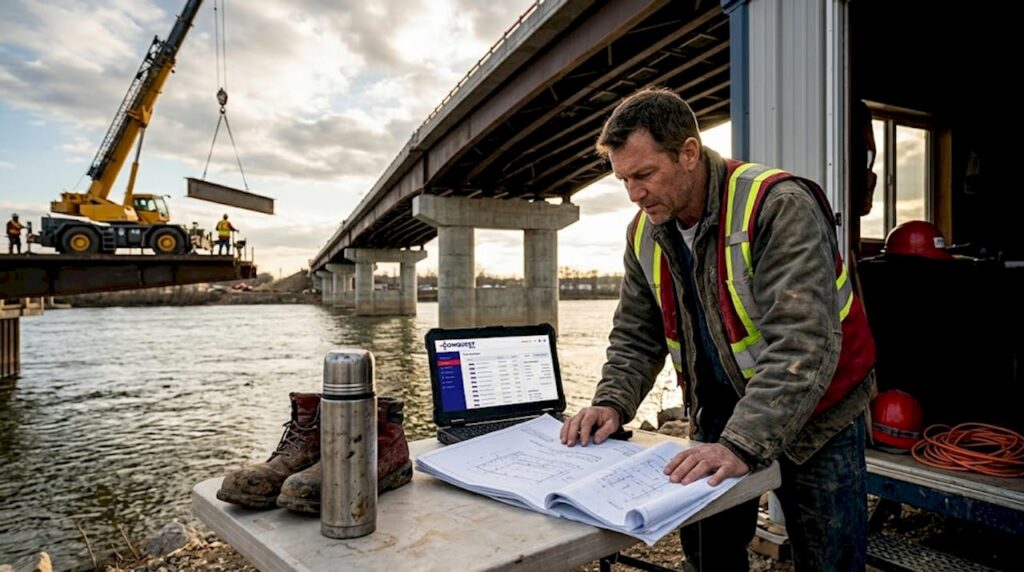
Most engineers and construction managers understand that equipment matters on a bridge project. What gets underestimated is just how deeply the role of equipment in bridge building shapes everything from structural feasibility to daily safety decisions. Equipment is not simply what moves concrete and lifts steel. It defines the construction method, constrains the design geometry, governs the construction schedule, and determines whether a project is even viable at a given site. This guide covers the full picture, from temporary works and crane engineering to integrated production systems and safety compliance, giving you a practical framework for every phase of your project.
Table of Contents
- Key takeaways
- The role of equipment in bridge building
- How equipment shapes design and method selection
- Equipment safety standards and operator requirements
- Modern integrated equipment systems
- Practical equipment planning for bridge projects
- My perspective on equipment’s evolving role
- How Conquestmfgusa supports your bridge project
- FAQ
Key takeaways
| Point | Details |
|---|---|
| Equipment shapes design, not just delivery | Equipment capabilities and constraints directly influence which construction methods and geometries are feasible. |
| Formwork and falsework are distinct systems | Formwork molds concrete; falsework carries structural loads. Confusing the two leads to engineering errors. |
| MSS systems act as mobile factories | Movable Scaffolding Systems integrate lifting, access, and geometry control into one production unit, reducing cycle time and variability. |
| Safety compliance is a planning input | OSHA crane and equipment standards must be integrated into scheduling and equipment selection before work begins, not during mobilization. |
| Equipment planning is site-specific | Remote, elevated, or constrained sites demand unique logistics and equipment configurations that must be resolved in the design phase. |
The role of equipment in bridge building
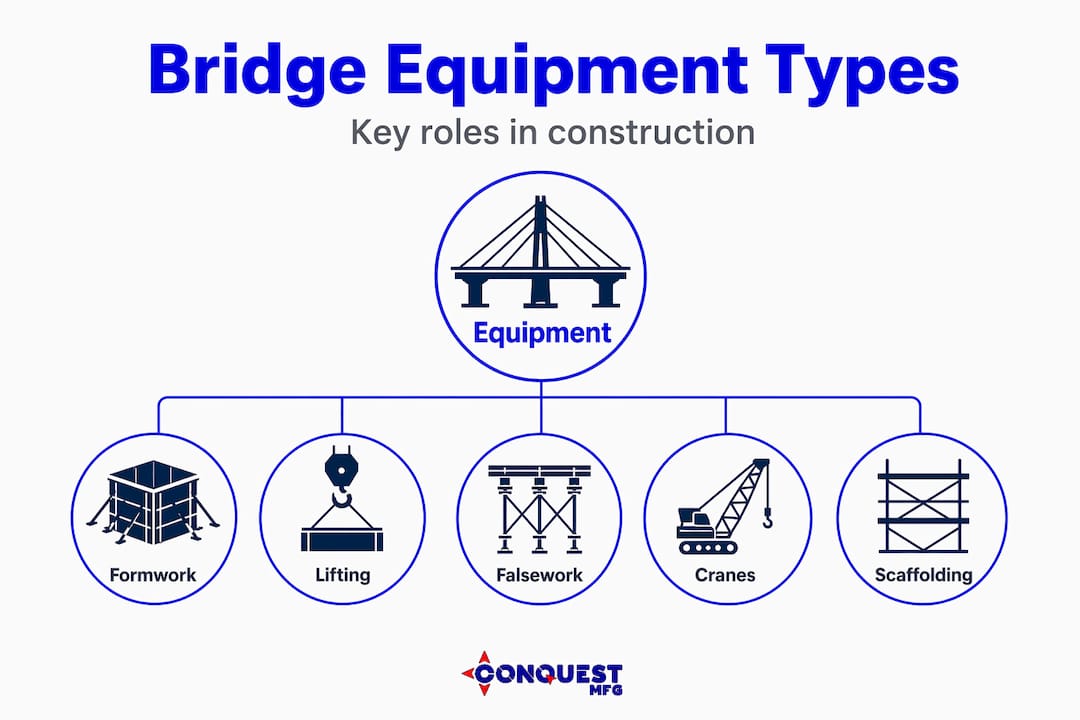
The equipment used on a bridge project falls into several distinct functional categories, and understanding each one is the starting point for any serious bridge construction equipment guide. Most people default to thinking of cranes when they picture bridge construction machinery. Cranes are critical, but they represent only one layer of a much larger system.
Temporary works: formwork and falsework
Formwork and falsework serve different structural purposes, and the distinction matters enormously in practice. Formwork refers to the molds that shape concrete elements such as columns, decks, and piers. Falsework refers to the load-bearing structures that support those forms during casting and curing. They are often deployed together, but they are distinct structural systems with separate engineering requirements. Treating them as interchangeable is one of the more common and costly mistakes on site.
At elevated positions, falsework can grow into massive temporary structures. Double-stacked truss configurations supporting hundreds of tons during casting are not unusual on tall bridge piers. These systems require independent stability analysis under wind loads and staged load transfer plans.
Lifting equipment and cranes
Tower cranes, mobile cranes, and overhead gantry systems handle reinforcement cages, precast segments, formwork panels, and concrete delivery equipment. What makes crane selection complex on bridge projects is that the structure changes geometry as construction progresses. On the Kruunuvuori Bridge in Helsinki, a Liebherr tower crane with 40,000 kg lift capacity handled the tall central pylon, requiring configuration adjustments as the pylon rose. The crane engineering ran concurrent with structural engineering at every stage.
Other essential machinery
Beyond cranes and temporary works, a functional bridge construction site depends on:
- Concrete batch plants: On-site or nearby plants produce the volumes and mix specifications required for deck and substructure pours.
- Concrete pumps and placing booms: These move concrete from the mixer to the formwork, especially critical on elevated or mid-span deck pours.
- Drilling and piling rigs: Used for deep foundations and pile caps in soft or variable ground conditions.
- Transport trailers: Pneumatic and dry bulk trailers move cement, aggregate, and admixtures to the batch plant efficiently.
| Equipment category | Primary function | Examples |
|---|---|---|
| Formwork systems | Shape cast concrete elements | Column forms, deck panels, pier cap forms |
| Falsework and shoring | Support loads during casting | Truss towers, shoring frames, post shores |
| Cranes and hoists | Lift and position materials | Tower cranes, mobile cranes, gantry lifters |
| Concrete production | Produce and deliver mix | Batch plants, transit mixers, concrete pumps |
| Ground improvement | Prepare foundations | Drill rigs, vibratory hammers, pile drivers |
How equipment shapes design and method selection
The impact of equipment on bridge design goes deeper than most project teams discuss openly during the design phase. Equipment capabilities set real limits on what is constructible. A design that looks elegant in the model may require a crane with a radius that cannot physically be positioned at the site, or a falsework system that would need to span a live waterway.
Segmental construction methods offer a clear example. Balanced cantilever construction, used on long-span concrete bridges, depends entirely on specialized travelers or form travelers that clamp to the last completed segment and carry the formwork for the next cast. The geometry control devices built into those travelers must match the design’s horizontal and vertical curvature requirements. If the available equipment cannot achieve the specified tolerances, the design must be revisited.
The Mosquito Road Bridge in California illustrates the logistics challenge clearly. Built using cast-in-place balanced cantilever segments with modular traveling formwork, the project required mobilizing heavy equipment into remote mountainous terrain. The equipment planning was not a separate task that followed design completion. It ran alongside design, because the terrain constraints and haul road limitations directly influenced which equipment configurations were feasible.
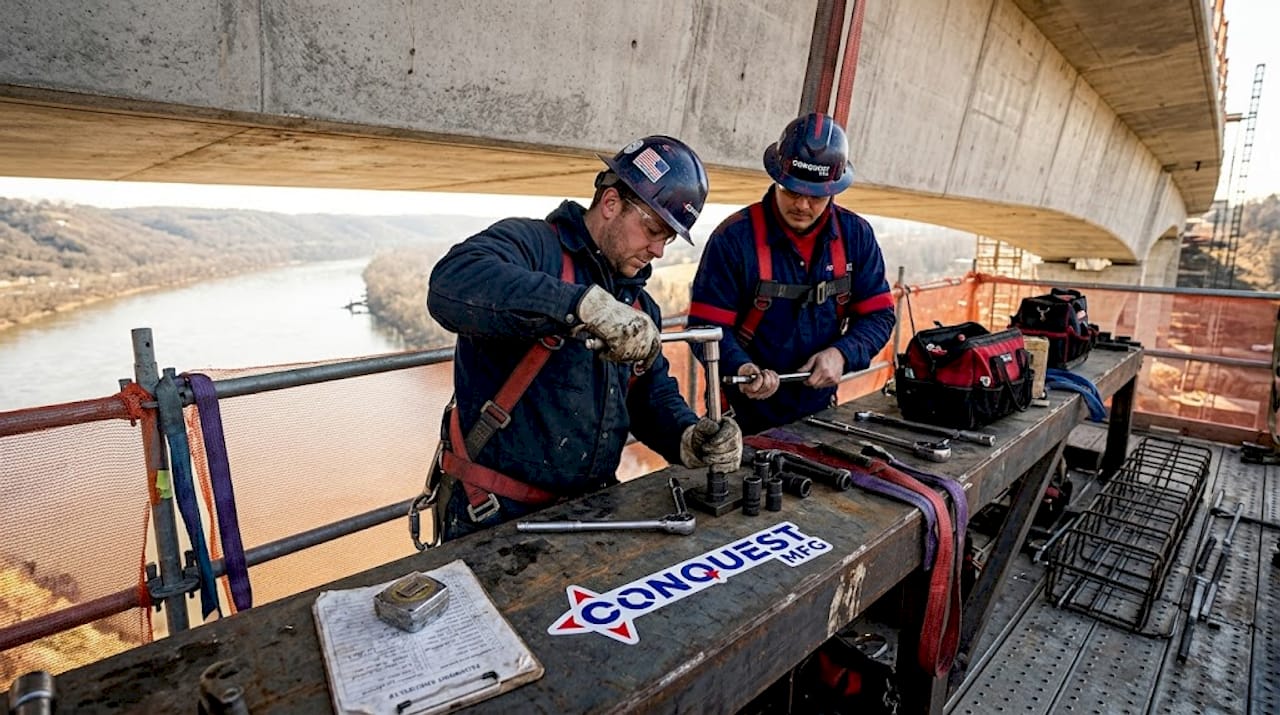
At the opposite end of the spectrum, Bailey bridges demonstrate how deliberate equipment minimization can itself become a design strategy. Because their modular panels are sized for hand lifting and roller launching, they can be deployed without cranes, making them viable in locations where heavy equipment simply cannot reach.
Pro Tip: When evaluating construction methods early in design, request equipment reach and load diagrams from your contractor or equipment specialist before finalizing geometry. A 10-meter adjustment to pier spacing can sometimes eliminate the need for a specialty crane that would add months to the schedule.
Equipment safety standards and operator requirements
Safety compliance is not a checklist item you address after equipment selection. It is a project planning input that affects scheduling, staffing, and equipment procurement decisions from the start.
OSHA 29 CFR 1926 Subpart CC governs crane and derrick operations in construction, covering operator qualification, hazard marking, rigging standards, and safe lifting practices. The practical implication for project managers is that qualified operators are not always immediately available, and certification timelines must be built into the project schedule. Failing to account for this is a common cause of mobilization delays.
The safety and training requirements for heavy equipment should be treated as project prerequisites rather than procedural formalities. They directly affect which equipment you can deploy, when you can deploy it, and who can legally operate it.
Integrating safety compliance into equipment management means addressing several areas before breaking ground:
- Operator certification records: Verify that all crane operators hold current credentials under Subpart CC requirements, including type and capacity ratings matching the selected equipment.
- Pre-lift planning documentation: For critical lifts over 75% of rated capacity or near power lines, documented lift plans are required and must be reviewed by a qualified rigger.
- Equipment inspection logs: OSHA requires daily and annual inspections. Build these into the site schedule as non-negotiable time allocations.
- Exclusion zones and communication plans: Establish defined ground exclusion zones under crane swing paths, with written communication protocols for lift supervisors and signal persons.
You can find a practical starting framework in this equipment safety checklist covering compliance steps for construction equipment on industrial projects.
Modern integrated equipment systems
The most significant shift in how machinery aids in bridge design and construction over the past two decades is not in raw capacity. It is in integration. Modern equipment systems combine multiple functions into a single coordinated unit, eliminating handoffs, reducing setup time, and controlling variability across repeated work cycles.
The Movable Scaffolding System (MSS) is the clearest example of this shift. An MSS integrates formwork, support structure, access platforms, lifting devices, and geometry control into one production unit that advances hydraulically or on rails from span to span. It is not simply a piece of equipment. It is a mobile manufacturing cell.
“The MSS carries formwork, support, access ladders, lifting systems, geometric control devices, and auxiliary infrastructure as one production unit, enabling consistent repetition that reduces both cycle time and construction variability.” — Industrialization of in-situ cast concrete bridge deck construction
The productivity gains from an MSS come primarily from controlling production cycle variability, not just from moving faster. When the same crew uses the same integrated system on every span, rework drops, quality consistency improves, and the project schedule becomes genuinely predictable.
| MSS performance factor | Traditional falsework | MSS-integrated system |
|---|---|---|
| Setup time per span | 5 to 10 days | 1 to 2 days |
| Crew mobilization between spans | Full remobilization | In-place advancement |
| Geometry control consistency | Manual verification each span | Integrated control devices |
| Access for inspection and safety | Separate scaffolding required | Built-in platforms |
Pro Tip: When evaluating an MSS for a multi-span project, request the contractor’s cycle time data from previous projects with similar span lengths and deck geometry. Claimed cycle times based on theoretical capacity rarely account for concrete cure time, weather, and inspection holds. Real project data is the only reliable benchmark.
Practical equipment planning for bridge projects
Selecting the right equipment for a bridge project requires matching capability to context, not just to specification. A crane with the right rated capacity is the wrong crane if it cannot be rigged safely at your site geometry. A batch plant with the right output is the wrong plant if it cannot be permitted or positioned close enough to maintain mix quality during transport.
Here is a practical sequence for equipment planning that integrates the lessons from real projects:
- Define site access constraints first. Before selecting any major equipment, document haul road load limits, overhead clearances, and proximity to utilities or waterways. Remote or elevated sites like the Mosquito Road Bridge demand logistics solutions that may influence which construction methods are viable.
- Map equipment requirements to construction stages. Bridge construction is not static. The equipment needed for foundation work differs from what is needed for pier construction and deck casting. Build a stage-by-stage equipment schedule and verify that transitions between stages do not create conflicts or gaps.
- Integrate equipment geometry into structural models. For crane-intensive operations, confirm that crane positions, swing radii, and support loads are modeled alongside the structural design. This is especially critical for pylon construction, as demonstrated on the Kruunuvuori Bridge project, where crane configuration changed with each construction stage.
- Plan concrete production logistics in parallel with deck design. The volume, placement rate, and mix specification of bridge deck concrete all determine whether an on-site batch plant is needed or whether a ready-mix supply chain can maintain quality. For large or remote projects, on-site production is typically the more reliable option. A well-executed concrete plant installation can mean the difference between meeting and missing pour windows.
- Build safety compliance milestones into the master schedule. Operator certifications, lift plan approvals, and equipment inspections must appear as schedule milestones, not as parallel activities. If they slip, the entire equipment deployment slips with them.
My perspective on equipment’s evolving role
I’ve worked alongside engineers and construction managers on projects where the equipment was treated as a procurement decision made after design was nearly finalized. In my experience, that sequencing produces predictable problems. You end up with designs that are theoretically buildable but practically difficult, and project teams spend weeks in value engineering sessions solving problems that should have been resolved in the first month of design.
What I’ve learned is that the most productive projects treat equipment as a design constraint from day one. The bridge designer and the equipment engineer are in the same room from the first constructability review. The result is not a compromise. It’s a better design, because real construction logic is baked into the geometry.
The shift toward integrated systems like MSS units is not just a productivity story. It’s a quality and safety story. When access, lifting, geometry control, and formwork are all part of one engineered system, you remove a category of site-level improvisation that is responsible for a disproportionate share of construction incidents and quality defects.
Looking ahead, automation is entering bridge construction through sensor-integrated falsework, computer-controlled form travelers, and autonomous concrete delivery. The teams that will use these tools most effectively are the ones who already think about equipment as an integrated system, not a collection of rented machines.
— Peter
How Conquestmfgusa supports your bridge project
At Conquestmfgusa, we manufacture the equipment that keeps complex construction projects moving. Our stationary dry and mobile concrete batch plants are built for the production demands that bridge deck construction places on concrete supply, whether your site is urban or remote. We also manufacture dry bulk pneumatic trailers, portable cement silo trailers, and sand hoppers that support reliable material logistics from batch plant to pour point.
Every piece of equipment we build is engineered for reliability, safety, and consistent performance under the conditions that real bridge construction projects create. If you are planning a bridge project and need concrete production or material transport equipment, explore our construction equipment solutions or contact us to discuss your specific requirements. We build equipment to meet your project, not the other way around.
FAQ
What is the role of equipment in bridge building?
Equipment in bridge building serves multiple functions including shaping and supporting concrete through formwork and falsework, lifting structural elements with cranes, producing concrete on site with batch plants, and enabling continuous deck casting with Movable Scaffolding Systems. Each equipment category directly affects construction method, schedule, and safety outcomes.
How does equipment influence bridge design decisions?
Equipment capabilities and constraints, such as crane reach, falsework load capacity, and form traveler geometry tolerance, directly shape which construction methods and structural geometries are feasible. Designs developed without concurrent equipment planning often require costly revisions during the construction phase.
What are the key safety regulations for bridge construction equipment?
OSHA 29 CFR 1926 Subpart CC governs crane and derrick operations on construction sites, requiring operator qualification, documented lift plans for critical lifts, and scheduled equipment inspections. These requirements must be incorporated into project scheduling before mobilization begins.
What is a Movable Scaffolding System and why does it matter?
A Movable Scaffolding System is an integrated mobile production unit that combines formwork, support structure, access platforms, lifting devices, and geometry control into one system that advances span to span. It reduces setup time per span from several days to one or two days and significantly improves cycle time consistency on multi-span bridge projects.
When does a bridge project need an on-site concrete batch plant?
Remote sites, high-volume pours, or projects with strict mix specification requirements typically need an on-site batch plant to maintain concrete quality and placement timing. Ready-mix supply chains introduce transport time variability that can compromise mix performance on large bridge deck pours.