
Getting a concrete batch plant online ahead of schedule is not a given. Projects across the commercial and infrastructure sectors lose days, sometimes weeks, to misaligned foundations, poorly sequenced mechanical hookups, and calibration oversights that force expensive rework. The good news is that most of these setbacks are preventable. A structured, sequential installation process, backed by proper site assessment and verified at every stage, eliminates the guesswork and protects your production schedule. In this guide, we walk you through everything from pre-installation planning to final compliance verification.
Table of Contents
- Pre-installation requirements and site assessment
- Step-by-step installation process
- Common mistakes and troubleshooting tips
- Verifying performance and ensuring compliance
- The overlooked advantages of modular plants
- Streamline your next concrete plant installation with industry-leading solutions
- Frequently asked questions
Key Takeaways
| Point | Details |
|---|---|
| Site prep is critical | Thorough site assessment prevents foundation and alignment errors for reliable plant setup. |
| Choose the right plant type | Select between stationary, mobile, or modular plants based on project needs, installation speed, and reliability. |
| Avoid common errors | Misalignment and skipped calibration are leading causes of operational downtime and safety risks. |
| Compliance ensures uptime | Verification and documentation keep your plant running and meet industrial regulatory requirements. |
| Modular plants offer flexibility | Modular and mobile options reduce installation time and adapt to changing project demands. |
Pre-installation requirements and site assessment
Now that the challenges are clear, let’s start with thorough site preparation and requirements gathering. Rushing into a pour or a structural anchor without first confirming your site conditions is the fastest path to costly slab rework. A disciplined pre-installation review sets the entire project up for success.
Site prerequisites checklist
Before any equipment arrives, confirm the following conditions and materials are in place:
- Geotechnical soil report completed and reviewed
- Utility routing (water, power, compressed air) mapped and accessible
- Site drainage plan approved
- Access roads rated for heavy equipment loads
- Aggregate storage zones designated and prepared
- Reinforcing steel and formwork materials staged on site
- Concrete mix designs specified and supplier confirmed
- Permits and environmental approvals in hand
You should also verify local zoning compliance before finalizing your equipment layout. Meeting industrial site requirements early prevents last-minute changes that ripple through your entire schedule.
Foundation types and critical nuances
Foundation selection is where many projects go wrong. The three most common foundation types for concrete plants are mat slabs, isolated footings, and pile-supported foundations. Each has a specific application, and getting this wrong is expensive.
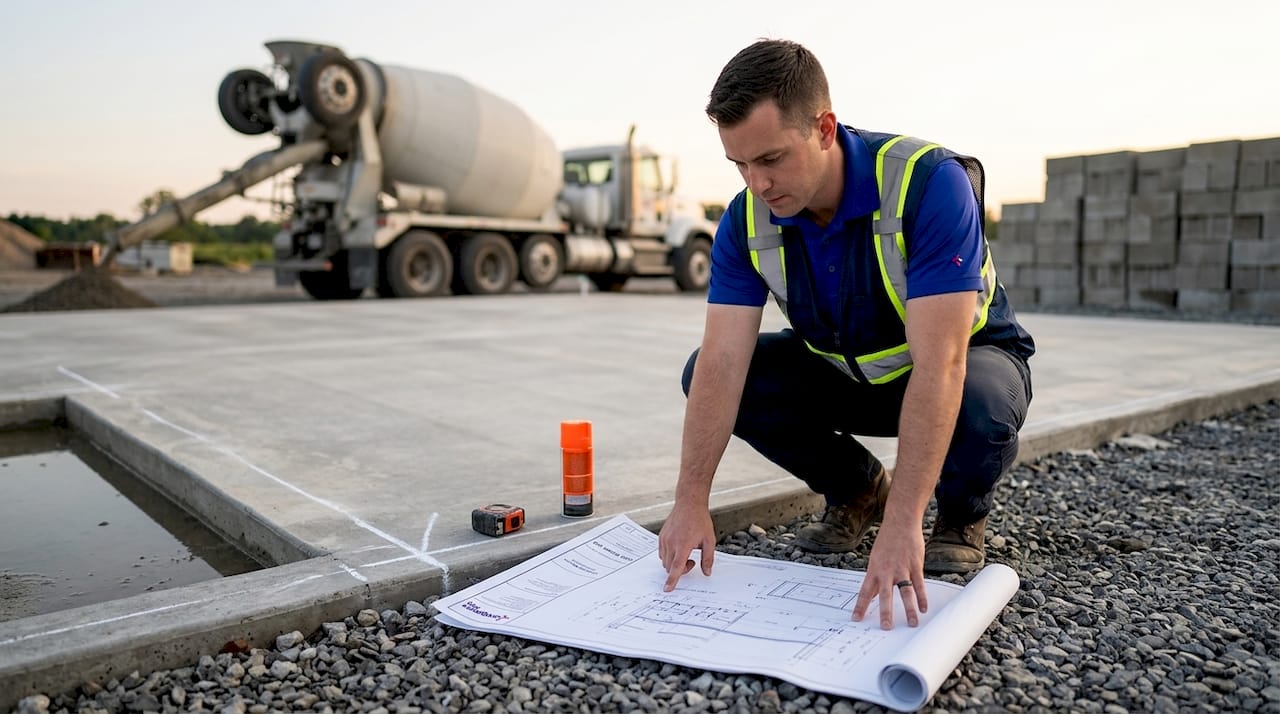
High groundwater requires shallow foundations and large slabs to withstand seismic forces. In coastal or low-lying sites, a mat slab distributes loads broadly and resists hydrostatic uplift far better than isolated footings. Seismically active regions demand reinforced designs with wider spread to dampen lateral movement. Pile foundations are appropriate when bearing capacity at depth is required, but they increase cost and lead time.
| Foundation type | Best application | Key consideration |
|---|---|---|
| Mat slab | High groundwater, soft soil | High steel reinforcement; broad load distribution |
| Isolated footings | Firm, well-drained soil | Cost-effective; requires consistent bearing capacity |
| Pile-supported | Deep bearing layer needed | Longer lead time; higher cost; excellent for poor surface soils |
Tools and equipment required
Every installation team should arrive with the following core equipment:
- Surveying instruments (total station or GPS layout tools)
- Concrete placement and vibration equipment for foundation work
- Mobile crane rated for your heaviest equipment lift
- Precision torque wrenches and alignment tools
- Calibrated scales and load cell testing equipment
- Electrical conduit tools and certified panel equipment
Pro Tip: A thorough site evaluation before mobilization is the single best investment you can make. Catching a drainage problem or a soil bearing issue at this stage costs a fraction of what it costs to correct after the foundation is poured. Review your aggregate plant operations overview to align site layout with future production flow.
Step-by-step installation process
With your site and materials prepped, here is the exact process that gets your concrete plant operational. Whether you are installing a stationary dry batch plant or a mobile unit, the sequence below provides a reliable framework.
Installation steps in order
-
Establish site layout. Use your surveying instruments to stake out all equipment positions, foundation edges, and utility corridors. Verify that clearances for maintenance access are built into the layout. Errors at this stage propagate through every phase that follows.
-
Complete foundation work. Excavate, form, and pour foundations per your approved structural drawings. Allow proper cure time. Do not rush this step. Full concrete strength is required before any structural steel is anchored.
-
Erect structural steel and support frames. Set columns, beams, and elevated platforms. Verify plumb and level at each connection point. Structural misalignment at this stage translates directly into equipment misalignment downstream.
-
Install aggregate bins, conveyors, and silos. Position and anchor cement silos, aggregate bins, and belt conveyors in sequence. Confirm that all anchoring hardware meets spec. Follow manufacturer torque requirements for every connection.
-
Complete mechanical and piping connections. Connect water supply lines, compressed air systems, and admixture pumps. Pressure test all lines before energizing equipment.
-
Complete electrical hookup. Run conduit, pull wire, and land all control panel connections. Have a licensed electrician verify all circuits before powering up. The control system is your plant’s operational brain, and it deserves careful attention.
-
Commission and calibrate. Run the system through dry cycles before introducing materials. Calibrate weigh systems, load cells, and moisture sensors. Verify all interlocks and safety shutoffs function correctly.
-
Conduct trial batches. Produce test loads and verify mix consistency against approved designs. Document all results. Adjust calibration as needed before entering full production.
Critical alignment and calibration note: Alignment errors as small as a few millimeters at the mixer or conveyor transfer points cause wear, spillage, and inconsistent mix quality over time. Calibration is not a one-time event; treat it as a living process that requires verification after any significant maintenance or structural change.
Stationary vs. mobile plant installation differences
Stationary plants offer high capacity and long-term reliability, while mobile plants deliver quick setup but lower throughput at peak demand. The installation approach differs in meaningful ways.
Fast-assemble modular plants reduce installation time and costs significantly compared with traditional stationary setups. For mobile batch plant assembly, foundations are minimal or use engineered steel outrigger pads, and the plant folds into transport configuration when the project moves.
| Factor | Stationary plant | Mobile/modular plant |
|---|---|---|
| Foundation requirement | Full concrete slab or piles | Minimal pads or engineered outriggers |
| Installation time | 3 to 8 weeks typical | 1 to 5 days typical |
| Labor hours | High | Moderate to low |
| Production capacity | High | Moderate |
| Relocation flexibility | None | High |
| Best application | Permanent or long-duration projects | Multi-site or phased projects |
Pro Tip: If your project schedule involves phased construction across multiple zones or sites, a modular plant can cut installation days dramatically and reduce your total labor cost per project phase. Consider reviewing energy-efficient plant types to identify configurations that best match your production demands.
Common mistakes and troubleshooting tips
Even the best plans encounter hiccups. Here are the biggest pitfalls and how to fix or prevent them before they derail your schedule or compromise mix quality.
Foundation and alignment errors
Poor foundation work is the number one source of long-term plant performance problems. Settlements, cracks, and unlevel pads cause misaligned conveyors, gate seal failures, and accelerated wear on mechanical components. Confirm bearing capacity before you pour.
Alignment errors during structural steel erection are the second most common issue. A steel column that is even slightly out of plumb transfers that error to every piece of equipment mounted above it. Use your total station at every floor level during erection. Correct immediately; do not leave it to be resolved later.
To avoid poor foundations, misalignment, and skipping calibration, treat each of these three areas as non-negotiable checkpoints before advancing to the next installation phase.
Calibration oversights
Calibration is not a post-installation formality. It is a core function that determines whether every load you produce meets specification. Common calibration mistakes include:
- Using test weights that are not traceable to NIST standards
- Failing to re-zero load cells after making mechanical adjustments
- Ignoring moisture sensor drift over time, which skews water-to-cement ratios
- Not accounting for temperature effects on aggregate moisture content
Statistic callout: Industry data consistently shows that the majority of unplanned production downtime at concrete plants traces back to foundation faults and calibration failures, not mechanical breakdown. Getting these two areas right at the start protects your uptime investment.
Troubleshooting checklist
When a problem arises during or after installation, work through this checklist:
- Recheck all foundation benchmarks against original survey data
- Inspect all anchor bolts for specified torque
- Verify load cell connections and zero the weigh system
- Confirm all conveyor belt tensions and tracking adjustments
- Test all control panel interlocks and emergency shutoffs
- Review electrical drawings against as-built field conditions
- Inspect all pneumatic and hydraulic connections for pressure loss
Pro Tip: Document every calibration step in a dedicated plant installation log. This record protects you during compliance audits and gives your maintenance team a clear baseline for future troubleshooting. Review your plant safety checklist to make sure installation documentation meets regulatory expectations.
Verifying performance and ensuring compliance
After overcoming installation challenges, verifying performance is your guarantee of uptime and regulatory approval. This stage is not a formality. It is the formal transition from installation to production readiness.
Performance verification steps
-
Conduct full dry-run cycles. Operate the plant through complete batch sequences without materials. Confirm all gates, conveyors, and controls cycle correctly. Verify timing sequences match your mix design parameters.
-
Execute load cell calibration check. Apply certified test weights to each weigh hopper. Record readings and compare against known values. Tolerances should be within 0.1% for aggregate hoppers and tighter for cement and water.
-
Produce and test trial batches. Run a minimum of three trial batches at your target mix design. Conduct slump tests and take cylinder samples for compressive strength testing. Review results against specification before declaring the plant ready for production.
-
Complete alignment inspection. Walk all conveyor transfer points, mixer shaft alignments, and silo connections. Use a precision level and dial indicator where required.
-
Review and file documentation. Collect all calibration certificates, test results, and equipment compliance records. File them in a format accessible for regulatory review.
Compliance and certification data
Calibration and proper alignment are crucial for reliable operation and form the technical basis for most third-party certification programs in the concrete industry.
| Compliance area | Verification method | Standard reference |
|---|---|---|
| Weigh system accuracy | Certified test weight calibration | NIST traceability required |
| Mix design conformance | Trial batch testing with field sampling | ACI 318 / project specification |
| Structural integrity | Engineering inspection and documentation | Local building code |
| Electrical safety | Licensed electrician sign-off | NEC and local authority |
| Environmental compliance | Dust collection and stormwater review | EPA and state permits |
For long-term production reliability, build a recurring calibration schedule into your plant operating procedures. Monthly load cell checks and quarterly full-system audits catch drift before it affects your product quality or creates compliance exposure. Efficient logistics also support compliance; review our guidance on optimizing plant logistics to keep your supply chain aligned with your plant’s production capacity.
The overlooked advantages of modular plants
Beyond step-by-step instructions, here is a perspective that could reshape your next installation decision.
For decades, the conventional wisdom in industrial concrete production has been straightforward: stationary plants are the reliable, high-output choice, and mobile or modular plants are a compromise you accept only when a permanent installation is not feasible. We disagree with that framing, and recent project experience has given us strong reasons to push back.
Modular fast-assemble plants have closed the gap with stationary setups on nearly every measure except maximum theoretical throughput. Installation timelines that once required months of civil work now take days with the right modular configuration. Labor costs drop proportionally. And critically, the risk profile of the project improves because you are not committing to a multi-week installation before you have proven site conditions and mix performance.
There is a broader strategic argument here, too. Infrastructure projects increasingly involve phased construction sequences, where production needs to move with the work front. Locking into a stationary plant for a phased highway project or a distributed industrial campus means either building multiple fixed plants or trucking concrete over distances that erode quality and margins. A modular plant follows the work. That is not a compromise. That is an operational advantage.
We have also seen modular plants outperform stationary alternatives on total uptime over a project lifecycle. When maintenance requires taking a stationary plant offline, the production stop is often measured in days while parts are sourced and repairs are made. A modular plant, designed for rapid disassembly, can have a major component swapped in hours. The design philosophy that makes modular plants fast to install also makes them faster to maintain.
Our recommendation: evaluate modular options seriously for any project involving phased delivery, uncertain site timelines, or anticipated future expansion. Visit our resource on aggregate operations modernization for a broader view of how modern plant configurations support efficient production.
Pro Tip: For large phased projects, consider a modular plant for early phases to generate cash flow and reduce schedule risk, then evaluate whether a stationary installation is warranted for later phases once site conditions and production volumes are confirmed.
Streamline your next concrete plant installation with industry-leading solutions
Ready to take your next installation from theory to action? At Conquest Manufacturing, we design and build stationary dry batch plants and mobile concrete batch plants engineered for the demands of commercial and infrastructure projects. Our equipment is custom-built for reliability, efficiency, and compliance from day one.
We understand that every project site is different, and our team is dedicated to helping you select the right configuration, whether that is a permanent stationary setup or a fast-deploy modular unit. Explore our aggregate plant solutions for production efficiency guidance, and review our industrial safety guide to ensure your installation meets every regulatory requirement. Contact us today to discuss your project requirements and get a tailored solution.
Frequently asked questions
What foundation type should I select for a concrete plant in high groundwater areas?
Use shallow, reinforced slabs sized to withstand seismic forces and prevent water-related damage. Shallow foundations with large slabs are specifically recommended for high-groundwater conditions to resist both uplift and lateral seismic forces.
How long does it take to install a modular vs. stationary concrete plant?
Modular plants install in days, while stationary setups often take several weeks depending on site complexity. Fast-assemble modular plants reduce installation time and costs significantly compared with traditional stationary systems.
What are the most frequent installation mistakes with concrete plants?
Common mistakes include poor foundations, misalignment during steel erection, and skipping calibration steps. Addressing all three before advancing to the next phase prevents the majority of downtime and rework issues that plague plant installations.
How do I verify a concrete plant is installed correctly?
Conduct functional dry-run tests, calibrate all weigh systems with certified test weights, run trial batches, and document all compliance checks. Calibration and proper alignment are the two most critical technical benchmarks for confirming a reliable installation.