
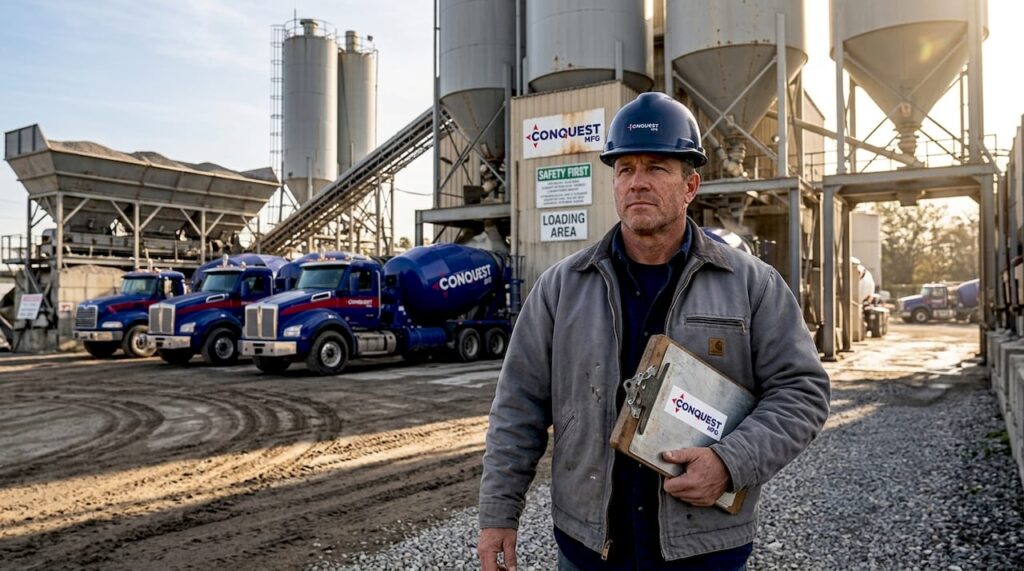
Modern batch plants are far more sophisticated than most construction professionals assume. The term suggests a simple mixing setup, but today’s batching plant combines precision automation, multi-stage material handling, and increasingly strict environmental compliance requirements into a single production system. Whether you’re evaluating batching plants for sale, managing an existing facility, or planning a mobile deployment, the decisions you make around technology, equipment, and regulatory strategy directly affect your output quality, your permit status, and your bottom line. This guide covers what you need to know.
Table of Contents
- Key takeaways
- What batch plants actually do
- Automation and control systems in batch plants
- Environmental compliance and dust control
- Choosing the right plant and equipment upgrades
- Managing materials and dust on site
- My perspective on balancing efficiency and compliance
- Conquestmfgusa builds plants that work in the real world
- FAQ
Key takeaways
| Point | Details |
|---|---|
| Precision drives quality | Modern batch plants achieve cement measurement accuracy within 0.5% of target weight, directly impacting concrete consistency. |
| Automation pays off | PLC-integrated batch plants can improve batching accuracy within ±1% and increase hourly output by 30%. |
| Compliance is non-negotiable | Dust emissions exceeding 100 tons per year can trigger major source permits under the Clean Air Act. |
| Equipment type matters | Portable vs. stationary plant selection should account for project duration, permit flexibility, and site mobility needs. |
| Haul roads are the hidden risk | Unpaved on-site roads often generate more particulate matter than all processing equipment combined. |
What batch plants actually do
A batch plant measures, proportions, and mixes the raw materials that become concrete: aggregates (sand, gravel, crushed stone), cement, water, and admixtures. The output quality depends almost entirely on how accurately each ingredient is weighed and how consistently the mixing cycle is executed. Get that wrong, and no amount of downstream quality control fixes it.
Types of batch plants fall into three primary categories:
- Central mix plants combine all ingredients, including water, in a stationary drum mixer before loading into trucks. They produce a highly uniform mix and are preferred for high-volume, consistent-spec projects.
- Transit mix (dry mix) plants weigh and load dry materials into a truck mixer, which blends the concrete in transit. These give greater flexibility for longer hauls where mix timing matters.
- Portable (mobile) batch plants are truck-mounted or trailer-mounted units designed for rapid deployment across multiple sites. Conquestmfgusa manufactures both stationary dry and mobile concrete batch plants to serve both categories of project need.
The core components across all types are essentially the same: aggregate storage bins, cement silos, individual weigh hoppers, a central mixer or loading conveyor, and a control system. Computerized batching controls and weigh hoppers can achieve material accuracy within 1 to 2%, with cement measurement often reaching 0.5% of target weight. That level of precision is not achievable manually. It demands well-calibrated equipment and a reliable control architecture.
Automation and control systems in batch plants
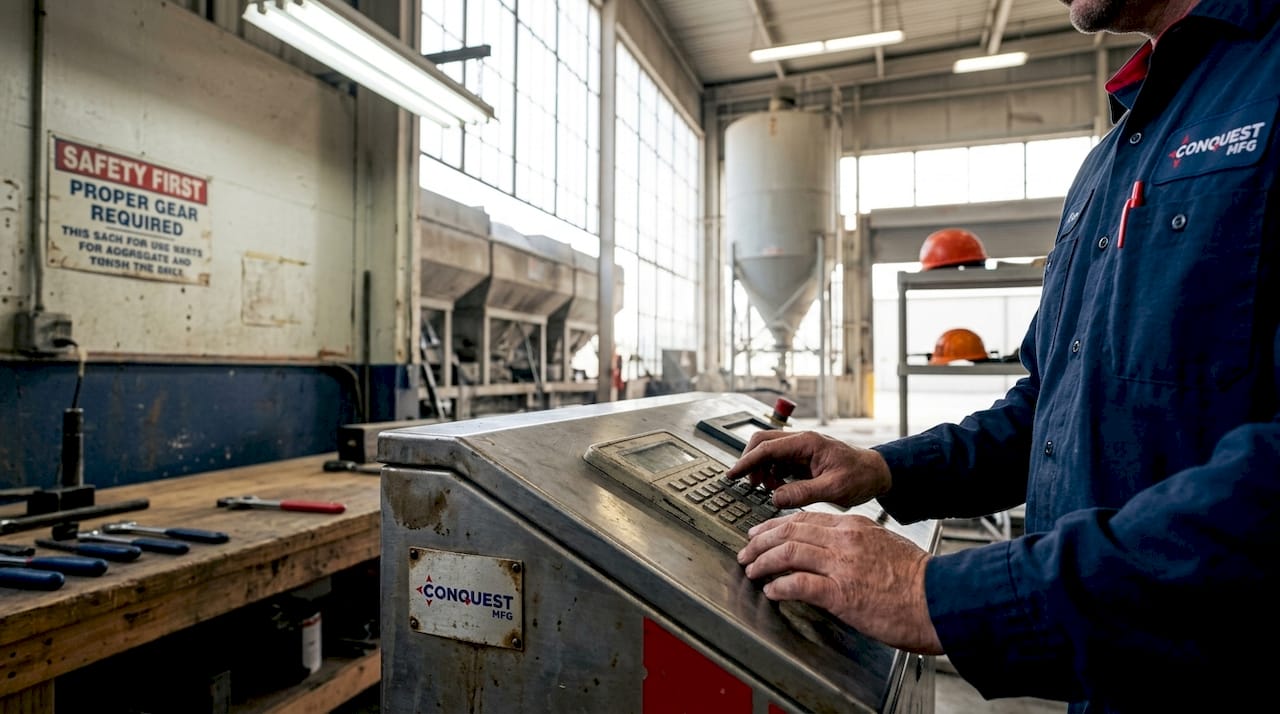
If there is one area where modern batching plants have changed most dramatically over the past decade, it is automation. A programmable logic controller, or PLC, manages the entire batching sequence: opening and closing aggregate gates, triggering weigh hoppers, controlling water flow, and activating the mixer. Every step follows a timed, sensor-verified logic that removes human error from the most repetitive and critical operations.
PLCs integrated into batch plant production cycles can improve batching accuracy within ±1% while increasing hourly output by up to 30%. That is not a marginal gain. On a high-volume paving project, a 30% throughput increase without adding crew or equipment is a significant operational advantage.
Key components in a modern control system include:
- Load cells and sensors that feed real-time weight data to the PLC
- Pneumatic or hydraulic actuators for gate and valve control
- HMI (human-machine interface) panels that allow operators to input mix designs and monitor cycle status
- SCADA (Supervisory Control and Data Acquisition) software for centralized monitoring, reporting, and remote access
SCADA systems can integrate with ERP platforms for financial tracking and batch data logging. This means every cubic yard produced is traceable: time, mix design, material weights, operator ID. That data is valuable for quality assurance, but also for demonstrating compliance to regulators and customers.
Pro Tip: When evaluating a new control system, prioritize data logging and export capability over interface aesthetics. Your permitting agency may require production records on demand, and systems that cannot export clean batch reports create real compliance risk.
Different projects call for different levels of automation. A small ready-mix producer may operate effectively with a semi-automated PLC panel and manual QC checks. A large infrastructure contractor running 24-hour operations benefits from full SCADA integration with remote diagnostics. The gap between those configurations is significant in both cost and capability, so match your automation level to your actual production volume and reporting requirements.
Environmental compliance and dust control
The assumption that environmental compliance is a paperwork issue is one of the most expensive mistakes a batch plant operator can make. Dust emissions from batch plants can exceed 100 tons per year without controls, which pushes the facility into major source territory under the Clean Air Act. That designation triggers significantly more stringent permitting, monitoring, and reporting requirements.
The primary emission sources on a typical site are:
- Cement silos during filling and discharge operations
- Aggregate bins and conveyor transfer points where material drop generates airborne particulate
- The mixer itself during loading and discharge
- Haul roads connecting stockpiles, the plant, and truck loading zones
The most common control technologies are baghouse dust collectors for enclosed systems and water sprays for open aggregate handling. Baghouses capture over 99% of cement silo emissions. Water sprays reduce aggregate-related dust by 70 to 90%. Neither system operates passively. Both require scheduled maintenance, filter inspections, and documented service records.
Most batch plant operators pursue a synthetic minor permit, which caps total emissions below major source thresholds through enforceable operational limits. These permits allow continued operation without the full burden of major source monitoring, but they are not low-effort. Maintaining synthetic minor status requires strict dust control and consistent recordkeeping. Baghouse stack testing, which typically costs $3,000 to $5,000 per event, may be required to demonstrate continued compliance.
Poorly maintained dust control equipment can cause regulatory shutdowns regardless of how much concrete you’re producing. A clogged baghouse filter creates pressure spikes that can damage silos and generate visible emissions. That combination invites inspections, citations, and, in serious cases, forced shutdowns that cost far more than any deferred maintenance.
The industrial equipment safety checklist approach applies directly here: treat dust control maintenance as a compliance-critical system, not an optional operational item.
Choosing the right plant and equipment upgrades
Selecting the right batch plant is not just a capacity decision. It is a strategic one. Portable plants give you flexibility on multi-site contracts and often qualify for general air quality permits that allow relocation without a full permit revision. Mobile concrete batching plants are still subject to air quality permitting, but many states offer general permits with fixed emission limits that simplify relocation approvals.
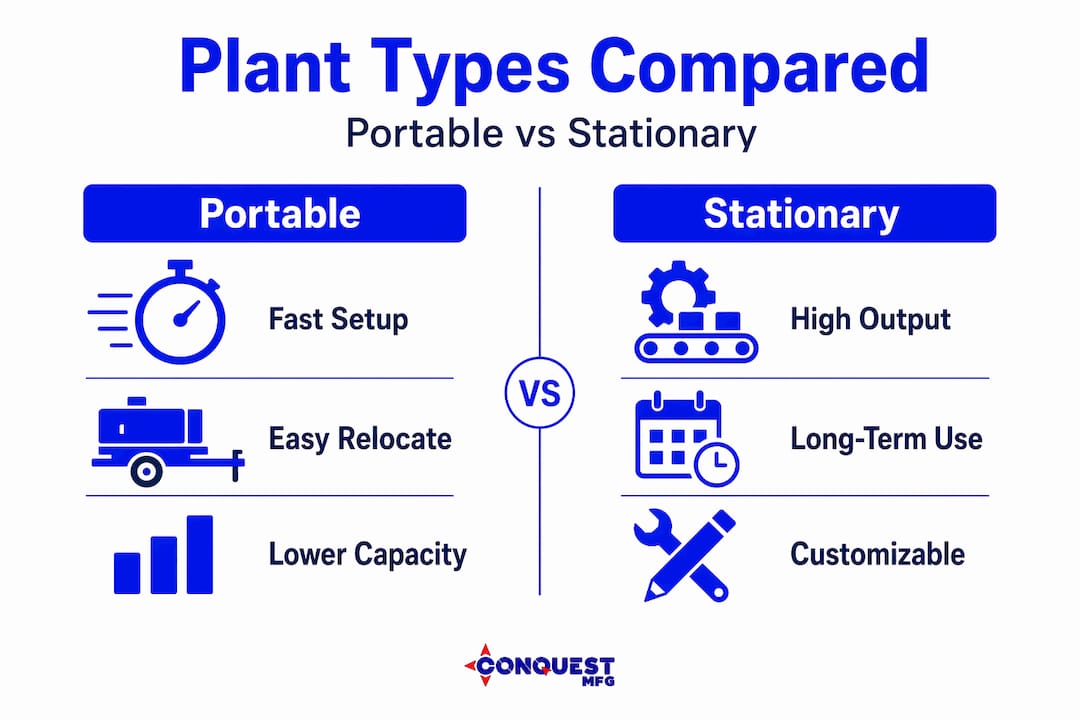
| Factor | Portable batch plant | Stationary batch plant |
|---|---|---|
| Deployment time | Days to weeks | Weeks to months |
| Permitting flexibility | Generally easier to relocate | Site-specific permit required |
| Production capacity | Moderate (up to ~200 cu yd/hr) | High (200+ cu yd/hr) |
| Dust control integration | Limited but available | Full system integration possible |
| Long-term cost | Higher per unit on extended projects | Lower on fixed, long-duration projects |
For operators who already have a stationary plant, targeted equipment upgrades often deliver better ROI than a full replacement. Dust control retrofits, updated PLC panels with modern HMIs, and aggregate moisture sensors for mix-water adjustment all improve output quality without a ground-up rebuild. Proper cement handling is equally critical. Understanding bulk cement handling systems and how pig silos integrate into plant logistics can prevent supply bottlenecks that slow your entire operation.
Pro Tip: Before purchasing a used batch plant, obtain the existing air quality permit and review the compliance history. A plant with permit violations on record may require significant control upgrades before you can legally operate it, and those costs rarely appear in the asking price.
Maintenance protocols matter as much as equipment quality. Weigh hopper calibration should be verified on a scheduled basis, not only when you notice output inconsistencies. Load cell drift is gradual and easy to miss until a concrete mix test failure flags it.
Managing materials and dust on site
Good material management reduces dust at the source before any control technology is needed. The most overlooked factor is moisture. Aggregate stockpiles with controlled moisture levels generate significantly less airborne dust during handling and loading. Covering stockpiles or using water suppression systems on exposed piles is practical and cost-effective.
Effective on-site dust management combines several approaches:
- Physical enclosures around conveyor transfer points and the mixer loading zone reduce fugitive emissions without requiring a baghouse at every point
- Windscreens or barrier walls around aggregate stockpiles cut wind-driven dust dispersal significantly on open sites
- Chemical suppressants on unpaved haul roads maintain surface cohesion longer than water alone, reducing re-application frequency
- Dust sensors integrated into the plant control system can trigger automatic water spray activation when particulate levels exceed a set threshold
Unpaved haul roads are consistently the largest dust source on batch plant sites, often contributing more particulate matter than all processing equipment combined. Paving primary haul routes can reduce road-generated PM by over 90%. That single investment frequently delivers more compliance benefit than upgrading multiple pieces of plant equipment. For facilities managing both dust control and bulk material logistics together, the aggregate plant operations guide covers practical strategies for integrating both into a unified workflow.
My perspective on balancing efficiency and compliance
I’ve worked closely enough with batch plant operations to know that the operators who struggle most are not the ones with outdated equipment. They are the ones who treat environmental compliance as a separate concern from production efficiency. Those two things are not in opposition. In my experience, the plants that run most efficiently are almost always the ones with the best compliance records.
Here is why that matters practically. When your dust control systems are well-maintained, your equipment runs cleaner, your load cells stay calibrated, and your baghouse filters don’t spike your pressure readings. The operational discipline that keeps you compliant is the same discipline that keeps your output consistent.
What I’ve seen too often is operators who invest heavily in automation for throughput and then defer maintenance on the baghouse because it feels like an overhead cost. That deferred maintenance creates compliance risk that, when it materializes, shuts down the very throughput gains they invested in.
My honest take is that automation and environmental compliance should be planned together from the start. Retrofitting dust sensors into a PLC control system that was not designed for them is possible but awkward. Building that integration in at the design stage costs less and works better. If you are evaluating batching plants for sale right now, ask the manufacturer specifically how the control system interfaces with dust control equipment. The answer tells you a lot about how that manufacturer thinks about total plant performance.
— Peter
Conquestmfgusa builds plants that work in the real world

At Conquestmfgusa, we manufacture both stationary dry and mobile concrete batch plants built for the operational realities you actually face: air quality compliance requirements, multi-site mobility demands, and the need for control systems that log data your regulators will actually accept. Our equipment is custom-built in the USA, and we support clients through the full lifecycle of plant ownership, from specification and delivery through field support.
If you are searching for batch plant solutions that are built to regulatory standards and designed for long-term reliability, our construction industry equipment line is the right starting point. We also manufacture complementary equipment, including portable cement pig silo trailers and dry bulk pneumatic trailers, that integrate directly with batch plant operations. Get in touch with our team to discuss your project requirements and get a quote tailored to your specifications.
FAQ
What is the difference between a batch plant and a batching plant?
The terms are interchangeable in the concrete production industry. Both refer to a facility or mobile unit that proportions and mixes raw materials, including aggregates, cement, and water, to produce concrete of a specified design.
How accurate are modern batch plant weigh systems?
Modern batching plants equipped with computerized controls achieve material accuracy within 1 to 2%, with cement measurement frequently reaching 0.5% of target weight. Load cell calibration and regular maintenance are required to sustain that level of precision.
Do mobile batching plants need air quality permits?
Yes. Mobile concrete batching plants are subject to air quality permitting in most states, though many jurisdictions offer general permits that allow relocation under fixed emission limits without requiring a full new permit for each site.
What causes most dust emissions on a batch plant site?
Unpaved haul roads are typically the single largest source of particulate matter on batch plant sites. Paving primary haul routes can reduce road-generated PM by over 90%, often delivering more compliance benefit than upgrading processing equipment.
What does a synthetic minor permit require for a batch plant?
A synthetic minor permit caps total plant emissions below major source thresholds through enforceable operational limits. Maintaining that status requires documented dust control maintenance, consistent recordkeeping, and potentially periodic baghouse stack testing to verify continued compliance.