
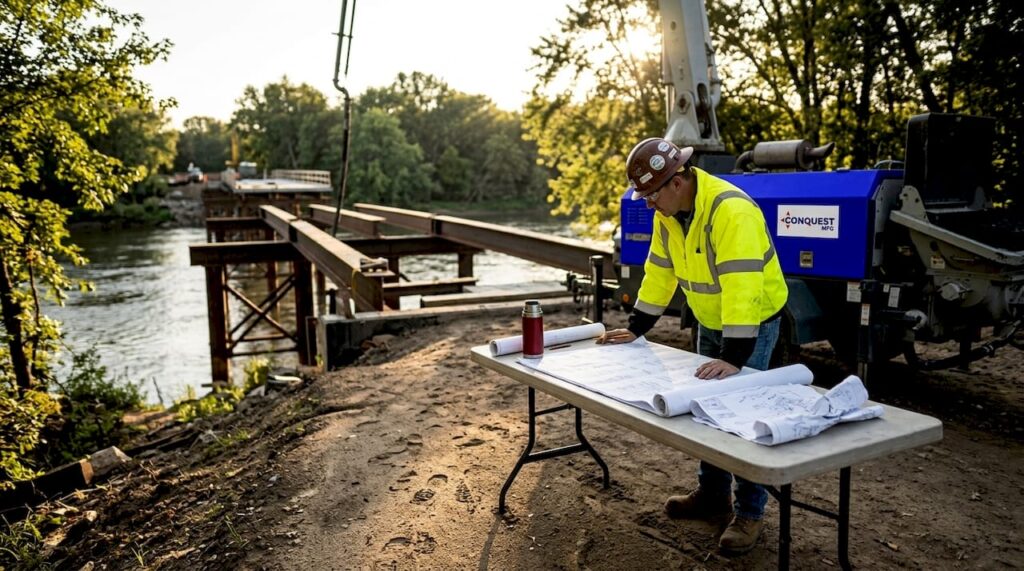
Choosing the wrong equipment at the wrong phase of a bridge project doesn’t just create delays. It creates cascading failures that compress schedules, inflate budgets, and put crews at risk. The bridge construction equipment process is not a simple checklist. It’s a dynamic, sequenced series of decisions where each piece of heavy machinery for bridge construction must match the structural method, site conditions, and span geometry. This guide breaks down what equipment is used for bridges, when to deploy it, and how to avoid the planning mistakes that derail projects before the first pile is driven.
Table of Contents
- Key takeaways
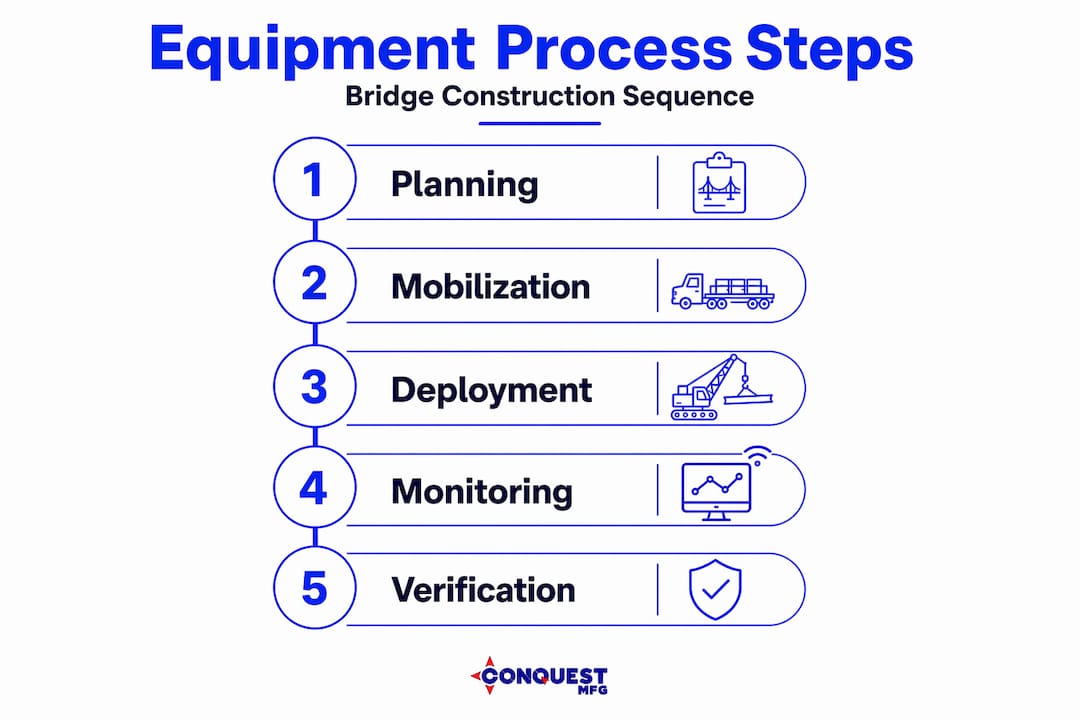
- The bridge construction equipment process: prerequisites and planning
- Steps in bridge construction and equipment deployment
- Advanced equipment and technologies for modern bridge projects
- Common challenges in the bridge construction equipment process
- Verification and quality assurance in equipment use
- My perspective on where bridge construction equipment is heading
- How Conquestmfgusa supports your bridge construction projects
- FAQ
Key takeaways
| Point | Details |
|---|---|
| Equipment selection drives outcomes | Matching construction equipment for bridges to span length and site conditions is the single biggest variable in project efficiency. |
| Sequencing is non-negotiable | Each step in the bridge construction process depends on prior phase completion, meaning equipment scheduling errors compound quickly. |
| ABC shortens site exposure | Accelerated Bridge Construction techniques move work off-site, reducing traffic disruption and hazard exposure for crews. |
| Digital tools reduce costly surprises | Digital twin technology and real-time sensor feedback catch misalignment and structural deviations before they become expensive field corrections. |
| Early contractor involvement pays off | Engaging contractors during design through methods like CMGC produces more realistic equipment plans and fewer deployment conflicts. |
The bridge construction equipment process: prerequisites and planning
Before any heavy machinery for bridge construction reaches the site, the planning phase determines whether the project runs efficiently or reactively. Site inspections must assess soil conditions, water table depth, traffic constraints, utility conflicts, and access routes. Each of these factors directly limits or expands your equipment options.
The major equipment categories you will deploy across a typical bridge project include:
- Cranes: Tower cranes and crawler cranes for segment lifting, form handling, and material placement
- Form travellers: Used in balanced cantilever construction for cast-in-place spans
- Movable Scaffolding Systems (MSS): Suited for repetitive span construction where cycle time matters
- Launching gantries: For erecting precast segmental spans over live traffic or water
- Piling rigs and vibro hammers: For deep foundation installation in varied soil and rock strata
- Concrete batch plants: For on-site or near-site concrete production ensuring mix consistency
| Equipment Type | Best Application | Key Consideration |
|---|---|---|
| Crawler crane | Segment lifts, heavy picks | Ground bearing capacity |
| Form traveller | Cast-in-place cantilever spans (50–250m) | Complex geometry, slower cycle |
| MSS | Repetitive spans (20–70m) | High upfront cost, faster cycles |
| Launching gantry | Precast segmental erection | Span-by-span over obstacles |
| Vibro hammer | Pile installation in cohesive soils | Noise and vibration limits |
| Self-Propelled Modular Transporter | Slide-in bridge replacement | Requires off-site prefab staging |
Safety equipment and regulatory compliance must be addressed before mobilization. This means fall protection systems, load monitoring on cranes, and equipment certifications aligned with OSHA and project-specific safety plans. Reviewing the industrial equipment safety checklist during pre-construction planning will help your team catch compliance gaps before they delay procurement.
Pro Tip: Engage your general contractor during the design phase using a Construction Manager/General Contractor approach. Early contractor input shapes more efficient equipment deployment plans and surfaces constructability issues before they become costly field changes.
Steps in bridge construction and equipment deployment
Understanding the process of bridge building means knowing which machine is critical at each stage. The sequence below reflects standard practice on a cast-in-place or precast segmental bridge.
-
Site preparation and access: Establish haul roads and crane pads. Ground improvement may be required to support crawler crane loads. Equipment: graders, compactors, and temporary steel mats.
-
Foundation and piling: Deep foundation pile installation combines cranes, vibro hammers, and augers to handle varying soil and rock conditions. Cluster hammers and compressed air jets clear cuttings from rock sockets. This phase sets the structural baseline for everything that follows.
-
Substructure construction: Pier caps and columns are formed and poured using conventional formwork systems. Concrete pumps, batch plants, and truck mixers are active throughout. Accurate placement at this stage is critical because pier geometry directly affects span alignment.
-
Superstructure erection using form travellers or MSS: Form travellers suit balanced cantilever spans of 50 to 250 meters, while MSS works best for repetitive spans of 20 to 70 meters. Form travellers offer flexibility for complex geometries. MSS delivers faster cycle times on uniform spans but requires significant capital investment upfront.
-
Segment lifting and placement: Launching gantries and synchronized twin lifting frames handle precast segments. Hydraulic cylinders and automated winches allow sub-millimeter alignment during placement, which is not optional in balanced cantilever work where symmetrical loading controls structural behavior.
-
Post-tensioning and epoxy jointing: Balanced cantilever construction demands that post-tensioning be applied within the epoxy open time window. Missing that window means stripping the joint and starting over. Precision here is purely a scheduling and crew coordination problem, not a technical mystery.
-
Deck finishing and barrier installation: Finishing machines, concrete pavers, and deck grinders complete the riding surface. Barrier forms and slip-form pavers handle the median and edge barriers.
-
Final inspection and load testing: Static and dynamic load tests confirm structural performance before opening to traffic.
Pro Tip: On projects using ABC methods, the design schedule is intentionally longer than traditional approaches. Rushing prefabrication design to save upfront time almost always costs more during site assembly.
Advanced equipment and technologies for modern bridge projects
Modern bridge building tools have moved well beyond cranes and formwork. The technologies now available give project teams real-time visibility into structural behavior and allow precision that manual methods cannot match.
Digital twin technology stands out as one of the most impactful recent developments. On the Black Hawk Bridge project in Iowa, digital twin implementation saved 6 weeks and $3.2 million during construction. A digital twin validates the design before work begins, then serves as a live reference during construction for comparing actual conditions against the model.
Real-time sensor systems add another layer of control. Sensors enable dynamic correction during segment lifts, compensating for sag and thermal movement in long spans. Without this feedback, crews are relying on survey readings that may lag actual structural behavior by hours.
Key advanced equipment worth evaluating for your next project:
- Articulated Bridge Rover (ABR1): Features a 750 lb platform capacity and 60-inch lowered deck height for work in areas where conventional access equipment cannot maneuver, particularly useful under existing structures or on narrow urban spans
- Self-Propelled Modular Transporters (SPMTs): Allow slide-in bridge replacement within hours, reducing traffic disruption to a single overnight closure instead of months
- Hydraulic strand jacks: Provide controlled, incremental lifting of heavy prefabricated sections with load monitoring at every increment
- Automated concrete batching systems: Deliver consistent mix designs at high volume directly tied to placement schedules on site
Pro Tip: Integrating digital monitoring tools early in project mobilization reduces the frequency of costly re-surveys and gives you documented evidence of construction conformance that protects all parties during close-out.
Common challenges in the bridge construction equipment process
Even well-planned projects encounter equipment-related problems. Knowing where failures cluster lets you build mitigation into the schedule rather than reacting in the field.
Equipment misalignment during segment placement is the most common technical problem on precast projects. The choice of lifting equipment defines the pace and safety of segmental assembly, and undersized or mismatched rigging introduces tolerance errors that accumulate across successive spans. A one-millimeter error per segment becomes a significant geometric deviation by span closure.
Scheduling conflicts create resource bottlenecks that are harder to recover from than most project managers anticipate. When a launching gantry finishes ahead of the concrete supply, the crew sits idle. When the concrete batch plant falls behind because the aggregate delivery schedule was not coordinated, the gantry queue backs up. These are logistics problems, not equipment problems.
Environmental constraints add another layer of complexity. River crossings must account for flood season windows. Urban projects face noise ordinances that restrict vibro hammer use to specific hours. Cold weather requires heated enclosures for concrete curing. Each constraint limits your equipment options and may force substitutions mid-project.
“Successful ABC implementations require detailed planning where the design schedule is typically longer than traditional methods to ensure flawless prefab and rapid site assembly.”
Strategies to keep projects on track include maintaining one spare crane allocation in the schedule, pre-qualifying multiple concrete suppliers, and conducting full equipment dry-runs for ABC slide-in operations before the traffic closure window opens.
Verification and quality assurance in equipment use
Verification is where the bridge construction equipment process either delivers on its promises or reveals its gaps. Every major equipment-driven operation needs a defined acceptance criterion before the work begins.
| Verification Activity | Equipment/Method | Acceptance Criterion |
|---|---|---|
| Pile installation | PDA testing with hammer | Bearing capacity per design |
| Segment geometry | Total station survey | Within 3mm of design alignment |
| Post-tensioning | Hydraulic jack with load cell | Force per strand per spec |
| Epoxy joint integrity | Visual and tap test | No voids, full contact |
| Load test | Static load per AASHTO | Deflection within predicted range |
| Monitoring sensors | Embedded strain gauges | Readings within analytical model |
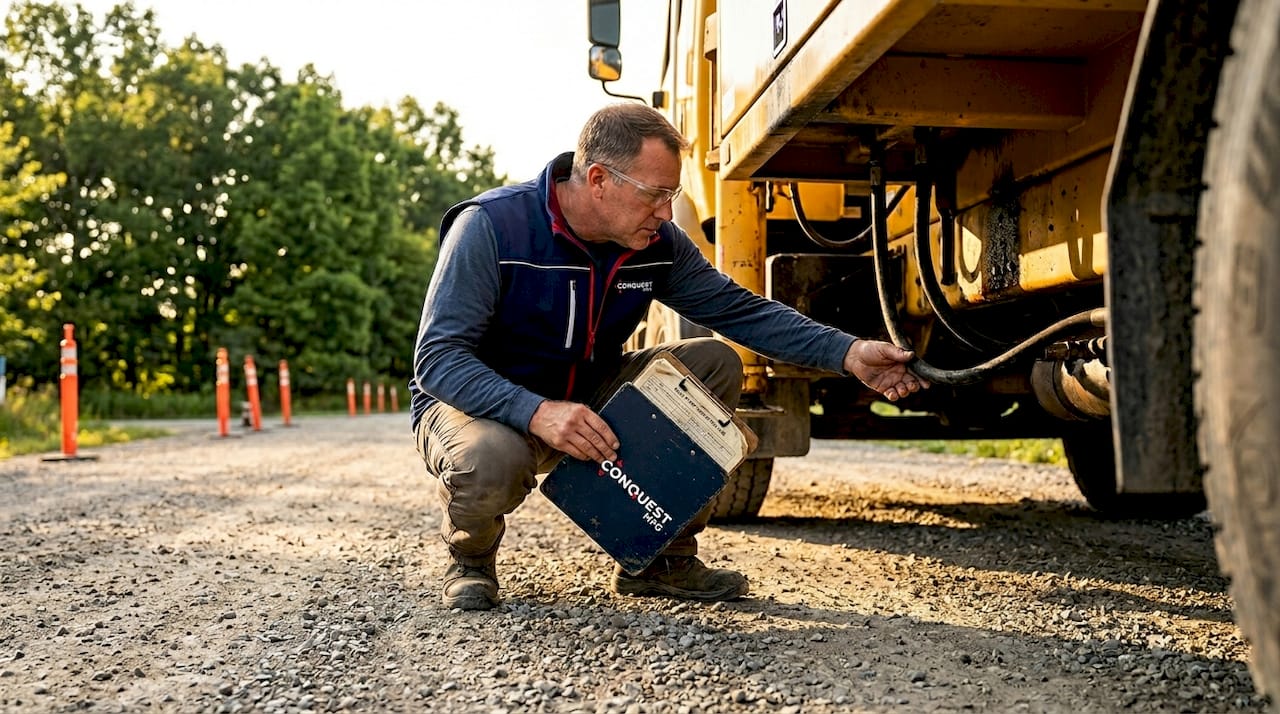
Inspection protocols must cover both the equipment condition and the work it produces. A crane operating within its rated capacity can still produce misaligned lifts if the rigging geometry is wrong. Post-tensioning jacks must be calibrated on a schedule tied to the number of operations performed, not just time elapsed.
Sensor data feedback during construction provides a verification record that extends beyond the project close-out. Reviewing the highway construction equipment procurement and maintenance practices documented by Conquestmfgusa reveals how equipment calibration schedules directly affect output quality, a principle that applies equally to bridge work.
Timing is the underappreciated factor in verification. Balanced cantilever construction requires post-tensioning within 30 to 60 minutes of epoxy application. Miss that window and the joint loses integrity at the molecular level. No amount of inspection after the fact recovers that structural performance.
My perspective on where bridge construction equipment is heading
I’ve spent years watching bridge projects succeed and fail, and the clearest pattern I’ve observed is this: the projects that run well are not the ones with the most advanced equipment. They are the ones where the equipment decisions were made early, with contractor input, and locked into the schedule before design was finalized.
The push toward ABC is the right direction. Reducing on-site exposure time genuinely improves safety, and off-site prefabrication under controlled conditions consistently produces better concrete quality than field-cast work. But I’ve also seen ABC projects fail spectacularly because the planning phase was treated as a formality. The design schedule for ABC must be longer. That’s not a limitation. It’s the mechanism that makes rapid site assembly possible.
Digital twins and real-time monitoring are tools I’d now call standard practice rather than advanced. The savings documented on projects like Black Hawk are not outliers. They reflect what happens when you replace guesswork with measured data. Any project above $10 million in bridge value that skips digital monitoring is leaving risk mitigation on the table.
My honest advice: invest more time in the equipment logistics plan than feels necessary. The contractors and project managers who treat that document as a living, frequently updated reference are the ones I’ve seen consistently finish on schedule.
— Peter
How Conquestmfgusa supports your bridge construction projects
When your project demands reliable concrete production, bulk material handling, and specialized transport equipment, Conquestmfgusa delivers purpose-built solutions tailored to construction-scale demands. Our construction industry equipment solutions include mobile and stationary concrete batch plants, dry bulk pneumatic trailers, and heavy-haul transport options designed for the logistical realities of major civil projects.

Whether you’re sourcing batch plant capacity for a cast-in-place span or coordinating bulk cement delivery to a remote site, our team has the manufacturing depth to spec and build equipment that fits your timeline and site conditions. We also offer guidance on concrete plant installation practices that reduce mobilization time and keep concrete supply aligned with your placement schedule. Contact Conquestmfgusa today to discuss your project requirements and get a tailored equipment recommendation from our team.
FAQ
What equipment is used in bridge foundation construction?
Foundation installation relies on crawler cranes, vibro hammers, auger rigs, and cluster hammers to drive piles through varied soil and rock strata. Compressed air is also used to clear cuttings from deep rock sockets during installation.
When should you use form travellers vs. movable scaffolding systems?
Form travellers work best for balanced cantilever spans between 50 and 250 meters where geometry is complex. Movable scaffolding systems suit repetitive spans of 20 to 70 meters and deliver faster cycle times despite a higher initial equipment investment.
What is Accelerated Bridge Construction and how does it affect equipment planning?
ABC shifts construction work off-site using prefabrication, then places completed sections using SPMTs or strand jacks during short traffic closures. The design phase is longer than traditional methods, but site installation is measured in hours rather than months.
How does digital twin technology improve the bridge construction equipment process?
Digital twins validate structural design before construction begins and provide a real-time reference during equipment operations. On the Black Hawk Bridge project, this approach saved 6 weeks and $3.2 million in construction costs.
What causes segment misalignment during precast bridge erection?
Misalignment typically results from rigging geometry errors, inadequate load monitoring on lifting frames, or tolerance accumulation across successive segments. Synchronized hydraulic lifting systems with automated load feedback reduce this risk significantly.