
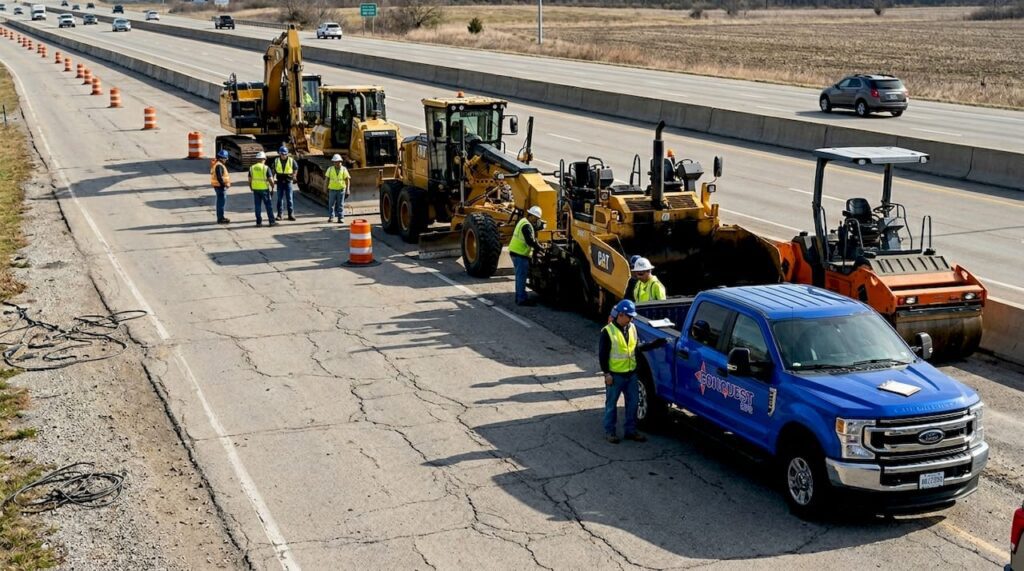
Selecting the wrong equipment for a highway construction project doesn’t just slow things down. It can trigger costly rework, failed inspections, and contract penalties that compound fast. For project managers and procurement officers, every machine that rolls onto a highway jobsite carries a financial and compliance weight that goes well beyond the purchase order. This guide walks you through the critical evaluation criteria, a research-backed equipment checklist, maintenance best practices, and supplier selection strategies so you can procure with confidence and keep your project on schedule, on spec, and on budget.
Table of Contents
- How to choose the right equipment for highway projects
- The essential highway construction equipment list
- Comparing highway equipment: capabilities and standards
- Preventive maintenance and lifecycle cost control
- How technology and innovation are shaping equipment choices
- What most spec sheets won’t tell you: insider lessons on equipment selection
- Connect with trusted suppliers for your next project
- Frequently asked questions
Key Takeaways
| Point | Details |
|---|---|
| Equipment choice impacts success | Choosing the right machines directly affects your project cost, timeline, and compliance. |
| Standards matter | US regulations set strict requirements on key equipment like rollers and mixers for highway jobs. |
| Maintenance pays off | Routine, data-driven maintenance can cut fleet costs by nearly half and prevent major breakdowns. |
| Leverage technology | GPS and connected equipment streamline operations, prevent rework, and give your bid an edge. |
| Supplier reliability counts | The best suppliers offer not only machines, but also proven support, compliance, and innovation. |
How to choose the right equipment for highway projects
Equipment selection for highway work is not a catalog exercise. It starts with regulatory requirements, project scale, and supplier reliability. Getting all three right separates projects that finish on time from those that spiral into claims and change orders.
Regulatory compliance comes first. Federal and agency specifications set hard floors on machine performance. US standards require specific equipment capabilities, including rollers weighing at least 10 tons with 90 psi contact pressure for compaction, and mixing plants with minimum capacity based on project tonnage. If your equipment doesn’t meet those specs, your bid is non-compliant before work even begins.
Before procuring any major machine, review your equipment compliance checklist and confirm the following critical specs are met:
- Roller minimum weight: 10 tons static weight
- Compactor contact pressure: minimum 90 psi
- Asphalt mixing plant output: calibrated to project daily tonnage requirements
- Haul trucks: payload and axle load ratings per state DOT limits
- Graders: blade length and horsepower matched to roadway width and cross-slope tolerance
Project scale drives machine selection. A two-lane rural resurfacing job has completely different demands than a six-lane interstate reconstruction. Wider projects require wider screed pavers, higher-output batch plants, and larger fleets of material transport vehicles. Overspecifying increases idle costs. Underspecifying causes bottlenecks and missed production targets.
Ask suppliers the right questions before committing. Don’t just request a spec sheet. Ask for documented performance data from comparable projects, delivery lead times, parts availability, and warranty terms. A supplier who hesitates on any of those answers is a supplier who may leave you exposed mid-project.
Pro Tip: Request a copy of the machine’s calibration certificate and service history before accepting delivery. A machine that looks new on the lot may have been rebuilt after a major hydraulic or structural failure.
The essential highway construction equipment list
With the selection criteria in mind, here’s the core lineup every highway project demands. Each category below includes its primary function and the standout features that matter most on a highway jobsite.
Excavators
Used for digging, trenching, and bulk material handling. Look for models with variable undercarriage width for tight right-of-way situations and long-reach boom options for deep utility crossings.
Bulldozers
Critical for clearing, grading, and pushing large volumes of material. Track width and blade type (straight, angle, or universal) should match your soil conditions and haul distances.
Motor graders
Used for fine grading and slope finishing ahead of paving. Blade length, tandem drive, and articulation range are the specs that matter most for consistent cross-slope tolerance on long highway stretches.
Asphalt pavers
Lay the finished riding surface. Screed width, automatic grade and slope control, and conveyor capacity determine production rate and mat quality. Wider screeds reduce longitudinal joints and improve long-term pavement performance.
Rollers and compactors
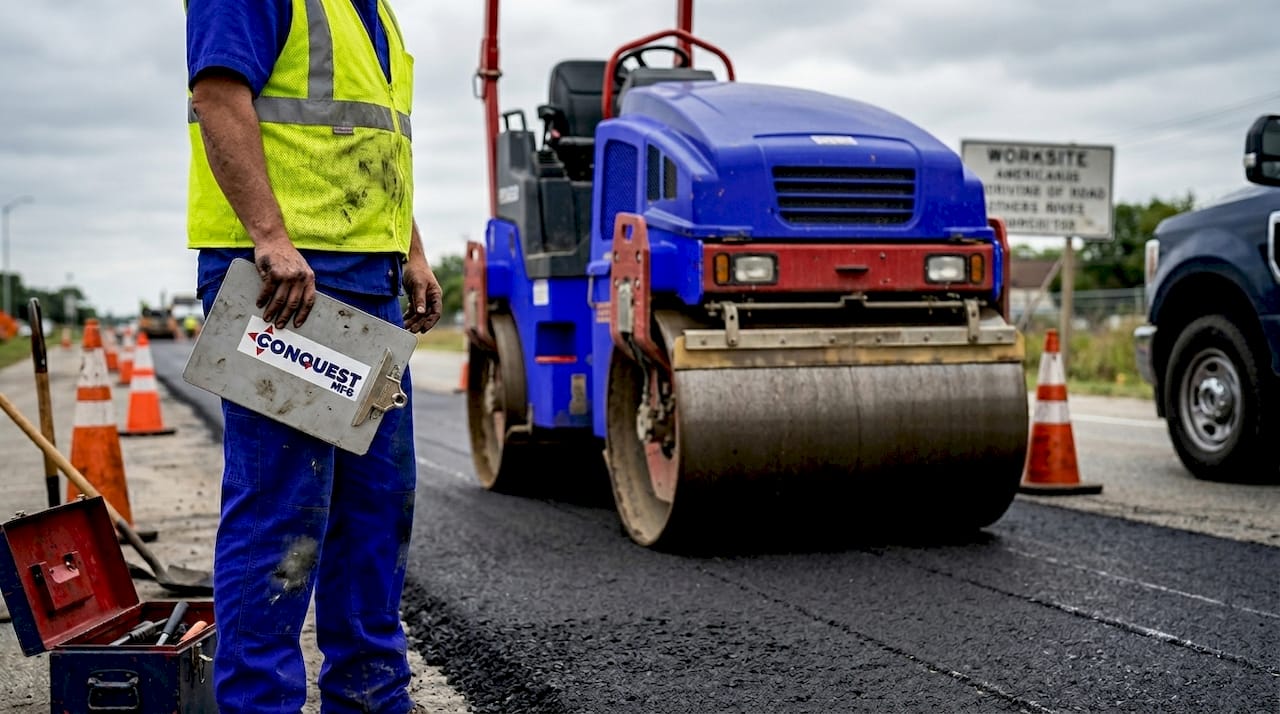
Common highway construction equipment includes excavators, bulldozers, graders, pavers, and rollers, each serving a distinct phase of the work. Rollers are among the most spec-sensitive machines on any project. Pneumatic tire rollers, steel drum rollers, and vibratory compactors each serve different layers of the pavement structure.
Dump trucks and bottom dumps
Material transport equipment is the circulatory system of any highway project. Bottom dump trailers offer faster cycle times for base course aggregate placement, while standard end dumps handle asphalt mat delivery directly to the paver.
Wheel loaders
Used for loading aggregate, moving stockpiles, and feeding batch plants. Match bucket capacity to your plant’s feed rate to avoid starving your mixer or creating surge loads.
Backhoe loaders
Versatile for smaller excavation tasks, utility work, and backfilling. Their dual functionality reduces the number of machines needed on smaller work zones.
Wheel tractor scrapers
Efficient for large-scale earthmoving on open alignments where haul distances range from 500 to 2,000 feet. Push-pull configurations improve production on flat or rolling terrain.
Trenchers
Essential for utility installation beneath highway corridors. Chain trenchers handle hard soil and rock, while wheel trenchers offer faster production in softer ground.
Concrete mixers and batch plants
For concrete pavement, median barriers, and bridge decks, a reliable mobile or stationary batch plant is non-negotiable. Capacity, mix consistency, and output rate determine whether your pour schedule holds.
Cold planers (milling machines)
Used for removing existing pavement to specified depths before overlay or full reconstruction. Drum width, cutting depth range, and conveyor clearance height are key specs for urban projects with overhead obstructions.
Slipform pavers
Used for continuously reinforced concrete pavement and median barrier construction. Precision grade control and real-time width adjustment capabilities are critical on long highway sections.
Pro Tip: GPS-grade integration is no longer a luxury for graders and pavers. Machines without it are slower, require more survey staking, and produce lower-quality results. Factor GPS readiness into your procurement criteria, not as an add-on decision after award.
For projects requiring specialized machinery like custom batch plants, pneumatic trailers, or intermodal support vehicles, standard catalog sourcing will fall short. Custom-built solutions matched to your project’s production rates and site logistics will outperform off-the-shelf equipment consistently.
When to rent versus buy depends on utilization rate. If a machine will be active for more than 60% of the project duration and has future work lined up, buying justifies the capital. Below that threshold, renting limits your exposure on maintenance, storage, and depreciation.
Comparing highway equipment: capabilities and standards
Now that you know the complete list, it’s critical to assess how each type stacks up against the required standards. The table below provides a practical side-by-side view.
| Equipment type | US minimum standard | Typical capacity or feature | Key application |
|---|---|---|---|
| Steel drum roller | 10-ton static weight, 90 psi | 10 to 14 tons | Asphalt surface compaction |
| Asphalt paver | Screed certified, grade control | 8 to 16 ft screed width | Mainline paving |
| Motor grader | State DOT grade tolerance | 14 to 16 ft blade | Subgrade/base fine grading |
| Batch plant (mobile) | Output per project tonnage | 150 to 400 tons/hour | On-site asphalt or concrete mixing |
| Excavator | EPA Tier 4 Final emission | 20 to 50 metric ton class | Excavation, material handling |
| Dump truck | State axle load limits | 20 to 40-ton payload | Material transport |
| Cold planer | Depth control certification | 4 to 14 ft drum width | Pavement milling |
Spec compliance matters beyond just winning the bid. Non-compliant equipment discovered during a field inspection can trigger work stoppages, require immediate substitution, and result in liquidated damages if delays push past milestone dates. Every day a project sits idle costs real money.
High-efficiency paving methods increasingly depend on connected equipment where the mill, paver, and compactor share real-time data. Spec sheets that confirm connectivity compatibility are becoming as important as horsepower ratings. Automation features like automatic grade control and real-time density monitoring reduce rework and improve final mat quality scores, which directly affects warranty exposure on quality-based contracts.
US compaction standards set hard performance floors that your rollers and compactors must meet before a lift can be accepted and the next lift placed. Failing a nuclear density gauge test means stripping and replacing the layer, which is one of the most expensive rework scenarios in highway construction.
Preventive maintenance and lifecycle cost control
After comparing specs, the next step is ensuring your investment performs optimally over time. Maintenance is where most project teams either recover their equipment investment or lose it.
A disciplined preventive maintenance (PM) program is one of the highest-return investments you can make on a major highway project. Engine-hour-based PM scheduling, oil analysis every 500 hours, and daily pre-shift inspections reduce maintenance costs by up to 45% and cut hydraulic failures by 73%. Those numbers are not marginal. They represent the difference between a machine that finishes the project and one that gets towed off the site.
Daily inspection items:
- Engine oil, coolant, and hydraulic fluid levels
- Air filter restriction indicators
- Track or tire condition and pressure
- All lighting and backup alarm function
- Structural cracks or visible leaks
Weekly inspection items:
- Swing bearing greasing (excavators)
- Blade or bucket edge wear measurement
- Battery terminal condition
- Transmission fluid check
- Undercarriage component wear
Monthly inspection items:
- Hydraulic filter replacement per hour schedule
- Boom pin and bushing inspection
- Fuel system filter service
- Calibration check for automated grade control systems
The table below shows the relationship between PM practices and their documented impact:
| Maintenance practice | Cost or failure reduction |
|---|---|
| Daily pre-shift inspections | Up to 20% reduction in unplanned repairs |
| Oil analysis every 500 hours | Up to 30% reduction in engine failures |
| Engine-hour-based PM scheduling | Up to 45% total maintenance cost reduction |
| Hydraulic system PM | Up to 73% reduction in hydraulic failures |
| Calibration checks (monthly) | Reduces grade rework by 15 to 25% |
Pro Tip: Engine-hour tracking software integrated with your fleet management system will automatically flag service intervals before they become failures. Set alerts at 80% of the service interval so your team schedules work during planned downtime, not during a critical pour or paving shift.
Reviewing maintenance safety steps as part of your PM program protects both your crews and your equipment warranties. Many manufacturers void warranty coverage when documented PM intervals are not observed, which is a liability no procurement officer should accept.
For projects involving efficiency-focused equipment like pneumatic trailers or specialized transport vehicles, PM schedules need to be adapted to the specific operational duty cycles of those machines, which often differ significantly from standard construction equipment guidelines.
How technology and innovation are shaping equipment choices
Beyond routine care, the next frontier in equipment procurement is leveraging technological innovation. The gap between crews using conventional machines and those deploying connected equipment is widening fast, and it shows up directly in bid competitiveness and project margins.
Here are the key technology features you should evaluate when procuring highway construction equipment in 2026:
- GPS-guided grade control for graders, pavers, and excavators. Reduces survey staking costs, improves grade accuracy, and cuts rework on earthwork and fine grading operations by as much as 20%.
- Remote machine monitoring via telematics. Tracks fuel consumption, idle time, and fault codes in real time. Enables fleet managers to optimize machine placement and identify underperforming units before they become schedule problems.
- Real-time density monitoring on compactors. Continuous compaction control (CCC) systems map compaction values across the entire mat, eliminating blind spots and reducing the number of passes required to reach target density.
- Connected fleet integration across mill, paver, and compactor. Data-driven paving with connected equipment reduces do-overs and allows GPS-guided systems to deliver consistent precision across the entire paving train.
- On-board diagnostics with predictive alerts. Modern Tier 4 Final engines generate fault codes that, when monitored through integrated platforms, can predict component failures days in advance.
- Video surveillance and site monitoring. Integrated monitoring solutions like rapidly deployed surveillance towers provide real-time site security and document production progress, which is increasingly required on federally funded projects.
Early adoption of these technologies doesn’t just improve project outcomes. It improves your bid scores on technically evaluated proposals, where documentation of advanced quality control methods can differentiate your team from competitors still relying on manual processes.
What most spec sheets won’t tell you: insider lessons on equipment selection
Having covered the nuts and bolts, let’s check the realities that spec sheets rarely capture. We’ve worked with project managers and procurement officers across major highway programs, and the same lessons come up repeatedly.
Hidden downtime costs more than sticker price. A machine that is 15% cheaper at purchase but requires parts with a six-week lead time will cost you far more when it sits idle during a critical phase. Always ask suppliers for parts availability data and regional dealer support coverage before you sign.
Over-promising suppliers are easy to spot if you know what to ask. Any supplier who can’t provide documented field performance data from at least three comparable projects should raise a flag. Legitimate manufacturers stand behind their equipment with real job references, not just brochures.
Specialized configurations often justify a premium. A custom-built mobile batch plant calibrated to your specific mix design and output schedule will outperform a generic rental unit that wasn’t designed for your production targets. We’ve seen projects try to cut costs with standard equipment on non-standard applications and pay twice the savings in rework and delay.
Invest in the supplier relationship, not just the machine. The best equipment deals we’ve seen come from long-term partnerships where the supplier understands your project pipeline and configures solutions proactively. A supplier who knows your upcoming projects will prioritize your delivery windows and often offer better configuration support.
Our reliable supply partners operate on this principle. We don’t just sell equipment. We help you match machine capability to project demand so the investment performs over the life of the asset, not just the first delivery window.
Connect with trusted suppliers for your next project
Translating these insights into action starts with knowing where to find equipment that is built to perform under real highway construction conditions, not just pass a spec review.

At Conquest Manufacturing, we specialize in custom-built equipment designed for the demands of highway, infrastructure, and transportation projects across the U.S. From mobile concrete batch plants and dry bulk pneumatic trailers to bottom dumps, end dumps, and intermodal chassis, our construction solutions are engineered with the production rates, compliance requirements, and site logistics of major projects in mind. Browse our full equipment shop to review specs, request configurations, or start a conversation with our team about tailored solutions for your upcoming project. We’re ready to be your long-term equipment partner.
Frequently asked questions
What is the most critical equipment in highway construction?
Excavators, bulldozers, graders, pavers, and rollers are essential for nearly every phase of highway construction, from initial earthwork through final pavement compaction.
How often should highway construction equipment be maintained?
Engine-hour-based PM scheduling with oil analysis every 500 hours and daily pre-shift inspections are the industry standard for controlling costs and preventing unplanned breakdowns.
What are the key regulatory requirements for highway equipment in the U.S.?
Rollers must weigh at least 10 tons with 90 psi contact pressure, and mixing plants must provide minimum output capacity scaled to project tonnage requirements.
How does technology improve efficiency in highway construction equipment?
Connected mill, paver, and compactor systems reduce do-overs and GPS-guided grade control delivers consistent precision that manual methods cannot match at scale.
Should I rent or buy highway construction equipment?
For large projects where a machine will operate above 60% utilization throughout the job, buying reduces long-term costs. Short-duration or highly specialized applications often make renting the smarter financial choice.
Recommended
- Industrial equipment safety checklist: Essential steps for compliance – CONQUEST MFG USA
- Oil industry equipment types for greater efficiency – CONQUEST MFG USA
- Safe vacuum tank transport: Standards and protocols guide – CONQUEST MFG USA
- Construction Industry – CONQUEST MFG USA
- How to Choose the Right Auction for Industrial Equipment | Blog | Insights on Asset Liquidation and Auction Trends