
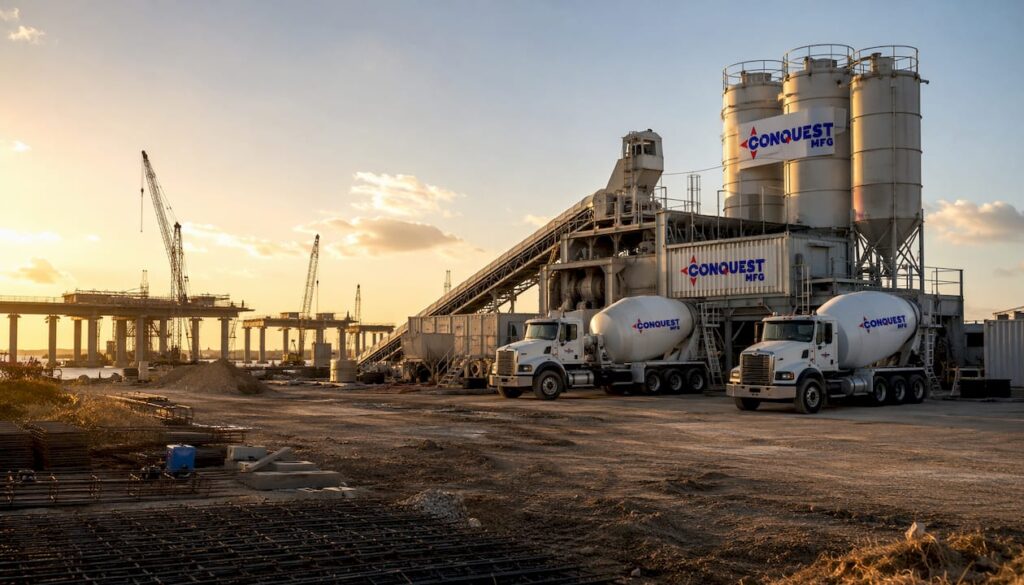
On-site concrete plants are essential for bridge construction when continuous supply, precise mix control, and schedule resilience directly affect structural quality and project cost. No ready-mix truck schedule can match the reliability of batching concrete at the pour face, and for most medium-to-large bridge projects, that gap translates into real dollars and real risk.
Immediate operational reasons to choose an on-site plant:
- Continuous, on-demand supply eliminates delivery windows and keeps crews productive through every shift
- No long-haul delivery risk removes transit-time penalties, load rejection, and the cost of wasted trucks
- Specialty mix control for UHPC, steel fiber, and low-heat mixes that commercial ready-mix plants cannot produce consistently
- Reduced queuing and downtime as mobile plants redeploy with the project rather than waiting on off-site logistics
Conquest Mfg manufactures both mobile and stationary batch plants, along with pig silo trailers and pneumatic trailers, specifically to address these demands on U.S. bridge projects.
Table of Contents
- Why on-site plants are the right call for bridge projects
- How on-site plants improve quality control and support specialized mixes
- What site conditions make on-site plants necessary?
- CAPEX vs. OPEX: how to calculate your break-even point
- Mobile vs. stationary plants: which equipment does your project need?
- How to install and commission an on-site plant correctly
- When on-site plants solved real bridge project problems
- Key Takeaways
- The part most contractors underestimate
- Conquest Mfg supports your next bridge project from spec to pour
- Useful sources and standards for procurement teams
Why on-site plants are the right call for bridge projects
Batch plants centralize precise measurement of cement, aggregates, water, and admixtures, reducing variability and improving both speed and quality. For bridge work, that precision is not optional. Structural specifications for piers, decks, and abutments carry tight compressive strength and durability requirements that a variable supply chain cannot reliably meet.
Supply resilience is the first benefit contractors notice, as detailed by the Flying Chip Factory analysis showing how on-site plants reduce expenses related to transportation, delays, and project downtime. On-site plants eliminate supply chain interruptions and transit delays, enabling continuous concrete supply in remote, high-altitude, or island locations where ready-mix delivery is unreliable or costly. Mobile plants add another layer: they can be redeployed as a project progresses, reducing inefficiencies from small truck-based deliveries and avoiding queuing delays at off-site facilities.
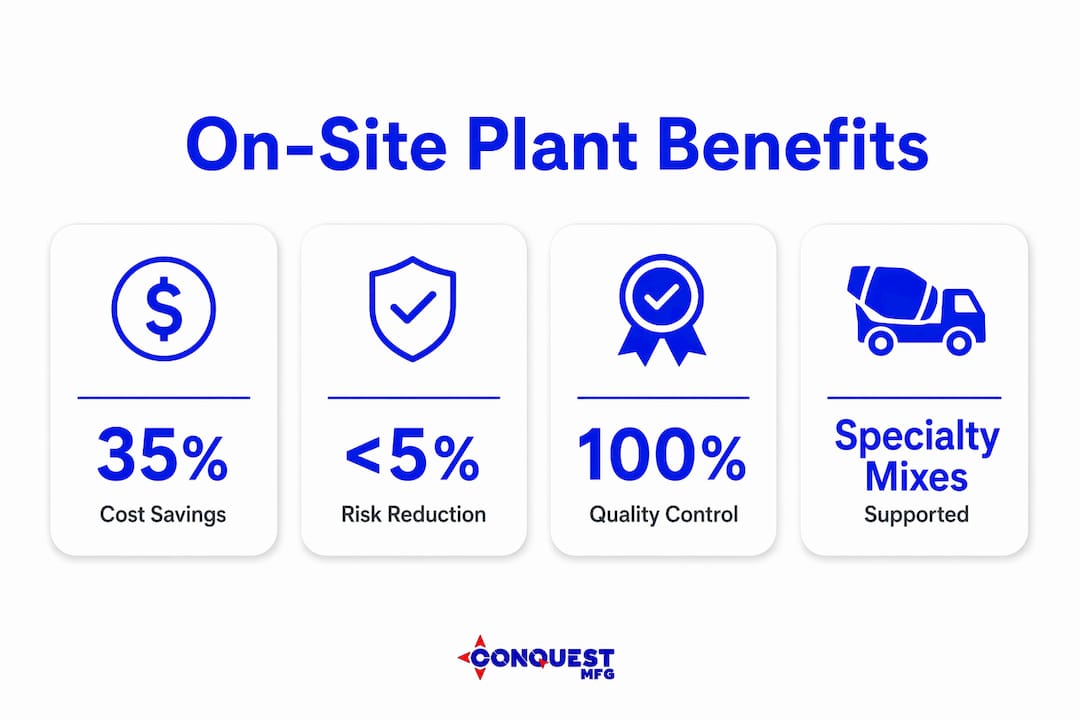
Key savings metric: When project demand exceeds 10,000 m³, on-site batching typically saves 20–30% on material and transportation costs compared with long-distance ready-mix delivery.
The Musi Toll Kayu Agung–Palembang–Betung bridge project study documented a notable cost saving with lower risk levels when self-managed batching replaced ready-mix procurement. That figure accounts for reduced delays, fewer re-pours, and the elimination of transit-time penalties that hide inside ready-mix invoices.
How on-site plants improve quality control and support specialized mixes
Full control from raw material intake through mixing and discharge is what separates on-site batching from off-site supply for high-standard infrastructure. On-site plants allow precise execution of mix ratios suited to bridges, dams, and nuclear structures. Ready-mix cannot guarantee that repeatability for specialty mixes, and for structural durability that gap matters.
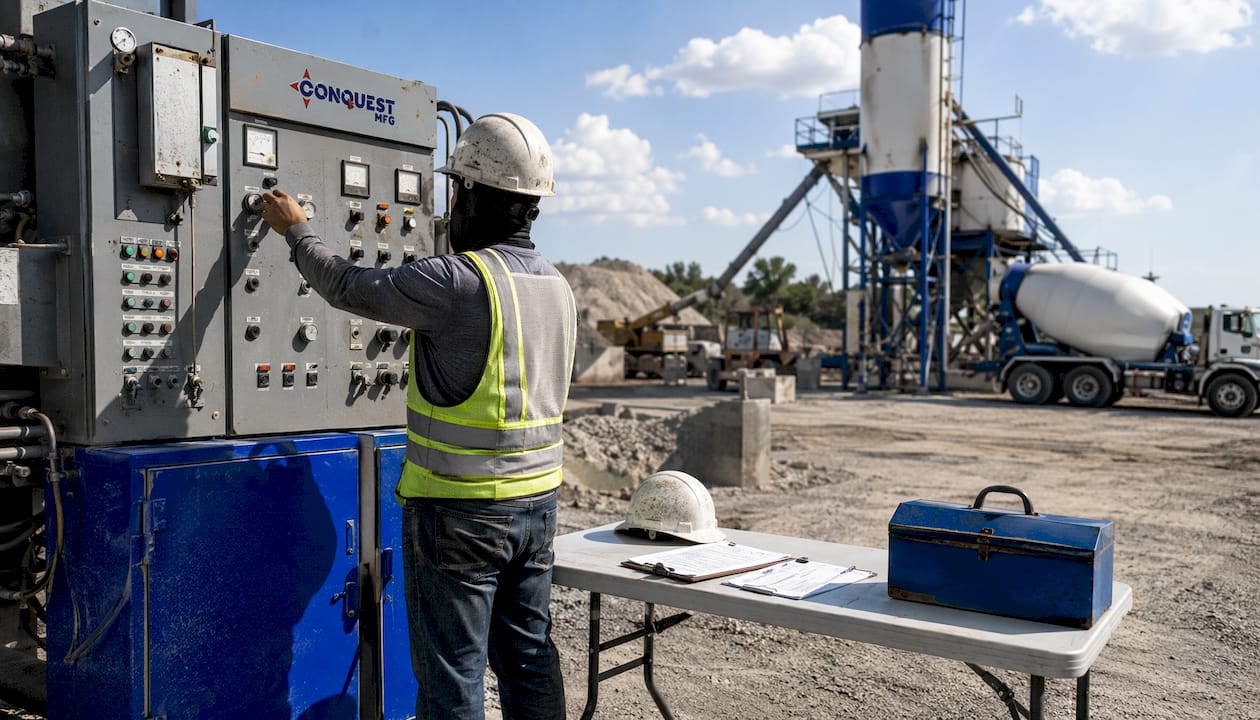
UHPC, steel fiber concrete, and low-heat-of-hydration mixes have tight reaction windows. They demand consistent admixture dosing and temperature control, and they require immediate placement after batching. An off-site plant cannot reliably deliver those conditions across a 30-minute haul.
Pro Tip: Batch specialty mixes in the coolest part of the day when ambient temperatures exceed 85°F. Pre-chill mix water and aggregate stockpiles, and always add admixtures in the sequence specified by the mix design. Temperature deviation of even 10°F can alter set time and early strength gain.
| QC Metric | Test Method | Recommended Frequency |
|---|---|---|
| Slump / flow | ASTM C143 | Every load during critical pours |
| Air content | ASTM C231 | Per project specification |
| Compressive strength | ASTM C39 cylinder | 3 cylinders per 100 m³ |
| Concrete temperature | Thermometer at discharge | Every load |
| Water-to-cement ratio | Calculated from batch records | Every batch |
What site conditions make on-site plants necessary?
Certain site conditions make off-site supply impractical regardless of cost. Remote locations, island spans, high-altitude crossings, and constrained urban staging areas all force the decision toward on-site batching.
- Remote and island sites: No reliable haul route means no reliable ready-mix. An island span requiring self-managed supply is a clear case where on-site batching is the only viable option.
- High-altitude crossings: Long haul times at elevation degrade mix quality before the truck reaches the pour face.
- Narrow urban staging: Compact skip-hoist mobile plants fit tight staging areas where a full ready-mix operation would require road closures.
- Long linear pours: As the pour face advances, a mobile plant redeploys with it rather than extending haul distances.
- Night and shift pours: On-site batching supports any pour window without depending on a supplier’s delivery schedule.
“Mobile on-site plants provide adaptability: they can be redeployed as a bridge project progresses, reducing inefficiencies from small truck-based deliveries and avoiding queuing delays at off-site plants.” — CNBM on-site plant overview
Permitting and haul-route limits also drive the decision. Many U.S. bridge corridors carry weight restrictions or time-of-day truck bans that make frequent ready-mix deliveries legally or logistically impossible. Establishing an on-site plant removes that dependency entirely.
CAPEX vs. OPEX: how to calculate your break-even point
The capital cost of an on-site plant is real, but so are the hidden costs inside ready-mix procurement. Operational costs in ready-mix delivery commonly include queuing penalties, transit-time surcharges, and quality-related rework that rarely appear as line items until the project is over.
| Cost Category | On-Site Plant | Ready-Mix |
|---|---|---|
| CAPEX | Equipment purchase or rental, silo, aggregate handling | None |
| Labor | Plant operator, QC technician | Included in delivery price |
| Fuel and maintenance | Ongoing OPEX | None direct |
| Transport premium | Eliminated | Built into per-m³ price |
| Rework and rejection | Minimized by QC control | Higher exposure |
| Redeployment value | Plant moves with project | No residual value |
Simple break-even framework:
- Establish your total concrete volume (m³) for the project.
- Get a per-m³ ready-mix delivered price including all surcharges.
- Divide total plant cost (purchase or rental plus operating) by the per-m³ savings.
- The result is your break-even volume. Projects above 10,000 m³ typically recover plant costs well within the project timeline.
For medium-to-large bridge projects, payback on a mobile plant often occurs within the first third of the pour schedule. The 15.7% cost saving documented in the Musi Toll study and the 20–30% material and transport savings at high volumes both support a payback timeline measured in weeks, not years, on projects of meaningful scale.
Mobile vs. stationary plants: which equipment does your project need?
Plant selection must match site footprint and staging constraints. Compact skip-hoist mobile plants suit limited staging, while long-duration pours over caissons or extended deck sections require stationary plants with bulk aggregate storage.
| Capability | Mobile / Compact | Stationary |
|---|---|---|
| Footprint | Small, fits tight staging | Larger, needs dedicated pad |
| Output capacity | Low to medium | Medium to high |
| Redeployability | High, moves with project | Fixed for project duration |
| Aggregate storage | Limited | High-capacity bins |
| Typical staffing | 1–2 operators | 2–3 operators |
| Best fit | Short spans, phased pours | Long-duration, high-volume pours |
Essential support equipment checklist:
- Pig silo trailers for bulk cement storage and transfer at the plant
- Pneumatic trailers for dry bulk cement delivery to silos
- Water tanks for mix water supply and curing
- Aggregate conveyors and hoppers sized to plant throughput
- Batching control systems with calibration logging
- Backup generator for uninterrupted operation
Conquest Mfg supplies all of these equipment classes, custom-engineered for U.S. bridge project specifications. Reviewing the stationary vs. mobile plant comparison early in procurement prevents costly equipment mismatches.
How to install and commission an on-site plant correctly
A poor installation costs more than a delayed delivery. Follow this sequence to get your plant producing specification concrete from day one.
- Site preparation: Clear, grade, and compact the plant pad. Confirm load-bearing capacity for silo and plant weight.
- Foundation or foundation-free positioning: Mobile plants typically require a compacted gravel base; stationary plants need a concrete pad per manufacturer specs.
- Aggregate feed setup: Position bins and conveyors to minimize cycle time and prevent contamination between aggregate grades.
- Silo and conveyor alignment: Align cement silos with the weigh hopper and confirm pneumatic transfer connections are sealed and pressure-rated.
- Electrical and water hookups: Verify supply voltage, phase, and amperage match plant requirements. Confirm water supply pressure and flow rate.
- Control calibration: Calibrate all weigh scales against certified test weights. Log calibration records before first batch.
- Dry runs: Run the plant through three to five dry cycles to confirm sequencing, timing, and discharge before any cement is loaded.
Refer to the concrete plant installation guide for a detailed commissioning checklist covering trial batches, QA sample plans, and operator training requirements.
Commissioning checklist items: calibration records signed by a qualified technician, trial batch cylinders tested before production pours, safety equipment inspected and in place, and all operators trained on emergency stop procedures.
Pro Tip: The most common commissioning failure is moisture correction. Aggregate moisture content changes daily. Measure stockpile moisture every morning and update the batch controller before the first pour of each shift. Ignoring this step is the fastest way to produce out-of-spec concrete.
Common troubleshooting issues:
- Inconsistent slump: check aggregate moisture correction and weigh scale calibration
- Slow cycle times: inspect conveyor belt tension and aggregate bin gate operation
- Admixture dosing errors: verify pump calibration and check for air locks in dosing lines
- Silo bridging: confirm aeration pads are functioning and cement is flowing freely
When on-site plants solved real bridge project problems
Island span with no haul route. A long-span crossing over water had no viable road connection for ready-mix trucks. The contractor deployed a mobile batch plant on the island staging area, eliminating ferry logistics entirely. Pour windows were maintained on schedule, and mix consistency met structural spec throughout the deck pour.
Constrained urban replacement. A city bridge replacement in a dense corridor had no room for truck queuing and faced time-of-day delivery restrictions. A compact mobile plant installed within the existing staging footprint removed the delivery dependency. Road closures were avoided, and the project maintained its night-pour schedule without a single rejected load.
Formal cost study: Musi Toll bridge. The Musi Toll Kayu Agung–Palembang–Betung project study compared self-managed batching against ready-mix procurement across the full project. Self-managed batching achieved a notable cost saving and lower risk levels, driven by eliminated transit penalties, reduced rework, and tighter mix control. The study is one of the clearest documented cases for on-site batching on a major bridge project.
Key Takeaways
On-site concrete plants are the decisive choice for bridge projects where volume, site access, or specialty mix requirements make ready-mix delivery unreliable or cost-prohibitive.
| Point | Details |
|---|---|
| Volume threshold for savings | Projects with concrete demand above 10,000 m³ can typically save 20–30% on material and transport costs with on-site batching. |
| Documented cost saving | The Musi Toll bridge study recorded a 15.7% cost saving with self-managed batching vs. ready-mix. |
| Plant selection by site | Mobile plants suit tight staging and phased pours; stationary plants handle long-duration, high-volume work. |
| Specialty mix requirement | UHPC, fiber-reinforced, and low-heat mixes require on-site batching for consistent dosing and immediate placement. |
| Conquest Mfg equipment | Conquest Mfg supplies mobile and stationary batch plants, pig silo trailers, and pneumatic trailers custom-engineered for U.S. bridge projects. |
The part most contractors underestimate
The technical case for on-site batching is well established. What buyers consistently underestimate is the site preparation and staffing side of the equation. A plant that arrives on time but sits on an unprepared pad, or runs without a qualified operator who understands moisture correction, will not deliver the cost savings the numbers promise.
Lead times on custom-engineered plants are real. Waiting until the project is mobilized to specify your plant is the single most common mistake we see. Spec alignment, silo sizing, and aggregate handling configuration need to happen during the bid phase, not after award. Early engagement with Conquest Mfg means your plant arrives configured for your mix design, your site footprint, and your pour schedule, not a generic spec that requires field modifications.
The other underestimated factor is the support equipment chain. A batch plant without a properly sized pig silo trailer and pneumatic transfer system is a bottleneck waiting to happen. Every component in the cement supply chain needs to be sized together.
Conquest Mfg supports your next bridge project from spec to pour
When your project demands reliable concrete supply at the pour face, Conquest Mfg delivers the equipment to make it happen. Our mobile and stationary batch plants are built to U.S. bridge project specifications, with custom engineering available for specialty mix requirements, constrained staging areas, and extended pour schedules.
Conquest Mfg’s product line covers every link in the on-site supply chain: batch plants, pig silo trailers for bulk cement storage, pneumatic trailers for dry bulk transfer, water tanks, and aggregate handling equipment. With over 35 years of engineering expertise, we configure each system to your project’s volume, footprint, and mix design requirements. Request a quote or site-specific engineering consultation through our batch plant procurement guide and get your equipment specified before your project mobilizes.
Useful sources and standards for procurement teams
- Musi Toll bridge cost study: Cost efficiency and risk management of the self-managed batching plant method — primary source for the a notable cost saving and risk comparison data
- On-site plant overview: CNBM on-site concrete batching plant page — source for the 20–30% material and transport savings threshold and specialty mix suitability
- Batch plant industry overview: Adatrad: Importance of Concrete Batch Plants — covers uniformity and production efficiency claims
- U.S. mix testing standards: ASTM C143 (slump), ASTM C231 (air content), and ASTM C39 (compressive strength) — verify current editions at astm.org before specifying test frequencies
- Structural design standards: AASHTO LRFD Bridge Design Specifications — consult the current edition for concrete material requirements applicable to your project class
- Conquest Mfg documentation: Request calibration records, commissioning checklists, and plant test plans from Conquest Mfg during your RFP review to confirm equipment compliance with project specifications