
Industrial material transfer is the controlled movement of bulk solids, powders, slurries, or granular materials from one process point to another using mechanical conveyors (belt, screw, drag/chain), pneumatic conveying (pressure or vacuum; dilute or dense phase), pumps for slurries, gravity chutes, bucket elevators, or mobile pneumatic trailers. Choosing the right method depends on material properties, throughput targets, contamination risk, and US compliance requirements under OSHA, NFPA, and DOT.
Quick method-selection baseline:
- Fixed, high-volume continuous flow → belt, screw, or drag conveyors
- Dry, enclosed, contamination-sensitive materials (cement, grain, flour) → pneumatic conveying systems
- Slurries and liquids → centrifugal or positive-displacement pumps
- Vertical lifts for dense bulk → bucket elevators
- Mobile or remote site offload → pneumatic trailers (DOT-regulated)
- Short drops, gravity-assisted flow → chutes and gravity spouts
Where combustible dust is present, NFPA 652 and NFPA 654 guidance applies from day one. Conquest Mfg, with over 35 years of manufacturing experience, produces specialist equipment across these method classes, including dry bulk pneumatic trailers, concrete batch plants, and vacuum tanks.
Table of Contents
- What are the core industrial material transfer technologies?
- How do material properties determine the right transfer method?
- What design principles reduce cost, downtime, and safety risk?
- What US safety and regulatory requirements apply to material transfer?
- How do you measure performance and what should acceptance testing cover?
- What are the most common failure modes and how do you prevent them?
- How do you scope, specify, and procure a material transfer solution?
- How does material transfer work across key industry use cases?
- What are your immediate next steps from site survey to commissioning?
- Key Takeaways
- The case for getting the specification right the first time
- Conquest Mfg can support your next material transfer project
- Useful sources and further reading
What are the core industrial material transfer technologies?
Efficient material handling covers receiving, storage, transport, and discharge across manufacturing and logistics. Each transfer technology has a defined operating envelope.
| Technology | Typical Best-Fit Materials | Common Failure Modes |
|---|---|---|
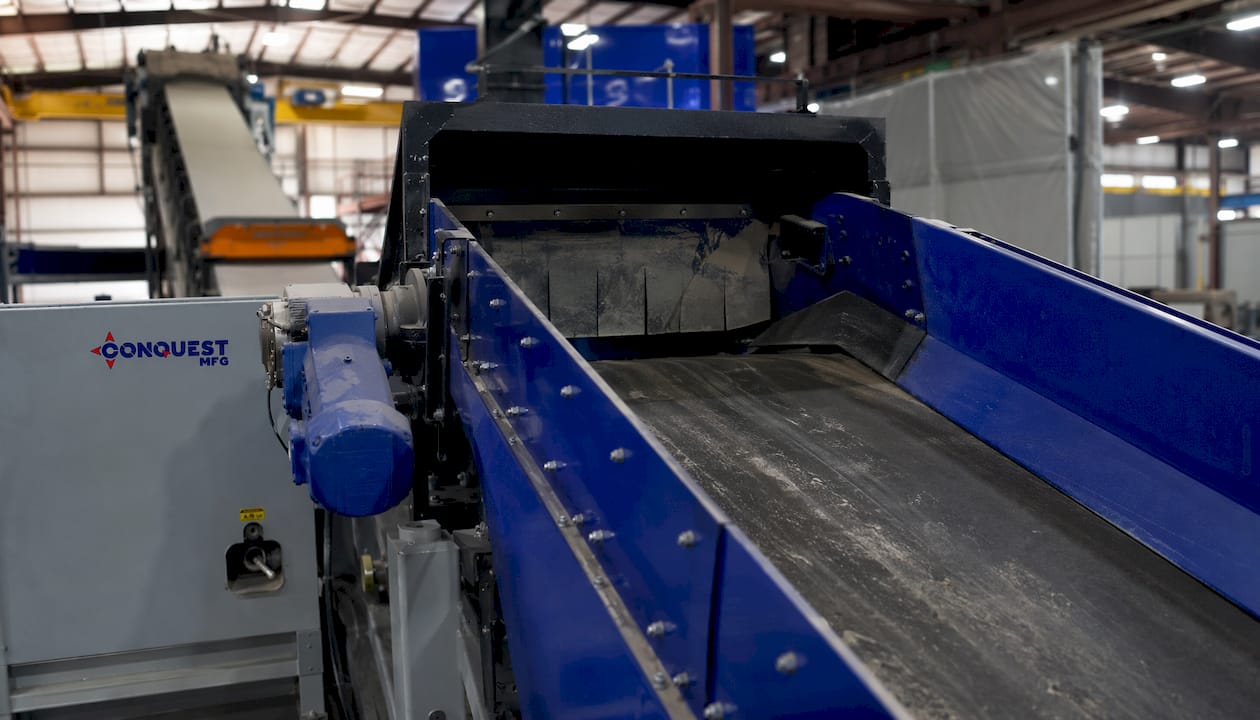
| Belt conveyor | Aggregates, coal, grain | Belt misalignment, spillage, idler wear |
| Screw conveyor | Powders, granules, wet solids | Flights worn, bridging at inlet, seal leaks |
| Drag/chain conveyor | Clinker, ash, heavy granules | Chain stretch, sprocket wear, blockage |
| Bucket elevator | Grain, cement, sand | Belt/chain slip, bucket wear, boot blockage |
| Dilute-phase pneumatic | Light powders, pellets | Pipeline wear, filter blinding, line plugging |
| Dense-phase pneumatic | Abrasive or fragile powders | Pressure surges, valve wear, slug blockages |
| Slurry pump | Wet solids, tailings, drilling mud | Impeller erosion, seal failure, cavitation |
| Gravity chute | Free-flowing granules | Bridging, dust at drop points, abrasion |
| Mobile pneumatic trailer | Dry bulk cement, fly ash, frac sand | Valve seat wear, hose coupling leaks |
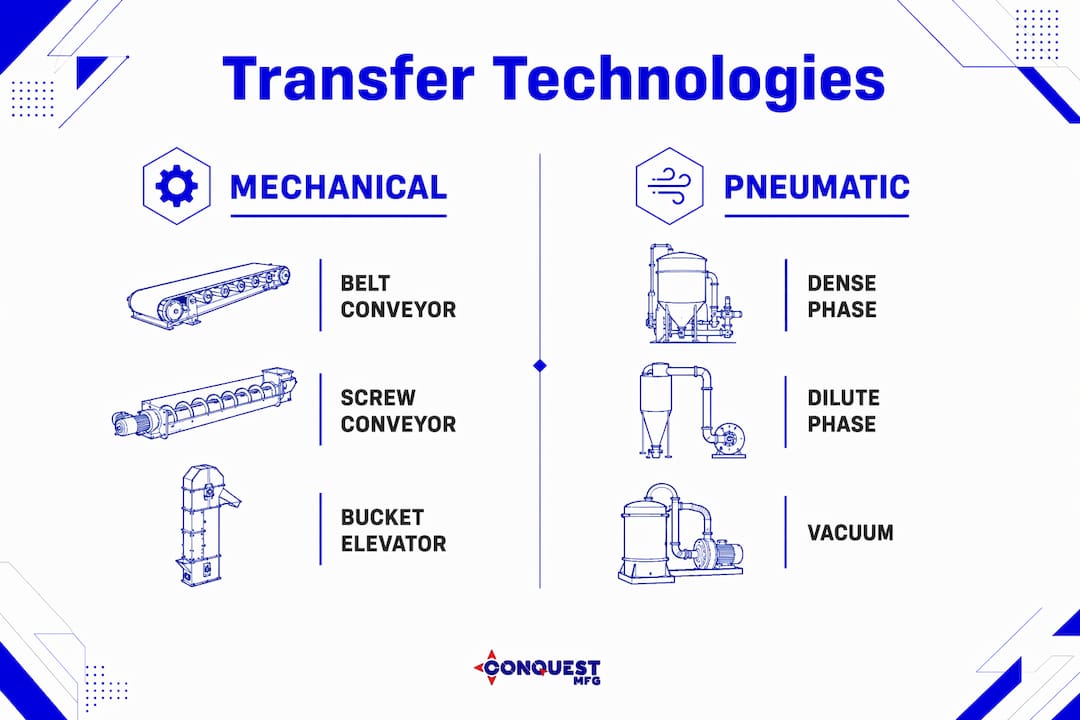
Dilute-phase pneumatic conveying operates at air velocities of 18–35 m/s, which accelerates pipeline wear on abrasive materials. Dense phase drops velocity to 3–10 m/s, reducing wear and protecting fragile particles. Vacuum conveying places the blower at the discharge end, avoiding compression heat and making it the preferred choice for temperature-sensitive or food-grade products.
Short use-case callouts:
- Concrete batch plant: Belt and screw conveyors feed aggregate and cement; bucket elevators lift sand; enclosed transfers control dust at every drop point.
- Oilfield pneumatic offload: Mobile pneumatic trailers discharge dry cement or frac sand directly to silos; DOT and OSHA requirements govern road transport and on-site pressurization.
- Bulk grain/aggregate transport: Long-run belt conveyors for high-volume reclaim; dense-phase pneumatic for enclosed, low-degradation transfer to storage.
How do material properties determine the right transfer method?
Material properties are the first filter in any selection process. Getting this wrong costs more in maintenance and downtime than any upfront equipment savings.
- Particle size distribution: Fine powders (under 100 microns) require enclosed systems to prevent dust emissions; coarse aggregates tolerate open belt conveyors.
- Bulk density: High-density materials (over 80 lb/ft³) demand robust structural support and higher-torque drives.
- Moisture content: Wet or sticky materials bridge in small-diameter pipelines and pack in screw conveyors; heat tracing or pre-drying is often required before pneumatic transfer.
- Abrasiveness: High-abrasion materials (silica sand, frac sand, clinker) accelerate pipe wear in dilute-phase systems; dense phase or mechanical conveyors with wear liners are the correct choice.
- Friability: Fragile pellets or crystals degrade under high-velocity dilute-phase air; dense phase or belt conveyors preserve product integrity.
- Cohesiveness: Cohesive powders with low flow function values bridge in hoppers and rat-hole in silos; mass-flow hopper geometry and flow aids are required.
- Combustibility: Materials with a Kst value above zero require a Combustible Dust Hazard Analysis (CDHA) per NFPA 652 before system design is finalized.
Pro Tip: Before specifying any system, test a representative sample for angle of repose, flow function (using a shear cell tester), and moisture content. These three measurements alone will eliminate at least half the candidate technologies from your shortlist.
What design principles reduce cost, downtime, and safety risk?
Prioritize continuous flow and minimize product touches. Every manual handoff adds labor cost, damage risk, and a potential safety exposure point. Layout designs that use gravity feeds, enclosed transfers, and conveyors in place of manual scooping or forklift moves consistently outperform alternatives on total cost of ownership.
Core design rules:
- Standardize unit loads before automating; automating inconsistent batches creates bottlenecks rather than efficiency gains.
- Size hoppers and bins for mass flow, not funnel flow, to prevent bridging and ratholing.
- Control incline angles and drop heights to limit impact degradation and dust generation.
- Specify PLC/SCADA controls with level sensors, belt scales, rotary airlocks, and sequencing interlocks early in the design phase, not as afterthoughts.
- Use OPC UA or equivalent open integration interfaces when connecting to ERP or MES systems.
Pro Tip: Design access points, inspection doors, and local hoisting points into the structure from day one. Retrofitting maintenance access after fabrication typically costs three to five times more than including it in the original design.
Enclosed transfer points with telescoping spouts, abrasion-resistant liners, and dust collection at every drop point are the most cost-effective way to reduce both wear rates and regulatory exposure. See bulk material handling best practices for additional configuration guidance.
What US safety and regulatory requirements apply to material transfer?
Three regulatory frameworks govern most US industrial material transfer operations: OSHA, NFPA, and DOT.
OSHA 29 CFR 1910.217 (machine guarding) and 29 CFR 1910.147 (lockout/tagout) are non-negotiable for any conveyor or rotating equipment. Confined-space entry procedures under 29 CFR 1910.146 apply to silos, bins, and enclosed hoppers. For transportable pneumatic trailers, DOT 49 CFR governs pressure vessel certification, road transport, and hazardous materials placarding where applicable.
Compliance checklist:
- Machine guarding on all nip points, rotating shafts, and conveyor tail pulleys
- Written LOTO procedures for every piece of transfer equipment
- Confined-space permit program for bins, silos, and enclosed hoppers
- Combustible Dust Hazard Analysis (CDHA) for any material with a Kst above zero
- Dust collection systems sized to maintain airborne concentrations below the Lower Explosive Limit (LEL)
- Explosion venting or suppression per NFPA 68/69 where deflagration risk exists
- DOT pressure certification and annual inspection records for pneumatic trailers
- Operator training records and documented FAT/SAT test results on file
Refer to the industrial equipment safety checklist for a structured compliance walkthrough aligned to these requirements.
How do you measure performance and what should acceptance testing cover?
Define KPIs before issuing an RFQ. Vendors who cannot commit to measurable acceptance criteria during the proposal stage rarely meet them at commissioning.
| KPI | How to Test | Acceptance Criterion |
|---|---|---|
| Throughput (tph or lb/min) | Witness run at design rate for 2 hours | Within ±5% of specified rate |
| Pipeline pressure loss | Pressure taps at inlet, midpoint, outlet | Within design band ±10% |
| Product degradation | Particle size analysis pre/post transfer | Fines generation below specified limit |
| Residual dust/leakage | Ambient air sampling at transfer points | Below OSHA PEL for the material |
| Safety interlock response | Simulated fault injection for each interlock | 100% correct response, logged |
| Instrumentation calibration | Certified calibration of all sensors | Within manufacturer tolerance |
Factory Acceptance Testing (FAT) confirms the system performs to spec in the supplier’s facility before shipment. Site Acceptance Testing (SAT) repeats the critical runs after installation with actual process material. Both generate documented records that support OSHA compliance files and warranty claims. For dry bulk operations, the dry bulk handling process guide provides a practical SAT checklist.
What are the most common failure modes and how do you prevent them?
Abrasion, blockages, and seal failures account for the majority of unplanned downtime in bulk transfer systems. Addressing them proactively is cheaper than reactive repair.
Maintenance checklist by interval:
- Daily walk-around: Check for unusual noise, vibration, belt tracking, dust leaks, and material spillage.
- Weekly: Lubricate bearings per OEM schedule; inspect rotary airlock vanes and seals; check filter differential pressure.
- Monthly: Verify belt/chain alignment; inspect wear liners and replace when below minimum thickness; check VFD cooling fans and heat sink temperatures.
- Annual major inspection: Full bearing replacement on high-cycle components; pipeline thickness measurement (ultrasonic) on pneumatic lines; pressure vessel re-certification for pneumatic trailers per DOT schedule.
High-value spare parts to stock: wear liners, replacement bearings (matched to OEM spec), rotary airlock vane sets, belt splice kits, VFD modules, and hose coupling assemblies for pneumatic trailers. Condition-based monitoring using vibration trending and temperature sensors on critical bearings reduces unplanned failures significantly.
How do you scope, specify, and procure a material transfer solution?
Define objectives and KPIs before soliciting bids. A vague RFQ produces proposals that cannot be compared and commissioning disputes that delay startup.
Vendor questions that matter:
- Is dense or dilute phase appropriate for this material, and what is the expected pipeline wear rate?
- What ancillaries are included: dust collection, rotary valves, pressure relief, instrumentation?
- What is the estimated energy consumption per ton at design throughput?
- What PLC/SCADA platform does the system use, and does it support OPC UA integration?
- Can you provide references for similar material and throughput applications?
Procurement timeline (typical phases):
Site survey (1–2 weeks) → engineering proposal (2–4 weeks) → detailed design (4–8 weeks) → fabrication (8–16 weeks) → FAT (1 week) → delivery and installation (2–4 weeks) → SAT/commissioning (1–2 weeks).
Pro Tip: Request the vendor’s pipeline wear-rate calculation methodology during the proposal stage. A supplier who cannot provide it is likely using dilute phase for a material that warrants dense phase, and you will pay for that decision in liner replacements within 18 months.
How does material transfer work across key industry use cases?
Real-world applications show how the selection principles above translate into specified systems.
- Concrete batch plants: Screw conveyors and bucket elevators move cement and aggregate from storage to weigh hoppers; enclosed belt conveyors handle sand; dust collectors at every transfer point keep PM10 emissions within permit limits. Typical throughput spec: 150–300 tph aggregate, with screw conveyors sized for 50–100 tph cement. See batch plants for concrete production for full configuration guidance.
- Oilfield pneumatic systems: Mobile pneumatic trailers offload dry cement or frac sand to wellsite silos at 20–40 tph; DOT pressure certification and OSHA LOTO procedures apply at every connection point. Conquest Mfg’s pneumatic trailer capabilities cover both steel and aluminum configurations for these applications.
- Bulk dry goods transport: Long-run belt conveyors handle high-volume grain or aggregate reclaim at 500+ tph; dense-phase pneumatic systems transfer flour or fine powders to packaging at 5–20 tph with minimal fines generation.
What are your immediate next steps from site survey to commissioning?
A structured sequence prevents the most common project failures: undefined scope, missing material data, and no agreed acceptance criteria.
Action checklist:
- Document material properties: particle size distribution, bulk density, moisture, abrasiveness, Kst value.
- Collect process KPIs: required throughput, operating hours per day, acceptable downtime budget.
- Run a site material-flow audit: map every transfer point, count manual touches, and identify bottlenecks.
- Define pilot scope: select one transfer leg for a pilot run before committing to full-system fabrication.
- Set FAT/SAT success criteria in writing before issuing the purchase order.
Involve your process engineer, safety lead, and maintenance supervisor from the first planning meeting. These three roles catch the specification gaps that cause commissioning delays.
Pro Tip: During the pilot, measure actual fines generation and energy consumption per ton, not just throughput. Those two numbers will tell you whether the selected technology is right for your material before you build the full system.
Key Takeaways
Selecting the right industrial transfer method by material properties, then designing for minimal product touches and full FAT/SAT documentation, is the most reliable path to operational efficiency and US regulatory compliance.
| Point | Details |
|---|---|
| Match method to material | Abrasive materials need dense-phase pneumatic or mechanical conveyors with wear liners, not dilute-phase systems. |
| Minimize product touches | Every manual handoff adds labor cost, damage risk, and safety exposure; design gravity and enclosed transfers in from the start. |
| Design for maintenance | Build in access points, inspection doors, and spares strategy during engineering, not after fabrication. |
| Require FAT and SAT | Documented acceptance tests at the supplier’s facility and on-site protect against commissioning disputes and support OSHA compliance records. |
| Conquest Mfg equipment | Conquest Mfg manufactures dry bulk pneumatic trailers, concrete batch plants, and vacuum tanks built for US compliance and field reliability. |
The case for getting the specification right the first time
Most material transfer failures are specification failures, not equipment failures. The pattern repeats: a project team selects a technology based on a vendor’s standard offering rather than the material’s actual properties, skips the FAT because the schedule is tight, and then spends the first year of operation chasing blockages, excessive wear, and dust complaints.
The concept-to-commissioning approach that Conquest Mfg recommends is not a sales position. It reflects what 35 years of manufacturing experience confirms: systems designed with material data, maintenance access, and acceptance criteria built in from the start run longer, cost less to operate, and clear regulatory audits without surprises. The engineers who push back on a rushed RFQ and insist on a pilot run before full fabrication are the ones whose projects commission on time.
The overlooked variable is almost always the cumulative cost of touches. A layout that eliminates three manual handoffs per shift does not just save labor. It removes three points where product degrades, dust escapes, and workers are exposed to moving equipment. That math is worth doing before the purchase order is signed.
Conquest Mfg can support your next material transfer project
Conquest Mfg builds the equipment that handles the hardest material transfer problems in US construction, oil and gas, and bulk transport. With over 35 years of engineering experience, the company manufactures dry bulk pneumatic trailers, concrete batch plants, vacuum tanks, bottom dumps, and sand hoppers, all designed for field durability and US regulatory compliance.
If you are scoping a new transfer system or auditing an existing one, Conquest Mfg’s team can help you define the right equipment configuration for your material, throughput, and compliance requirements. Whether you need a mobile pneumatic trailer for oilfield offload or a complete concrete batch plant for a construction project, the starting point is a direct conversation about your site conditions and KPIs. Request a quote or site survey at conquestmfgusa.com.
Useful sources and further reading
The following references support the technical claims and design guidance in this guide:
- Pneumatic conveying selection (dilute vs. dense phase, vacuum systems): Atlas Copco USA, Pneumatic Conveying Systems: Basic Principles — supports Sections 2, 3, and 5.
- Bulk material handling system design, wear, and dust control: ACI Industrial, Bulk Material Handling 101 — supports Sections 2, 4, and 7.
- Material handling principles, unit load, and equipment categories: Modula, What Is Material Handling? — supports Sections 1 and 4.
- Automated material handling and OPC UA integration: KUKA, Automated Material Handling — supports Section 4.
- Unit-load standardization before automation: Wikipedia, Material Handling — supports Section 4.
- Concept-to-commissioning and minimizing product touches: Haskell, Safest and Most Efficient Material-Handling Solutions — supports Sections 4 and 12.
- Efficiency as a data-backed outcome: Magnum Systems, Six Ways to Build an Efficient Integrated Material Handling System — supports Sections 8 and 10.
- Conquest Mfg internal resources: Role of Pneumatics in Oilfield Cement Operations; Oilfield Material Handling Overview — support Sections 9 and 13.