

Misreading a single term in a bulk transport contract can delay a project by days, trigger unexpected demurrage charges, or send the wrong equipment to a job site. Yet most procurement managers working across construction and oil logistics treat terms like “bulk,” “breakbulk,” “transloading,” and “lift obligation” as if they carry the same meaning in every context. They do not. Each industry sector, from aggregate quarries to offshore oil terminals, uses a distinct vocabulary shaped by decades of operational practice. This guide breaks down that vocabulary clearly, so you can specify, negotiate, and manage bulk transport decisions with real precision.
Table of Contents
- Core categories and definitions: Bulk, dry bulk, liquid bulk, and breakbulk
- Operational terminology: Handling methods and event language
- Equipment and loadout language in aggregates and construction logistics
- Oil and fuel bulk transport: Procurement and compliance language
- Maritime and bulk carrier terminology: Discharge and benchmarking language
- Our perspective: Why terminology precision is a competitive advantage, not just a formality
- Conquest Manufacturing: Equipment built to match every term in this guide
- Frequently asked questions
Key Takeaways
| Point | Details |
|---|---|
| Know your cargo type | Understanding bulk, dry bulk, liquid bulk, and breakbulk definitions prevents costly mix-ups. |
| Speak the operational language | Accurate use of terms like transloading and live load avoids handoff confusion and streamlines logistics. |
| Master contract terms | Recognizing contract and fee terms such as demurrage and minimum lift helps control costs and reduce disputes. |
| Apply sector-specific vocabulary | Using the right language for construction, oil, and maritime settings improves negotiation and compliance. |
| Benchmark performance wisely | Citing relevant KPIs enables fair assessment of service providers in global contracts. |
Core categories and definitions: Bulk, dry bulk, liquid bulk, and breakbulk
Every procurement or logistics spec you encounter will use these foundational terms, but the distinctions between them are not always obvious. Getting this right from the start protects you in contracts and during equipment selection.
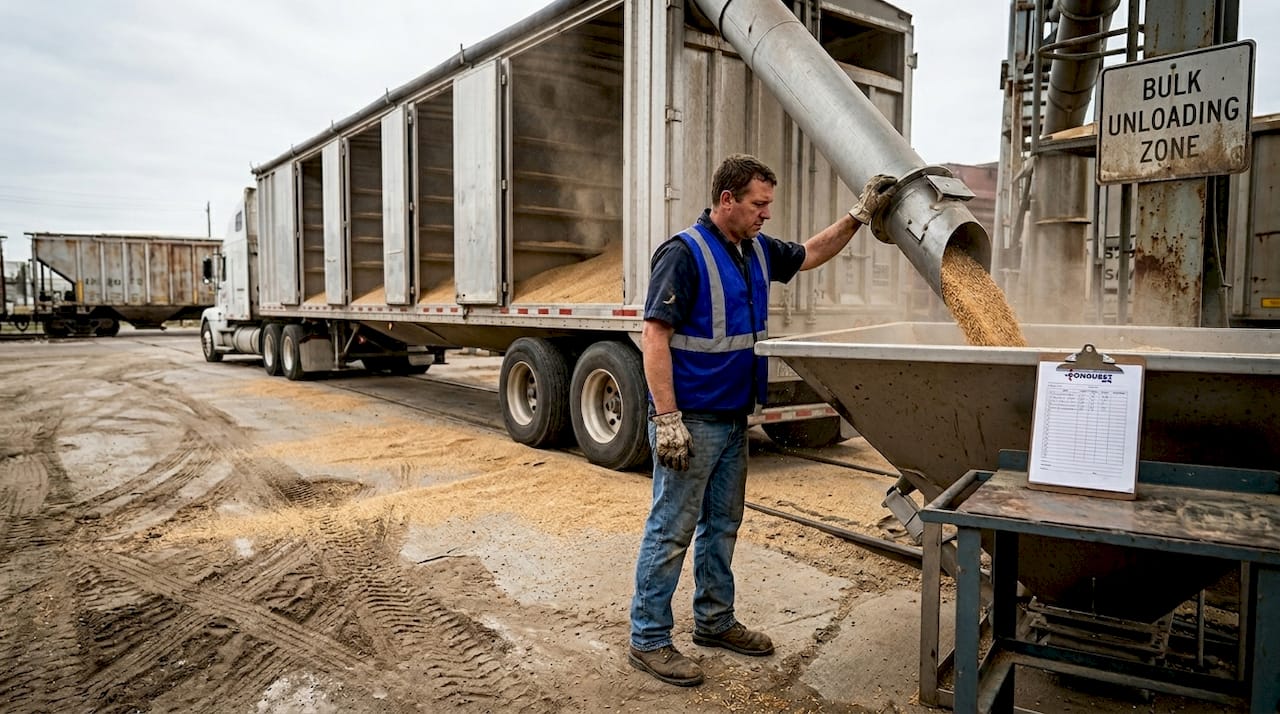
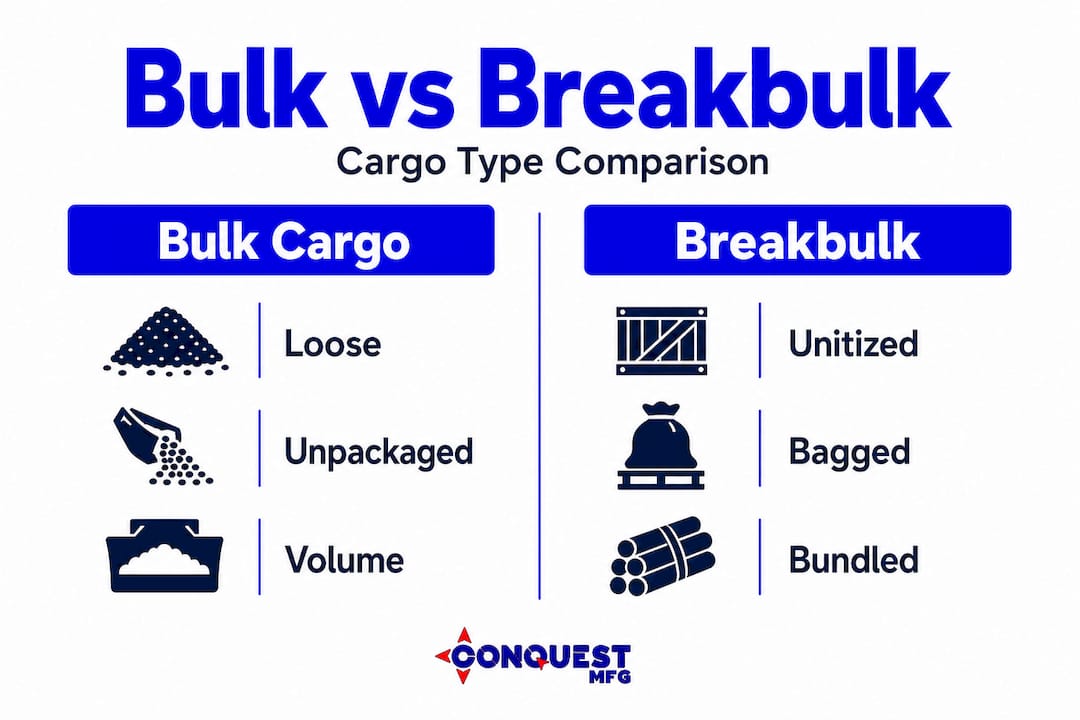
Bulk cargo refers to material that is loaded in loose, unpackaged form directly into a vessel, trailer, or container. The FHWA Freight Glossary defines bulk cargo as cargo that is “unbound as loaded,” citing coal, grain, and petroleum products as primary examples. Liquid bulk cargo is recognized as a distinct subtype, covering fluids like petroleum, water, and liquefied natural gas.
Breakbulk cargo, on the other hand, is unitized. Think bags of cement on pallets, steel pipes bundled together, or drums of lubricant. These items are counted individually and handled piece by piece. The difference between bulk and breakbulk has major implications for how you select carriers, price contracts, and manage loading times.
Here is a quick reference to keep the primary categories straight:
| Category | Form | Common examples | Key equipment |
|---|---|---|---|
| Dry bulk | Loose solid | Aggregates, grain, cement, coal | Pneumatic trailers, bottom dumps, end dumps |
| Liquid bulk | Loose liquid | Petroleum, LNG, water | Vacuum tanks, tanker trailers |
| Breakbulk | Unitized/packaged | Bags, drums, pallets | Flatbeds, standard containers |
| Ro-Ro | Self-propelled units | Vehicles, machinery | Ramps, specialized vessels |
“The single most common contract error we see is using ‘cargo’ as a catch-all when the spec actually requires ‘dry bulk’ or ‘liquid bulk’ precision. That gap creates real liability.”
Understanding bulk transport equipment efficiency starts with knowing which cargo category you are actually moving. A pneumatic trailer is built for dry bulk. A vacuum tank handles liquid bulk. Specifying the wrong category at the procurement stage means the wrong asset arrives at your site.
Key distinctions to carry into every procurement decision:
- Dry bulk includes aggregates like crushed stone, sand, and gravel, as well as powders like cement and fly ash. These move by pneumatic trailers, bottom dump trailers, or end dumps.
- Liquid bulk covers any pumpable liquid product, most commonly petroleum-based fuels, refined chemicals, and water. These require sealed tanks with pressure or vacuum capability.
- Breakbulk is the outlier. If material has been packaged, bagged, or unitized before loading, it is no longer bulk cargo, regardless of volume.
Operational terminology: Handling methods and event language
Once you have the broad categories, the next hurdle is communication at terminals and during transport operations. The following terms appear in quotes, procurement specs, and handoff instructions across construction and oil logistics. Misunderstanding any one of them can create confusion about who owns a task, a cost, or a risk.
The FHWA Freight Glossary confirms that mode-neutral bulk transport operations regularly reference transloading, drop and live load events, and owner-operator relationships when specifying how equipment and cargo are handled at terminals and transfer points.
Here is what each term actually means on the ground:
- Transloading is the process of transferring cargo from one transport mode to another at an intermediate facility. For example, bulk cement arriving by rail is transloaded into pneumatic trailers for final delivery to a batch plant. Transloading adds handling time and cost, but it is often necessary when direct delivery is not possible or efficient.
- Drop (also called a drop-and-hook) means the driver leaves a loaded or empty trailer at a facility without waiting for it to be unloaded or reloaded. The receiving facility handles the rest on their own schedule.
- Live load/live unload means the driver waits on site while loading or unloading occurs. This is standard at many aggregate quarries and oil terminals, but it affects driver hours-of-service compliance and increases dwell time costs.
- Owner-operator refers to an independent driver who owns and operates their own equipment under contract. In bulk transport, this distinction matters because responsibility for equipment maintenance, compliance, and sometimes insurance falls on the individual, not a carrier fleet.
Common misunderstandings in construction settings include assuming a drop trailer service is available when the terminal only supports live unloading, which leads to unexpected driver wait time and detention charges. In oil logistics, confusing transloading with direct delivery can result in mispricingcontract quotes by a meaningful margin.
Pro Tip: Always clarify operational responsibility at every handoff point before signing a transport agreement. Specifically ask whether a terminal operates on live load or drop procedures, and confirm whether owner-operators carry adequate insurance for your cargo value. One overlooked detail here can shift liability directly onto your operation.
Reviewing transportation industry terms in context with your specific equipment and site requirements is a practical first step before drafting any bulk transport specification.
Equipment and loadout language in aggregates and construction logistics
Building on operational vocabulary, specialized terms appear as soon as you engage with aggregate or construction workflow. The language here is precise because it maps directly to physical steps in the supply chain.
According to the Pit & Quarry Glossary, “loadout” in aggregates refers to the complete process of moving material from stockpiles into trucks or trailers, including weighing and ticketing. Additional terms in active use include distribution, feed hopper, IPCC (in-pit crushing and conveying), overland conveyor, slurry transport, and dump trailer tipping procedures.
Here is a breakdown of the most critical equipment and process terms:
| Term | Definition | Context |
|---|---|---|
| Loadout | Transfer from stockpile to transport unit, including weighing and ticketing | Quarry to site delivery |
| Feed hopper | Receiving structure that accepts aggregate from a loader or conveyor | At batch plants and transfer stations |
| IPCC | In-pit crushing and conveying system eliminating haul trucks within the pit | Large quarries, open-pit mining |
| Overland conveyor | Long-distance belt conveyor moving material between site locations | Mine to port, quarry to plant |
| Slurry | Mixture of aggregate or cement with water for pipeline transport | Cement, concrete, and mining operations |
The aggregate loadout process follows a consistent sequence that every logistics manager should be able to walk through:
- Loader or conveyor feeds the stockpile material into the loadout structure or directly into the trailer.
- The trailer positions on the scale for a tare weight measurement before loading begins.
- Material is loaded to the specified net weight, with operators monitoring for legal axle load limits.
- A load ticket is generated with gross weight, tare weight, net weight, material type, and destination.
- The driver reviews and signs the ticket, which serves as the primary document for billing and compliance.
- The trailer departs and the ticket data enters the inventory management system.
Understanding bulk cement loadout procedures specifically adds another layer of precision when you are managing cement supply chains with pig silo trailers or pneumatic systems.
Pro Tip: Documentation at the loadout stage is not just a compliance formality. Discrepancies between tickets and delivery receipts are one of the top causes of billing disputes and inventory shrinkage on large construction projects. Require electronic ticketing that integrates with your project management system wherever possible.
For a broader look at how construction bulk movement equipment is specified and deployed, matching the right trailer type to your material type and site conditions will always deliver better results than defaulting to the cheapest available option.
Oil and fuel bulk transport: Procurement and compliance language
With physical equipment and processes defined, success in oil logistics relies on navigating contract and compliance language. The terms below appear in nearly every fuel procurement contract and bulk terminal agreement. Understanding them prevents costly disputes.
Robinson Coker Refinery fuel sales terms confirm that oil and fuel procurement contracts regularly include commercial delivery terms like FOB and CIF, as well as operational charge concepts like demurrage and minimum lift obligations. These terms define risk transfer, delivery responsibility, and volume commitment in precise ways.
Key contract terms to know:
- FOB (Free on Board) means the seller’s responsibility ends when the cargo is loaded onto the transport vessel or trailer at the named point. From that moment, the buyer bears all risk and cost. In oil logistics, knowing the FOB point tells you exactly when your liability begins.
- CIF (Cost, Insurance, Freight) means the seller covers cost, insurance, and freight to the named destination port or terminal. The buyer takes risk at the destination. CIF contracts reduce your up-front logistics burden but typically price in a premium.
- Demurrage is the fee charged when a vessel, tank car, or tanker trailer is held beyond the contracted loading or unloading time. In high-volume oil operations, demurrage can accumulate rapidly. Even a few hours of delay at a busy terminal can generate thousands of dollars in charges.
- Lift / minimum lift obligation refers to the contractual requirement for a buyer to take delivery of a specified minimum volume of product within a contract period. Falling short of the minimum lift triggers penalty provisions or price adjustments.
Sample contract clause: “Demurrage shall accrue at the rate of [USD amount] per hour for all time in excess of the laytime allowed. Buyer shall lift a minimum of [volume] barrels per contract month. Failure to meet the minimum lift obligation shall trigger the volume deficiency fee specified in Schedule B.”
The OPIS Glossary also draws an important distinction between a bulk station (a facility that stores and distributes refined petroleum products primarily by truck to a local market) and a bulk terminal (a large-scale storage and distribution hub connected to pipelines, rail, or marine vessels). Your procurement strategy changes significantly depending on whether your supply source is a local bulk station or a major terminal.
For a detailed view of oil equipment terms and how specialized trailers and tanks are specified for oil industry applications, matching procurement language to the right physical asset class is where planning pays off.
Maritime and bulk carrier terminology: Discharge and benchmarking language
Expanding beyond land-based logistics, seaborne bulk transport introduces its own language for vessel handling and performance assessment. If you are importing aggregates, coal, or other dry bulk commodities, or managing fuel imports, this vocabulary belongs in your working knowledge.
BulkersGuide maintains a detailed glossary of bulk carrier and shipping terminology, covering operational concepts that procurement teams need when engaging with vessel operators or drafting import contracts.
Essential maritime bulk terms:
- CSU (Continuous Ship Unloader) is a mechanical discharge system that operates continuously rather than using grab cranes or conveyor sequences. CSU technology dramatically increases unloading rates at major terminals and reduces vessel turnaround time.
- BWMS (Ballast Water Management System) and BWTS (Ballast Water Treatment System) are regulatory compliance systems required under international maritime law. When negotiating charter agreements, vessel BWMS certification status affects which ports the vessel can call at.
- BWRB (Ballast Water Record Book) is the onboard compliance log for ballast water operations. Port state control inspectors review the BWRB during inspections.
- BRM (Bridge Resource Management) refers to the structured approach to managing the bridge team on a vessel, covering communication protocols and decision-making under stress. BRM certification status can affect your assessment of a carrier’s safety record.
The INTERCARGO Benchmarking Report 2024-2025 provides empirical data on bulk carrier performance metrics, including Detention Rates (DTR) and Deficiencies per Inspection (DPI). These KPIs matter when you are comparing bulk carriers or evaluating service levels in an import contract.
Key performance benchmarks to track:
- DTR (Detention Rate) measures the percentage of port state control inspections that resulted in vessel detention. A lower DTR signals stronger compliance performance.
- DPI (Deficiencies per Inspection) tracks the average number of regulatory deficiencies identified per inspection event. Industry benchmarks from INTERCARGO allow you to compare a specific carrier against fleet-wide averages.
- Laytime and dispatch are the contractual time windows for loading and unloading. Completing operations ahead of schedule earns dispatch money. Overrunning triggers demurrage, consistent with the oil contract language covered earlier.
Our perspective: Why terminology precision is a competitive advantage, not just a formality
Most logistics managers treat industry terminology as background knowledge, something to check when confusion arises rather than a tool to apply proactively. We believe that is a mistake worth correcting.
Terminology precision gives you leverage. When you walk into a negotiation knowing the difference between FOB and CIF risk points, you can push back on pricing with authority. When you specify “live load” versus “drop” in your transport contracts, you eliminate the dwell-time surprises that quietly inflate your logistics costs quarter after quarter. When you can cite DTR and DPI benchmarks during carrier evaluation, you signal to vendors that performance will be measured, not assumed.
We have seen procurement teams lose significant value not through bad strategy but through imprecise language. A spec that says “bulk delivery” without distinguishing dry versus liquid bulk creates the conditions for the wrong equipment to show up. A contract that omits minimum lift definitions leaves both buyer and seller arguing about intent rather than terms. These are not rare edge cases. They are common outcomes of assuming shared understanding where none actually exists.
The construction and oil industries move fast, and vocabulary gaps compound under time pressure. Building your terminology fluency now, before the pressure hits, is the most practical form of risk management available to you.
Conquest Manufacturing: Equipment built to match every term in this guide
Every term covered in this guide points to a real piece of equipment, a real process step, or a real contract obligation. At Conquest Manufacturing, we build the specialized trailers and bulk handling equipment that connect terminology to performance on the ground.

From dry bulk pneumatic trailers and portable cement pig silo trailers to steel and aluminum vacuum tanks, bottom dumps, end dumps, sand hoppers, and intermodal chassis, our equipment is custom-built for the construction and oil industries across the United States. We also manufacture equipment tailored for oil field operations and portable video surveillance solutions for remote sites. When your procurement specs call for a specific equipment class, we are ready to match your requirement precisely. Contact us to discuss your project needs and get a quote tailored to your operation.
Frequently asked questions
What is the difference between bulk and breakbulk cargo?
Bulk cargo is loose, unpackaged material moved in volume, while breakbulk is counted, unitized items such as bags or drums that are handled individually.
Why does demurrage impact bulk transport costs?
Demurrage charges apply when loading or unloading exceeds the contractually allowed time, and those fees accumulate by the hour in high-throughput oil and fuel operations.
How does transloading differ from direct delivery?
Transloading involves transferring cargo between transport modes at an intermediate terminal, while direct delivery moves cargo from origin to destination using a single mode throughout.
What is a minimum lift obligation in oil procurement?
A minimum lift obligation requires the buyer to take delivery of a contractually specified minimum volume within a set period, with penalties applying if that volume is not met.
Which KPIs are most useful for benchmarking bulk shipping performance?
Detention Rates and Deficiencies per Inspection are the leading KPIs for comparing dry bulk carrier compliance and service performance against industry benchmarks.