
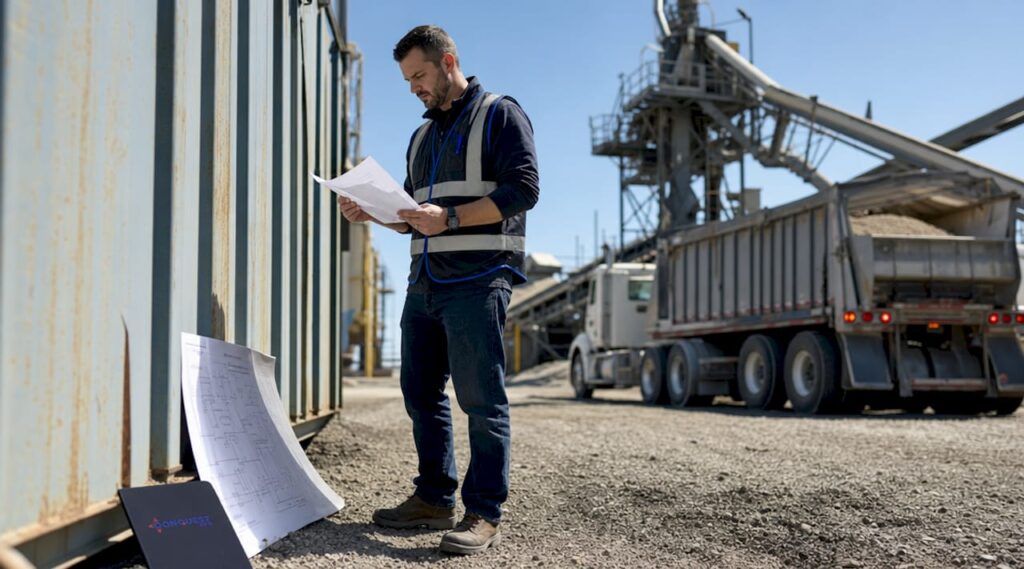
The dry bulk handling process is defined as the systematic movement, storage, and transfer of unpackaged granular or powdered materials, including cement, grain, fertilizer, and sand, through purpose-built equipment and automated workflows. In 2026, this process is shaped by AI-enabled analytics, material-specific engineering, and integrated transport management systems (TMS) that replace manual workflows with data-driven precision. The bulk material handling market was valued at $28.7 billion in 2025 and is projected to reach $41.9 billion by 2036, reflecting sustained investment across every stage of the supply chain. For logistics and operations professionals, understanding where the technology stands today is the prerequisite for making sound equipment and process decisions.
What equipment and technologies define the dry bulk handling process in 2026?
The modern dry bulk handling process runs on a combination of smart conveyors, automated guided vehicles (AGVs), robotic transfer arms, and sensor networks that monitor material flow in real time. The smart bulk material handling market is projected to grow from $10.27 billion in 2025 to $10.97 billion in 2026, driven by AI-enabled analytics and accelerating automation adoption. That 6.8% annual growth rate signals that the industry is not experimenting with these technologies. It is committing to them at scale.

Conveying systems alone account for approximately 38% of market share within bulk material handling equipment, with smart conveyor networks leading adoption. These systems use embedded sensors to adjust belt speed, detect misalignment, and flag blockages before they cause downtime. The practical result is fewer unplanned stoppages and lower labor costs per ton moved.
Key equipment categories and their primary functions in 2026 include:
- Smart conveyors: Adjust speed and tension automatically based on load sensors and material flow data
- Automated guided vehicles (AGVs): Move bulk containers within terminals without human operators, reducing labor exposure in hazardous zones
- Robotic transfer arms: Handle precise loading and unloading at transfer points where material spillage is costly
- IoT sensor arrays: Monitor bearing temperature, motor vibration, belt misalignment, chute blockage, and dust concentration continuously
- Edge computing controllers: Process sensor data locally to trigger real-time responses without relying on cloud latency
| Equipment Type | Primary Function | 2026 Advancement |
|---|---|---|
| Smart conveyors | Material transport and flow control | AI-adjusted speed and predictive belt monitoring |
| AGVs | Autonomous terminal movement | Obstacle detection and route optimization |
| Sensor arrays | Real-time condition monitoring | Predictive maintenance triggers |
| Edge computing units | Local data processing | Sub-second response to flow anomalies |
| Pneumatic trailers | Bulk material road transport | Precision discharge control and load tracking |
Critically, automation success depends on selecting equipment engineered for specific dry bulk materials rather than deploying generic robotic solutions. A system designed for cement behaves differently than one built for grain or potash. Equipment customization based on material characteristics produces fewer disruptions and measurably better throughput.
Pro Tip: When evaluating smart conveyor systems, request performance data from installations handling materials with similar bulk density and moisture content to your own. Generic benchmarks from different material categories will mislead your ROI projections.
How are material properties analyzed for efficient bulk handling system design?
Effective bulk handling system design begins with measuring the physical properties of the material before specifying any equipment. The Flow First engineering philosophy developed by Jenike & Johanson treats material characterization as the foundation of every handling system, not an afterthought. This approach requires testing cohesive strength, wall friction, compressibility, and bulk density under the actual temperature and humidity conditions the material will experience in operation.
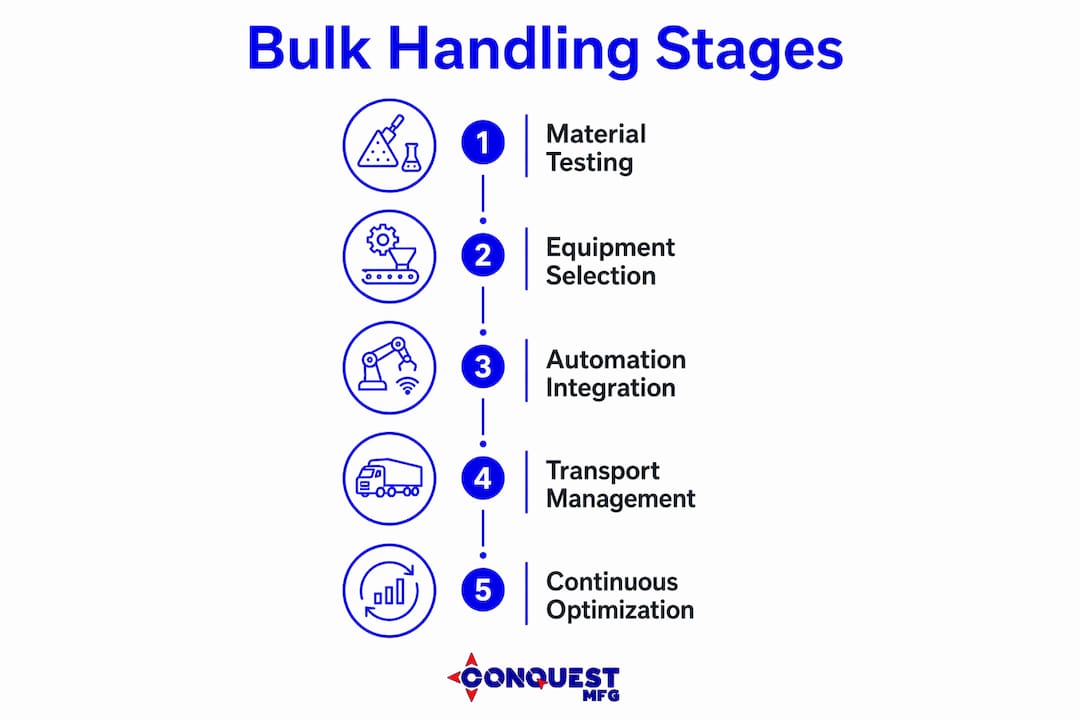
Skipping this step is the most common and costly mistake in bulk handling system design. Designing storage hoppers and transfer chutes without material-specific flow testing leads to chronic problems including arching, ratholing, inconsistent discharge rates, and excessive dust generation. These are not minor inconveniences. They translate directly into unplanned downtime, product loss, and safety incidents.
The properties that require measurement before system design include:
- Cohesive strength: Determines minimum outlet dimensions to prevent arching
- Wall friction angle: Governs hopper slope angles and liner material selection
- Bulk density at various compaction levels: Affects structural load calculations and feeder sizing
- Permeability and air retention: Critical for fine powders like cement and fly ash that aerate during discharge
- Moisture sensitivity: Identifies how material flow properties change with humidity or temperature shifts
Engineering adjustments based on this data are specific and measurable. A fertilizer with high wall friction may require a steeper hopper angle and a polished stainless steel liner rather than carbon steel. A cement silo designed without permeability testing will experience flooding discharge or complete flow stoppage depending on ambient conditions. Both outcomes are preventable when the data drives the design.
For operations professionals managing multiple material types across the same terminal, the material property database becomes a living document. Properties shift with supplier changes, seasonal humidity, and storage duration. Updating test data annually prevents gradual performance degradation from going undetected.
Pro Tip: Test your material at the highest expected moisture content, not just at standard conditions. Moisture is the single most common cause of flow property changes in fertilizers, grains, and mineral powders. A system that performs well at 2% moisture may fail completely at 6%.
What does the integration roadmap for bulk terminal automation look like?
Terminal operators in 2026 adopt a three-stage automation roadmap structured around stabilize, optimize, and autonomize. This phased approach spans 18 to 30 months and is specifically designed to introduce automation without halting daily bulk handling operations. The logic is straightforward: a terminal that shuts down for a full system overhaul loses revenue that no efficiency gain can recover quickly enough.
The three stages work as follows:
-
Stabilize (Months 1 to 8): Install sensor networks on existing equipment to establish baseline performance data. Critical sensors monitor bearing temperature, motor vibration, belt misalignment, chute blockage, and dust concentration. No operational changes are made at this stage. The goal is data collection and system mapping.
-
Optimize (Months 9 to 20): Use collected data to identify bottlenecks, adjust equipment parameters, and introduce edge computing controllers that automate responses to common fault conditions. Predictive maintenance schedules replace time-based maintenance, reducing unnecessary part replacements and unplanned failures.
-
Autonomize (Months 21 to 30): Integrate AGVs, automated loading systems, and business-level optimization software that connects terminal operations to supply chain planning. This stage requires the most capital investment and carries the highest operational risk, which is why it comes last.
| Stage | Timeline | Primary Objective | Key Technology |
|---|---|---|---|
| Stabilize | Months 1 to 8 | Baseline data collection | Sensor arrays, data logging |
| Optimize | Months 9 to 20 | Bottleneck elimination | Edge computing, predictive maintenance |
| Autonomize | Months 21 to 30 | Full workflow automation | AGVs, AI optimization software |
Phased terminal automation projects use 3 to 10 day planned shutdown windows to install sensors and integrate control systems. This approach preserves operational continuity while incrementally improving safety, energy efficiency, and throughput. Legacy infrastructure is the primary constraint. Older conveyor drives, analog control panels, and non-networked equipment require retrofit kits or replacement before they can participate in a digital control architecture. Budgeting for legacy system integration in Stage 1 prevents costly surprises in Stage 3.
For operations teams managing aggregate plant workflows, this roadmap applies directly to batching, transfer, and loading sequences where manual intervention currently creates throughput variability.
How do Transport Management Systems enhance dry bulk logistics workflows?
A Transport Management System (TMS) built for dry bulk logistics replaces paper dockets, manual dispatch boards, and spreadsheet billing with a single integrated platform. Dry bulk TMS platforms in 2026 automate weighbridge integration, driver communication, and invoice generation, which reduces billing disputes and improves cash flow in high-volume, margin-thin operations. The shift from paper to digital is not incremental. It eliminates entire categories of administrative error.
The operational benefits of a purpose-built dry bulk TMS include:
- Automated dispatch: Assigns loads to drivers based on vehicle capacity, location, and material certification without manual coordination
- Weighbridge integration: Captures tare and gross weights electronically, eliminating transcription errors that cause invoice disputes
- Contract-validated invoicing: Generates invoices against pre-loaded contract rates, so billing reflects agreed terms automatically
- Live GPS tracking: Provides real-time fleet visibility for dispatch teams and customers, reducing inbound inquiry calls
- Route optimization: Calculates the most efficient delivery sequence based on load weight, road restrictions, and delivery windows
Integrated TMS platforms provide live GPS tracking and contract-validated invoices that create measurable efficiency and reduce errors in bulk transport. For operations managing pneumatic trailer fleets, TMS integration adds discharge confirmation and load documentation to the data stream, giving dispatch teams complete visibility from loading to delivery.
The freight procurement layer adds another dimension. Dry bulk freight systems require features like bid isolation and charter party-specific data fields to manage freight costs accurately. Generic TMS platforms built for parcel or LTL freight lack these fields, which forces workarounds that reintroduce the manual errors the system was meant to eliminate.
Pro Tip: When evaluating TMS platforms for dry bulk operations, verify that the system supports material-specific load limits, axle weight compliance by state, and multi-compartment load tracking. These are non-negotiable for cement, sand, and aggregate transport in the U.S. market.
Key takeaways
The dry bulk handling process in 2026 requires material-specific engineering, phased automation, and integrated TMS to deliver consistent throughput and cost control.
| Point | Details |
|---|---|
| Material testing drives design | Measure cohesive strength, wall friction, and moisture sensitivity before specifying any equipment. |
| Automation follows a three-stage roadmap | Stabilize, optimize, and autonomize over 18 to 30 months to protect operational continuity. |
| Smart conveyors lead equipment adoption | Conveying systems hold 38% of market share, with AI-adjusted speed and predictive monitoring as standard features. |
| TMS eliminates manual billing errors | Weighbridge integration and contract-validated invoices remove the most common source of billing disputes. |
| Equipment must match material properties | Generic automation solutions underperform. Purpose-built equipment for specific bulk materials produces better throughput and fewer failures. |
What I’ve learned about getting dry bulk automation right
Having worked closely with operations teams across cement, aggregate, and fertilizer handling, the pattern I see most often is this: facilities invest in automation technology before they understand their own material behavior. A terminal installs a new smart conveyor network, then discovers six months later that the material’s moisture sensitivity causes sensor false positives that trigger unnecessary shutdowns. The technology was not wrong. The sequence was.
The Flow First philosophy is not a niche academic concept. It is the most practical framework I have encountered for preventing expensive rework. When you measure your material under real operating conditions before you specify equipment, you eliminate the guesswork that causes chronic handling problems. The facilities that skip this step spend years adjusting equipment that was never designed for their actual material.
On the automation roadmap, I would push back on the instinct to accelerate Stage 3. The autonomize phase is where most projects stall or fail, and almost always because Stage 1 data collection was rushed. Sensors installed during a compressed stabilize phase produce incomplete baselines. When you try to optimize against incomplete data, you optimize for the wrong conditions. The 18 to 30 month timeline exists for a reason. Respecting it is not slow. It is disciplined.
The TMS conversation is where I see the clearest gap between what operations teams think they need and what actually solves their problems. Most teams focus on GPS tracking as the primary TMS benefit. Live tracking matters, but the real value is in automated billing and weighbridge integration. Billing disputes consume more management time than any other administrative function in bulk transport. A TMS that eliminates those disputes pays for itself faster than any other technology investment in this category.
For 2026, the professionals who will lead their operations are the ones who treat material engineering, automation planning, and logistics digitization as connected disciplines rather than separate projects. The bulk transport terminology and equipment decisions you make this year will define your operational baseline for the next decade.
— Peter
Equipment built for the demands of bulk handling in 2026
Conquestmfgusa designs and manufactures equipment specifically for the dry bulk handling and transport requirements that logistics and operations professionals face every day. From dry bulk pneumatic trailers and portable cement pig silo trailers to stationary and mobile concrete batch plants, every product is built to perform under the material-specific and operational demands described in this guide.
Whether you are upgrading a terminal’s transport fleet or specifying batch plant equipment for a new aggregate operation, Conquestmfgusa’s product line covers the full workflow. Explore the construction industry equipment range to find trailers, hoppers, and batch plant solutions matched to your operational requirements. For teams integrating batch production with bulk transport, the batch plant guide for 2026 provides detailed specifications and configuration options. Contact Conquestmfgusa directly to discuss equipment tailored to your exact material handling needs.
FAQ
What is the dry bulk handling process?
The dry bulk handling process is the systematic movement, storage, and transfer of unpackaged granular or powdered materials through purpose-built equipment including conveyors, hoppers, silos, and transport vehicles. In 2026, the process integrates AI-enabled sensors, automated guided vehicles, and TMS platforms to manage material flow from origin to delivery.
Why does material testing matter before designing a bulk handling system?
Designing hoppers and transfer chutes without material-specific flow testing causes chronic problems including arching, ratholing, and inconsistent discharge. The Flow First approach requires measuring cohesive strength, wall friction, and moisture sensitivity under actual operating conditions before any equipment is specified.
What are the three stages of bulk terminal automation in 2026?
Terminal operators follow a stabilize, optimize, and autonomize roadmap spanning 18 to 30 months. Each stage builds on the previous one, using short planned shutdown windows of 3 to 10 days to install sensors and integrate control systems without halting operations.
How does a TMS improve dry bulk transport workflows?
A purpose-built TMS automates weighbridge integration, dispatch assignment, route optimization, and contract-validated invoice generation. This eliminates manual billing errors, reduces disputes, and gives dispatch teams real-time fleet visibility across all active loads.
What equipment does Conquestmfgusa manufacture for dry bulk operations?
Conquestmfgusa manufactures dry bulk pneumatic trailers, portable cement pig silo trailers, steel and aluminum vacuum tanks, bottom dumps, end dumps, sand hoppers, and stationary and mobile concrete batch plants. All equipment is designed for the specific material handling and transport demands of U.S. industrial operations.