
Expect prices to vary widely for new mobile batch plants depending on capacity, with used equipment generally significantly cheaper and monthly rental costs also varying considerably based on capacity. Before committing, request a landed-cost quote that folds in transport, silo setup, permits, and commissioning. Mobile plants are usually built to order and vendors can help you work through the numbers.
TL;DR:
- Mobile batch plant prices increase significantly with capacity, from around $75,000 to over $900,000 for high-capacity units, with used equipment often costing 30-50% less.
- The main cost drivers include mixer type, automation level, silo capacity, chassis type, and environmental controls, which can add thousands to the base price.
- Landed cost often exceeds sticker price by 10-25% due to transport, site prep, permits, and commissioning expenses not included in initial quotes.
- Short-term rentals are cost-effective for projects under six to nine months, while buying is better for ongoing use across multiple projects.
- Request detailed quotes with itemized costs and precise specifications, including automation and environmental features, to compare options accurately.
Table of Contents
- Mobile Concrete Plant Price Ranges By Capacity And Condition
- What Actually Drives Mobile Batching Plant Price
- Should You Buy New, Buy Used, Or Rent?
- Hidden Costs: What Landed Price Actually Includes
- How To Get A Quote You Can Actually Compare
- A Manufacturer’s View On What Actually Lowers Total Cost
- Request A Landed-Cost Quote From The Manufacturer
- Sources
- FAQ
Mobile Concrete Plant Price Ranges By Capacity And Condition
Capacity is the single biggest lever on mobile concrete plant price, but condition and financing terms shift the math almost as much. Here’s how the market breaks down by segment.
Compact mobile units (roughly 30 to 75 cubic yards per hour) run $75,000 to $180,000 new. These plants suit smaller ready-mix operators, DOT road jobs, and contractors who need to relocate between sites every few months. Used compact units show up in the $40,000 to $110,000 band, though age and mixer wear drive wide swings.
Mid-range mobile plants (75 to 150 cubic yards per hour) typically land between $180,000 and $450,000 new, according to industry pricing breakdowns that track capacity-based cost ranges for concrete batching plants. This tier is where most commercial contractors buy: enough throughput for mid-size pours without the footprint of a stationary plant.
High-capacity mobile and containerized units (150+ cubic yards per hour) start around $450,000 and can exceed $900,000 once you add multiple aggregate bins, cement silos, and advanced automation. Larger throughput means bigger drive motors, reinforced chassis, and often dual-shaft mixers, all of which raise the base price before options.
Rental rates generally run:
- Daily: $400 to $900
- Weekly: $2,000 to $5,000
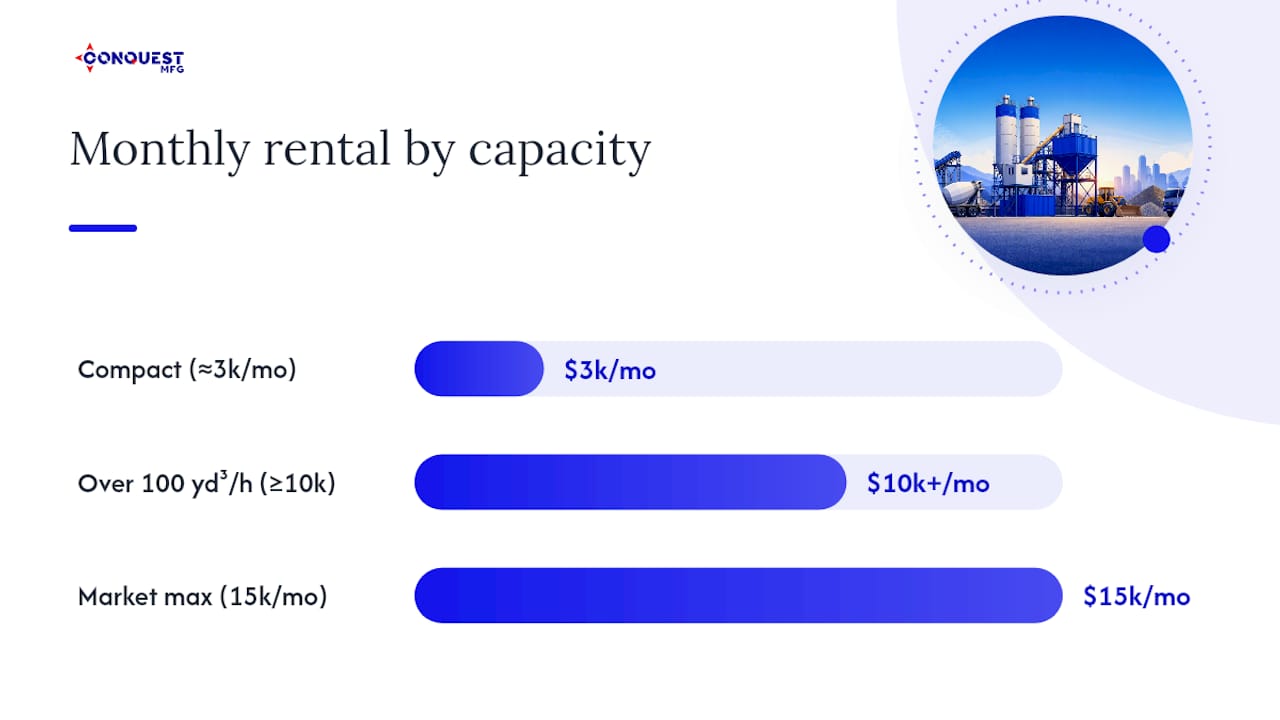
- Monthly: $3,000 to $15,000
Market listings that track portable concrete plant sale prices and financing indicators show a similar spread on used equipment, with sellers frequently offering payment plans alongside outright sale.
Statistic to watch: Financing and rental data from equipment marketplaces shows short-term rental pricing scales fast with capacity. A plant renting near $3,000 a month at the compact tier can climb past $10,000 a month once you’re producing over 100 cubic yards an hour.
Renting makes sense for a single project under six to nine months. Buying makes sense once you can keep the plant running across two or more projects a year.
What Actually Drives Mobile Batching Plant Price
Two mobile plants with the same rated capacity can carry a $150,000 price gap, and the difference almost always traces back to five line items vendors bury in the spec sheet.
- Capacity and mixer type. A twin-shaft mixer costs more than a single-shaft or pan mixer but produces tighter, more consistent batches at higher output. Capacity is quoted in cubic yards per hour, and every jump in that number raises motor size, structural steel, and mixer cost together.
- Automation and controls. A basic manual control panel keeps sticker price low, but a PLC-based automated batching system that logs mix data and reduces operator error can add $15,000 to $40,000. That upfront cost often pays back through reduced material waste and fewer rejected loads.
- Silo count and size. Each additional cement silo, and every jump in silo capacity, adds steel, foundation requirements, and pneumatic loading gear.
- Chassis and transportability. A heavy-duty trailer-mounted chassis built for frequent relocation costs more than a skid-mounted unit meant to sit in one spot for years.
- Compliance and environmental controls. Dust collection systems, water reclamation, and noise mitigation required by local permits can add five figures depending on your jurisdiction.
Pro Tip: Ask every vendor to itemize automation and dust control separately from the base plant price. Bundled quotes make it nearly impossible to compare two plants apples to apples.
Should You Buy New, Buy Used, Or Rent?
The right route depends on utilization, not just cash on hand.
- Buy new when you need warranty coverage, a plant configured for a specific mix design, or year-round uptime where a breakdown would stall multiple crews. New plants also let you specify silo count and automation level from the factory.
- Buy used when your fleet runs below 60% utilization or cash flow is tight. Inspect the mixer liners, drive motor hours, and silo integrity closely. Wear on the mixer paddles is the single biggest hidden cost in a used purchase.
- Rent for single projects under six to nine months, or when testing a new market before committing capital. Rental agreements also avoid maintenance and storage costs between jobs.
- Finance through equipment lenders offering 10% to 20% down payments and terms of three to seven years. Lenders typically want two years of financial statements and will often use the plant itself as collateral, with residual value tied to the model and hour count at resale.
For a side-by-side on when a mobile unit beats a fixed installation entirely, see the stationary versus mobile plant comparison.
Hidden Costs: What Landed Price Actually Includes
The sticker price on a mobile batch plant rarely matches what hits your final invoice. Landed cost, the true out-the-door number, includes several categories vendors don’t always volunteer.
- Transport. Oversized loads require lowboy trailers, permits, and sometimes police escorts across state lines. Shipping metadata on heavy-equipment listings consistently flags transport as a separate, often underestimated line item.
- Rigging and crane work. Setting silos and mixer units in place typically requires crane rental and a certified rigging crew.
- Site prep. Mobile plants need less concrete work than stationary ones, but you still need a level, compacted pad and drainage for washout water.
- Power hookups. Expect electrical upgrades or a rental generator sized for peak mixer draw.
- Permits and testing. Local dust-control permits, water discharge permits, and factory acceptance testing add both time and fees.
Statistic to watch: Lifecycle-cost modeling for capital equipment suggests budgeting 10% to 25% above the base purchase price for setup, commissioning, and initial adjustments. On a $250,000 mid-range plant, that’s $25,000 to $62,500 in costs many first-time buyers forget to plan for. For a full walkthrough of what commissioning actually involves, see Conquest Mfg’s installation guide.
How To Get A Quote You Can Actually Compare
Vendor quotes vary wildly in what they include, so a loose request for “mobile batch plant pricing” invites apples-to-oranges bids. Send this instead:
- Specify capacity, mixer model, and silo sizes exactly, not a range.
- Request separated line items: equipment, transport, installation, permits, and training, each broken out.
- Ask about warranty terms, lead time, and the spare-parts list included at delivery.
- Demand documentation: spec sheets, shipping weights and dimensions, and factory test reports before you sign anything.
- Confirm on-site commissioning fees are quoted separately from the equipment price.
Pro Tip: Never accept a verbal shipping estimate. Get the exact weight and dimensions in writing, then confirm transport cost against those numbers, not a vendor’s rough guess.
The batch plant selection guide walks through additional inspection questions worth adding to this list before you sign a purchase order.
A Manufacturer’s View On What Actually Lowers Total Cost
Factory-tested plants with matched silos and documented shipping weights cut onsite commissioning time and reduce first-month downtime risk, a detail buyers often discount when comparing sticker prices alone. Tailored chassis and silo specs built for your job site, rather than a generic configuration, avoid retrofit costs later. Local parts and service access matters more than most buyers realize; a plant that’s cheap to buy but slow to repair costs more over its first year than one priced higher with a responsive factory support pipeline.
— Sam
Request A Landed-Cost Quote From The Manufacturer
Some manufacturers sell direct, meaning the price reflects factory cost plus configuration without dealer markup, which can significantly impact pricing on mobile batch plants depending on options like automation and silo count. Plants may be custom-designed with integrated trailers, chassis, matched silos, and factory commissioning prior to shipment.
To request a landed-cost quote, include your target capacity, mixer preference, site power availability, and delivery location so the estimate covers transport and installation from the start. Review the Concrete Batch Plants product page for configuration options, or use the budgeting guide to build your project numbers before you call. Contact manufacturers directly to start that conversation today.
Sources
For deeper price benchmarking and specification detail beyond this guide, these resources are worth a look:
FAQ
How much does a batch plant cost?
A new mobile batch plant typically costs $75,000 to $180,000 for compact units, $180,000 to $450,000 for mid-range plants, and $450,000 or more for high-capacity models. Used equipment runs 30% to 50% lower, and monthly rentals range from roughly $3,000 to $15,000 depending on capacity.
How much does 1,000 square feet of concrete cost?
Concrete cost depends on slab thickness and mix design rather than batch plant type, so this figure varies by project rather than by equipment choice. For contractors running their own plant, per-cubic-yard production cost is driven mainly by cement, aggregate, and labor rather than the batching equipment itself.
Are concrete batch plants profitable?
Yes, for contractors with consistent volume. A mobile plant that stays utilized across multiple projects a year typically pays back its purchase price faster than repeated rental fees would cost, especially once you factor in reduced dependence on outside ready-mix suppliers.
What is the price of a concrete batch plant?
Price depends heavily on mobile versus stationary design, capacity, and automation level, with mobile units generally costing less than comparable stationary plants due to simpler foundations. Contact Conquest Mfg directly through the Concrete Batch Plants page for current pricing on a configuration matched to your project.
Is it cheaper to rent or buy a mobile batch plant?
Renting is usually cheaper for a single project running under six to nine months, since it avoids the landed costs of transport, installation, and permits. Buying becomes the better economic choice once you can keep the plant running across two or more projects annually.