
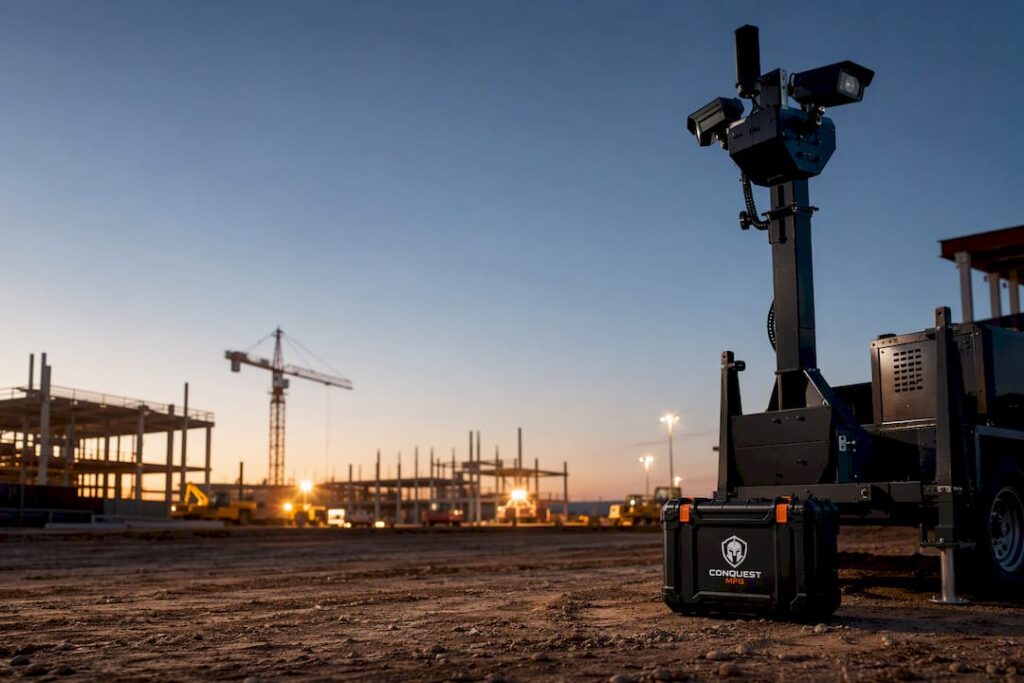
Purchase prices for mobile surveillance towers typically run from about $18,500 for basic two-panel units to $180,000 for large, custom-equipped builds, while rentals commonly range from $799 to $4,000 or more per month. Most projects hit breakeven on buying versus renting somewhere between 18 and 24 months, though mandatory software subscriptions can push that timeline out. The rest of this guide explains the main factors influencing these price ranges and offers guidance on obtaining comparable quotes from vendors.
TL;DR:
- Renting a surveillance tower at $799 to $2,500 per month is often more cost-effective than buying if the deployment lasts less than 24 months, especially when including monitoring services.
- Vendors often omit additional costs such as installation, permits, delivery, and ongoing maintenance, which can add thousands to the total price and must be itemized for accurate comparison.
- The breakeven point for buying versus renting usually occurs between 18 and 24 months, but mandatory software subscriptions can extend ownership costs beyond this timeframe.
- To compare quotes effectively, request all-in pricing that includes mobilization, permits, and decommissioning, and verify the scope of software, warranty, and site-specific connectivity requirements.
Table of Contents
- Quick cost summary: what each budget band typically includes
- Line-item budget: trailer base, cameras, power, and the rest
- Lease vs buy: when ownership actually pays off
- What moves the price most and where to save
- Exact questions and checklist items for a comparable quote
- Delivery, site prep, permits, and mobilization costs
- Annual maintenance, battery lifecycle, and warranty considerations
- Conquest Manufacturing: what to expect from working with a manufacturer
- What buyers consistently get wrong about this decision
- Get a quote for a custom surveillance tower build
- Sources
- FAQ
Quick cost summary: what each budget band typically includes
Your budget dictates the spec sheet more than any other factor. An entry-level unit gets you basic coverage; a custom heavy-duty build gets you redundancy, analytics, and long field autonomy.
- Entry purchase ($18,500 to $40,000): 20 to 24 foot trailer, one to two cameras, basic solar array, no analytics.
- Mid-range purchase ($40,000 to $80,000): Larger chassis, three to six cameras, expanded battery bank, cellular connectivity, basic video analytics.
- High-end or custom purchase ($80,000 and up): 30 to 40+ foot units with advanced optics and analytics, thermal imaging, satellite backup, and reinforced chassis for extended field deployment.
- Entry solar rental ($799 to $1,500 per month): Single mast, basic camera package, standard monitoring.
- Mid rental with monitoring ($1,000 to $2,500 per month): The band most standard construction deployments fall into, typically bundling live monitoring and cloud storage.
- Premium rental with monitoring ($2,500 to $4,000 and up): Rapid redeploy service, dedicated monitoring staff, and priority technical support.
Because rental pricing is charged per mast rather than per camera, a large site that needs coverage on four corners will need four units, not one unit with four times the cameras. A single jobsite renting four mid-range towers at $1,800 per month each lands at $7,200 per month, a figure worth comparing directly against buying two or three units outright if the project runs longer than a season.
Line-item budget: trailer base, cameras, power, and the rest
Breaking a quote into its components lets you catch what a vendor’s summary price might be hiding. The bands below reflect typical component shares used across market pricing tables and vendor comparisons.
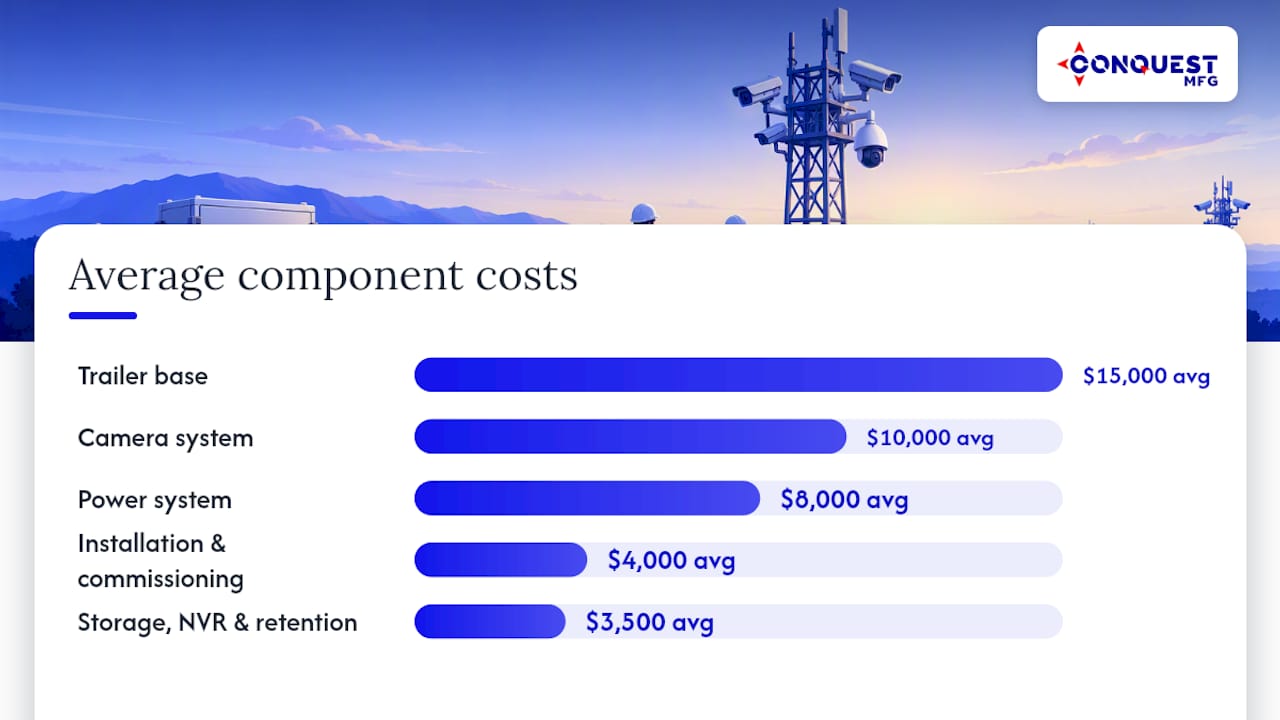
- Trailer base and chassis: $8,000 low, $15,000 average, $30,000 high, depending on axle rating and material.
- Camera system: $2,500 low (one to two fixed cameras), $10,000 average (mixed PTZ and fixed), $35,000 high (PTZ plus thermal array).
- Power system (solar, battery, generator backup): $3,000 low, $8,000 average, $20,000 high for extended autonomy setups.
- Connectivity (cellular modem, antennas): $500 low, $1,500 average, $4,000 high with satellite backup included.
- Storage, NVR, and cloud retention: $1,000 low, $3,500 average, $9,000 high for extended retention and edge analytics.
- Installation and commissioning: $1,500 low, $4,000 average, $9,000 high.
- Permits and local fees: $200 low, $800 average, $2,500 high depending on jurisdiction.
- Delivery and decommission: $500 low, $2,000 average, $6,000 high based on distance and site access.
- Contingency: Budgeting 10% of the subtotal covers most surprises without padding the quote unnecessarily.
Labor is where a lot of budgets go wrong. Typical mid-range builds require 16 to 40 labor hours, and technicians or systems integrators commonly bill $60 to $120 per hour depending on region and skill level. At the high end, that’s $4,800 in labor alone before a single camera ships.
A vendor’s headline price rarely includes everything you’ll actually pay. Mobilization and demobilization charges, fuel for onsite generators, and extra insurance riders for high-value equipment are frequently left off published quotes and only surface once the invoice arrives. Regional differences between urban and rural deployments can swing the total price by 10% to 25%, driven mostly by labor rates, permitting scrutiny, and freight distance. Ask every vendor to itemize these separately rather than folding them into a single “installation” line, so you can compare quotes on equal footing.
Lease vs buy: when ownership actually pays off
The standard rule of thumb holds up well: breakeven between renting and buying a surveillance tower typically falls between 18 and 24 months of continuous or near-continuous use. Two examples make the math concrete.
- Scenario one: A $1,200 per month rental against a $28,000 purchase breaks even at roughly 23 months, meaning any deployment running two years or longer favors buying.
- Scenario two: A $2,500 per month rental against a $60,000 purchase breaks even at 24 months, the same window despite the higher price tag, because the monthly rate scales with the equipment tier.
One caveat changes this math for a lot of buyers. Some vendors that sell units outright still require ongoing mandatory software subscriptions for monitoring or analytics access, which means ownership starts to behave like a rental with a large upfront deposit. Read the software terms before you calculate breakeven, not after.
Before committing either direction, run through a short checklist: how long is the deployment, how often will the unit need to move between sites, is capital available now versus spread over a lease term, and does your team have the in-house capability to maintain the unit once the warranty period ends.
What moves the price most and where to save
Three variables drive most of the cost swing between quotes: hardware, power, and software, and each has a clear tradeoff point.
- Power autonomy: More panels and higher battery amp-hours cost more upfront but prevent downtime during extended overcast stretches. Undersizing the power system is the single most common reason a tower goes dark mid-deployment.
- Camera type and count: PTZ cameras cost more per unit than fixed cameras but cover a wider field, often letting you use fewer cameras for the same functional coverage.
- Connectivity: Cellular-only service works for most jobsites; satellite backup adds cost but matters for remote sites with unreliable cellular signal.
- Chassis and material choices: Reinforced steel chassis and custom mounting hardware add manufacturing time and cost, so specify only what the deployment environment actually requires.
Pro Tip: If your site already has a stable network connection nearby, ask whether the tower can use it instead of a paid cellular data plan, since that alone can cut monthly operating cost noticeably.
Hybrid monitoring, where onsite alerts trigger a remote operator only when needed rather than continuous live monitoring, and negotiated multi-site discounts for fleets of three or more units are two of the more reliable ways to trim recurring cost without losing coverage.
Exact questions and checklist items for a comparable quote
A quote is only useful if you can compare it directly against another vendor’s number. Push every vendor toward the same format.
- Request one all-in number covering delivery, setup, permits, and demobilization for the exact scope you specified, not a base price with add-ons listed separately.
- Insist that mobilization and demobilization charges appear as their own line item, since these are commonly left off published rental quotes.
- Ask for battery autonomy stated in days at a specified sun-hours figure, not just panel wattage, since that number tells you how the unit performs in your actual climate.
- Request cellular signal validation for your specific site address, included camera retention days, the monitoring service level agreement, and full warranty terms in writing.
Treat a quote that bundles software access as “included” with no term length as a red flag. Ask what happens to that access after year one, since a jump in subscription cost after the introductory period is one of the most common surprises buyers report.
Delivery, site prep, permits, and mobilization costs
Non-hardware costs routinely change a quote by thousands of dollars, and they’re the easiest line items to overlook during initial budgeting.
- Shipping and mobilization are typically billed as either a flat regional fee or a per-mile rate, so a unit traveling 300 miles from the manufacturer will cost noticeably more to deliver than one sourced locally.
- Local permitting can trigger added cost or delay through municipal zoning reviews, fire code compliance for onsite lighting or generators, and lighting ordinances in residential-adjacent areas.
- Site access requirements, including crane or lift equipment for uneven terrain and a staged pad for the trailer to sit on, add both time and cost that a remote quote can’t always anticipate.
Reviewing site access and delivery scheduling ahead of time, using a resource like this construction site logistics checklist, helps avoid the kind of last-minute staging delays that turn into unplanned mobilization fees. Decommissioning at project end usually carries its own smaller fee, which vendors sometimes forget to quote upfront.
Annual maintenance, battery lifecycle, and warranty considerations
Recurring costs matter as much as the purchase price once you’re planning past year one.
- Annual service budgets typically range from $500 per year for basic upkeep to $5,000 per year for full-coverage maintenance plans with priority response.
- Battery replacement is the most predictable lifecycle cost, generally needed every three to five years depending on usage cycles and climate exposure.
- Warranty scope varies significantly between vendors, so compare what’s covered (parts, labor, travel) rather than just the length of the warranty period.
- Extended-service plans shift risk to the vendor for a fixed annual fee, which is worth it for buyers without in-house maintenance staff.
When modeling three- and five-year total cost of ownership, factor in one full battery replacement cycle and at least one storage or data plan renewal, since both recur predictably over that window.
Conquest Manufacturing: what to expect from working with a manufacturer
Some manufacturers produce portable rapid-deployed video surveillance towers alongside broader trailer and equipment lines, offering options for custom or heavy-duty units. Custom fabrication, meaning chassis materials, camera mounting, and power system sizing built to a specific deployment environment, reduces the retrofit work and premature failures that come from forcing a generic unit into a demanding site.
When working with any manufacturer on a custom build, request engineering drawings, load calculations for the chassis and mounting hardware, and documented quality assurance specs before finalizing an order. Those deliverables are what separate a genuine custom build from a modified stock unit.
What buyers consistently get wrong about this decision
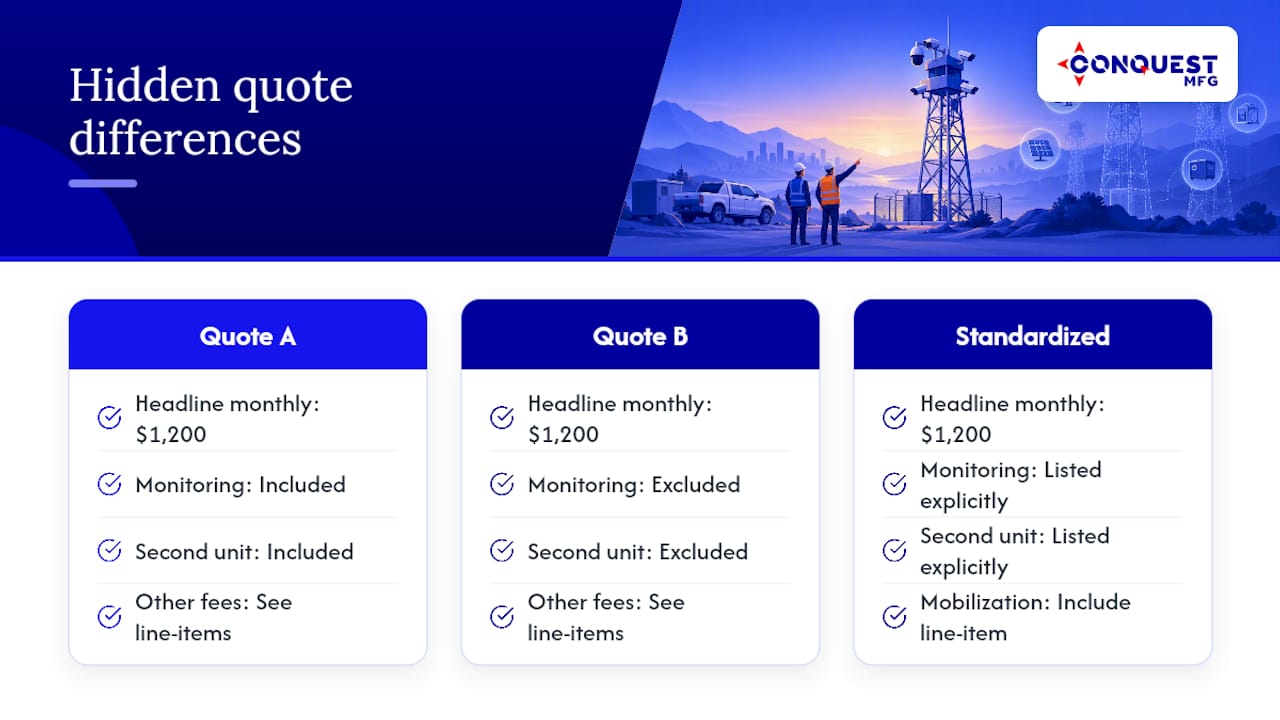
The biggest mistake in surveillance tower budgeting isn’t picking rent or buy incorrectly, it’s comparing quotes that aren’t actually comparable. One vendor’s $1,200 monthly rate includes monitoring and a second unit’s $1,200 rate doesn’t, and that gap disappears entirely once you force every quote into the same line-item format.
Conventional advice leans hard on the 18 to 24 month breakeven rule, and that rule holds up reasonably well as a starting point. Where it falls short is ignoring mandatory software subscriptions, which quietly convert a purchase into something closer to a long-term lease. Read the software terms before you sign anything, not after the first invoice.
If you take one thing from this guide, prioritize getting an all-in number that covers mobilization, permits, and demobilization before comparing any vendor’s base price. A buyer who does that first will avoid the vast majority of the quote surprises this guide covers.
— Sam
Get a quote for a custom surveillance tower build
If your project needs a heavier chassis, extended power autonomy, or camera integration beyond a standard rental package, Conquest Mfg builds surveillance towers and trailer integrations to your project’s specifications rather than a generic template.

Explore Conquest Mfg’s full trailer and security tower lineup or start a conversation about custom trailer fabrication for your next deployment.
Sources
Price bands above draw on published vendor pricing guides and rental rate comparisons. Always request a written quote tied to your exact scope before comparing vendors directly.
- Mobile surveillance trailer price: U.S. buyers guide (LatestCost)
- Surveillant
- Mobile surveillance trailer cost: rental, purchase & complete price guide (Calvis)
FAQ
How much should a surveillance system cost?
A basic surveillance tower purchase starts around $18,500 for two-panel units, while larger custom builds can reach $180,000. Renting typically runs $799 to $4,000 per month depending on camera count and monitoring service level.
Is it illegal for my neighbor to have a camera pointed at my house?
Camera placement rules vary by state and municipality, and most jurisdictions allow cameras aimed at a neighbor’s property as long as they don’t capture areas with a reasonable expectation of privacy, such as through a window. Check your local ordinances or consult a property attorney for guidance specific to your situation.
What is a surveillance tower?
A surveillance tower is a self-contained, often trailer-mounted unit combining cameras, power (typically solar with battery backup), and connectivity for monitoring a site without fixed infrastructure. They’re commonly deployed on construction sites, industrial yards, and other locations needing temporary or mobile security coverage.
How much does a lot cop cost?
Pricing for mobile security units marketed under names like this generally falls within the same bands covering the broader mobile surveillance tower market, with purchase prices from roughly $18,500 to $180,000 and monthly rentals from $799 to $4,000 depending on specification. Request an itemized quote to compare any specific product against these published bands.