
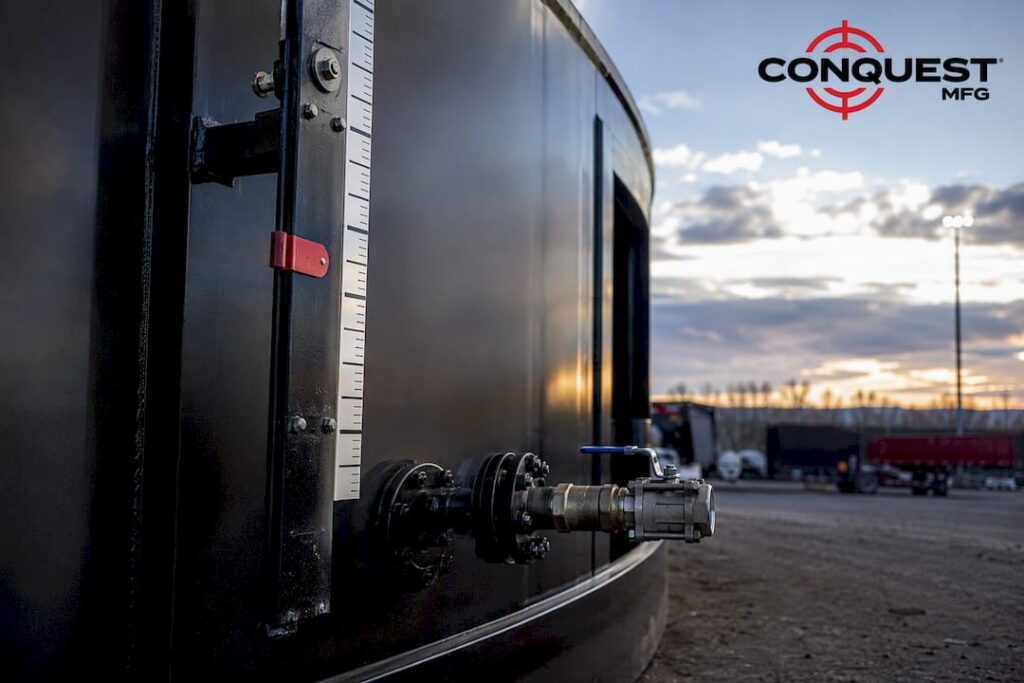
The most common frac tank on a job site is the 500 BBL unit, holding roughly 21,000 gallons. Mini tanks in the 200 to 300 BBL range (about 8,400 to 12,600 gallons) fill smaller staging needs. The right choice comes down to one rule: size the tank to your peak simultaneous volume, then add a contingency buffer for unexpected changes.
TL;DR:
- The peak simultaneous volume and flow rate determine the tank size, plus a contingency buffer of 10 to 25 percent to account for unexpected changes.
- Chemical compatibility, temperature control needs, and solids content can significantly reduce usable capacity beyond the nominal volume.
- Confirm exact tank dimensions, strapping chart, and regulatory transport certificates before delivery to avoid misreading fill levels or exceeding weight limits.
- Environmental factors like temperature swings, UV exposure, and corrosion can degrade tank integrity and safety margins over time.
- Custom-built tanks tailored to specific project requirements often outperform stock units, especially for corrosive fluids, limited space, or long-term use.
Table of Contents
- What a Frac Tank Is and How Capacity Is Measured
- Standard Frac Tank Sizes and Dimensions
- How Liquid Properties Change Your Capacity Decision
- Open Top, Closed Top, and Specialty Configurations
- Transport, Site Prep, and Weight Constraints
- Choosing the Right Capacity: A Decision Checklist
- What to Verify With the Manufacturer Before You Commit
- Maintenance and Inspection Practices That Protect Rated Capacity
- Environmental Factors That Affect Capacity and Durability
- An Operator’s Take on Sizing Frac Tanks
- Get a Custom-Built Frac Tank Sized to Your Project
- Sources
- FAQ
What a Frac Tank Is and How Capacity Is Measured
A frac tank is a mobile, trailer-mounted or skid-mounted vessel used for staging water, storing produced water, supporting dewatering operations, or holding fluids temporarily during construction and oilfield work. Capacity gets measured in barrels (BBL), the standard oilfield unit, where one BBL equals 42 US gallons. That conversion exists because barrels have been the industry’s shorthand for liquid volume since the earliest oil operations, and it still shows up on every spec sheet you’ll see.
Reading a tank’s fill level takes a strapping chart, a table that maps inches of liquid height to barrels of volume. Because a horizontal cylindrical tank doesn’t fill in a straight line, the volume formula (V = π × r² × length, with 1 cubic foot equal to 7.48052 gallons) produces a curve, not a ramp.
- Manual strapping tables remain standard on rental fleets
- Some suppliers offer online frac tank calculators for quick inches-to-barrels conversions
- Remote gauges eliminate the need to climb the tank for a reading
Standard Frac Tank Sizes and Dimensions
Three nominal sizes dominate the market: 200 BBL, 300 BBL, and 500 BBL. Each has a rough gallon equivalent, but exact dimensions and empty weight shift depending on manufacturer and configuration, so treat the table below as a planning reference, not a substitute for a specific unit’s strapping chart.
| Nominal Size | Approximate Gallons | Typical Use Case |
|---|---|---|
| 200 BBL | ~8,400 gal | Small-footprint staging, tight site access |
| 300 BBL | ~12,600 gal | Mid-scale water transfer, secondary storage |
| 500 BBL | ~21,000 gal | Standard rental and purchase size |
The 500 BBL size earns its “standard” label partly because it’s often the largest trailer-mounted unit that stays highway-legal without special escorts in many jurisdictions, though you should always confirm state transport rules before mobilizing one.
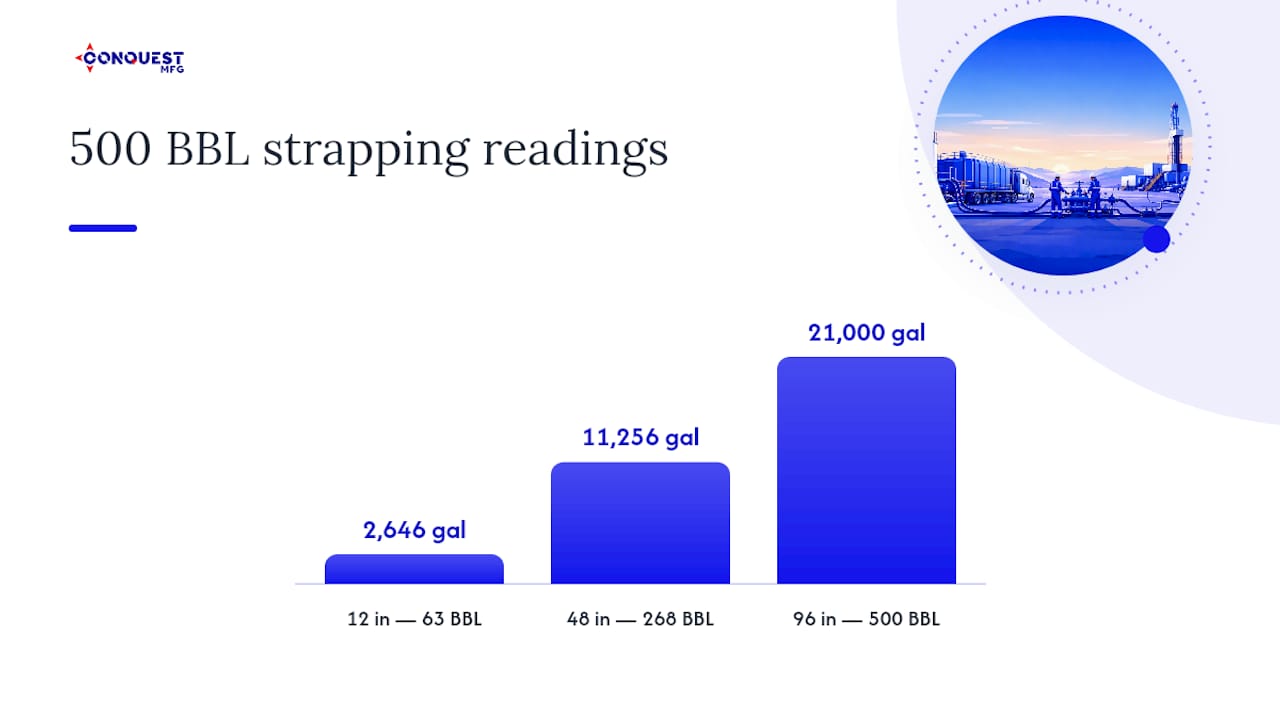
Strapping charts turn height into volume in ways that aren’t intuitive. On many 500 BBL models, 12 inches of liquid reads around 63 BBL (2,646 gallons), 48 inches reads around 268 BBL (11,256 gallons), and a full 96 inches hits the tank’s rated 500 BBL (21,000 gallons). Those numbers vary by manufacturer and tank geometry, which is exactly why every acceptance inspection should include the unit-specific strapping chart, not a generic industry average.
How Liquid Properties Change Your Capacity Decision
Raw capacity numbers only tell half the story. What you’re storing changes which tank actually works, sometimes more than the volume itself.
Corrosive or chemically aggressive fluids demand a lining or shell material rated for that chemistry. A tank sized perfectly for your volume is worthless if the steel construction breaks down against a low pH fluid within weeks. Temperature matters too: fluids that need to stay warm or cold often require insulated shells or steam coils, and both additions reduce usable interior volume slightly while adding to tare weight.
- Check pH and chemical compatibility before locking in a lined or stainless tank
- Confirm whether steam coils or insulation are needed for temperature-sensitive fluids
- Route high-solids or settling-prone liquids to weir tanks, mix tanks, or multiple smaller units instead of one large tank
Pro Tip: Never assume a rental fleet’s “500 BBL” units are chemically interchangeable. Ask for the lining spec and compatibility rating before the tank shows up, not after it’s full.
Open Top, Closed Top, and Specialty Configurations
Configuration decides how a tank handles vapor, weather, and secondary containment, independent of its rated volume.
- Open-top tanks cost less to rent and clean, and they work well for non-hazardous water storage where vapor control isn’t a concern.
- Closed-top tanks control vapor emissions and handle hazardous or volatile liquids that open-air storage can’t safely contain.
- Single-wall tanks cover most general water staging needs at a lower weight and rental cost.
- Double-wall tanks add secondary containment and interstitial monitoring, often required for regulated or environmentally sensitive fluids.
- Specialty builds, including stainless steel, insulated, steam-coil, mix, and weir tanks, solve narrower problems like corrosion resistance, temperature control, or solids separation.
Transport, Site Prep, and Weight Constraints
Frac tanks travel empty. That’s not a convenience choice, it’s a physical necessity: water weighs about 8.34 pounds per gallon, so a full 500 BBL tank carries roughly 175,140 pounds of liquid on top of its own tare weight. No standard trailer or road surface tolerates that load in motion, which is why tanks arrive dry and get filled on site.
That same full-in-place weight drives every site prep decision that follows. A loaded 500 BBL tank puts serious point-loading on whatever it’s sitting on, so soil-bearing capacity and pad design matter as much as the volume you’re planning to store.
- Confirm pad compaction or cribbing rated for the full loaded weight, not just the empty tare weight
- Check overhead clearance and access routes for the delivery vehicle before scheduling drop-off
- Plan secondary containment or berms around the tank footprint per site and regulatory requirements
- Verify manway access, inlet and outlet sizing, and valve condition during acceptance, before the tank goes into service
A safe transport protocol for heavy tank trailers applies the same weight and clearance logic seen across other large industrial vessels, worth reviewing if your site handles multiple tank deliveries per project.
Choosing the Right Capacity: A Decision Checklist
Sizing a frac tank correctly starts with math, not a catalog number.
- Calculate peak simultaneous volume and flow rate. Know your maximum inflow and outflow, not just your average daily use.
- Add a contingency buffer of 10 to 25 percent. Weather delays, equipment downtime, and unexpected inflow spikes eat into your margin fast.
- Decide between one large tank and multiple smaller units. Site access, cleaning frequency, and settling or segregation needs often favor multiple smaller tanks over a single large one, especially on constrained pads.
- Compare mobilization costs against rental duration. Short jobs favor rental; long-duration or repeat projects shift the economics toward purchase.
- Request the strapping chart and DOT transport certificate before delivery. Confirm the exact capacity and legal transport status for your unit, not a generic model number.
Pro Tip: Round your contingency buffer up, not down. A tank that’s 10 percent too big costs you rental fees for unused space; a tank that’s 10 percent too small costs you an emergency mobilization mid-project.
What to Verify With the Manufacturer Before You Commit
Spec sheets vary between manufacturers even at the same nominal size, so the acceptance checklist matters as much as the capacity number.
- Strapping chart specific to the exact unit, not a generic 500 BBL average
- Material and lining specification, including chemical compatibility ratings
- Tare weight, listed separately from loaded weight
- DOT inspection records and current transport certificates
- Manway dimensions and inlet/outlet port sizing
- Valve type and condition
Custom frac tank trailers are often built alongside a broader lineup of oilfield and industrial equipment, with common customization requests including stainless steel linings for corrosive fluids, additional ports for multi-line operations, insulation or steam coils for temperature control, and double-wall construction with interstitial monitoring for regulated sites, thanks to oil & gas sheet metal fabrication capabilities in China. Each of those changes tare weight and usable volume slightly, which is exactly why the spec sheet, not the marketing brochure, should drive your final decision.
Maintenance and Inspection Practices That Protect Rated Capacity
A frac tank’s rated capacity isn’t a one-time number stamped at the factory. It holds only as long as the shell, seams, and fittings stay in the condition that rating assumed.
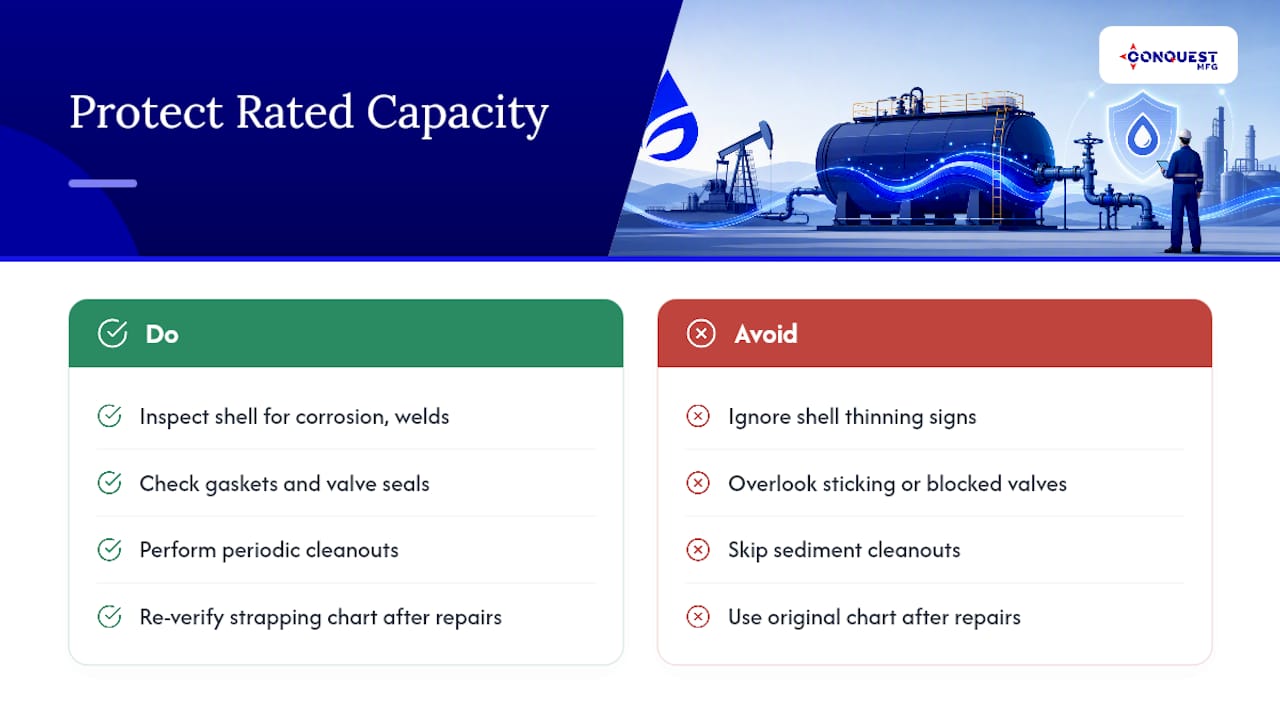
Routine visual inspections should check for shell corrosion, weld integrity, and gasket wear at every manway and valve connection. Corrosion thins steel walls gradually, and a thinned wall doesn’t fail predictably. It can hold pressure fine for months, then develop a leak under a load it previously handled without issue. Catching pitting or scaling early, especially on tanks that cycle between corrosive and non-corrosive fluids, prevents small problems from becoming capacity losses.
Valve and fitting checks matter just as much as shell condition. A sticking or partially blocked outlet valve doesn’t reduce a tank’s rated volume, but it does reduce its effective usable capacity on a job where flow rate matters as much as total storage. Inspect gaskets and seals for degradation, particularly on tanks exposed to fluids outside their original design chemistry.
Sediment buildup deserves its own inspection cycle. Tanks used repeatedly for produced water or fluids with suspended solids accumulate sediment at the bottom over time, and that buildup eats into usable volume even though the tank’s rated capacity on paper hasn’t changed. Periodic cleanouts, especially between contracts or fluid types, keep the gap between rated and actual usable capacity as small as possible.
Finally, re-verify the strapping chart after any repair involving the shell or internal baffles. A patched or re-welded section can shift internal volume slightly, and operators who keep using the original chart without rechecking it risk misreading fill levels on a tank that no longer matches its factory spec exactly.
Environmental Factors That Affect Capacity and Durability
Temperature extremes and sun exposure don’t change a tank’s stamped rating, but they do change how reliably that rating holds up over a tank’s working life.
Steel shells contract and expand across seasonal temperature swings, and that cycling stresses welds and seams over years of use, particularly in regions with sharp day-to-night or winter-to-summer temperature differences. Cold climates introduce a separate risk: liquids that freeze inside a tank expand, and that expansion can stress walls and fittings never designed for ice pressure. Insulated tanks and steam coils address this directly, but they also add tare weight and reduce usable interior volume slightly compared to an uninsulated shell of the same nominal size.
UV exposure targets different components. Gaskets, seals, and any polymer linings degrade faster under sustained sun exposure, and a degraded seal is a leak point long before it’s a visible failure. Tanks stationed outdoors for extended contract durations, common in oilfield staging, need more frequent seal inspections than tanks used for short-term jobs and then returned to a covered rental yard.
Coastal or high-humidity environments accelerate corrosion on unlined carbon steel shells, which is one practical reason stainless steel or specialized coatings show up so often on tanks destined for long-term outdoor service near salt air or industrial emissions. None of these environmental pressures shrink a tank’s rated barrel capacity on the spec sheet. They do shrink the margin of safety between that rating and what the tank can actually deliver reliably, year after year, without an unplanned inspection or repair.
An Operator’s Take on Sizing Frac Tanks
Most capacity mistakes trace back to matching a tank to average flow instead of peak flow, then getting caught when conditions spike. Before signing off on any delivery, pull the unit’s own strapping chart and confirm it against the site’s actual bearing capacity and access constraints, not the number on the rental quote.
— Sam
Get a Custom-Built Frac Tank Sized to Your Project
Rental fleets work fine when your specs match a stock unit, but plenty of projects don’t fit a generic 500 BBL tank, whether that’s a corrosive fluid, a tight site footprint, or a long-term contract where purchasing beats repeated rental fees. Frac tank trailers can be custom-built to the exact volume, lining, and configuration a project calls for, rather than compromising around whatever a rental yard has on the lot.
The specification process usually begins with a quote request where fluid type, peak volume, site constraints, and transport requirements are reviewed before recommending a build. That conversation covers lining material, port placement, insulation needs, and any double-wall or monitoring requirements your site or regulator demands. If you’re ready to move past stock rental limitations, visit the construction industry equipment page to start a specification conversation and request a quote for your next frac tank build.
Sources
- Frac Tanks: 200, 300 & 500 Barrel Sizes | Cooper Tank
- Tank capacity chart and volume formulas
- Frac Tank Volume Calculator – Quick Frac Tank Strapping | WellAware
FAQ
How many gallons of water are in a frac tank?
A standard 500 BBL frac tank holds about 21,000 gallons. Smaller mini tanks in the 200 to 300 BBL range hold roughly 8,400 to 12,600 gallons.
What are the dimensions of a 21,000-gallon frac tank?
Dimensions vary by manufacturer, but a 500 BBL (21,000 gallon) tank typically runs in the range documented on manufacturer strapping charts, with a maximum gauge height often around 90 to 96 inches. Always confirm exact length, width, and height against the specific unit’s spec sheet before planning site placement.
How many barrels (BBL) are in a frac tank?
Nominal frac tank sizes run 200, 300, and 500 BBL, with 500 BBL being the most common size in active use. One barrel equals 42 US gallons, so a 500 BBL tank holds 21,000 gallons.
How long is a frac tank?
Length varies by nominal capacity and manufacturer configuration. Rather than relying on a single average figure, request the manufacturer’s strapping chart, which lists exact length, width, and height alongside the inches-to-barrels conversion for that specific unit.