
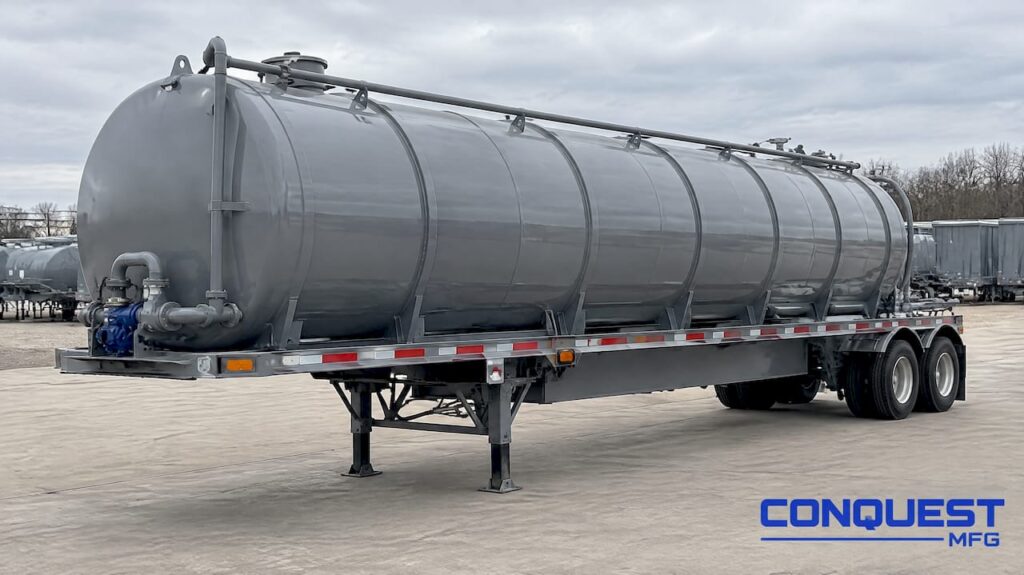
Frac tank trailer features fall into several groups: capacity, construction, interior shape, access and safety, piping and manifolds, temperature control, and chassis limits. The common baseline is a 500 BBL tank, roughly 21,000 gallons, but you should confirm exact dimensions and empty weight with the manufacturer. DOT/FMCSA and OSHA expectations shape the details.
TL;DR:
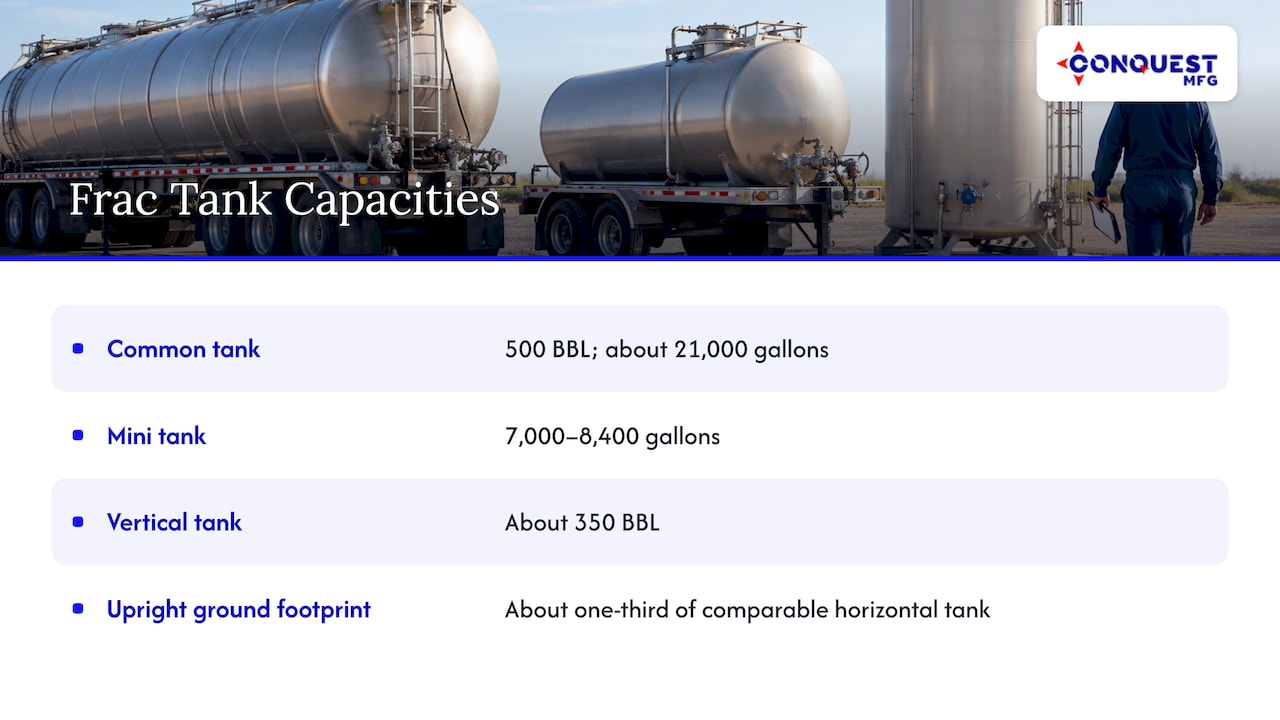
- Mini tanks hold 7,000 to 8,400 gallons; vertical units often hold 350 BBL and use about one third the ground footprint of horizontal tanks.
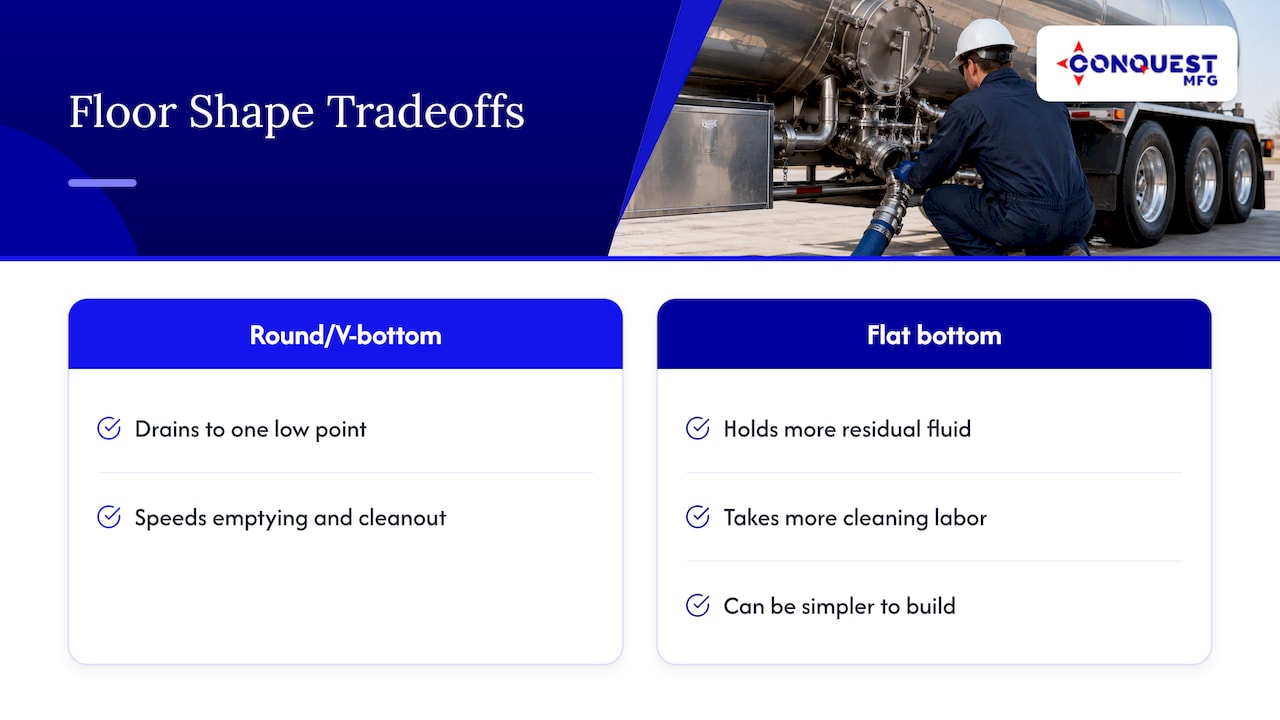
- Request plate thickness for each surface; a round or V shaped base drains faster, while a flat base leaves more residual fluid.
- Confirm whether stairways, guardrails, and manway landings come with the base tank or cost extra, and check that steps and walkways resist slipping.
- Tell the manufacturer your fluid and process requirements so it can size manifolds and determine whether heating, mixing, or protective coatings are needed.
- A 28,000 to 30,000 pound empty tank can approach standard flatbed limits, so verify axle ratings, route clearances, and permits before booking transport.
Table of Contents
- Which feature categories show up on a frac tank spec sheet?
- How much does a frac tank hold, and what sizes exist?
- What construction and materials should you look for?
- What access and safety features reduce risk on site?
- What piping, manifolds and fittings come standard?
- When do you need steam coils, mixers or coatings?
- How do trailer type and legal limits shape your choice?
- What belongs on your spec checklist before you buy?
- Why does specification detail matter this much?
- How can we help you specify and build your frac tank trailer?
- FAQ
- Sources
Which feature categories show up on a frac tank spec sheet?
Every spec sheet you read will sort into the same groups. Knowing them first keeps vendor comparisons fair.
- Type and capacity: open-top or closed-top, horizontal or vertical, and the volume each holds.
- Construction: steel grade, plate thickness for floor, walls and roof, and the interior finish.
- Access and safety: manways, stairways, guardrails and anti-slip steps.
- Piping and manifolds: the feed line, drains, roof ports and valves.
- Temperature control: steam coils, insulation and mixers.
- Chassis and transport: trailer type, axles and legal height and width.
Each group answers a different practical question. Capacity sets your site footprint, construction sets service life, access sets how safely crews can sample and inspect, and transport decides how the tank reaches you at all.
How much does a frac tank hold, and what sizes exist?
The common size is 500 BBL, about 21,000 gallons. A standard unit measures roughly 45–46 feet long, 8’6" wide and 10–11 feet tall, and it often weighs 28,000 to 30,000 pounds empty. Treat those as reference ranges and get the exact figures in writing.
Mini frac tanks sit well below that, around 7,000–8,400 gallons, and suit smaller jobs and tighter access roads. Vertical tanks, often around 350 BBL, matter when space is scarce. On space-constrained sites, uprights commonly use about one-third the ground footprint of a comparable horizontal tank.
Capacity also drives containment and hauling. A bigger tank needs a larger berm and a heavier trailer, so settle the volume first. Our guide to sizing frac tank capacity walks through matching volume to peak flow.
What construction and materials should you look for?
Most frac tanks are built from carbon steel such as ASTM A36. Spec sheets list plate thickness separately for the floor, walls and roof, and the floor deserves the closest look because it takes the most abuse. Ask for the gauge of each surface rather than accepting a general “heavy duty” claim.
Interior shape changes how the tank behaves in service. A round or V-bottom floor drains toward a single low point, which speeds emptying and makes cleanout faster. A flat bottom holds more residual fluid and takes more labor to clean, though it can be simpler to build.
Also check the structural details: roof members, wall posts, lifting lugs and whether the interior is smooth or corrugated. Smooth walls clean more easily. If you want background on why steel remains the standard material, read why steel tanks suit industrial waste.
What access and safety features reduce risk on site?
Crews sample, gauge and inspect from the top, so access design decides how much risk they carry. Manufacturer data sheets, such as the FRT-452 sheet, list 22" manways with wingnut closures and Buna‑N gaskets. Commercial inventories show that stairways and top manways are among the first items buyers check.
Modern designs go further. Manufacturer documents show integrated OSHA-compliant stairways with guard-railed landings and grip-strut steps. These provide an alternative to ladder-only access.
Look for these fixtures on the spec:
- Anti-slip steps and walking surfaces
- Painted handrails that stay visible
- Safe-operation decals at the stairway and valves
- Guard-railed landings at the manway
Pro Tip: Ask whether the stairway and guardrails are part of the base tank or a priced add-on, because the answer changes your comparison between quotes.
What piping, manifolds and fittings come standard?
Front-end plumbing decides how quickly you can fill, pump and gauge. A common setup includes a front feed line with a cap and chain, and the roof may carry vapor recovery, auxiliary and gauging ports. Confirm the size and location of each one against your pump hookups.
Manifold layout matters most when you battery several tanks together. Dual manifolds let crews move fluid between tanks without rerouting hoses, which saves field time and cuts handling errors. Some jobs also call for gas buster piping and surge-protection features, so state your fluid and process up front and let the manufacturer match the plumbing to it.
When do you need steam coils, mixers or coatings?
Specify temperature control when your fluid thickens or separates in cold weather. Steam coils keep it pumpable, and insulation holds the temperature longer. Many closed-top and open-top models offer steam coils or insulation as options for temperature-sensitive fluids.
Mix tanks add mixer paddles so a blend stays uniform instead of settling. For corrosive services, an epoxy lining or protective coating shields the steel, though it changes how you clean and inspect the interior. If your fluid is acidic, abrasive or heated, write those requirements into the spec rather than assuming a standard tank covers them.
How do trailer type and legal limits shape your choice?
A 500 BBL tank at roughly 45–46 feet long, 8’6" wide and 10–11 feet tall, weighing 28,000–30,000 pounds empty, usually needs a tank trailer chassis or a heavy flatbed. It can approach the limits of a standard flatbed, so the trailer and the tank have to be planned together.
Axle count and suspension ratings decide how much weight the rig can carry legally. Added axles spread the load, and RGN or lowboy options drop the deck height, which helps when overall height become the constraint. Check height and width limits and permit needs for every state on the route before you commit to a date.
Moving the unit is its own job. Heavy-haul specialists such as Cornelius Wrecking’s dump trucking and hauling crews operate the kind of fleets this work calls for.
What belongs on your spec checklist before you buy?
Bring this list to every manufacturer conversation:
- Capacity and exact empty weight.
- Specific gravity rating, commonly in the 1.7 to 2.0 range per rental guidance.
- Venting and pressure relief capacity.
- Manway size and location.
- Piping and manifold layout.
- Heating, mixing and interior coating options.
- Secondary containment and SPCC planning.
Request the manufacturer’s QC checklist, material certificates and any DOT/FMCSA compliance statements that apply. On containment, discuss the required capacity with the vendor, because portable berms may not suit every tank configuration. Our vacuum tank trailer checklist shows the same approach applied to another trailer.
Why does specification detail matter this much?
Most delays we see trace back to a line nobody confirmed: a plate gauge assumed, a manifold position guessed, a stairway left off the order. Each one is cheap to settle on paper and expensive to fix once the tank sits on your site. We believe a spec sheet should be argued over before fabrication, not after delivery. Send us your requirements and our engineering team will review them with you line by line.
— Sam
How can we help you specify and build your frac tank trailer?
We fabricate custom frac tank trailers, and our team reviews your specification against the checklist above. We quote from the figures you confirm. Because we build to your fluid, site and haul route, you avoid paying for features you will not use or missing one you need.
Your next steps are simple:
- Request a spec sheet for the tank size you are considering.
- Schedule an engineering call to walk through your checklist.
- Request a quote through our custom trailer fabrication page.
Prices are available on request once we know your configuration.
FAQ
What is the 60/40 rule for trailers?
A loading guideline describes how cargo weight is distributed around the trailer axles. Confirm the appropriate distribution with your manufacturer. That keeps enough tongue or kingpin weight for stable towing. Liquid loads shift, so confirm distribution with your manufacturer.
Can you haul a full frac tank?
Check with the manufacturer and your carrier first. A tank that weighs 28,000 to 30,000 pounds empty adds a great deal once it holds fluid, so legal axle limits and permits decide the answer.
What are the different types of tanker trailers?
Common types include frac tank trailers, vacuum tank trailers, dry bulk pneumatic trailers and water tank bodies. Each suits a different material and duty cycle. You can compare ours on our transportation industry page.
Why do they call it a frac tank?
The name comes from hydraulic fracturing, where these portable tanks hold water and fluids on the well site. Today they also store other liquids and waste across many industries.
Sources
- Frac Tank Guide: Choosing the Best Frac Tank for the Job | United Rentals
- FRT-452
- Oilfield Equipment Transport – Great Western Transportation