
Section 179 remains fully available for 2026, paired with permanent 100% bonus depreciation. The maximum Section 179 deduction is $2,560,000, with the phaseout starting once equipment purchases exceed $4,090,000, and the SUV cap sits at $32,000. For the full legal text, Publication 946 and Notice N-26-11 are the authoritative references.
TL;DR:
- Section 179 covers machinery, trailers, certain building improvements, and off the shelf software; mixed use deductions must reflect documented business use.
- Commercial hauling trucks and trailers usually avoid passenger vehicle limits; SUVs rated from 6,001 to 14,000 pounds face the $32,000 cap.
- Apply Section 179 first, subject to taxable income and annual limits, then use uncapped bonus depreciation on remaining basis; consider opting out for tax planning.
- Equipment must be operational and ready for intended use by year end; a purchase order or invoice alone does not establish its deduction year.
- Claim Section 179 on Form 4562 attached to the return; opting out of bonus depreciation requires a timely statement for that asset class.
Table of Contents
- 2026 at a Glance: Key Numbers and Definitions
- How Section 179 Works in 2026: Qualifying Property and Limits
- 100% Bonus Depreciation: A Complement to Section 179
- Timing, Elections, and Filing: Claiming the Deduction
- Practical Planning Strategies and Worked Examples
- How Equipment Sellers Should Support Section 179 Planning
- Equip Your Business for Section 179 in 2026
- FAQ
- Sources
2026 at a Glance: Key Numbers and Definitions
Before diving into the mechanics, here are the figures that matter most for 2026 planning.
| Item | 2026 Amount |
|---|---|
| Section 179 maximum deduction | $2,560,000 |
| Phaseout threshold begins | $4,090,000 |
| SUV cap (6,001 to 14,000 lb GVWR) | $32,000 |
| Bonus depreciation rate | 100% for property acquired after January 19, 2025 |
A few terms come up constantly in this process:
- Placed in service means the equipment is ready and available for its intended use, not simply purchased or delivered.
- Qualified property covers tangible personal property, certain real property improvements, and off-the-shelf software used in your trade or business.
- Opt-out election lets a business decline bonus depreciation for a given asset class, often for strategic tax-planning reasons.
Both deductions get reported on Form 4562, and Publication 946 walks through the underlying rules in full.
How Section 179 Works in 2026: Qualifying Property and Limits
Section 179 lets a business deduct the full cost of qualifying equipment in the year it goes into service rather than depreciating it over several years. For contractors, fleet operators, and manufacturers, that applies to a wide range of purchases.
- Tangible personal property, including machinery, equipment, trailers, and batch plants.
- Certain qualified real property, such as specified improvements to nonresidential buildings.
- Off-the-shelf software used directly in business operations.
When a piece of equipment serves mixed use, the deduction is allocated based on the business-use percentage, and unused Section 179 amounts carry forward to future tax years under the limits in Publication 946.
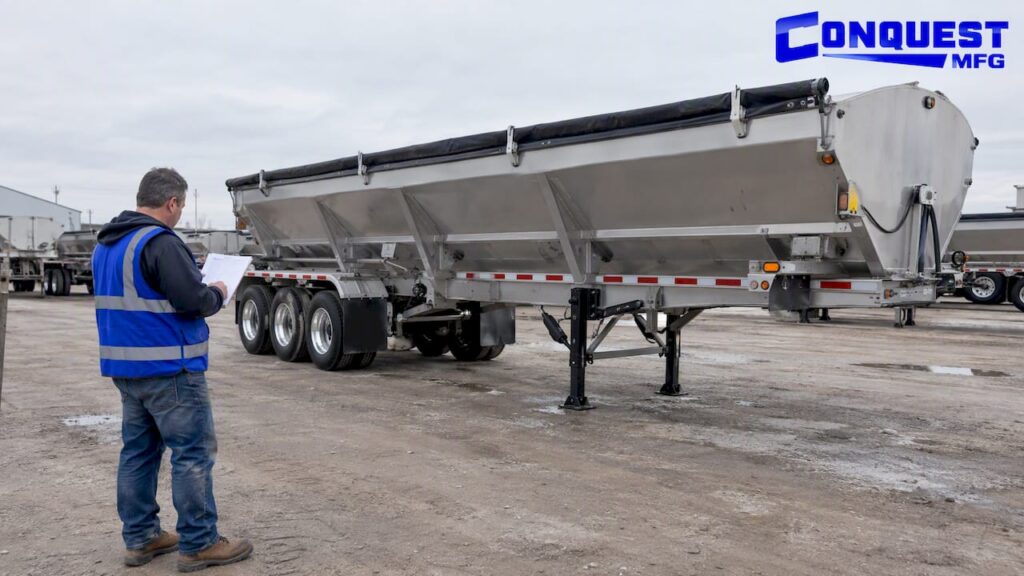
Vehicle rules get specific attention. SUVs with a gross vehicle weight rating between 6,001 and 14,000 pounds face a $32,000 cap for 2026. Heavy trucks, semi-trailers, dump trailers, and similar equipment built for commercial hauling typically fall outside the passenger-vehicle caps entirely, since they do not meet the SUV definition and are not designed for personal transport. That distinction matters for fleet operators buying bottom dump trailers, vacuum tank trailers, or specialized oilfield trailers, since the full purchase price is generally eligible rather than being subject to a passenger-vehicle ceiling.
Pro Tip: Keep a written record of business-use percentage for any equipment that sees occasional personal or mixed use, since the IRS can require allocation evidence during a review.
100% Bonus Depreciation: A Complement to Section 179
The One Big Beautiful Bill restored permanent 100% bonus depreciation for qualifying property acquired and placed in service after January 19, 2025. Unlike Section 179, bonus depreciation carries no dollar cap and no taxable-income limitation, which makes it the tool of choice once Section 179’s limits are reached.
Bonus depreciation now applies permanently at a 100% rate for qualifying property acquired after January 19, 2025, according to IRS newsroom guidance. That permanence removes the phase-down schedule that applied in prior years.
For sequencing a large purchase:
- Apply Section 179 first, up to your taxable-income limit, to target specific assets for immediate expensing.
- Apply bonus depreciation to the remaining basis, since it has no income ceiling and can create or increase a net operating loss.
- Consider opting out of bonus depreciation for a given asset class if you are managing alternative minimum tax exposure, a net operating loss carryback, or multi-year income smoothing.
Notice N-26-11 provides the interim guidance on acquisition dates, elections, and how §168(k) applies to property placed in service after January 19, 2025. Equipment buyers in energy-related industries may also find it useful to review how depreciation approaches apply to production assets in energy project investing.
Timing, Elections, and Filing: Claiming the Deduction
“Placed in service” is not the same as the purchase date, and this distinction carries real weight for custom-manufactured equipment. A concrete batch plant ordered in October but not operational until February of the following year is not placed in service in the earlier tax year, regardless of when the invoice was issued.
To claim these deductions:
- Make the Section 179 election by completing Part I of Form 4562 and attaching it to your business return.
- Elect out of bonus depreciation, if desired, by attaching a statement to a timely filed return for the relevant asset class.
- Keep delivery receipts, acceptance documentation, and evidence the equipment was ready for its intended use, since invoices alone often fall short of what a preparer or examiner expects.
Pro Tip: Request a dated delivery or acceptance confirmation from your equipment seller at the time of handoff. It becomes the backbone of your placed-in-service documentation at tax time.
A common pitfall: buyers assume a deposit or purchase order date controls the deduction year. It does not. The equipment must be installed, tested if applicable, and ready for operational use before the deduction year closes.
Practical Planning Strategies and Worked Examples
A simple planning checklist keeps this process on track:
- Review projected taxable income for the year before finalizing purchase timing.
- Confirm the equipment qualifies as tangible personal property or another eligible category under Publication 946.
- Decide how much to allocate to Section 179 versus bonus depreciation based on income limits.
- Document the placed-in-service date with delivery and acceptance records.
Worked Example A: A profitable contractor buys a vacuum tank trailer for $200,000 (illustrative figure) and has sufficient taxable income. Electing full Section 179 expensing reduces taxable income by $200,000 in that year, rather than spreading the deduction across a multi-year depreciation schedule.
Worked Example B: A manufacturing business plans $4,300,000 (illustrative figure) in capital equipment for the year, which exceeds the $4,090,000 phaseout threshold. Any unused Section 179 carries forward under the rules in Publication 946.
| Scenario | Section 179 Used | Bonus Depreciation Used | Result |
|---|---|---|---|
| Example A: $200,000 purchase | Full $200,000 | Not needed | Full first-year expensing |
| Example B: $4,300,000 purchase | Partial, limited by phaseout | Applied to remaining basis | Full expensing split across both provisions |
For buyers financing these purchases, reviewing financing options alongside the tax math helps confirm the deduction timeline matches the payment structure. Equipment depreciation methods and calculations from industry sources can also help frame the comparison between immediate expensing and standard depreciation schedules.
How Equipment Sellers Should Support Section 179 Planning
We believe equipment manufacturers have a real role to play in making Section 179 filings go smoothly, even though we never provide personalized tax advice. When we deliver a concrete batch plant, trailer, or oilfield unit, we supply spec sheets, dated delivery confirmations, and documentation that ready-for-use status has been met. That paperwork matters more than most buyers realize when a preparer asks for proof of the placed-in-service date.
We also encourage every buyer to coordinate directly with their tax advisor before finalizing a purchase timeline, since taxable-income limits and entity structure affect how much of a deduction is available in a given year. Our team can connect buyers with financing resources, but the election itself, and how it fits your broader tax picture, belongs with your accountant.
Equip Your Business for Section 179 in 2026
We manufacture the kind of equipment that regularly qualifies for Section 179 and bonus depreciation: concrete batch plants, semi-trailers, vacuum tanks, and specialized oilfield trailers among them. Because these are tangible business assets built for heavy-duty commercial use, they typically avoid the passenger-vehicle caps that limit SUV deductions.

When you buy from us, we provide the delivery confirmation and ready-for-use documentation your tax preparer will want on file, whether you are adding a batch plant to a ready-mix operation or a fleet of bottom dump trailers to a hauling business. Our custom trailer fabrication team works with you from specification through delivery, so the placed-in-service date lines up with your planning window.
Ready to see how our equipment fits your 2026 tax strategy? Request a quote or explore our transportation industry catalog to find the right fit for your fleet or facility.
This article is general information, not a substitute for advice from a qualified financial advisor. Consult a qualified financial professional about your own circumstances before acting on anything here.
FAQ
Is Section 179 still available in 2026?
Yes, Section 179 remains fully available for 2026, with a maximum deduction of $2,560,000 and a phaseout threshold of $4,090,000.
What equipment can be deducted under Section 179?
Qualifying property includes tangible personal property such as machinery, trailers, and batch plants, certain qualified real property improvements, and off-the-shelf software, as outlined in Publication 946.
What qualifies for 100% bonus depreciation in 2026?
Property acquired and placed in service after January 19, 2025, generally qualifies for 100% bonus depreciation under the permanent rate restored by the One Big Beautiful Bill, according to IRS guidance. Both new and used equipment can qualify, provided the property is new to the taxpayer claiming the deduction.