
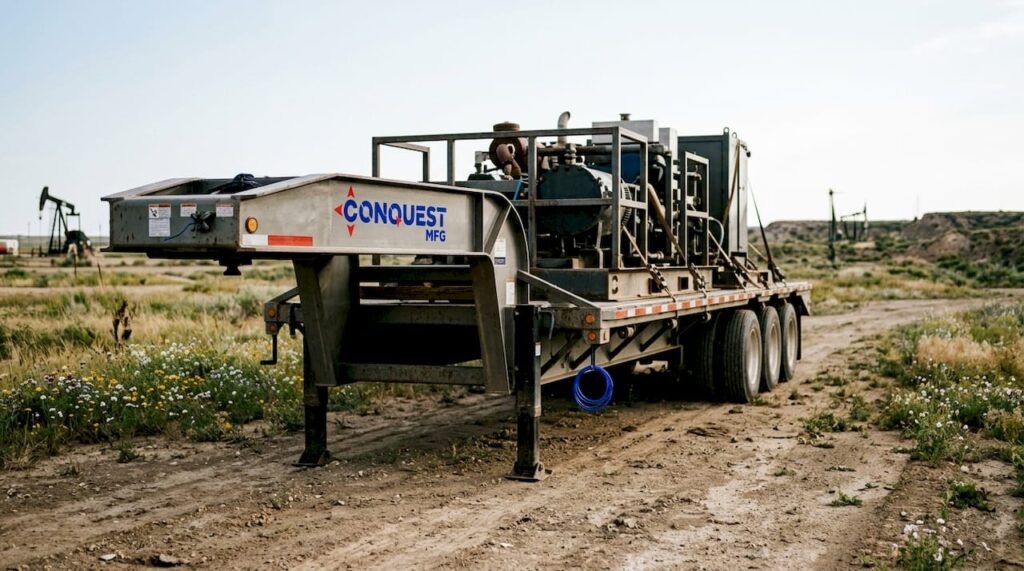
Specialized oilfield trailers are vehicles engineered specifically to transport the oversized, heavy, and sensitive equipment that oil and gas operations demand. Standard commercial trailers cannot safely handle drilling rigs, fracking units, or solids control systems. Oilfield equipment loads often exceed 100,000 lbs, requiring multi-axle configurations and professional rigging that general freight equipment cannot provide. Understanding why use specialized oilfield trailers comes down to one reality: the wrong trailer does not just slow a project down. It shuts it down.
Why use specialized oilfield trailers instead of standard equipment?
Standard commercial trailers are built for predictable freight on paved highways. Oilfield transport is the opposite. Loads are irregular in shape, extreme in weight, and often destined for remote lease roads that would destroy a conventional trailer’s suspension and frame.
The most immediate difference is weight capacity. Drilling rigs and fracking equipment can weigh upwards of 100,000 lbs, which demands multi-axle trailer configurations that distribute load across enough contact points to stay within DOT axle weight limits. A standard flatbed tops out well below that threshold. Exceeding axle limits without proper configuration creates legal liability and catastrophic safety risk.
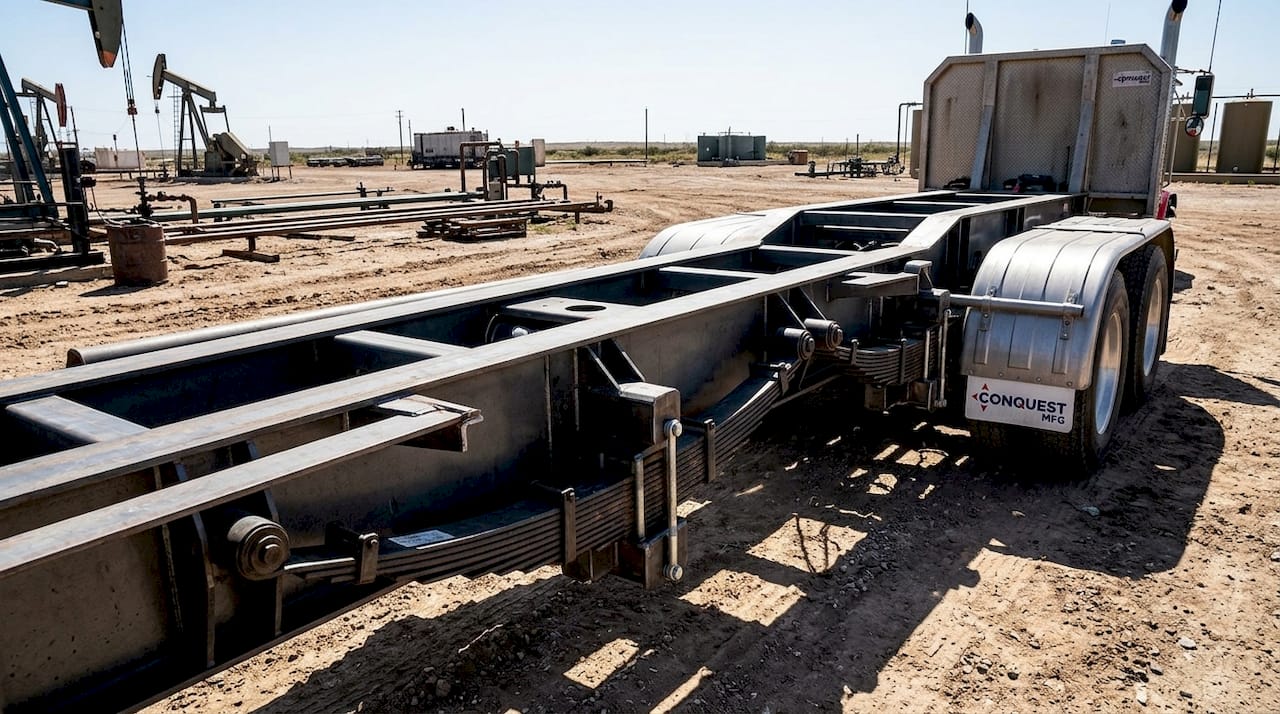
Off-road capability is the second major distinction. Oilfield sites sit at the end of unpaved lease roads, often with soft ground, steep grades, and tight turning radii. Specialized trailers built for oilfield mobile equipment use reinforced frames, heavy-duty suspension, and wider axle spreads to navigate these conditions without getting stuck or damaging the cargo.
| Feature | Standard commercial trailer | Specialized oilfield trailer |
|---|---|---|
| Max payload capacity | Up to ~48,000 lbs | 100,000+ lbs with multi-axle setup |
| Axle configuration | Typically 2–3 axles | 4–8+ axles, extendable |
| Off-road capability | Minimal | Engineered for lease roads |
| DOT oversize compliance | Standard freight | Oversize/overweight permitting |
| Cargo type | General freight | Drilling, fracking, solids control |
Pro Tip: Always verify that your trailer configuration holds the correct state-issued oversize permits before moving any load above 80,000 lbs gross vehicle weight. Permit requirements vary by state and route.
What types of specialized oilfield trailers are commonly used?
The oilfield trailer category covers several distinct configurations, each matched to a specific cargo type and site requirement. Choosing the wrong type costs time and money.
- Pneumatic tankers: Transport dry bulk materials such as frac sand, cement, and barite. They pressurize cargo for discharge directly into sealed silos or batch plant systems. Pneumatic delivery integrates with automated batch plants and enclosed silos, reducing dust and contamination risk on site.
- Hopper bottom trailers: Gravity-discharge units suited for frac sand delivery where pneumatic infrastructure is not available. Lower maintenance complexity than pneumatic units, but not compatible with sealed site systems.
- Lowboy trailers: Carry tall, heavy equipment such as drilling rig components, compressors, and large generators. The low deck height keeps the center of gravity down and satisfies height restrictions on public roads.
- Flatbed trailers: Handle structural steel, pipe, and modular equipment. Versatile and widely used for general oilfield freight that does not require enclosed or pressurized transport.
- Trailer-mounted solids control systems: Purpose-built units that house shale shakers, centrifuges, and mud tanks on a single trailer frame. Trailer-mounted designs reduce setup time and drilling fluid consumption compared to fixed solids control installations, making them the preferred choice for workover rigs.
The choice between pneumatic and hopper bottom trailers is one of the most consequential decisions in frac sand logistics. Pneumatic trailers typically earn $50–$125 more per load than hopper bottom equipment. That premium reflects the added complexity of operating and maintaining pressurized systems.
Pro Tip: If your site uses an automated batch plant or enclosed silo, specify pneumatic trailers from the start. Retrofitting a site for gravity-discharge after the fact adds cost and delays that are entirely avoidable.
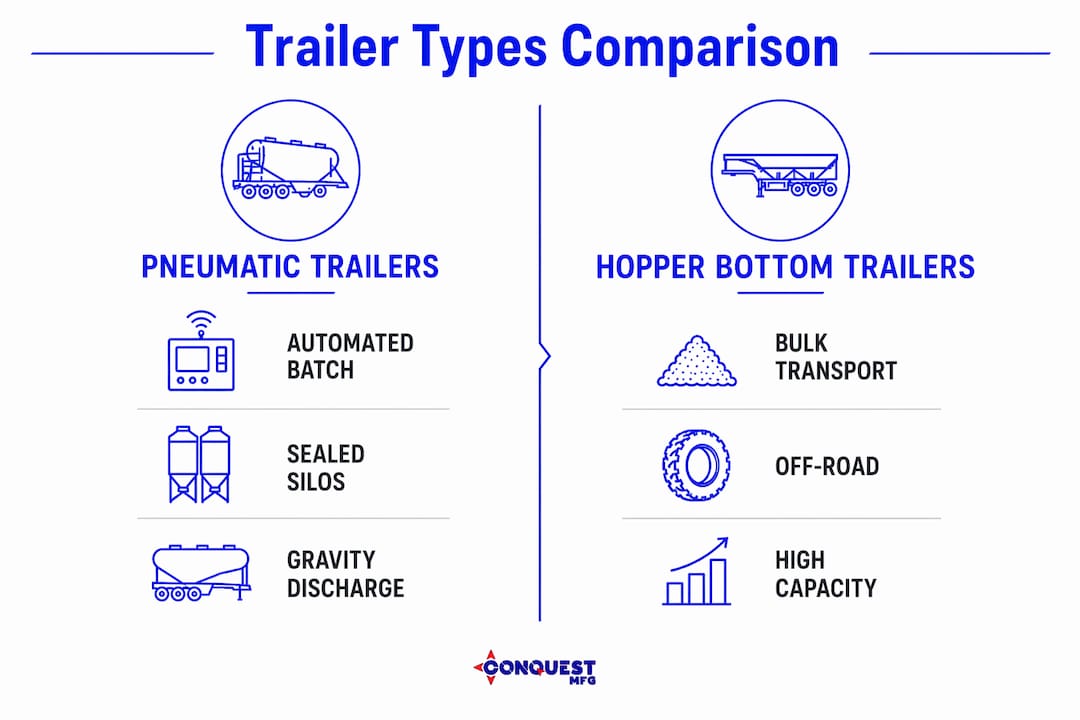
You can review a detailed breakdown of configurations in this frac sand trailer guide covering the operational tradeoffs between trailer types.
How do specialized oilfield trailers improve efficiency and reduce project risk?
Uptime preservation is the primary financial driver behind every specialized trailer decision in oilfield logistics. A rig that sits idle because a critical part or material did not arrive on schedule costs far more than any premium paid for the right transport equipment.
Hotshot trucking moves loads directly with no terminal delays, preserving rig schedules and preventing expensive project shutdowns. That point-to-point delivery model is only possible when the trailer is already configured for the load. A standard freight carrier cannot accept an oversized drilling component on short notice. A specialized oilfield transport operator can.
Rapid “load-to-road” times driven by specialized rigging and trailer features help prevent rig downtime by enabling on-demand delivery of critical parts. When a rig goes down, every hour of delay compounds the financial loss. The trailer is not a logistics detail. It is a financial safety net.
Trailer-mounted solids control systems add another layer of efficiency. These systems improve drilling fluid treatment and reduce setup time in demanding environments, which directly shortens the non-productive time between well sections. Fixed installations require days to commission. A trailer-mounted unit can be operational within hours of arrival.
| Factor | Standard freight approach | Specialized oilfield trailer |
|---|---|---|
| Delivery model | Hub-and-spoke with terminal stops | Direct, point-to-point |
| Response time for urgent loads | 24–72 hours | Same-day or next-day |
| Rig downtime risk | High, due to scheduling gaps | Low, due to on-demand availability |
| Site infrastructure compatibility | Limited | Matched to pneumatic or gravity systems |
The role of semi trailers in oilfield operations extends well beyond moving cargo from point A to point B. The right trailer configuration directly determines whether a project stays on schedule or bleeds cost through avoidable delays.
What are the key considerations for selecting and maintaining oilfield trailers?
Selecting the right trailer starts with understanding your site conditions, not your cargo weight alone. Road quality, discharge infrastructure, and operational scale all determine which configuration delivers the best return.
- Assess site access conditions. Measure the road width, load-bearing capacity, and turning radius of every route from the highway to the wellpad. A trailer that cannot reach the site is useless regardless of its payload rating.
- Match the trailer type to your discharge infrastructure. Pneumatic trailers are required at many sites for dust control and compatibility with sealed batch plant systems. Confirm your site’s receiving equipment before specifying a trailer type.
- Apply the 60/40 load distribution rule. The 60/40 rule dictates load weight distribution for safe and stable transport. Sixty percent of the load weight should sit over the rear axles and 40% over the front. Improper distribution creates handling instability and DOT compliance violations.
- Budget for pneumatic maintenance. Blower failure can cost $5,000–$20,000 and sideline equipment for days. Operators running pneumatic units need certified technicians and spare blower components on hand to avoid extended downtime.
- Verify operator certification. Specialized oilfield trailers require operators trained in oversize load handling, pneumatic discharge procedures, and site-specific safety protocols. Untrained operators increase accident risk and void insurance coverage.
- Plan maintenance intervals around operational cycles. Pneumatic systems require more frequent inspection than hopper bottom units. Schedule blower checks, hose inspections, and pressure relief valve tests between every major haul cycle.
The vacuum tank trailer checklist offers a practical framework for building maintenance schedules across pressurized trailer types, including pneumatic tankers used in oilfield applications.
Pro Tip: Run a full pneumatic system pressure test before every load. A small leak in a discharge hose that goes undetected can contaminate the cargo and damage the receiving silo, creating costs that dwarf the time saved by skipping the check.
Key Takeaways
Specialized oilfield trailers are the single most important logistics variable in preserving rig uptime and keeping oil and gas projects on schedule.
| Point | Details |
|---|---|
| Weight capacity is non-negotiable | Oilfield loads exceed 100,000 lbs and require multi-axle, DOT-compliant configurations. |
| Trailer type must match site infrastructure | Pneumatic units are mandatory where sealed batch plants or dust control systems are in place. |
| Uptime drives trailer selection | Point-to-point specialized transport prevents the rig downtime that standard freight cannot avoid. |
| Maintenance determines profitability | Pneumatic blower failures cost $5,000–$20,000 and require proactive maintenance programs. |
| Load distribution is a safety requirement | The 60/40 rule governs weight placement and compliance with DOT transport regulations. |
What I’ve learned after years of watching trailer decisions make or break oilfield projects
The most expensive mistake I see project managers make is treating trailer selection as a procurement checkbox. They specify the cheapest available unit that meets the stated payload weight, then discover on day one that it cannot navigate the lease road, cannot discharge into the site’s silo system, or cannot be permitted on the state highway connecting the yard to the wellpad.
The second mistake is underestimating pneumatic maintenance. Operators are drawn to the higher per-load earnings that pneumatic trailers generate. That premium is real. But a blower failure at the start of a major frac job, with no spare unit available, wipes out weeks of margin in a single day. The operators who profit consistently from pneumatic equipment are the ones who treat maintenance as a fixed operating cost, not an optional expense.
What I find genuinely underappreciated is how much trailer-mounted solids control systems have changed workover economics. The ability to relocate a complete fluid treatment system in hours rather than days compresses the non-productive time that used to define workover budgets. That is not a minor efficiency gain. It changes the financial model of the entire operation.
The trend I expect to define 2026 and beyond is tighter integration between trailer specifications and site infrastructure design. Projects that specify their trailer types at the engineering phase, rather than the procurement phase, consistently outperform those that treat transport as an afterthought. The trailer is not the last decision. It should be one of the first.
— Sam
Conquest Mfg builds trailers engineered for oilfield demands
Conquest Mfg designs and manufactures specialized trailers built for the weight, distance, and site conditions that oil and gas operations require. From dry bulk pneumatic trailers and sand chassis to bottom dumps and end dumps, every unit is engineered to meet the payload and compliance demands of the oilfield.
Fleet operators and project managers working on frac sand logistics, solids control transport, or heavy equipment moves can review Conquest Mfg’s full range of oilfield transport solutions to find configurations matched to their exact site requirements. Conquest Mfg also builds to custom specifications, so if your operation has unique road conditions, discharge infrastructure, or payload requirements, the engineering team can work from your project parameters directly. Contact Conquest Mfg to discuss your trailer specifications and get a quote tailored to your operation.
FAQ
What makes oilfield trailers different from standard flatbeds?
Specialized oilfield trailers use multi-axle configurations, reinforced frames, and off-road suspension to handle loads exceeding 100,000 lbs on unpaved lease roads. Standard flatbeds are not rated for these weights or terrain conditions.
When are pneumatic trailers required on oilfield sites?
Pneumatic trailers are required at sites using sealed silos or automated batch plant systems, where gravity-discharge equipment would create dust and contamination problems. Many large-scale frac operations mandate pneumatic delivery for this reason.
What is the 60/40 rule for trailer loading?
The 60/40 rule requires that 60% of a trailer’s load weight sits over the rear axles and 40% over the front axles. Correct weight distribution maintains handling stability and keeps the transport within DOT compliance.
How much does a pneumatic blower failure cost?
A pneumatic blower failure typically costs between $5,000 and $20,000 in parts and repairs, plus additional losses from equipment downtime during the repair period.
What trailer type works best for workover rig operations?
Trailer-mounted solids control systems are the preferred choice for workover rigs because they reduce setup time significantly and can be relocated between well sites within hours rather than days.