
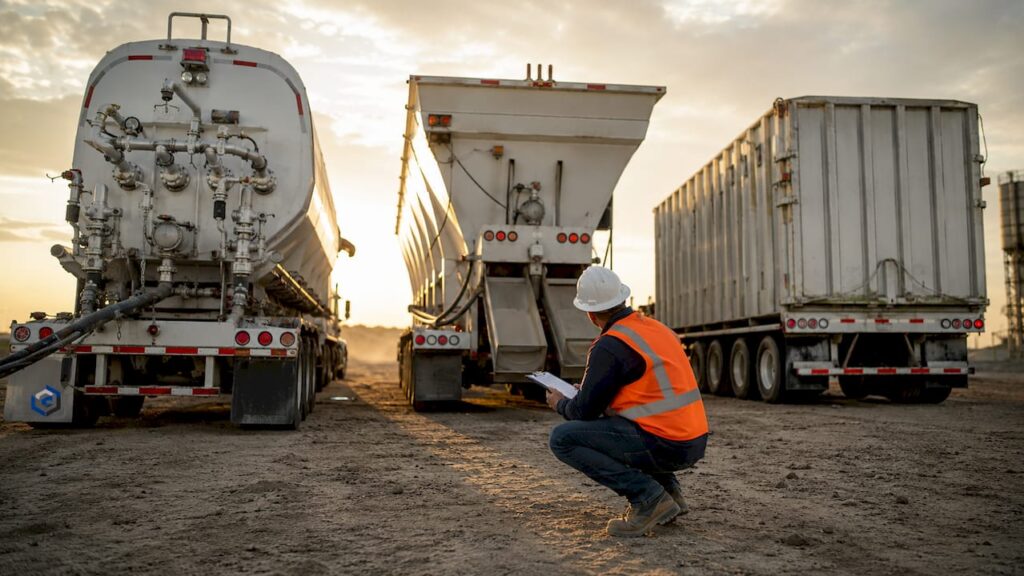
The three primary types of frac sand trailers are pneumatic tankers, hopper bottom (belly dump) trailers, and sand box container systems, each designed for distinct operational conditions, cost profiles, and site infrastructure requirements. Logistics managers in the oil and gas sector who choose the wrong trailer type pay for it in queue time, driver turnover, and unloading delays that compound across every shift. This guide breaks down each frac sand trailer type by cost, unloading speed, driver requirements, and site fit so you can match equipment to your operation with precision.
1. Types of frac sand trailers: the three core systems
The three primary frac sand transport methods are pneumatic tankers, hopper bottom trailers, and sand box container systems. Each system handles the same material but operates on a fundamentally different unloading logic. Pneumatic tankers use compressed air; hopper bottoms use gravity; sand box systems use container swaps. Understanding that distinction upfront determines every downstream decision about cost, driver hiring, and pad logistics.
Industry terminology matters here. The informal phrase “frac sand trailer” covers all three systems, but each has a recognized equipment classification. Hopper bottoms are also called belly dumps. Sand box systems are sometimes called last-mile container systems, popularized by operators like Solaris Oilfield Infrastructure and PropX. Pneumatic tankers are the same dry bulk pneumatic trailers used across cement and fly ash transport, adapted for frac sand service.
2. Pneumatic frac sand trailers: features and best use cases
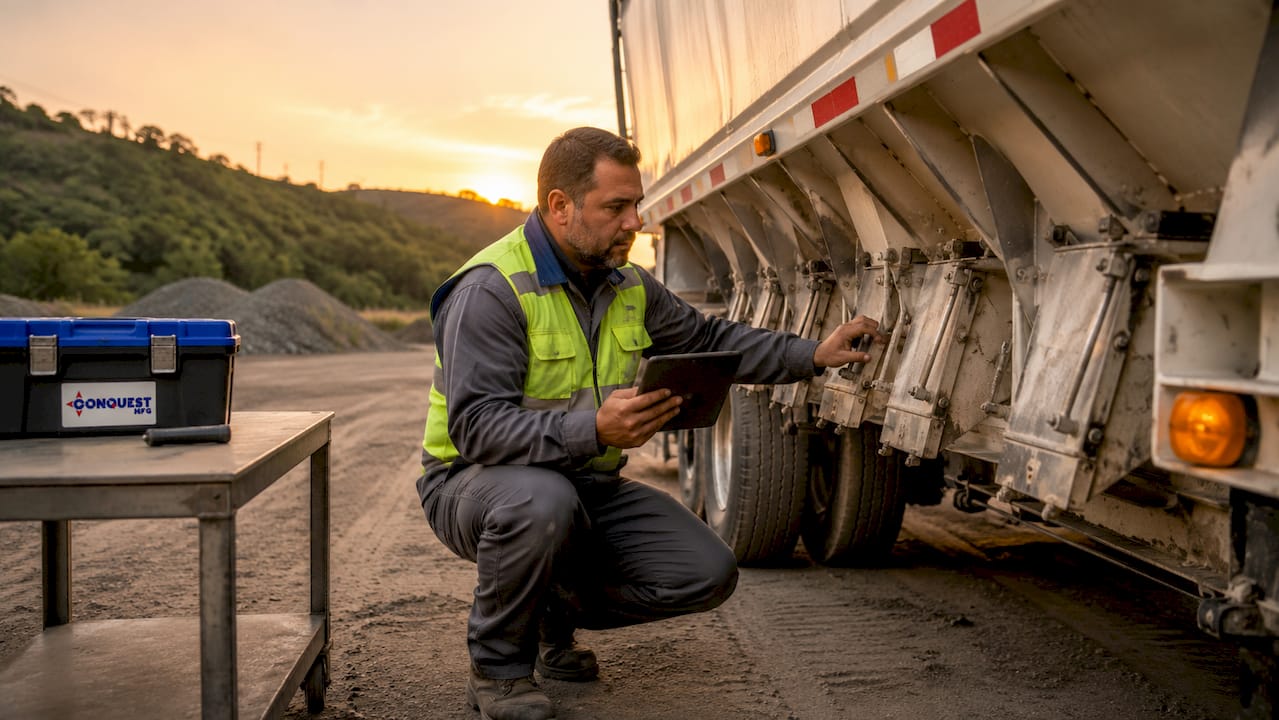
Pneumatic tankers unload frac sand by pressurizing the tank with an onboard or truck-mounted blower, pushing material through a discharge pipe directly into silos or storage vessels. This method takes between 45 and 90 minutes per load, making it the slowest of the three systems. The tradeoff is precision: pneumatic delivery minimizes dust exposure and delivers sand directly to closed silo systems without manual handling.
Leasing a pneumatic trailer costs between $800 and $1,500 or more per week, reflecting the mechanical complexity of the blower system and the specialized maintenance it requires. That cost premium does not automatically translate to higher net profitability. Pneumatic trailers command $50 to $125 more per load than hopper bottoms, but longer unload times reduce the number of turns a driver completes per day, which cuts into that rate advantage.
Driver requirements are a significant operational constraint. Pneumatic systems require blower operator certification and demonstrated oilfield experience, which narrows the available driver pool and increases scheduling complexity. This matters most during periods of high rig activity when qualified drivers are scarce across the Permian Basin and Eagle Ford.
- Best suited for established pad sites with permanent silo infrastructure
- Preferred when dust control and closed-system delivery are contractual requirements
- Higher per-load rates partially offset by fewer daily turns
- Driver certification requirements add hiring lead time
Pro Tip: If your pad site runs Solaris or PropX silo systems, confirm blower compatibility before committing to a pneumatic trailer lease. Mismatched discharge pressures cause delays that erase the dust-control advantage.
3. Hopper bottom trailers: gravity-fed efficiency for bulk sand
Hopper bottom trailers, also called belly dumps, unload frac sand through gravity-fed gates at the bottom of the trailer body. A full unload takes 20 to 30 minutes, roughly half the time of a pneumatic system. That speed advantage compounds across a fleet: a 10-truck operation running hopper bottoms completes significantly more turns per day than the same fleet running pneumatics.
Leasing costs run between $500 and $900 per week, with regional rates in some Texas markets dropping as low as $210 to $350 per week. That lower cost floor makes hopper bottoms the default choice for owner-operators and carriers entering the frac sand market without deep capital reserves. Purchase prices range from $70,000 to $130,000 or more, with typical specs around 12,975 lbs empty weight and 23.5 cubic yards capacity.
Hopper bottom trailers require no oilfield experience from drivers, which is a material advantage when hiring in competitive labor markets. Any CDL holder with flatbed or bulk experience can operate one after a brief site orientation. This accessibility expands your driver pool and reduces onboarding time compared to pneumatic systems.
- Gravity unload in 20 to 30 minutes with no mechanical systems to maintain
- Lease rates as low as $210 per week in competitive regional markets
- No specialized driver certification required
- Compatible with open-top receiving hoppers and conveyor systems at most pad sites
Pro Tip: Hopper bottoms perform best with dry, free-flowing frac sand. Moisture-sensitive dry bulk materials can bridge at the gate and slow unloading. Specify moisture content tolerances with your mine supplier before dispatch.
4. Sand box container trailer systems: drop-and-go logistics
Sand box systems use sealed, rectangular containers holding 22 to 30 tons of frac sand, hauled on standard flatbed trailers. At the wellsite, a forklift or crane swaps the full container for an empty one in 10 to 15 minutes. The driver never waits for unloading. That drop-and-go workflow is the defining operational advantage of this system.
Flatbed trailers for sand box systems cost $40,000 to $70,000, which is lower than hopper bottom purchase prices. The container cost is separate and adds to total system investment. Operators like Solaris and PropX have built proprietary container ecosystems, which means the containers themselves are often supplied by the E&P operator or the last-mile logistics provider rather than the carrier.
Sand box systems promote dust control and high load counts at infrastructure-ready wellsites. The sealed container design prevents moisture ingress and contamination during transport, which matters for proppant quality. The limitation is site dependency: sand box systems require drop frame infrastructure and container-handling equipment at the wellsite, which not every pad has.
| Feature | Sand box system |
|---|---|
| Unload time | 10 to 15 minutes (container swap) |
| Flatbed trailer cost | $40,000 to $70,000 |
| Driver wait time at pad | Minimal (drop and go) |
| Site infrastructure needed | Drop frames, forklift or crane |
| Dust control | High (sealed container) |
| Contract flexibility | Low (tied to proprietary systems) |
5. Comparing frac sand trailer types: cost, speed, and flexibility
Side-by-side comparison clarifies where each system wins and where it creates operational risk. The table below covers the metrics that matter most to logistics managers: lease cost, unload time, driver requirements, and market flexibility.
| Metric | Pneumatic tanker | Hopper bottom | Sand box system |
|---|---|---|---|
| Weekly lease cost | $800 to $1,500+ | $500 to $900 ($210 regionally) | Flatbed $40K to $70K purchase |
| Unload time | 45 to 90 minutes | 20 to 30 minutes | 10 to 15 minutes |
| Driver certification | Blower cert required | Standard CDL | Standard CDL |
| Oilfield experience needed | Yes | No | No |
| Market flexibility | Moderate | High | Low |
| Dust control | High | Moderate | High |
Hopper bottoms offer superior market flexibility because they are not tied to proprietary infrastructure and can be leased across multiple carriers and spot-market lanes. Sand box systems deliver the fastest turn times but lock you into dedicated contracts with operators who have the required drop frame equipment. Queue exposure time at wellpads is a cost that most operations managers undercount. A pneumatic trailer sitting for 90 minutes at a congested pad is a truck that is not making another run.
6. How to choose the best frac sand trailer for your operation
Selecting among frac sand trailer options requires matching equipment capabilities to your specific site conditions, contract structure, and driver availability. These steps give you a practical framework.
- Audit your pad site infrastructure. Confirm whether your wellsites have silo systems (pneumatic-compatible), open-top hoppers (hopper bottom-compatible), or drop frame and container-handling equipment (sand box-compatible). Trailer choice is constrained by what the pad can receive.
- Assess your contract structure. Sand box systems excel at major E&P sites with drop frame infrastructure and dedicated volume commitments. Hopper bottoms serve spot market and multi-customer operations better. Pneumatics fit long-term contracts where silo delivery is specified.
- Evaluate your driver pool. If you cannot source blower-certified drivers reliably, pneumatic trailers create scheduling risk. Hopper bottoms and sand box flatbeds draw from a broader CDL driver base.
- Calculate total cost per turn, not just lease rate. Factor in unload time, driver wait costs, and turn frequency. Successful logistics managers prioritize trailers that reduce downtime over those with the lowest rate per ton.
- Account for regional rig activity. Increased rig activity shifts demand regionally, which affects trailer availability and lease rates. In high-activity basins like the Permian, hopper bottom availability tightens quickly. Build flexibility into your fleet mix.
- Consider material properties. Frac sand with higher moisture content or fine grain sizes performs differently across trailer types. Review the role of semi trailers in oilfield logistics to understand how equipment design affects material integrity during transport.
Key takeaways
Choosing the right frac sand trailer type requires matching unloading method, cost structure, and site infrastructure to your specific operational conditions.
| Point | Details |
|---|---|
| Three core trailer types | Pneumatic, hopper bottom, and sand box systems each serve distinct site and contract conditions. |
| Unload speed drives turn rates | Sand box swaps take 10 to 15 minutes; pneumatics take 45 to 90 minutes, directly affecting daily load counts. |
| Hopper bottoms offer most flexibility | Lower lease costs and no specialized driver certification make them the default for spot market operations. |
| Queue exposure is a hidden cost | Drop-and-go sand box systems reduce pad wait time and improve net profitability on high-volume sites. |
| Infrastructure determines fit | Pneumatics need silos, sand boxes need drop frames. Hopper bottoms work with the widest range of receiving setups. |
What I’ve learned about picking the right frac sand trailer
The most common mistake I see logistics managers make is optimizing for lease rate instead of total cost per turn. A hopper bottom at $210 per week looks attractive until you account for a pad that runs slow conveyors and backs up your trucks for an hour per load. That math changes fast.
Pneumatic trailers get oversold on the dust-control argument. Yes, closed-system delivery matters at certain sites. But the driver certification requirement is a real constraint that creates scheduling gaps during peak rig activity. If you cannot guarantee a certified blower operator on every dispatch, you are building fragility into your operation.
Sand box systems are genuinely impressive at high-volume dedicated sites. The drop-and-go workflow is the most efficient pad-level logistics model available right now. The catch is that you are operationally dependent on the E&P operator’s infrastructure. When that contract ends or the pad shuts down, your flatbeds need to find work elsewhere, and not every site accepts them.
My recommendation for most operations managers in 2026: build your core fleet around hopper bottoms for flexibility, add pneumatic capacity for contracts that specifically require silo delivery, and evaluate sand box systems only when you have a dedicated, long-term volume commitment with a pad that has the right infrastructure. Procurement decisions should also factor in dispatch transparency and mine load variability, not just the rate per ton. The future of industrial trailers points toward faster turn times and tighter pad logistics. Build your fleet for that direction now.
— Peter
Explore Conquestmfgusa’s industrial trailer solutions
Conquestmfgusa manufactures a full range of commercial bulk transport trailers built for the demands of oil and gas operations, including dry bulk pneumatic trailers, sand hoppers, bottom dumps, and end dumps. Every unit is engineered for durability and tailored to the specific material handling requirements of oilfield logistics.
Whether you are sourcing pneumatic trailers for silo delivery or sand hoppers for high-volume pad operations, Conquestmfgusa builds equipment to your exact specifications. Our team works directly with logistics and operations managers to match trailer design to site conditions, contract requirements, and fleet composition. Contact Conquestmfgusa to discuss your frac sand transport requirements and get a quote tailored to your operation.
FAQ
What are the main types of frac sand trailers?
The three main types are pneumatic tankers, hopper bottom (belly dump) trailers, and sand box container systems. Each uses a different unloading method and suits different site infrastructure and contract conditions.
How long does it take to unload each frac sand trailer type?
Pneumatic trailers take 45 to 90 minutes, hopper bottoms take 20 to 30 minutes, and sand box container swaps take 10 to 15 minutes. Unload time directly affects how many turns a driver completes per day.
Do hopper bottom trailers require specialized driver training?
No. Hopper bottom trailers require only a standard CDL and no oilfield-specific certification, unlike pneumatic systems that require blower operator certification and demonstrated oilfield experience.
When should I choose sand box trailers over hopper bottoms?
Sand box systems are best for dedicated, high-volume contracts at wellsites with drop frame infrastructure and container-handling equipment. Hopper bottoms are better for spot market operations and sites without proprietary container systems.
What is the weekly lease cost difference between trailer types?
Hopper bottom leases range from $210 to $900 per week depending on region, while pneumatic trailers lease for $800 to $1,500 or more per week. That cost gap makes hopper bottoms the lower-risk entry point for most frac sand hauling operations.