
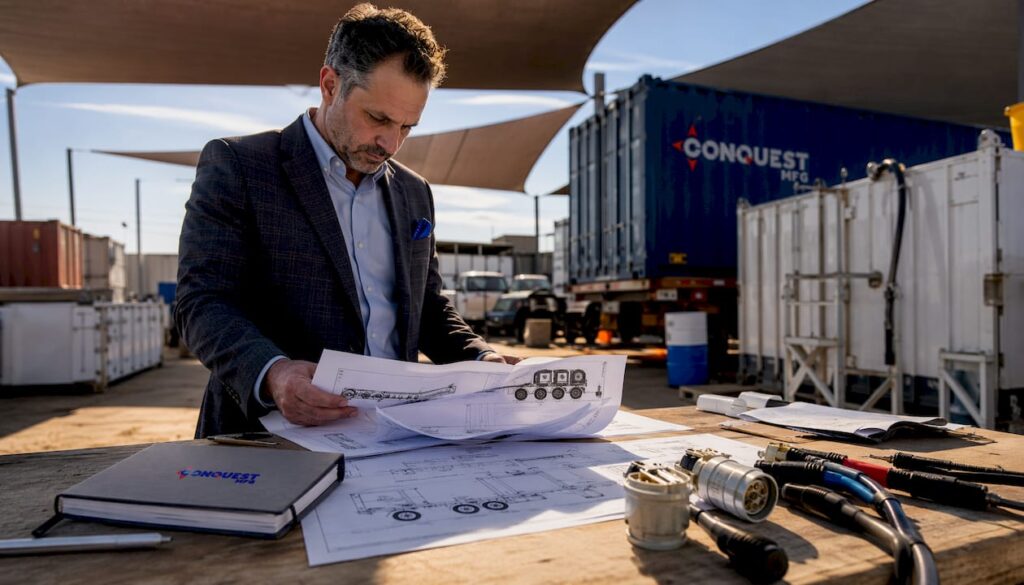
Match the complete transport configuration to your cargo, route, and site constraints — not the highest declared capacity. That single rule, applied consistently, is what separates equipment that performs from equipment that creates permit violations, accessorial charges, and downtime. Conquest Mfg recommends three immediate steps: collect precise cargo data (weight, dimensions, center of gravity, loading method), run a preliminary route check against bridge formulas and state weight limits, and request a load-distribution sketch from your vendor before any purchase order is issued. The decision checklist and sample spec in Section 9 are designed to hand directly to a supplier.
Configuration drives legal payload. Wrong trailer selection frequently produces accessorial charges and rescheduling in capacity-constrained markets — the right configuration eliminates most of that risk before the first load moves.
Table of Contents
- What questions should you answer before choosing freight equipment?
- Why chassis, axle layout, and loading system matter more than declared capacity
- Which equipment type fits your specific industrial use-case?
- U.S. compliance and operational constraints to validate before you buy
- How do you build a realistic total cost of ownership for freight equipment?
- How do you procure and accept a custom-built unit from spec to delivery?
- Maintenance, inspection, and operator training essentials
- What should your vendor-ready spec sheet include?
- Environmental and sustainability considerations in equipment selection
- Safety features and risk mitigation in freight equipment design
- What should you ask a vendor before committing to a purchase?
- What do successful equipment configurations look like in practice?
- Key Takeaways
- The configuration mistake most buyers make — and how to avoid it
- Conquest Mfg builds the equipment this guide describes
- Useful sources and further reading
What questions should you answer before choosing freight equipment?
Procurement mistakes start with incomplete cargo data. Before comparing any equipment families, work through this buyer questionnaire.
Cargo data to collect:
- Gross weight and tare weight of the load
- Dimensions: length, width, height, and center-of-gravity position
- Loading and unloading method (pneumatic, gravity, crane, conveyor, pump)
- Frequency of use and cycle time per shift
- Special handling requirements: hazmat classification, temperature sensitivity, contamination risk
- Environmental exposure: corrosive materials, abrasive bulk solids, high-pressure fluids
Site and facility constraints:
- Dock heights and loading-platform elevations at origin and destination
- Turning radii and access-road widths at the job site
- Available lift equipment and ground-bearing capacity
- Storage footprint and maneuvering clearance
Operational constraints:
- Typical routes and states traversed (permit-sensitive corridors vary by state)
- Seasonal weight restrictions on rural and secondary roads
- Contractor availability for pilot cars and escort services
- Facility constraints such as dock height and maneuverability can render otherwise ideal trailers unusable — confirm site geometry before finalizing dimensions.
Why chassis, axle layout, and loading system matter more than declared capacity
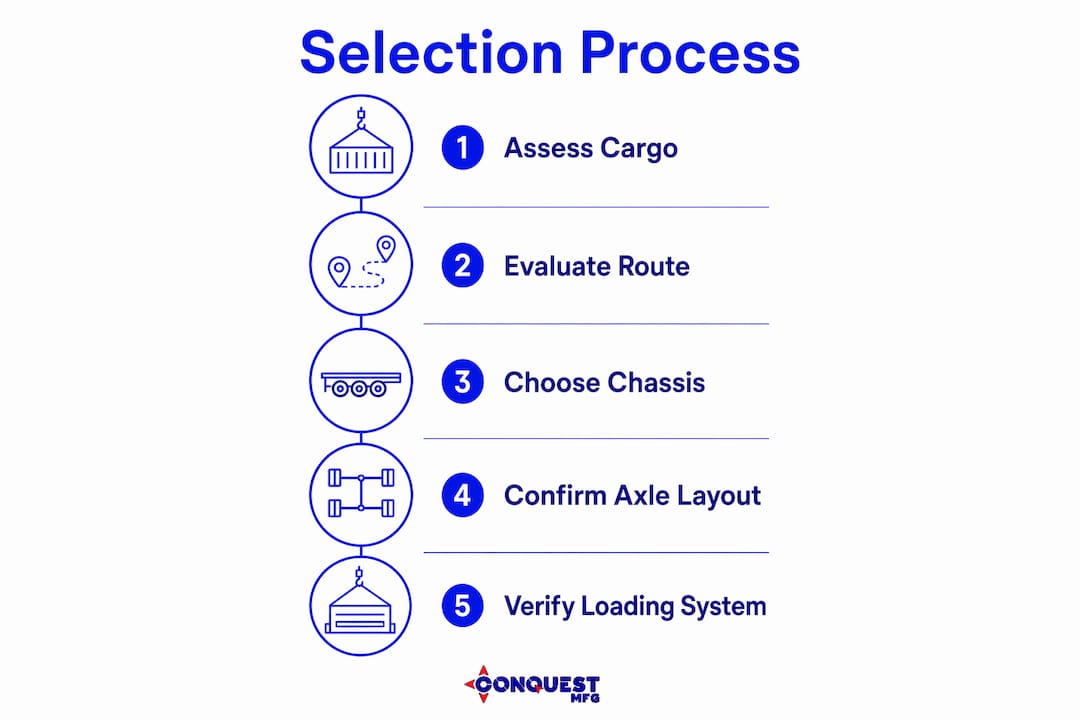
Declared capacity is a structural figure. Legal payload is what the regulations allow on a specific route with a specific axle configuration. The two numbers are rarely identical, and the gap between them is where procurement errors live.
Technical vs. legal payload defined:
| Term | Definition | Why It Matters |
|---|---|---|
| Gross Combined Weight (GCW) | Tractor + trailer + cargo | Federal limit is 80,000 lbs on Interstate highways |
| GVWR | Manufacturer’s max loaded trailer weight | Sets structural design limit |
| Legal payload | GCW minus tare, constrained by axle formula | Actual cargo weight you can legally haul |
| King-pin load | Weight transferred to the fifth wheel | Affects tractor spec and steer-axle compliance |
Axle spacing and grouping determine how the bridge formula distributes weight across the road structure. A trailer with more axles spread further apart can carry more legal payload on the same route — the declared capacity figure tells you nothing about this. Configuration must match the whole transport project, not just the cargo weight in isolation.
Platform height, ramp design, and loading angles are equally critical for self-propelled or crane-loaded equipment. A low deck height reduces total transport height and may eliminate the need for an oversize permit entirely.
Pro Tip: Request a load-distribution drawing and axle-load table before approving any purchase order. Ask the vendor to tie material grade and weld specifications to fatigue-life expectations in writing.
Which equipment type fits your specific industrial use-case?
The profiles below map each equipment family to its primary cargo, key specs to request, and common constraints. Suppliers often quote structural capacity that differs from what regulations allow on specific routes — always request both technical and legal payload figures.
Equipment family profiles:
- Pneumatic dry bulk trailers: Carry cement, fly ash, lime, frac sand, and similar free-flowing dry materials. Request discharge rate (CFM), working pressure rating, number of compartments, and unloading hose configuration. Oilfield and concrete supply operations depend on rapid, dust-free transfer. See Conquest Mfg’s breakdown of pneumatic trailer advantages for industrial material handling.
- Vacuum tank trailers (steel and aluminum): Steel tanks handle aggressive waste streams, drilling fluids, and hydrovac spoil. Aluminum tanks reduce tare weight for lighter-duty liquid waste or where corrosion resistance is secondary to payload. Specify tank capacity (gallons), pump type, vacuum rating, and inlet/outlet valve configuration.
- Bottom dump trailers: Preferred for granular materials — aggregate, sand, gravel — where controlled, linear discharge is needed. Key specs: gate width, discharge opening geometry, and axle configuration for the target route.
- End dump trailers: Higher discharge speed than bottom dumps; suited for loose bulk material at sites with adequate clearance above the trailer. Specify body material (steel vs. aluminum), body geometry (half-round vs. rectangular), and hydraulic cylinder rating.
- Sand hoppers and sand chassis: Purpose-built for frac sand logistics at well sites. Hopper geometry, discharge gate size, and chassis ground clearance are the critical spec items. Conquest Mfg’s frac sand trailer guide covers site-specific configuration options.
- Intermodal chassis: Match chassis length and twist-lock pattern to the container size (20-foot, 40-foot, 45-foot, 53-foot). Freight mode selection affects axle configuration — domestic intermodal chassis differ from port chassis in axle spacing and suspension spec.
- Portable cement pig silo trailers: Self-erecting silos for on-site cement storage. Specify silo capacity (tons), discharge height, and transport dimensions for route compliance.
- Mobile and stationary concrete batch plants: Mobile plants suit projects requiring relocation; stationary plants serve fixed ready-mix operations. Specify output capacity (cubic yards per hour), aggregate bin count, mixer type, and control system. Conquest Mfg’s batch plant production guide details configuration options for both plant types.
U.S. compliance and operational constraints to validate before you buy
Federal and state regulations materially change which trailer you can legally operate on a given route. Validate these constraints before finalizing any specification.
- Federal bridge formula: Under 23 U.S.C. § 127, axle spacing and grouping determine the maximum weight per axle group. Adding axles or spreading them further apart increases legal payload — this is an engineering decision, not just a compliance checkbox.
- 80,000 lb Interstate limit: The federal gross weight ceiling applies to all Interstate highways. Heavier loads require a state oversize/overweight (OS/OW) permit, which varies by state, route, and season.
- Oversize/overweight permits: OS/OW permits add cost, restrict travel hours, and may require pilot cars or police escorts. Equipment configured to stay within legal limits on your primary routes eliminates most of this overhead.
- PHMSA/DOT tank regulations: Vacuum tank trailers and liquid bulk trailers carrying hazardous materials fall under 49 CFR Parts 178–180. Specify the correct DOT specification (e.g., DOT 407, DOT 412) for the commodity being transported.
- Seasonal weight restrictions: Many states impose spring load restrictions on secondary roads. Route planning must account for these windows, particularly for construction and oilfield operations on rural corridors.
- Site access validation: Bridge clearances, weight-posted roads, and municipal restrictions can block an otherwise legal load. Complete a route survey — including bridge ratings and overhead clearances — before the purchase order is issued.
Route analysis completed before purchase prevents the most expensive procurement mistakes. Bridge clearance, weight-restricted roads, and permit requirements materially affect equipment choice and operating cadence. A trailer that is legal in Texas may require a permit in Oklahoma on the same corridor.
How do you build a realistic total cost of ownership for freight equipment?
Purchase price is the most visible line item and rarely the largest over a five-year horizon.
| TCO Component | What Drives It | How to Control It |
|---|---|---|
| Purchase price | Spec complexity, material grade, axle count | Standardize specs across fleet where possible |
| Customization engineering | Change orders, late spec changes | Lock specs before PO issuance |
| Permitting and admin fees | OS/OW frequency, state count | Configure to stay within legal limits on primary routes |
| Scheduled maintenance | Axle count, suspension type, hydraulic systems | Follow OEM intervals; negotiate service contracts |
| Unscheduled downtime | Weld quality, component grade, operator training | Insist on FAT and weld inspection reports |
| Fuel and operational penalties | Tare weight, aerodynamics, idle time | Specify aluminum where payload gain justifies cost |
| Depreciation and residual value | Spec standardization, condition at trade | Maintain service records from day one |

Specialized equipment changes recurring costs in ways general freight equipment does not. A trailer requiring OS/OW permits on every run adds pilot-car fees, restricted travel windows, and administrative overhead that compounds across a fleet. Upfront spec work — selecting the right configuration before purchase — is the single highest-return investment in the procurement process. For fleet-level TCO analysis, Conquest Mfg’s trailer fleet optimization guide provides a structured framework.
How do you procure and accept a custom-built unit from spec to delivery?
A disciplined procurement workflow eliminates most engineering change orders and delivery surprises.
| Stage | Key Actions | Output |
|---|---|---|
| Define cargo and route | Complete buyer questionnaire; run route survey | Cargo data sheet and route constraints summary |
| Request engineering drawings | Provide cargo data to vendor; request axle-load table | Preliminary drawings with load-distribution sketch |
| Confirm axle/load distribution | Review drawings against legal payload targets | Approved load-distribution drawing |
| Issue purchase order | Specify components, materials, certifications, FAT scope | Signed PO with explicit technical schedule |
| Production and FAT | Attend factory acceptance test; verify checklist items | Signed FAT report |
| Transport and commissioning | Coordinate delivery logistics; complete operator training | Commissioned unit in service |
Factory acceptance test (FAT) checklist items to insist on:
- Dimensional verification against approved drawings
- Axle-load verification under simulated load conditions
- Ramp function and loading-angle test (where applicable)
- Brake and suspension validation
- Weld inspection report (visual and NDT where specified)
- Hydraulic system pressure test and leak check
- Unloading system function test (pump rate, discharge time)
Pro Tip: Build production lead time into your project schedule from the first planning meeting. Custom-built units at Conquest Mfg carry lead times that depend on specification complexity and current production slots — confirm availability before committing to a project start date.
For heavy truck parts testing standards that apply during FAT, reference the component-level testing protocols your vendor should meet before sign-off.
Maintenance, inspection, and operator training essentials
A custom asset is only as reliable as the maintenance program behind it.
- Daily pre-trip checks: Tire condition and inflation, brake function, lighting, hydraulic fluid level, king-pin engagement, and securement hardware.
- Monthly inspections: Axle and suspension fastener torque, brake lining wear, hydraulic hose condition, weld integrity at high-stress joints, and unloading system component wear.
- Annual service items: Full brake system service, suspension rebuild or inspection per OEM spec, hydraulic fluid and filter replacement, structural weld inspection (NDT where required), and DOT annual inspection filing.
- Operator training essentials: Safe loading and unloading procedures specific to the equipment type, emergency shutdown sequences, proper cargo securement and lashing to DOT standards, and basic troubleshooting for pneumatic, hydraulic, and vacuum systems.
- Inspection documentation: Maintain a logbook for every inspection event. Documented service history directly supports residual value and demonstrates compliance during roadside inspections.
Conquest Mfg’s industrial equipment safety checklist provides a structured inspection template aligned to these intervals.
What should your vendor-ready spec sheet include?
A complete spec handed to a vendor at first contact compresses the quoting cycle and reduces change orders.
Decision checklist:
- Cargo: gross weight, dimensions, center of gravity, commodity classification
- Route: primary states, bridge formula compliance target, OS/OW permit tolerance
- Site: dock height, turning radius, ground-bearing capacity, lift equipment available
- Legal: target GVWR, axle configuration, DOT specification (for tanks)
- Operating cadence: loads per day, annual mileage, seasonal restrictions
- TCO triggers: permit frequency target, maintenance budget, residual value floor
Sample spec fields to provide to vendors:
- Cargo drawings or commodity data sheet
- Desired tare weight and GVWR
- Axle count, spacing, and grouping
- Material grade (steel specification or aluminum alloy)
- Critical dimensions: overall length, width, platform height, deck angle
- Loading and unloading interface: connection sizes, pump spec, discharge rate
- Required certifications: DOT specification, state registration requirements
- FAT scope: dimensional check, load test, brake validation, weld inspection
Reference the FAT checklist in Section 7 when writing the acceptance criteria into your purchase order.
Environmental and sustainability considerations in equipment selection
Material choice and configuration both carry environmental implications that affect operating cost and regulatory exposure. Aluminum construction reduces tare weight, which lowers fuel consumption per ton-mile and extends tire life. For pneumatic and vacuum systems, specifying efficient compressor and pump configurations reduces engine load and fuel burn during discharge operations.
Payload optimization matters here too. A trailer configured to carry maximum legal payload per trip reduces the total number of trips required, cutting fuel consumption and emissions across the project. Specifying durable materials and corrosion-resistant coatings extends service life, reducing the manufacturing energy embedded in replacement units. For oilfield and construction buyers, equipment that stays in service longer also reduces the waste stream from decommissioned trailers.
Safety features and risk mitigation in freight equipment design
Safety is built into the specification, not added after the fact. Axle configuration and load distribution prevent overloading conditions that cause tire failures and loss of control. Brake specifications must match the loaded GVWR — undersized brakes on a heavy-haul trailer are a design defect, not an operator error.
For bulk material trailers, discharge system interlocks prevent accidental release during transit. Vacuum tank trailers require pressure relief valves rated to the tank’s working pressure, and all fittings must be compatible with the commodity being transported. End dump and bottom dump trailers need hydraulic cylinder ratings that account for off-level discharge conditions common on construction sites. Conquest Mfg engineers these safety parameters into every custom build, and the FAT process verifies them before delivery.
What should you ask a vendor before committing to a purchase?
Vendor evaluation goes beyond price. The questions below separate capable custom manufacturers from catalog resellers.
Engineering capability: Can the vendor provide load-distribution drawings and axle-load tables for your specific cargo and route? A vendor who cannot produce these documents is not equipped for custom industrial work.
Production transparency: What is the current lead time, and how is it affected by specification changes after PO issuance? Transparent lead-time communication prevents project schedule failures.
FAT process: Does the vendor conduct a factory acceptance test, and will they provide a signed inspection report? This is non-negotiable for custom-built units.
Post-delivery support: What warranty terms apply, and does the vendor offer field service or parts support in your operating region? For oilfield and construction buyers, downtime cost makes post-delivery support a financial consideration, not just a convenience.
References and track record: How many units of this specific type has the vendor built? Request references from buyers in the same industry and application.
What do successful equipment configurations look like in practice?
Frac sand logistics, Permian Basin: An oilfield services operator needed high-cycle frac sand delivery to well sites with limited road access. The configuration selected was a sand hopper chassis with a low-profile frame for site clearance, a high-capacity discharge gate, and an axle spread optimized for the Texas bridge formula. The result was legal operation at maximum payload without OS/OW permits on the primary corridor.
Ready-mix concrete supply, Gulf Coast construction project: A contractor required on-site cement storage between batch plant deliveries. Portable cement pig silo trailers provided self-erecting storage capacity that relocated with the project, eliminating the cost of fixed silo installation at each site. The role of semi trailers in construction projects covers additional configuration examples for site-integrated equipment.
Vacuum tank for industrial waste transfer: A facility manager handling drilling fluid waste specified a steel vacuum tank trailer with a DOT 407-compliant tank, dual-inlet configuration, and a high-vacuum pump rated for viscous material. Steel construction was selected over aluminum for chemical compatibility with the waste stream.
Key Takeaways
Matching configuration to cargo, route, and site constraints is the single decision that determines legal payload, permit exposure, and total cost of ownership for any industrial freight equipment purchase.
| Point | Details |
|---|---|
| Configuration over capacity | Axle layout, spacing, and loading system determine legal payload — declared capacity alone misleads buyers. |
| Validate routes before purchase | Bridge formula compliance, OS/OW permit exposure, and seasonal restrictions must be confirmed before the PO is issued. |
| FAT is non-negotiable | Insist on a signed factory acceptance test report covering dimensional, load, brake, and weld checks for every custom build. |
| TCO extends beyond purchase price | Permit frequency, downtime, and maintenance costs often exceed the purchase price difference between configurations over five years. |
| Conquest Mfg custom builds | Conquest Mfg engineers load-distribution drawings, conducts FAT, and supports custom trailer and batch plant procurement across construction, transport, and oilfield applications. |
The configuration mistake most buyers make — and how to avoid it
The most consistent procurement error we see is a buyer who leads with payload capacity and treats everything else as secondary. They specify the highest-rated trailer in the category, then discover during route planning that the axle configuration requires an OS/OW permit on their primary corridor, or that the platform height puts them over the legal transport height for their cargo. Both problems are solvable at the specification stage. Neither is solvable cheaply after the purchase order is signed.
The second most common mistake is skipping the site visit. Dock heights, turning radii, and ground-bearing capacity at the delivery site have disqualified trailers that were otherwise perfectly specified. A 15-minute site measurement prevents a costly equipment swap.
Conquest Mfg’s approach is to work through the buyer questionnaire and route analysis before any drawing is produced. Engineering drawings and axle-load tables are standard deliverables, not optional add-ons. The FAT process is structured, documented, and signed off before a unit leaves the facility. That sequence — cargo data first, configuration second, compliance third, production last — is what makes a custom build reliable from day one.
Conquest Mfg builds the equipment this guide describes
Custom-engineered trailers and batch plants — specified to your cargo, route, and site — are Conquest Mfg’s core business. The product range covers pneumatic dry bulk trailers, steel and aluminum vacuum tank trailers, bottom and end dump trailers, sand hoppers, intermodal chassis, portable cement pig silo trailers, and mobile and stationary concrete batch plants. Every unit is built to a confirmed specification with load-distribution drawings and a factory acceptance test included.
To request a quote, send the completed sample spec from Section 9 — cargo data sheet, axle/load table, critical dimensions, and FAT scope — to Conquest Mfg’s engineering team. A complete spec compresses the quoting cycle and eliminates the change orders that delay production. Financing and dealer partnership options are available for qualified buyers. Visit the construction equipment solutions page to start the process or request an engineering review directly.
Useful sources and further reading
- How to Choose the Right Semi Trailer for Transport Projects — technical buyer’s guide covering load-distribution drawings, axle-load tables, platform height, and ramp specifications.
- Choosing the Right Trailer for Your Freight — stepwise cargo-analysis checklist and guidance on requesting technical vs. legal payload figures from suppliers.
- How Trailer Selection Impacts Cost, Capacity, and Transit Performance — industry analysis linking trailer configuration to accessorial charges, on-time performance, and facility constraint validation.
- Complete Guide to Freight Types — freight-type taxonomy covering dry bulk, flatbed, oversized, and heavy-haul categories with recommended equipment per class.
- Master the freight booking process in 2026 — practical guidance on freight booking, mode selection, and procurement timing relevant to equipment-to-mode decisions.
- FHWA Bridge Formula Weights (23 U.S.C. § 127) — primary federal source for axle spacing and weight distribution requirements on Interstate highways.
- 49 CFR Parts 178–180 (PHMSA/DOT) — governing regulations for tank trailer specifications, hazardous material compatibility, and inspection requirements.