

A bridge building equipment checklist is defined as a structured, stage-based inventory of every machine, tool, and safety item required to execute a bridge construction project within compliance and schedule. Without it, project managers face equipment gaps, OSHA violations, and costly site shutdowns. The checklist spans heavy lifting machinery, concrete production systems, safety gear, and calibration tools. Organized by construction stage and equipment function, it gives you a systematic way to confirm readiness before the first bolt is torqued. This guide covers every major category your bridge project equipment list must include.
1. What belongs on your bridge building equipment checklist?
The bridge building equipment checklist is the industry’s standard project control document, known formally as a construction equipment mobilization register. It confirms that every machine on site is certified, calibrated, and matched to the specific erection method your team has selected. A checklist that only lists equipment names without noting certifications, capacities, and crew assignments is incomplete. Project managers who treat it as a living document, updated at each construction stage, consistently outperform those who treat it as a one-time procurement list.
The checklist divides naturally into six functional categories: heavy lifting and erection, concrete works, safety and fall protection, survey and alignment, calibration and quality control, and mobilization logistics. Each category maps to a distinct construction phase. Skipping any one category creates a gap that typically surfaces as a delay, a safety incident, or a failed inspection.
2. What are the essential heavy lifting and erection machines?
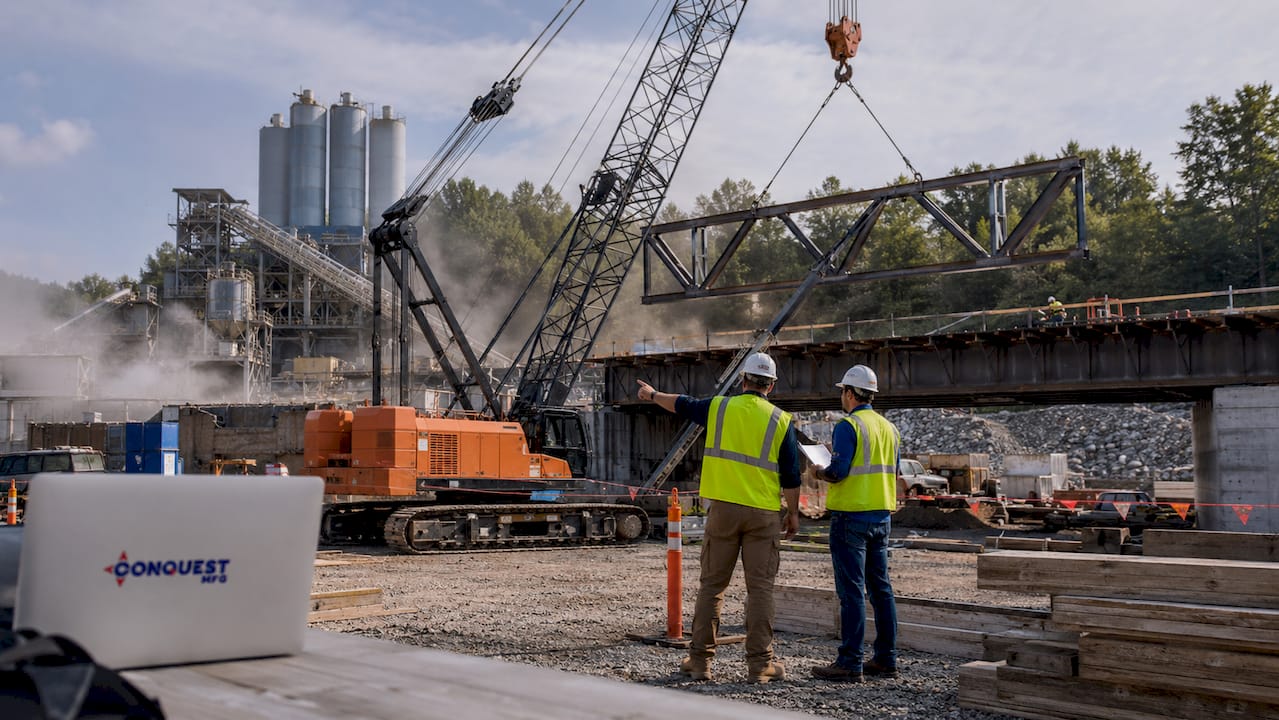
Heavy lifting equipment is the core of any bridge construction tools inventory. Hydraulic strand jack systems can lift synchronously at 120 points with ±1mm accuracy, making them the preferred choice for precision incremental launching. Cranes handle loads from 40 to over 900 tons depending on span length, with floating cranes required for water sites and rail-mounted gantries preferred for spans up to 70 meters.
Your lifting equipment checklist must include:
- Hydraulic strand jack systems with synchronous control units and load monitoring displays
- Launching gantries sized to the span length and girder weight
- Crawler cranes with documented load charts for each configuration
- Floating cranes for river, bay, or coastal bridge sites
- Rail-mounted gantries for repetitive span construction on viaducts
- Fixed-boom telehandlers with 8,000–12,000 lb lift capacity and 42–56 ft lift height for deck and approach work
- Rotating telehandlers for confined urban sites and major bridge packages
Equipment compatibility with bridge-specific attachments, including truss booms and suspended work platforms, is often more critical than raw lifting capacity. Downtime costs on a cantilever launch can exceed the cost of the machine itself, so dealer support proximity belongs on your checklist alongside the equipment name.
Pro Tip: List the exact configuration, boom length, and counterweight setup for each crane on your checklist. A crane that meets load requirements in one configuration may fail in another, and discovering that on site costs you a full shift.
3. What concrete works equipment should be on the checklist?
Concrete production equipment is non-negotiable for bridge decks, piers, and foundations. Batching plants are the primary production unit, and their selection determines concrete consistency, pour volume, and schedule compliance. A stationary dry-mix batching plant suits large, fixed-site projects with high daily volume. A mobile batching plant works for remote or multi-span projects where the plant must relocate as work progresses.
The concrete works section of your bridge project supply checklist should include:
- Stationary or mobile batching plant matched to daily pour volume requirements
- Concrete pumps with reach specifications confirmed against pier height and deck elevation
- Truck mixers in sufficient quantity to maintain continuous pour cycles
- Formwork systems for piers, abutments, and deck soffits
- Vibrators and screeds for consolidation and surface finishing
The table below compares batching plant types for common bridge project scenarios:
| Project type | Recommended plant | Key advantage |
|---|---|---|
| Large fixed-site bridge | Stationary dry-mix plant | High output, consistent mix quality |
| Remote or multi-span project | Mobile batching plant | Relocates with the work front |
| Urban bridge with limited access | Compact mobile plant | Reduced footprint, faster setup |
Integrating your batching plant schedule with the pour sequence prevents the most common concrete works delay: the plant producing mix faster than the pump can place it, or vice versa. Confirm pump reach and output rate against the plant’s rated capacity before mobilization. For detailed setup guidance, the concrete plant installation guide from Conquest Mfg covers the full process.
4. Which safety equipment is critical on a bridge construction site checklist?
Safety equipment is a legal requirement under OSHA 1926.500, not an optional add-on. A comprehensive daily bridge construction safety inspection covers 37 critical points across six operational sections, taking 20–30 minutes to complete. Those sections are Pre-Inspection Verification, Regulatory Compliance, Physical Inspection, Operational Verification, Findings and Corrective Actions, and PPE Compliance. Missing any section on a given day creates a documented compliance gap.
Your safety and inspection checklist must confirm the following items daily:
- Scaffolding systems inspected and tagged by a competent person
- Full-body harnesses with shock-absorbing lanyards issued and logged
- Safety nets installed at all open deck edges and pier tops
- Emergency exits marked and unobstructed on all work platforms
- First aid kits stocked and accessible within 50 feet of active work
- Fire extinguishers rated and mounted at all fuel storage and welding stations
- Identified hazards documented with corrective action assigned and dated
- PPE compliance verified for every worker before shift start
The OSHA 1926.500 compliance documentation requirement means your superintendent must sign off on the daily checklist and retain records for the project duration. Digital checklist tools like POPProbe allow real-time completion and automatic record storage, which simplifies audit preparation significantly.
Pro Tip: Assign the daily safety inspection to a dedicated safety officer, not the site superintendent. Superintendents under schedule pressure routinely compress inspection time. A dedicated role produces complete records and catches hazards that production-focused supervisors miss.
For a broader view of equipment safety compliance, Conquest Mfg’s industrial checklist resource covers verification steps applicable across construction manufacturing environments.
5. How to organize your checklist for mobilization and crew coordination
Mobilization planning is where most equipment checklists fail. The list confirms what equipment is coming, but not whether the crew assigned to operate it is certified, whether spare parts are on site, or whether the assembly rate matches the launch method selected. Larger modular components require 2–4 certified riggers and a QA inspector during bolting operations. That crew requirement must appear on your checklist alongside the equipment item, not in a separate HR document.
Your mobilization checklist must confirm:
- Equipment certifications current and on file for every machine before it leaves the yard
- Operator qualifications verified against the specific machine type and configuration
- Spare parts inventory confirmed for high-wear items: hydraulic seals, crane wire rope, pump wear plates
- Crew composition matched to the erection method, with rigger and QA inspector counts confirmed
- Resource-loaded schedule showing equipment utilization by day and crew assignment by task
Failing to align crew composition with the chosen launch method is the single most common equipment planning error on bridge projects. You can have every machine on site and still lose a week because you have three riggers when the method requires five.
A resource-loaded schedule, built in Primavera P6 or Microsoft Project, links each equipment item to a specific task and crew. When the schedule slips, the resource-loaded version immediately shows which equipment sits idle and which crew is the constraint. That visibility is what separates a recoverable delay from a project-wide shutdown.
6. What calibration and quality control items belong on the checklist?
Calibration is a strict requirement, not a best practice. Hydraulic jacks, tensioning tools, and torque wrenches must be calibrated annually and re-validated immediately before any high-precision bridge erection project. An out-of-calibration torque wrench on a high-strength bolt connection is a structural liability that no inspection certificate can retroactively fix.
Your quality control checklist must include:
- Pre-assembly structural inspection verifying all components against packing lists, checking for shipping damage, corrosion, and dimensional accuracy
- Mill test reports confirmed on file for all structural steel before erection begins
- Welding inspection certificates verified for all shop-welded connections
- Hydraulic jack calibration records dated within the required cycle and signed by a certified technician
- Torque wrench calibration tags physically attached to each tool and confirmed before use
- Survey instrument calibration for total stations, laser levels, and alignment tools
| Calibration item | Required cycle | Consequence of non-compliance |
|---|---|---|
| Hydraulic jacks | Annual + pre-project | Incorrect load application, structural failure risk |
| Torque wrenches | Annual + pre-project | Under or over-torqued connections, bolt failure |
| Total stations | Annual | Alignment errors, geometric non-compliance |
| Laser levels | Annual | Grade and elevation errors in deck pours |
Pre-assembly inspection of structural components against packing lists is frequently skipped under schedule pressure. Discovering a missing or damaged panel after erection has begun triggers a site shutdown that costs far more time than the inspection would have taken.
Key takeaways
A complete bridge building equipment checklist organized by construction stage and function is the most reliable tool for preventing compliance failures, crew mismatches, and costly site shutdowns.
| Point | Details |
|---|---|
| Organize by construction stage | Structure your checklist across lifting, concrete, safety, calibration, and mobilization phases. |
| Match crew to erection method | Confirm rigger count and QA inspector assignment before mobilization, not during. |
| Calibrate before every project | Hydraulic jacks and torque wrenches require annual calibration plus re-validation before high-precision work. |
| Daily safety inspections are mandatory | OSHA 1926.500 requires a 37-point daily inspection covering six operational sections. |
| Prioritize attachment compatibility | Equipment that accepts bridge-specific attachments reduces fleet size and logistical complexity on site. |
Why I think most bridge equipment checklists miss the point
Most checklists I see are procurement lists dressed up as project control documents. They confirm that a crane is ordered and a batching plant is scheduled. They do not confirm that the crane operator holds the right certification for that specific configuration, that the batching plant output rate matches the pump’s placement capacity, or that the rigger count aligns with the launch method selected.
Bridge erection equipment must be treated as an integrated system aligned with the bridge’s structural behavior at each construction stage. A crawler crane that works perfectly for a simple span becomes a liability on a cantilever launch if the operator has never run that method. The checklist needs to capture that distinction.
My advice: build your checklist in layers. The first layer is equipment type and capacity. The second layer is certification and calibration status. The third layer is crew assignment and method compatibility. Most project managers stop at layer one. The teams that finish on schedule and pass every inspection work through all three.
— Sam
How Conquest Mfg supports your bridge construction project

Conquest Mfg manufactures the concrete production equipment that bridge projects depend on, including stationary dry-mix and mobile concrete batch plants built for the output volumes and mix consistency that deck pours and pier foundations require. When your bridge project supply checklist calls for a batching plant that can relocate between spans or sustain continuous production on a fixed site, Conquest Mfg delivers equipment built to those specifications. Explore the full range of construction equipment solutions available for bridge and infrastructure projects, or review the 2026 batch plant guide to match plant type to your project’s volume and schedule requirements.
FAQ
What is a bridge building equipment checklist?
A bridge building equipment checklist is a stage-based inventory document that confirms every machine, tool, and safety item on a bridge construction site is certified, calibrated, and assigned to the correct crew before work begins.
What heavy lifting equipment is needed for bridge construction?
Hydraulic strand jack systems, launching gantries, crawler cranes, floating cranes, and telehandlers with 8,000–12,000 lb capacity are the primary lifting machines on most bridge projects, selected based on span length and site conditions.
How often must bridge construction equipment be calibrated?
Hydraulic jacks, torque wrenches, and tensioning tools require annual calibration plus immediate re-validation before any high-precision bridge erection project, per quality control standards for structural steel assembly.
What does OSHA require for bridge construction safety inspections?
OSHA 1926.500 requires a daily safety inspection covering 37 critical points across six sections, including PPE compliance, fall protection, emergency exits, and documented hazard corrective actions, completed by a competent person on site.
How many riggers does a bridge erection crew need?
Larger modular bridge components require 2–4 certified riggers plus a QA inspector during bolting operations, with the exact count determined by the erection method and assembly rate specified in the project schedule.