

The importance of batch plant efficiency is something most construction professionals underestimate until a project deadline slips. A plant rated at 90 cubic yards per hour sounds reliable on paper. In practice, truck loading queues, recipe changeovers, and routine maintenance pauses can push your real-world output down to 63–72 yd³/hr before a single problem occurs. That gap between theoretical capacity and usable throughput is where project margins get quietly eroded. Understanding it clearly is what separates operations that hit their targets from those that perpetually scramble to catch up.
Table of Contents
- Key takeaways
- What batch plant efficiency actually means
- Financial benefits of improving batch plant performance
- Technologies that improve batching plant performance
- Practical strategies for improving batch plant efficiency
- My take on what the efficiency conversation is really about
- How Conquestmfgusa supports your efficiency goals
- FAQ
Key takeaways
| Point | Details |
|---|---|
| Capacity is not output | Real-world utilization typically sits at 70–80%, not the rated maximum. |
| Cycle time drives volume | A 30-second reduction in cycle time can increase total output by 33%. |
| Logistics coordination multiplies gains | Aligning batching cycles with truck dispatch cuts idle labor and wait times. |
| Technology closes the visibility gap | Real-time dashboards catch efficiency losses before they compound into rework. |
| Maintenance protects margins | Proactive repair scheduling during low-demand periods prevents costly emergency stoppages. |
What batch plant efficiency actually means
Most professionals think about batch plant productivity as a question of mixer speed. It is not. Actual plant output is constrained more by how well the system absorbs real-world variability than by how fast the drum turns. Efficiency in batching is the ratio of usable, on-spec output to theoretical maximum capacity over a given period.
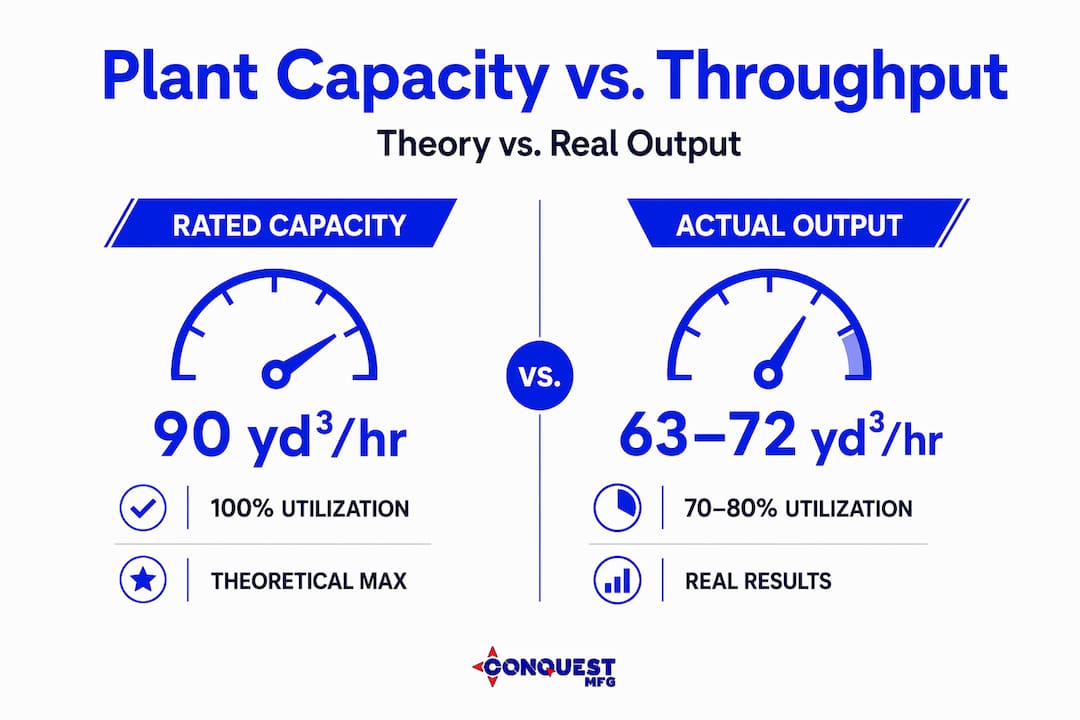
Here is the benchmark you need to plan around: most U.S. ready-mix batch plants operate at 70–80% utilization due to delays from truck loading, recipe changes, and maintenance. A plant rated at 90 yd³/hr realistically delivers 63–72 yd³/hr. Treating rated capacity as your planning number is one of the fastest ways to miss a project commitment.
Factors that reduce usable throughput include:
- Weighing and moisture check pauses between batches
- Recipe changeovers when product specifications shift mid-pour
- Truck loading bottlenecks when dispatch and batching are not synchronized
- Mixer type: pan mixers and twin-shaft mixers have different cycle characteristics, and selecting the wrong type for your pour volume adds minutes per batch
The distinction between theoretical max capacity and usable throughput is the foundation of batch plant performance analysis. Until you know your actual utilization rate, you cannot plan realistically or identify where losses are occurring.
| Utilization Rate | Output from 90 yd³/hr Plant | Practical Implication |
|---|---|---|
| 100% (theoretical) | 90 yd³/hr | Unachievable in normal operations |
| 80% | 72 yd³/hr | Strong real-world benchmark |
| 70% | 63 yd³/hr | Typical with recipe changes or older equipment |
| 60% | 54 yd³/hr | Indicates systemic inefficiency requiring review |
Financial benefits of improving batch plant performance
The benefits of batch plant optimization are not abstract. They show up directly in project cost statements. Higher usable throughput, combined with reliable mix quality control, reduces material waste, cuts labor idle time, and lowers the frequency of rework. Each of those outcomes has a dollar value attached to it.

Consider the cycle time variable. A 30-second reduction in cycle time can increase output by 33%. On a large commercial pour or infrastructure project, that kind of gain compresses schedules, reduces overtime exposure, and keeps transport fleets moving rather than waiting at the gate.
The financial case for improving batch plant performance spans several categories:
- Waste reduction: Tighter batch control means fewer over-mixed or off-spec loads. Every rejected load carries a material cost plus disposal and re-batching labor.
- Labor efficiency: Synchronized truck loading and shorter batching cycles significantly reduce crew idle time, turning hourly labor costs into productive output rather than waiting time.
- Rework avoidance: Consistent mix quality directly lowers the risk of structural deficiencies that require correction after placement, which on fixed-price contracts can erase an entire project margin.
- Energy cost management: A plant running at 70% capacity produced over 2,000 tons in eight hours with fuel consumption around 50 liters per hour. Planning efficient utilization rather than forcing near-maximum output often produces better fuel cost per ton.
Pro Tip: When reviewing project bid estimates, cross-check your assumed output rate against your plant’s documented utilization history from the last six months, not its rated capacity. That single adjustment will produce more accurate labor and transport cost projections.
Maintenance risk is the cost many operations fail to quantify until it hits them. Proactive maintenance and spare-part standardization reduce downtime risk, directly protecting profit margins on fixed-price contracts where a stoppage at the wrong moment is not just an operational inconvenience but a contractual and financial liability.
Technologies that improve batching plant performance
Technology has changed what is possible in batch plant operations, and the gap between plants using modern tools and those relying on manual observation is widening. Why batch plant efficiency matters is visible most clearly when you look at how fast efficiency losses are detected and corrected. Efficiency losses are often hidden due to delayed detection of variability or poor coordination. Real-time KPI visibility changes that completely.
Here is how modern technology translates into measurable efficiency gains:
- Real-time KPI dashboards: Operators monitor throughput, batch weight accuracy, cycle duration, and material consumption as it happens. When a metric drifts outside agreed thresholds, correction happens immediately rather than after the fact.
- Centralized plant control automation: Automation reduces manual intervention per batch, which lowers cycle time variability and keeps quality consistent across shifts. It also limits the influence of individual operator differences on output quality.
- Cloud-connected multi-plant batching: Cloud-connected batching systems provide real-time visibility into production metrics across locations, enabling centralized control with flexible shift coverage. For companies running multiple plants on different job sites, this creates consistency that is otherwise impossible to achieve.
- Predictive maintenance alerts: Remote diagnostics flag wear patterns before they cause failure. Automation and remote diagnostics limit errors and speed troubleshooting, improving plant operational flexibility and reducing reliance on on-site specialists for routine diagnosis.
- Data-driven changeover planning: Systems that log mix recipe frequency and timing allow operations teams to schedule changeovers at natural demand gaps rather than mid-production, protecting overall throughput.
Pro Tip: Real-time dashboards only deliver value when your team has agreed definitions for what constitutes a performance deviation and clear corrective protocols. Technology surfaces the data. Operational discipline determines whether that data leads to action.
The impact of efficiency on batch production is multiplied when you combine automation with good data discipline. A cloud-connected aggregate plant operation that aligns batching data with dispatch and delivery scheduling creates compounding savings that equipment upgrades alone cannot match.
Practical strategies for improving batch plant efficiency
Knowing why batch plant efficiency matters is useful. Having a clear set of actions to take is what actually moves the needle. The following strategies address the most common efficiency gaps seen in concrete and asphalt batch plant operations.
- Plan against 70–80% utilization, not rated capacity. Micro-pauses like weighing and moisture checks quickly consume utilization buffer. Build your pour schedules and truck dispatch around what the plant will reliably deliver, not its nameplate rating.
- Synchronize batching cycles with truck loading and site demand. Aligning batching with dispatch rhythms reduces truck waiting and crew idle time, creating compounded savings beyond equipment improvements alone. A five-minute truck wait at the drum, multiplied across a fleet of ten trucks on a long pour day, adds up fast.
- Minimize recipe changeovers during peak demand periods. Batch recipe changes require weighing system recalibration and often a flush cycle. Group mix specifications to consolidate changeovers at the start or end of shifts rather than mid-operation.
- Schedule proactive maintenance during low-demand windows. Easier access to wear parts and predictive alerts allow you to schedule repairs during low-demand periods, preventing emergency stoppages that halt production at the worst possible moment.
- Review your concrete plant installation layout for material flow efficiency. A poorly positioned aggregate bin or cement silo relative to the mixer adds seconds per batch that accumulate into significant daily output losses.
- Track and report utilization weekly, not monthly. Monthly reporting masks weekly patterns that reveal whether a specific crew shift, material supplier, or dispatch coordination issue is the root cause of inefficiency.
My take on what the efficiency conversation is really about
I have seen plenty of operations that bought the right equipment and still consistently underperformed on output. The plant was capable. The planning was not.
In my experience, the biggest source of efficiency losses is not equipment. It is the assumption that a plant will perform at near-maximum capacity by default. That assumption flows into bid pricing, scheduling, and truck dispatch, and when reality arrives at 70–75% utilization, the project absorbs that gap through compressed margins, overtime, and rushed pours.
What I have found actually works is treating 70–80% utilization as the starting baseline and then systematically working backward to understand what is consuming the remaining capacity. Is it truck queuing? Recipe changeovers? A mixer type that is mismatched to the pour volume? Each cause has a specific fix, and finding it requires data, not guesswork.
The professionals who take improving batch plant performance seriously treat it like a continuous monitoring discipline, not a one-time equipment selection decision. They track cycle times, flag deviations, and coordinate batching with logistics as a unified production system. That operational discipline, combined with the right equipment and modern monitoring tools, is where the real gains live.
If there is one thing I would encourage you to do today, it is to pull your plant’s actual utilization data from the last quarter and compare it against your planning assumptions. The gap you find is your improvement opportunity.
— Peter
How Conquestmfgusa supports your efficiency goals

At Conquestmfgusa, we design and manufacture stationary dry and mobile concrete batch plants built to deliver consistent, reliable output in real-world operating conditions. We understand that rated capacity is only part of the story. Our equipment is engineered to minimize cycle time variability and support the operational discipline your projects depend on.
Explore our batch plant solutions guide to see how our concrete batch plants are configured for practical efficiency gains, not just impressive nameplate numbers. For operations with broader material handling needs, our portfolio extends to construction industry equipment including pneumatic trailers, bulk material transport, and specialized hauling solutions that integrate with your batching operations. Contact our team to discuss your project requirements and find the right configuration for your application.
FAQ
What is a realistic output rate for a concrete batch plant?
Most U.S. batch plants operate at 70–80% of their rated capacity due to truck loading delays, recipe changes, and maintenance pauses. A plant rated at 90 yd³/hr typically delivers 63–72 yd³/hr under normal operating conditions.
How does cycle time affect batch plant productivity?
Cycle time has a direct, linear impact on output. A 30-second reduction in cycle time can increase total output by approximately 33%, making cycle time one of the highest-leverage variables in batch plant performance.
What technologies most improve efficiency in batching operations?
Real-time KPI dashboards, automation-driven centralized control, and cloud-connected multi-plant batching systems have the most measurable impact. They reduce variability, speed up issue detection, and enable consistent quality across shifts and locations.
Why does maintenance planning matter for batch plant efficiency?
Unplanned downtime on fixed-price contracts carries both operational and financial consequences. Proactive maintenance scheduling during low-demand periods protects output continuity and prevents emergency stoppages from erasing project margins.
What is the single most common planning mistake that reduces batch plant efficiency?
Using rated capacity instead of realistic utilization rates in project planning. Building schedules around 100% output when 70–80% is the operational reality leads to missed pour windows, idle trucks, and compressed margins that compound across the project timeline.