
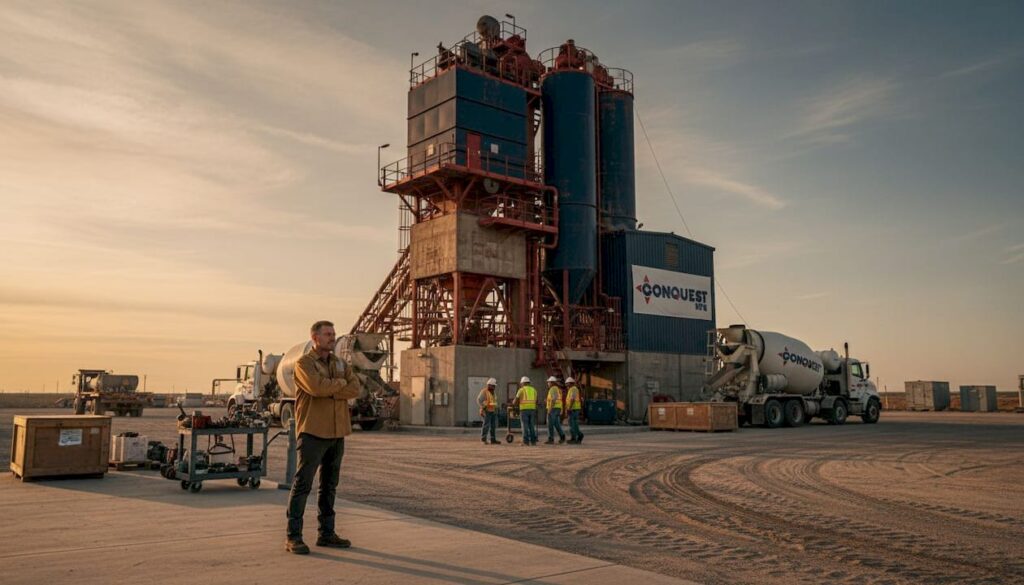
Batch plants are not the background machinery most facility managers assume them to be. In oil and gas construction, where pad foundations, secondary containment berms, equipment bases, and road surfaces must meet strict specifications under tight schedules, the batch plant is directly tied to project outcomes. Get it wrong and you face failed inspections, costly demolition, and schedule delays that ripple across the entire operation. Get it right, with the right plant configuration, the right logistics plan, and the right integration with your field team, and your concrete program becomes a competitive advantage rather than a liability.
Table of Contents
- How batch plants work: Behind the scenes of efficient oil industry construction
- Timing, quality, and the concrete workability clock
- Batch plant choices: Dry mix vs. wet mix for oil field realities
- Coordinating plant and equipment: Downtime, maintenance, and integrated planning
- Why most oil site batch plant problems are rooted in missed integration, not technology
- Achieve greater efficiency: Solutions for batch plants and oil facility operations
- Frequently asked questions
Key Takeaways
| Point | Details |
|---|---|
| Batch plants ensure quality | The heart of reliable oil construction is precise concrete mixing, made possible by batch plants. |
| Timing is critical | Concrete workability has a narrow window, so coordinating plant, transport, and placement is essential. |
| Choose the right system | Selection between dry and wet batch plants impacts project quality and flexibility, especially for remote sites. |
| Integration prevents delays | Plant, equipment, and haul logistics should be planned as a single interconnected system to reduce costly downtime. |
How batch plants work: Behind the scenes of efficient oil industry construction
Now that you understand why batch plants matter, let’s break down the essential components and how they directly influence oil industry project quality.
A concrete batch plant is best understood as a precision manufacturing system, not just a mixing station. Each sub-system plays a defined role, and the performance of one directly affects all the others. Oil and gas facility managers who treat the plant as a black box often miss the leverage points that determine whether a pour goes smoothly or becomes an emergency.
Core sub-systems of a concrete batch plant:
- Material storage bins and silos: Aggregate, sand, and cement are stored in separate compartments to prevent contamination and enable rapid, accurate dispensing. On oil sites where space is limited and weather is variable, silo capacity and protection directly affect your schedule reliability.
- Conveyors and screw conveyors: These move raw materials from storage to the weigh hopper. The speed and reliability of conveyor systems set the upper ceiling on batch plant output. Pneumatic systems move dry cement powder without spillage, which matters on environmentally sensitive oil field locations.
- Weighing and metering systems: Load cells and automated weigh hoppers measure each material with precision, typically to within 1% tolerance. This is where quality control actually starts, not at the mixer.
- Central mixer: The mixer controls blend time, water-to-cement ratio, and additive incorporation. As batch plants integrated systems confirm, the plant functions as a coordinated sequence of storage, conveyance, weighing, and controlled mixing to meet mix design requirements.
The degree of automation built into modern batch plants is significant. Digital controls allow operators to monitor real-time material weights, moisture content in aggregates, and mix consistency. For oil industry applications where concrete must meet API or DOT specifications, this automated feedback loop removes guesswork from compliance.
| Batch plant sub-system | Primary function | Impact on oil field operations |
|---|---|---|
| Storage silos and bins | Hold raw materials separately | Prevents contamination, supports schedule reliability |
| Conveyors and pneumatics | Transport materials to weigh hoppers | Sets batch rate ceiling, reduces spillage |
| Weigh hoppers and load cells | Measure each component precisely | Drives spec compliance and mix consistency |
| Central mixer | Blend all components uniformly | Determines final concrete quality |
| Automation controls | Monitor and adjust in real time | Reduces human error, supports remote site oversight |
Exploring batch plant designs for oil fields shows how configuration choices, from mobile to stationary, affect what your operation can realistically achieve on a given site. Understanding aggregate plant operations also reveals how upstream material supply feeds directly into plant performance.
Pro Tip: Request data logs from your batch plant automation system after every pour. These logs document actual weights, mix times, and water additions. If a concrete element later shows signs of distress, you have objective records that separate a mix design problem from a placement problem.
Timing, quality, and the concrete workability clock
With the mechanics established, timing emerges as a critical factor, especially because every minute counts for concrete workability.
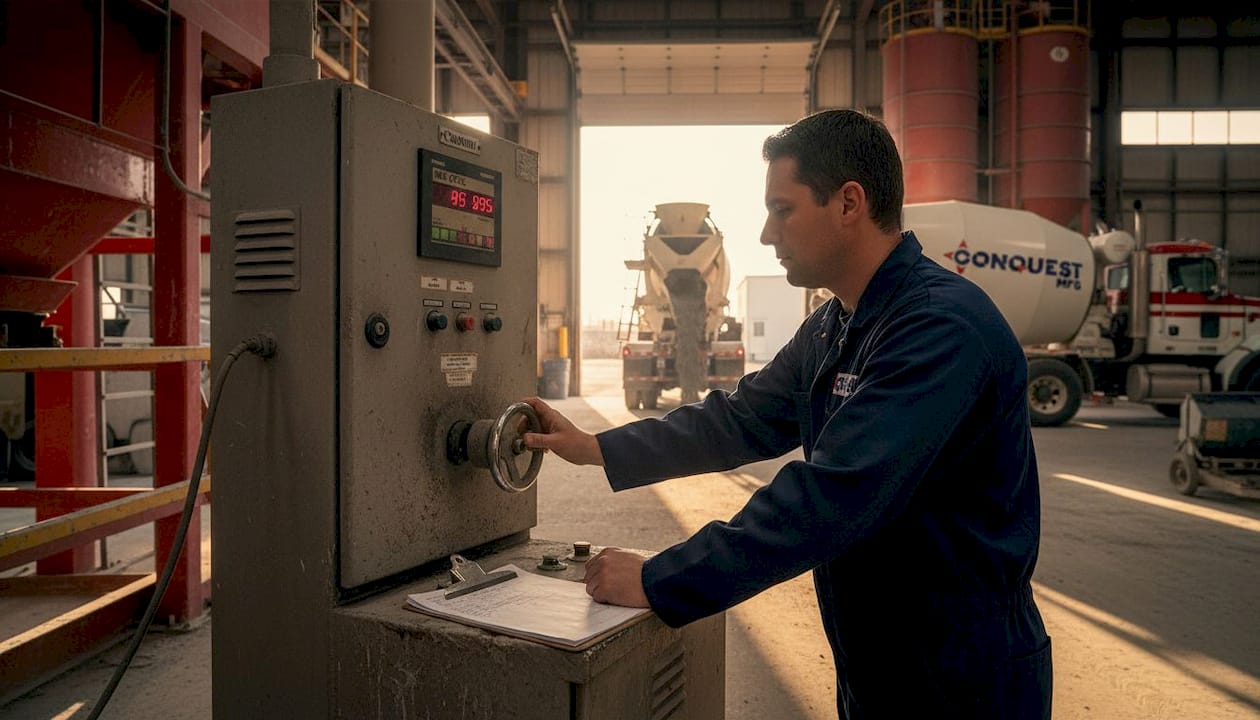
Once water contacts cement, a chemical reaction called hydration begins and it does not pause for traffic delays, equipment breakdowns, or logistical complications. The concrete workability window constrains both throughput and dispatch, meaning plant output must be tightly coordinated with haul times and placement operations to prevent premature setting and loss of workability.
In practice, the industry standard for placement is 90 minutes or 300 drum revolutions after water contact, whichever comes first. On a standard urban construction project, this window is tight but manageable. On remote oil and gas sites in West Texas, the Permian Basin, or North Dakota’s Bakken formation, that same window becomes a high-stakes race.
Why the workability clock is especially dangerous on oil sites:
- Haul distances are longer. Remote well pad construction may require concrete to travel 15 to 30 miles from the nearest batch plant. A round trip for a single truck can consume 40 to 60 minutes before placement even begins.
- Road conditions are unpredictable. Oil field roads are often unpaved, shared with heavy equipment, and subject to seasonal closures. A 30-minute delay in transit is not unusual during busy operational periods.
- Placement equipment can stall. Pump setup, line priming, and crew positioning take time. If those activities are not completed before the truck arrives, your concrete sits in the drum and loses workability.
- Temperature extremes accelerate hydration. In hot summer conditions common to oil-producing regions, concrete can stiffen significantly faster than at the standard 70°F test temperature. Every 10°F increase above that benchmark can cut your workability window by 20 to 30 minutes.
- Multiple pours must be staged. Large equipment foundations or secondary containment systems require continuous concrete supply. If batch plant dispatch timing is off by even one truck, a cold joint forms between pours and that becomes a structural defect.
Key insight: Treating the batch plant dispatch schedule and field placement schedule as separate plans is one of the most common and costly mistakes oil site managers make. They are one plan with two execution points.
Coordinating this process around oil industry equipment integration is essential when concrete, pumping, and placement equipment must work as a single system.
Batch plant choices: Dry mix vs. wet mix for oil field realities
Equipped with timing realities, facility managers must now evaluate which batch plant type actually fits their job site and risk profile.
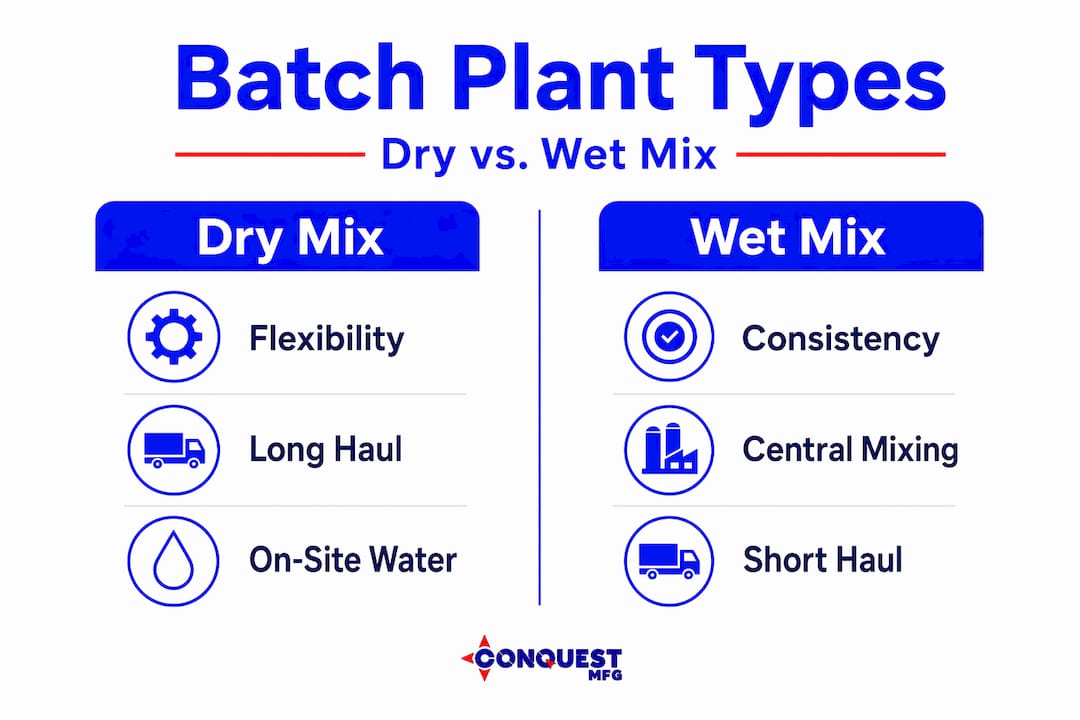
The choice between dry mix (transit mix) and wet mix (central mix) batch plants is not simply a technical specification decision. It is a risk management decision that reflects your specific site conditions, haul logistics, and concrete specification requirements.
In a dry batch (transit mix) plant, dry materials are combined and loaded into a transit mixer truck without water. Water is added during transport, and mixing occurs in the drum en route to the site. This approach extends flexibility because the full hydration clock does not start until water addition, which can happen later in the haul. For remote oil field sites where haul times are long or unpredictable, this added buffer has real operational value.
In a wet batch (central mix) plant, all materials including water are combined in a stationary mixer before loading. The concrete is fully mixed and ready at the plant. This approach delivers superior uniformity and quality control. Load cells, mixer sensors, and automation systems can verify mix quality before the truck ever leaves the plant. For structural foundations and containment systems that must meet strict engineering specifications, this consistency is often non-negotiable.
“The choice between dry and wet batch systems effectively determines how much of the hydration and workability window is consumed during transit versus at the plant, and this distinction carries real operational weight for remote oil and gas sites with variable travel times.” Dry batch vs wet batch
Dry mix advantages for oil field operations:
- More flexible for long or variable haul distances
- Lower capital cost per unit of output
- Easier to deploy rapidly at new locations
- Mixing occurs during transport, using time that would otherwise be idle
Wet mix advantages for oil field operations:
- Consistently higher concrete quality and uniformity
- Quality verified at the plant before dispatch
- Reduced risk of overdose or underdose of admixtures in the field
- Better suited for high-specification structural applications
Batch plant type selection should prioritize spec compliance and consistency for high-consequence pours, favoring central wet mix, while preserving dry mix flexibility for longer hauls where controlling the hydration clock timing is the bigger operational concern.
Pro Tip: On oil field projects, we recommend identifying your highest-risk concrete placements first, usually structural foundations and environmental containment. Specify wet mix for those elements. Use dry mix for secondary applications like access roads and equipment pads where tolerances are wider and flexibility matters more.
Understanding remote oil project transport challenges is equally important when planning which batch plant format gives you the right combination of reliability and timing control.
Coordinating plant and equipment: Downtime, maintenance, and integrated planning
Once the right batch plant is chosen, operational readiness depends on supporting systems and tightly integrated planning.
The relationship between batch plants and placing equipment is not symmetric. A failure in the placing system (concrete pumps, boom lines, or buckets) halts placement, but the plant can continue producing. That creates a growing queue of trucks with concrete setting in their drums. A failure in the batch plant itself halts production entirely. In either case, the concrete that was already in transit is at risk of being wasted. As batching and pumping integration research confirms, downtime risk between batching and pumping is asymmetric, and integrated planning with coordinated maintenance schedules is the only reliable mitigation.
Practical steps for integrated plant and equipment planning on oil sites:
- Establish a single project scheduler who owns both the batch plant dispatch schedule and the field placement sequence. Separate schedules coordinated by separate teams are a recipe for timing failures.
- Pre-qualify all equipment before pour day. Pump trucks, boom lines, and batch plant systems should be tested and confirmed operational at least 24 hours before a critical pour.
- Define a clear abort protocol. Every team member should know at what point a batch plant stop or pump failure triggers a pour halt. A concrete cold joint from a delayed recovery is often less damaging than a rushed, non-compliant placement.
- Maintain spare wear parts on site. Concrete pumps and batch plants both have predictable wear components (seals, wear plates, conveyor belts). Stocking common spares on site eliminates multi-day delays waiting for parts to arrive at remote locations.
- Include material transport in your maintenance planning. Pneumatic trailers that haul bulk cement and fly ash to the plant are part of the production chain. A trailer breakdown means the plant runs out of cementitious materials, even if the plant itself is fully operational.
Learning more about bulk transportation efficiency and the benefits of pneumatic trailers can help facility managers see the full supply chain that feeds a concrete program, not just the plant itself.
Pro Tip: Build a simple downtime cost model before your project begins. Calculate your hourly cost when the batch plant is down versus when only placing equipment is down. That model will justify the maintenance investment and contingency planning that most schedules undervalue.
Why most oil site batch plant problems are rooted in missed integration, not technology
Stepping beyond equipment specs, it is time to share some hard-won industry wisdom.
After working with oil industry operators across the country, we have seen a consistent pattern. The projects that experience the most painful batch plant problems are rarely using inferior equipment. The plants are capable. The trucks are reliable. The crews are experienced. The failures happen because someone treated the batch plant as an isolated piece of equipment rather than a node in a coordinated supply chain.
The real challenge in oil field concrete is integration. Batching, transport, and placement must function as a single operation. When those three functions report to different managers, follow different schedules, and are maintained by different service providers, the handoffs between them become failure points. A truck dispatched five minutes too early sits at the gate with concrete setting. A truck dispatched five minutes too late leaves the pump idle while the crew waits. Neither failure requires bad equipment. Both require better planning.
We also see a consistent underestimation of site-specific variables. The same batch plant that works perfectly on a structured industrial site can underperform on an oil field location where road conditions change weekly, ambient temperatures swing by 40°F between morning and afternoon, and pour windows are dictated by pipeline tie-in schedules rather than by concrete production convenience.
Custom solutions, built around your specific site realities, almost always outperform off-the-shelf configurations. That means specifying mobile or stationary batch plants based on actual project duration. It means selecting trailer configurations based on real haul distances and payload requirements. And it means coordinating your concrete program with your material supply chain from the start. Exploring how aggregate process integration affects the full production picture is a practical place to start.
The technology is ready. The question is whether your integration plan matches it.
Achieve greater efficiency: Solutions for batch plants and oil facility operations
With this groundwork in place, here is where operators and facility managers can turn for proven solutions.
We design and manufacture equipment purpose-built for the demands of oil and gas construction. From stationary and mobile batch plants for oil and gas to dry bulk pneumatic trailers, portable cement silo trailers, and specialized haul equipment, our product line covers the full concrete supply chain.
Our industrial material handling solutions are built to keep your concrete program running without unplanned stops. Whether you need streamlined aggregate operations upstream or a tailored trailer configuration for remote cement delivery, we bring the manufacturing expertise and field experience to match the solution to your specific operation. Contact our team to discuss your project requirements and get a quote built around your actual site conditions.
Frequently asked questions
What is the main function of a batch plant in oil industry projects?
Batch plants enable precise and consistent concrete production by storing, measuring, and mixing materials under controlled conditions, as confirmed by the integrated system design that governs modern batch plant operations. This level of precision is critical for oil facility builds where structural and environmental specifications are non-negotiable.
Why does concrete timing matter for oil facility sites?
Concrete must be placed within a specific workability window, usually within 90 minutes after water is added, because the hydration clock constraint means premature setting can render a pour non-compliant. Remote oil sites with longer haul distances and unpredictable road conditions make this timing risk significantly higher than on standard construction projects.
Which is better for remote oil fields: dry mix or wet mix batch plants?
Dry mix plants may provide more flexibility for remote sites with longer or variable haul times because water addition can be delayed, while wet mix plants deliver higher consistency for projects where the plant is close to the placement zone. The dry batch vs wet batch decision should match your site’s haul profile and specification requirements.
How do batch plants support uptime for oil installations?
Planned integration of batching, pumping, and transport systems reduces downtime risk because batching and pumping systems share asymmetric failure consequences, making coordinated maintenance and scheduling essential for continuous concrete placement. A failure anywhere in the chain affects the entire pour.