
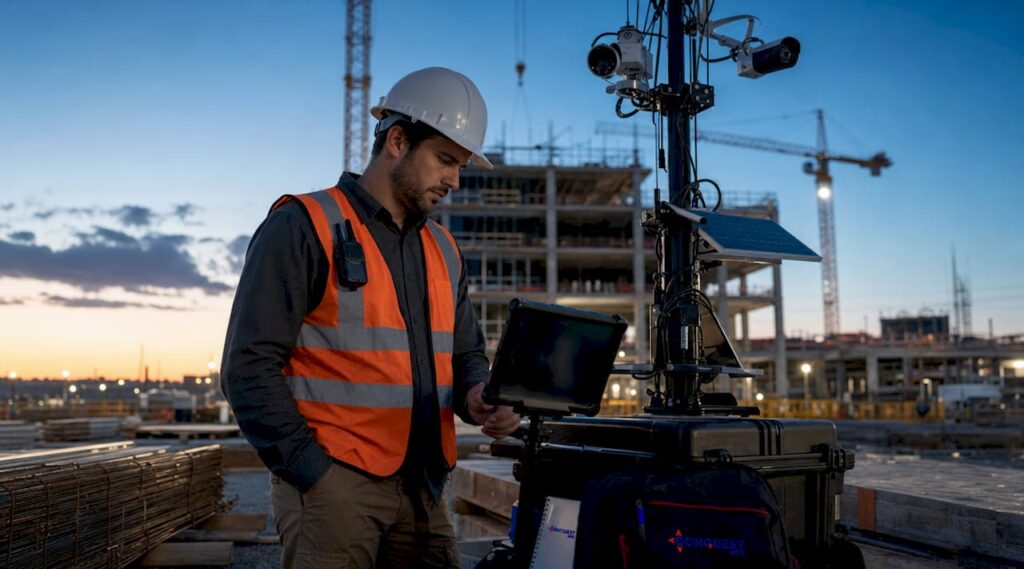
Portable surveillance in construction refers to mobile security units equipped with cameras, sensors, and communication systems that deploy rapidly across active job sites to prevent theft, monitor safety, and support operational oversight. These units are not a minor upgrade to traditional security. They represent a fundamental shift in how construction professionals protect assets, manage risk, and document site activity across every project phase. With theft averaging $30,000 per incident on active sites, the financial case for mobile surveillance is immediate and measurable.
What is the role of portable surveillance in construction?
Portable surveillance units are self-contained security platforms mounted on trailers or towers, typically combining high-definition cameras, AI-driven motion detection, solar power, cellular connectivity, and two-way audio. The industry term for these systems is Rapid-Deployed Video Surveillance Towers, or RDVSTs. You will also hear them called mobile surveillance trailers or portable security camera systems. All three terms describe the same core product.
The primary role these units play is filling the security gaps that fixed cameras and manned guards cannot cover cost-effectively. Construction sites are not static environments. High-value zones shift as a project moves from site mobilization to structural work to finishing. A fixed camera installed at the perimeter in month one may cover nothing critical by month six. Mobile units reposition quickly to track those shifting risk zones without requiring new infrastructure.
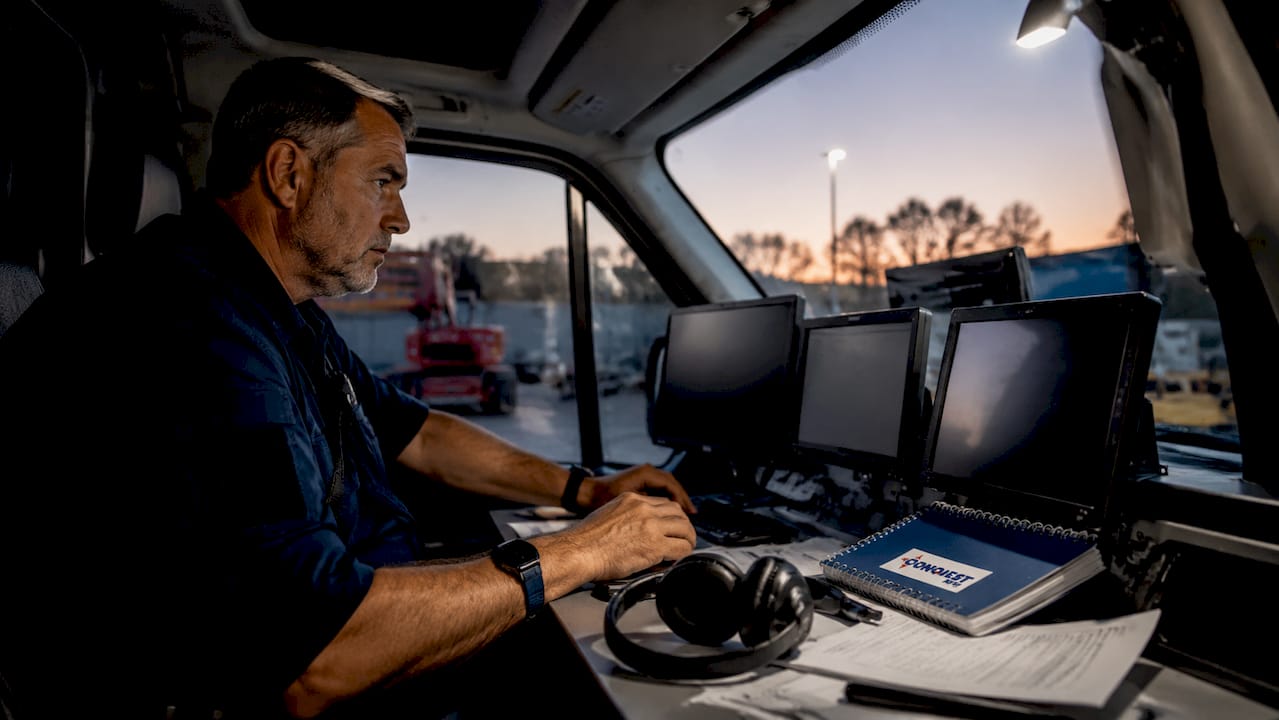
Beyond theft prevention, portable surveillance serves three additional functions that project managers often underestimate. First, it creates a documented record of site conditions for insurance and legal purposes. Second, it supports safety compliance monitoring by capturing footage of worker behavior in hazardous zones. Third, when integrated with platforms like Procore or Autodesk, it contributes time-lapse documentation and progress records that have real operational value.
How portable surveillance reduces theft and improves site security
Construction sites are high-value targets. Equipment, copper wire, lumber, and fuel are all portable and easily resold. The financial exposure is significant, and the deterrence value of visible surveillance is one of the most direct returns on investment a project manager can achieve.
The cost comparison with manned security is stark. Portable units cost 60 to 90 percent less to operate than 24/7 security guards while delivering equivalent or better around-the-clock monitoring. For a six-month project, that difference can represent tens of thousands of dollars in savings that go directly back into the project budget.
Modern portable surveillance systems include several active deterrence features that passive cameras cannot match:
- AI motion detection that distinguishes human movement from environmental noise like wind-blown vegetation or passing traffic
- Night vision and thermal imaging for reliable coverage during the highest-risk overnight hours
- Talkdown speakers and sirens that allow remote operators to confront intruders directly with audio warnings before law enforcement arrives
- Strobe lights and alarm systems that activate automatically upon detection, making the unit a visible and audible deterrent
- Remote live feed access so project managers and security teams can monitor activity from any location in real time
Pro Tip: Position at least one surveillance unit at the material staging area during the first and last two weeks of a project phase. These transition periods carry the highest theft risk because inventory is concentrated and site traffic is irregular.
The active intervention capability separates modern portable surveillance from traditional CCTV. A remote operator can speak directly to a trespasser through the unit’s speaker system, often causing them to leave before any physical damage or theft occurs. This real-time response capability is something no fixed camera system provides on its own.
How do portable units compare to fixed cameras and manned guards?
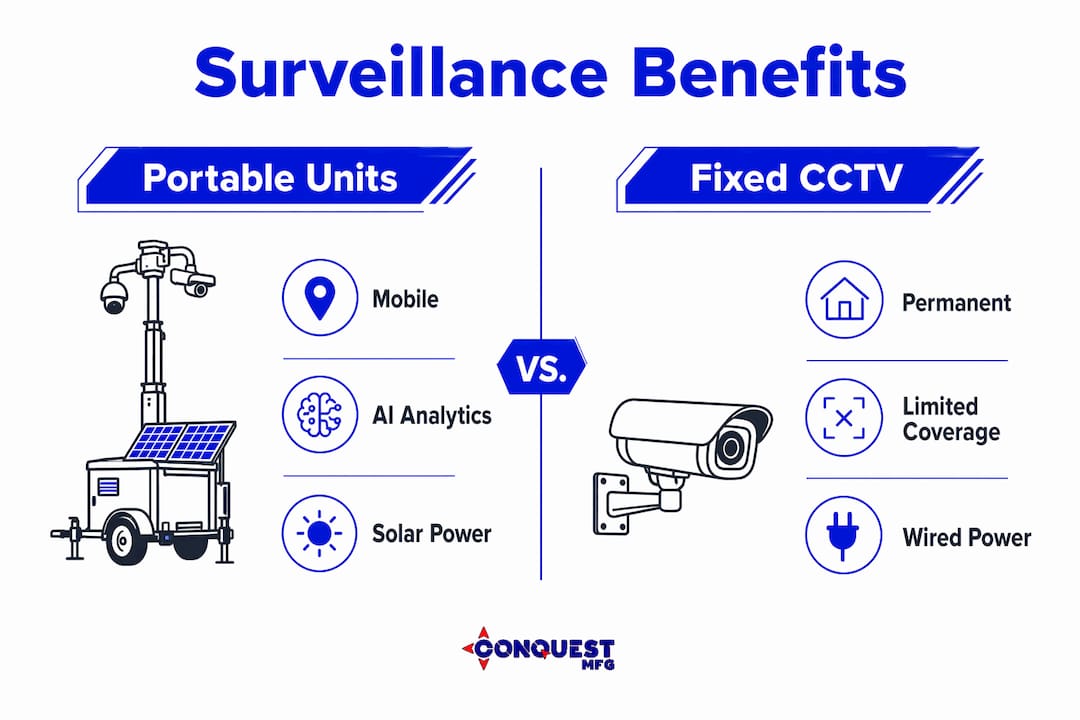
The choice between portable surveillance, fixed CCTV, and manned security is not binary. Each option has defined strengths and limitations that make a hybrid approach the most effective model for most construction projects.
| Feature | Portable surveillance units | Fixed CCTV systems | Manned security guards |
|---|---|---|---|
| Deployment speed | Hours, no infrastructure needed | Days to weeks, requires wiring | Immediate but costly at scale |
| Repositioning flexibility | Full mobility across site phases | Fixed, no repositioning | Mobile but limited coverage area |
| Operating cost | 60 to 90% less than guards | Low after installation | High, especially for 24/7 coverage |
| Active deterrence | Audio warnings, alarms, live response | Passive recording only | Direct physical presence |
| Off-grid capability | Solar and battery powered | Requires power infrastructure | No power dependency |
| Software integration | Procore, Autodesk compatible | Limited to security platforms | None |
Fixed cameras work well for permanent entry points, site offices, and equipment yards where coverage needs do not change. They are cost-effective for long-term installations where the infrastructure investment pays off over time. The limitation is that fixed systems cannot adapt to the evolving layout of an active construction site without significant reinstallation costs.
Manned guards provide a physical presence that technology cannot fully replicate. They exercise judgment, respond to unexpected situations, and serve as a visible human deterrent. The cost, however, makes full 24/7 guard coverage impractical for most mid-size projects. The most effective security model combines portable surveillance units with periodic human patrols, using the technology to extend coverage and the guards to respond to verified incidents.
Pro Tip: Use portable units as your primary overnight coverage layer and schedule human patrols during the highest-activity daytime hours. This combination delivers the best coverage-to-cost ratio for projects running six months or longer.
What technology features matter most in portable surveillance?
Not all portable surveillance systems are built for construction environments. General-purpose security cameras lack the durability, power independence, and software integration that active job sites demand. The following features define a construction-grade portable surveillance unit.
Power independence is the baseline requirement. Solar panels combined with battery backup allow units to operate for three to five days without direct sunlight, and some configurations include backup generators for extended off-grid deployment. This matters on remote sites where grid power is unavailable during early project phases.
AI-driven analytics determine how useful the system is in practice. Raw motion detection generates too many false alerts on a busy construction site. AI filtering that excludes vegetation movement, passing vehicles, and wildlife reduces alert fatigue and keeps security operators focused on genuine threats. The difference between a well-configured AI system and a basic motion sensor is the difference between a useful tool and an ignored one.
Camera resolution and frame rate directly affect whether footage is usable for legal and insurance purposes. 4K cameras at 30 frames per second produce footage that meets evidentiary standards. Lower resolution footage is often inadmissible in investigations and rejected by insurance adjusters. This is a specification detail that many buyers overlook until they need to file a claim.
Software integration separates construction-specific platforms from general security products. Systems that connect with Procore or Autodesk deliver dual-use value by combining security monitoring with time-lapse documentation, progress reporting, and compliance records. TrueLook and ArcadianAI both offer platforms built specifically for construction environments, with features that general security vendors do not prioritize.
Two-way audio and remote access complete the feature set. Live feed access through a mobile app or web dashboard lets project managers check site conditions from anywhere. Two-way audio enables direct communication with workers or intruders without requiring a person on site.
Best practices for deploying portable surveillance on construction sites
Effective deployment requires planning before the first unit arrives on site. The most common failure point is connectivity. Cellular signal strength varies significantly across construction sites, particularly in rural or industrial areas. Verify signal coverage across the planned unit locations before finalizing your deployment plan. Satellite connectivity is a reliable fallback for remote sites where cellular coverage is weak.
Follow these steps to deploy portable surveillance effectively:
- Map your risk zones by project phase. Identify where high-value materials and equipment will be concentrated at each stage. Plan unit positions to cover those zones, not just the site perimeter.
- Verify connectivity at each planned location. Walk the site with a cellular signal meter or use a carrier coverage map to confirm data transmission will work reliably.
- Configure AI detection zones before going live. Narrow detection thresholds to the specific areas you want monitored. Broad detection on a busy site generates constant false alerts that desensitize your security team.
- Set camera resolution to 4K at minimum. Confirm frame rate meets the 30 FPS standard required for insurance and legal evidence.
- Integrate with your construction management software. Connect units to Procore or Autodesk to capture time-lapse footage and compliance documentation alongside security monitoring.
- Schedule human patrol overlap. Coordinate guard patrols to cover the periods and zones where camera coverage has natural blind spots.
- Reposition units at each major phase transition. Treat unit placement as a living plan that updates with the project schedule, not a one-time setup decision.
Pro Tip: Document your unit placement decisions and the reasoning behind them. If a theft or incident occurs, that documentation supports your insurance claim and demonstrates due diligence.
Key takeaways
Portable surveillance units deliver the most value when deployed as part of a planned, phased security strategy that combines mobile technology with human monitoring and construction-specific software integration.
| Point | Details |
|---|---|
| Theft cost justifies investment | A single theft incident averages $30,000, making portable units financially self-justifying on most projects. |
| Mobility matches site dynamics | Units reposition across project phases to cover shifting high-value zones that fixed cameras cannot track. |
| Cost advantage over guards | Operating costs run 60 to 90 percent lower than 24/7 manned security without sacrificing monitoring quality. |
| Resolution affects legal value | 4K cameras at 30 FPS produce footage that meets insurance and evidentiary standards; lower specs do not. |
| AI configuration prevents fatigue | Narrowing detection zones reduces false alerts and keeps security teams focused on real threats. |
Why hybrid security is the only model worth building
I have seen project managers make the same mistake repeatedly: they treat portable surveillance as a complete security solution and skip the human monitoring layer entirely. The technology is genuinely impressive, and the cost savings over guards are real. But cameras do not make judgment calls. They do not recognize when a situation requires a different response than the one the algorithm was trained to trigger.
The most effective sites I have observed use portable units as a force multiplier, not a replacement. The cameras cover the overnight hours and the wide-area monitoring that guards cannot do cost-effectively. The guards handle verified incidents, daytime patrols, and the unpredictable situations that no AI system handles well yet. That combination produces better outcomes than either approach alone.
The second mistake I see consistently is buying general-purpose security cameras instead of construction-specific systems. General cameras are cheaper upfront, but they lack the software integrations, durability ratings, and AI configurations that construction environments require. The total cost of ownership, including the value of time-lapse documentation and Procore integration, makes construction-specific platforms like TrueLook a better investment for any project running longer than three months.
Connectivity planning is the detail that separates successful deployments from frustrating ones. I have watched teams set up excellent equipment on sites where the cellular signal was too weak to transmit data reliably. The cameras worked. The monitoring did not. Verify signal strength before you commit to unit placement, and budget for satellite backup on any remote site.
— Peter
Portable surveillance towers built for construction sites
Conquestmfgusa designs and manufactures Portable Rapid-Deployed Video Surveillance Towers built specifically for the demands of active construction environments. These units are engineered for durability, off-grid power independence, and rapid repositioning across project phases.

If you are evaluating surveillance technology for your next project, the construction industry solutions at Conquestmfgusa cover the full range of portable security infrastructure your site requires. Our team works directly with project managers to match unit specifications to project scale, site conditions, and security objectives. Explore our mobile security manufacturing capabilities and get in touch to discuss a configuration tailored to your project.
FAQ
What is the average cost of theft on a construction site?
A single theft incident on an active construction site costs an average of $30,000. Portable surveillance units typically pay for themselves after preventing one or two incidents.
How quickly can a portable surveillance unit be deployed?
Most portable surveillance trailers and towers deploy within hours of arriving on site, requiring no wiring or permanent infrastructure. This makes them practical for projects at any phase, including early mobilization when fixed systems are not yet installed.
Do portable surveillance units work without grid power?
Yes. Construction-grade units use solar panels and battery backup systems that provide three to five days of runtime without direct sunlight. Some configurations include backup generators for extended off-grid operation on remote sites.
What camera resolution is required for insurance claims?
4K resolution at 30 FPS is the standard that meets insurance and legal evidentiary requirements. Footage from lower-resolution cameras is frequently rejected by insurance adjusters and may be inadmissible in legal proceedings.
Can portable surveillance integrate with construction management software?
Yes. Construction-specific platforms integrate with Procore and Autodesk to deliver time-lapse and compliance monitoring alongside security functions. This dual-use capability makes the investment more defensible across a project budget.