
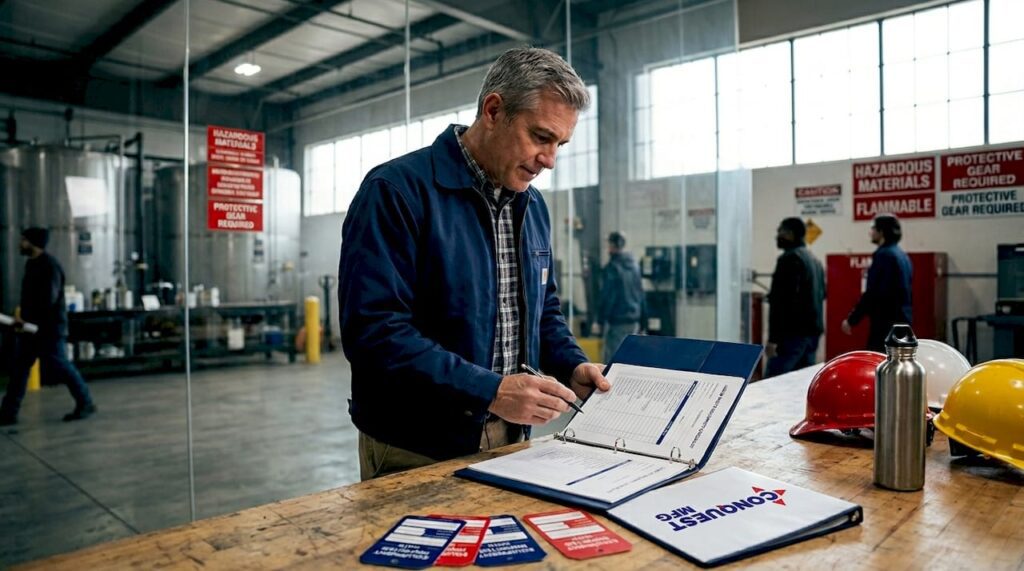
Managing liquid waste on a construction or industrial site means navigating a web of EPA regulations, permit conditions, and day-to-day operational demands simultaneously. A well-built liquid waste equipment checklist is the single most reliable tool for keeping your facility compliant and your operations running without costly interruptions. This guide walks you through the criteria, equipment categories, sampling protocols, and documentation practices that matter most, so you can build a checklist that holds up under a real audit, not just a casual walkthrough.
Table of Contents
- Key criteria for your liquid waste equipment checklist
- Essential equipment and inspection components in liquid waste management
- Sampling protocols and documentation for compliance assurance
- Comparing equipment checklist approaches for industrial pretreatment programs
- Building your custom liquid waste processing checklist: Tips and best practices
- Why most liquid waste equipment checklists miss the compliance mark and how to fix it
- Optimize your liquid waste equipment compliance with Conquest MFG USA solutions
- Frequently asked questions
Key Takeaways
| Point | Details |
|---|---|
| Checklist criteria essentials | Align your equipment checklist with regulatory workflows and ensure it covers sampling, calibration, and documentation for compliance. |
| Sampling methods matter | Use correct sample types — grab or composite — based on pollutant requirements to avoid invalid compliance results. |
| Audit-ready records | Maintain timestamped calibration, maintenance, and corrective action logs to demonstrate operational compliance during audits. |
| Annual pretreatment inspections | Mandatory yearly inspections for industrial users ensure equipment functions and records are complete to prevent violations. |
| Digital checklists boost compliance | Leverage digital workflows to automate task scheduling and create traceable audit packages, reducing manual errors and time. |
Key criteria for your liquid waste equipment checklist
To effectively maintain compliance and efficiency, you first need to understand the key criteria that your liquid waste equipment checklist must meet. This is where most facilities get the foundation wrong. They build their checklist around the equipment they own rather than the compliance workflows the equipment is supposed to support.
Your checklist must cover four non-negotiable areas:
- Regulatory alignment: Every item on your list should tie directly to a permit parameter, an EPA method, or a state pretreatment requirement.
- Calibration and QA documentation: Equipment must produce defensible data. That means timestamped calibration logs for every measurement device.
- Corrective action tracking: When something fails, your checklist must capture what failed, when, and what was done about it.
- Audit-ready formatting: The checklist itself is a compliance document. Structure it so an inspector can follow the logic without explanation.
The NPDES compliance logic requires integration of sampling execution, measurement QA, data packaging, and timely DMR (Discharge Monitoring Report) submission within 28 days. Your checklist structure should mirror that workflow exactly. If your checklist ends at “equipment inspected,” you are only halfway there.
For a broader look at how these criteria apply across facility types, reviewing an industrial equipment safety checklist gives useful structural context.
Essential equipment and inspection components in liquid waste management
With these criteria in mind, let’s review the essential equipment and inspection tasks you must incorporate into your liquid waste management tools and daily workflows.
Core equipment categories every site needs:
- pH probes and meters: Verify calibration with at least two buffer solutions daily. Note the calibration date, operator, and any drift from expected values.
- Dissolved oxygen (DO) sensors: Critical for biological treatment units. Check membrane integrity and zero-point calibration weekly.
- Dissolved air flotation (DAF) units: Inspect air-to-solids ratio, surface skimmer function, and effluent clarity every shift.
- Pumps (submersible, centrifugal, progressive cavity): Check for unusual vibration, seal leaks, and flow rate consistency against permit baseline.
- Chemical dosing systems: Verify pump stroke settings, chemical inventory levels, and feed-line integrity. Document any adjustments.
- Flow meters: Confirm readings against known calibration points. Flow data feeds directly into your DMR calculations.
- Alarm systems: Test auto-dialer or SCADA alert functions weekly. A silent alarm is worse than no alarm.
Daily checks for liquid waste systems include pH verification, dissolved oxygen levels, skimmer operation, and alarm system status to detect issues early. These are not optional line items. They are the evidence trail that proves your system was functioning correctly during the monitoring period.
Sludge handling deserves its own section in your checklist. Record sludge removal volumes, dates, disposal method, and receiving facility. This data protects you if a downstream facility questions the quality of what you sent them.
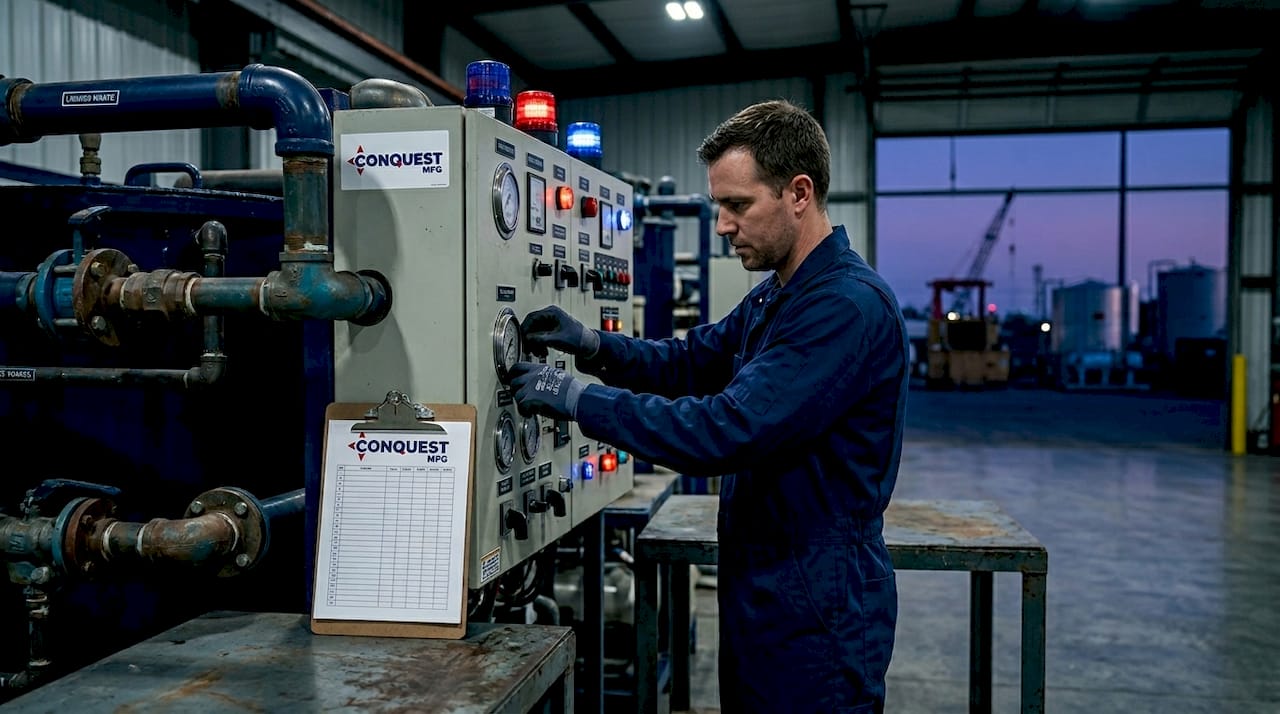
Pro Tip: Tie every corrective action directly to the equipment item that triggered it. An inspector reviewing your records should be able to trace a permit exceedance back through the corrective action, to the calibration log, to the operator on duty. That chain of evidence is what clears you in an audit.
For facilities managing vacuum tank operations, the vacuum tank maintenance workflow provides a solid model for how to document corrective actions at the equipment level. And if you are assessing equipment purchases, the septic equipment buying guide covers selection criteria that align well with compliance requirements.
Sampling protocols and documentation for compliance assurance
Equipped with a checklist of equipment and inspections, you must also master the sampling protocols and documentation that ensure your compliance efforts stand up to scrutiny.
Here is how to structure your sampling documentation workflow:
- Identify required sample types by pollutant. pH, oil and grease, and cyanide require grab samples taken at a specific point in time. Flow-proportional or time-based 24-hour composite samples are required for most conventional pollutants like BOD and TSS.
- Record the sampling location for every event. Regulators require that samples be collected at a representative point in the discharge. Sampling from a turbulent zone or a location influenced by dilution can invalidate your results.
- Document the EPA method used. Your permit specifies approved analytical methods. Using an unapproved method, even if the result is accurate, can be treated as a reporting violation.
- Log the number of samples collected. Many permits specify minimum sample frequency. If you are required to collect four grab samples during a monitoring event and you collect three, that is a reportable deficiency.
- Maintain chain-of-custody records. Every sample that leaves your facility for lab analysis should travel with a chain-of-custody form. Keep copies on site for the full retention period.
“Sampling type (grab vs composite) varies by pollutant and affects compliance; validated composite sampling equipment is crucial to avoid invalid results.” — Spokane Municipal Code, Section 13.03A.0501
This distinction matters more than most managers realize. A composite sample taken with faulty equipment, such as a malfunctioning peristaltic pump in an automatic sampler, can produce results that do not represent actual discharge quality. That puts your entire monitoring event at risk of being thrown out, which triggers a compliance gap in your DMR.
For facilities that transport liquid waste, maintaining documentation continuity from collection through transport is equally critical. The vacuum tank transport standards guide covers how to preserve that documentation chain during transit.
Comparing equipment checklist approaches for industrial pretreatment programs
Turning from sampling specifics, let’s evaluate how different checklist approaches meet pretreatment regulatory and audit demands across industries.
Industrial users must be inspected at least once annually with verified pretreatment equipment operation and complete records for audits. That is the regulatory floor, not a best practice. Most significant industrial users (SIUs) face more frequent oversight depending on their permit conditions and historical compliance record.
| Checklist approach | Equipment verification | Record retention | Audit retrieval | Recommended for |
|---|---|---|---|---|
| Paper-based logs | Manual signature per item | 3 to 5 years in binders | Slow, prone to gaps | Low-volume facilities only |
| Spreadsheet-based | Operator-entered data | Stored locally or on shared drive | Moderate, version control risk | Small to mid-size operations |
| CMMS (Computerized Maintenance Management) | Automated scheduling and alerts | Cloud-stored, searchable | Fast, exportable reports | Mid-size to large facilities |
| Integrated digital compliance platform | Real-time data capture with QA flags | Continuous, audit-package ready | Immediate, full history available | High-compliance-risk operations |
What effective pretreatment checklists must verify:
- Equipment is functioning within permit parameters, not just present and operational
- Sampling was performed according to permit-specified frequency and method
- Records are complete, signed, and date-stamped
- Any deviations were documented, reported if required, and corrected
- Chemical handling and storage comply with applicable safety regulations
Record retention spanning 3 to 5 years is a firm requirement under most pretreatment programs. Facilities that rely on paper binders routinely struggle to retrieve specific records during surprise inspections. An integrated digital system retrieves a complete compliance package in minutes, not hours.
Understanding how this connects to broader equipment categories in your operation is valuable. The oil industry equipment types overview provides a useful reference for facilities that process oily waste streams under pretreatment permits.
Building your custom liquid waste processing checklist: Tips and best practices
Having seen comparison frameworks, here are practical tips to customize an effective liquid waste processing checklist that works for your facility.
Design principles that matter:
- Mirror your permit structure. Organize checklist sections by the parameters and equipment your permit requires you to monitor. An inspector should be able to match your checklist to your permit without asking questions.
- Separate daily, weekly, and monthly tasks. Daily checks catch acute failures. Weekly and monthly checks catch slow drift issues, such as gradual sensor fouling or pump wear, before they become violations.
- Embed corrective action fields. Every equipment item should have a field for “action taken” and “date resolved.” Blank corrective action fields are a red flag during audits.
- Assign responsibility clearly. Every line item should identify a responsible operator or crew. Shared responsibility is no responsibility when something fails.
- Schedule regular checklist reviews. Permits change. Equipment gets upgraded. Assign a quarterly review to ensure the checklist reflects current permit conditions and installed equipment.
The true value of checklists lies in audit-ready records demonstrating system performance during monitoring periods, not just inspection completion. This reframes how you should think about your liquid waste safety checklist. It is not a task completion tool. It is an evidence-generation system.
Pro Tip: Use your CMMS or digital checklist platform to set automatic alerts when calibration is overdue or when a corrective action has not been closed within a defined window. This removes the human memory dependency that causes most compliance gaps.
For additional structure, reviewing industrial equipment checklist tips from a manufacturing compliance perspective adds useful cross-industry best practices.
Why most liquid waste equipment checklists miss the compliance mark and how to fix it
Here is a pattern we see repeatedly across construction and industrial sites: a facility builds a thorough-looking checklist, operators complete it dutifully every day, and then an audit reveals critical gaps. The checklist confirms equipment was present. It does not prove it was working correctly, calibrated accurately, or producing valid data.
That gap is where most compliance failures originate. Audit-ready documentation, not just equipment inspections, demonstrates compliance and prevents costly violations. The equipment is only the starting point. What regulators want to see is the evidence that the equipment performed correctly during every monitoring event.
Pretreatment program deficiencies are often due to missed annual inspections and poor records management, not equipment failures. That finding should shift your focus. Your biggest compliance risk is probably not a broken pH probe. It is an incomplete inspection record or a missed sampling event that nobody flagged because the checklist did not require escalation.
The fix is architectural. Build your checklist so that completing it generates a defensible compliance record automatically. Every calibration entry should capture the instrument ID, the standard used, the result, and the operator. Every sampling entry should capture the method, the location, the sampler, and the preservation method. Every corrective action should link back to the specific instrument or parameter that triggered it.
Digital workflows solve this more effectively than paper ever will. A platform that stores, timestamps, and cross-references every entry lets you pull a complete compliance history for any piece of equipment in seconds. That is the difference between spending two days preparing for an audit and spending two hours.
The managers who handle audits with the least stress are not the ones with the most sophisticated equipment. They are the ones whose documentation tells a clear, complete story with no missing chapters.
Optimize your liquid waste equipment compliance with Conquest MFG USA solutions
At Conquest MFG USA, we build equipment designed to hold up under real operational conditions and regulatory scrutiny. Whether you need steel or aluminum vacuum tanks, pneumatic trailers, or purpose-built oil industry equipment, every unit we manufacture is engineered for reliability and compliance-ready performance.

If you are working through a waste disposal equipment guide or updating your facility’s liquid waste management tools, our product range covers the specialized equipment that construction and industrial operations depend on. From construction industry equipment to detailed vacuum tank maintenance workflows, we give you the resources to manage your liquid waste systems with confidence. Explore our industrial equipment safety checklist resources and get in touch with our team to find the right solution for your facility.
Frequently asked questions
What types of samples are required for liquid waste compliance monitoring?
Regulatory protocols require grab samples for pollutants like pH, oil, and cyanide, while 24-hour composite samples apply to others. Following specified methods and collection frequencies is critical for valid compliance results.
How often must industrial pretreatment equipment be inspected for compliance?
EPA mandates annual inspections and sampling for significant industrial users, with verification of equipment operation and proper recordkeeping. Facilities with a history of violations often face more frequent review.
What records should managers maintain to be audit-ready?
Managers should retain complete, timestamped records of calibrations, maintenance events, sampling results, and corrective actions. Records retention for audits typically spans 3 to 5 years depending on permit conditions.
Why is calibration of measurement instruments important in liquid waste management?
Calibration of pH and DO probes prevents measurement drift that can cause undetected permit exceedances. Accurate instrument data is the foundation of every valid compliance record.
Can digital checklists improve liquid waste compliance management?
Yes. Digital systems generate audit packages rapidly by storing calibrated records and lab results in searchable formats, cutting audit preparation time significantly and reducing the risk of missing documentation.