
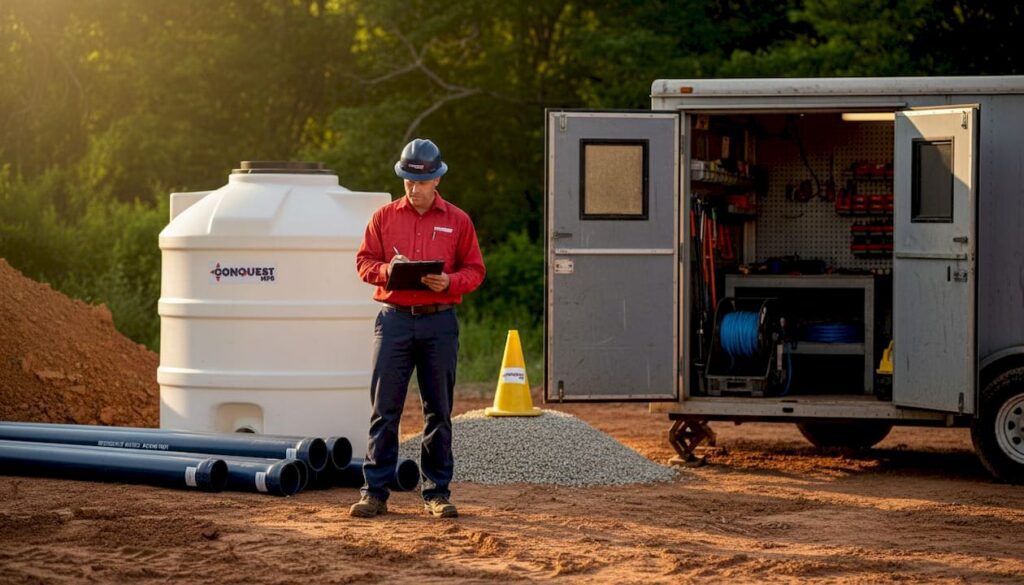
Choosing the wrong septic equipment on a construction project does not just slow you down. It can trigger costly rework, failed inspections, regulatory fines, and project shutdowns that no timeline or budget can easily absorb. We have seen firsthand how a single poor equipment decision at the start of a septic installation cascades into weeks of corrective work and strained client relationships. This guide cuts through the noise and gives construction project managers and contractors a clear, practical roadmap for selecting the right septic tools, tanks, pumps, and support systems, built around compliance, durability, and job-site efficiency.
Table of Contents
- Essential tools and equipment for septic projects
- Key criteria for selecting septic equipment
- Septic tanks and system components: Types and compliance
- Choosing pumps, aerators, and advanced system options
- Inspection, maintenance, and regulatory steps
- The reality most guides miss: Matching equipment to site and usage
- Trusted solutions for your septic equipment needs
- Frequently asked questions
Key Takeaways
| Point | Details |
|---|---|
| Compliance is critical | Always use equipment that meets local and national regulatory requirements to avoid fines and costly repairs. |
| Choose for durability | Select corrosion-resistant, compatible, and easy-to-use septic tools for long-term efficiency. |
| System type matters | Match tanks, pumps, and aerators to your specific site and system for reliable and compliant operation. |
| Plan for maintenance | Schedule regular inspections and pumping to extend system life and maintain compliance. |
Essential tools and equipment for septic projects
With the project’s stakes in mind, let’s break down exactly what equipment you will need on site.
Essential tools for septic installation and maintenance include vacuum trucks, excavators or backhoes, inspection tools, and safety gear. Each category plays a distinct role, and gaps in any one of them create bottlenecks that can stall your schedule and put workers at risk.
Service and transport vehicles are the first critical category. Vacuum trucks handle waste extraction and tank pumping during maintenance. The role of vacuum tanks in keeping septic operations running smoothly cannot be overstated. These vehicles need sufficient tank capacity and proper certification for hauling septage. Beyond vacuum trucks, your transport vehicles for septic projects must be spec’d to handle heavy tank loads on uneven terrain without compromising safety.
Excavation and earthmoving equipment, including backhoes and mini excavators, are needed for trench digging, tank placement, and drain field preparation. Precision matters here. Over-digging damages surrounding soil structure and can collapse absorption trenches before they function.
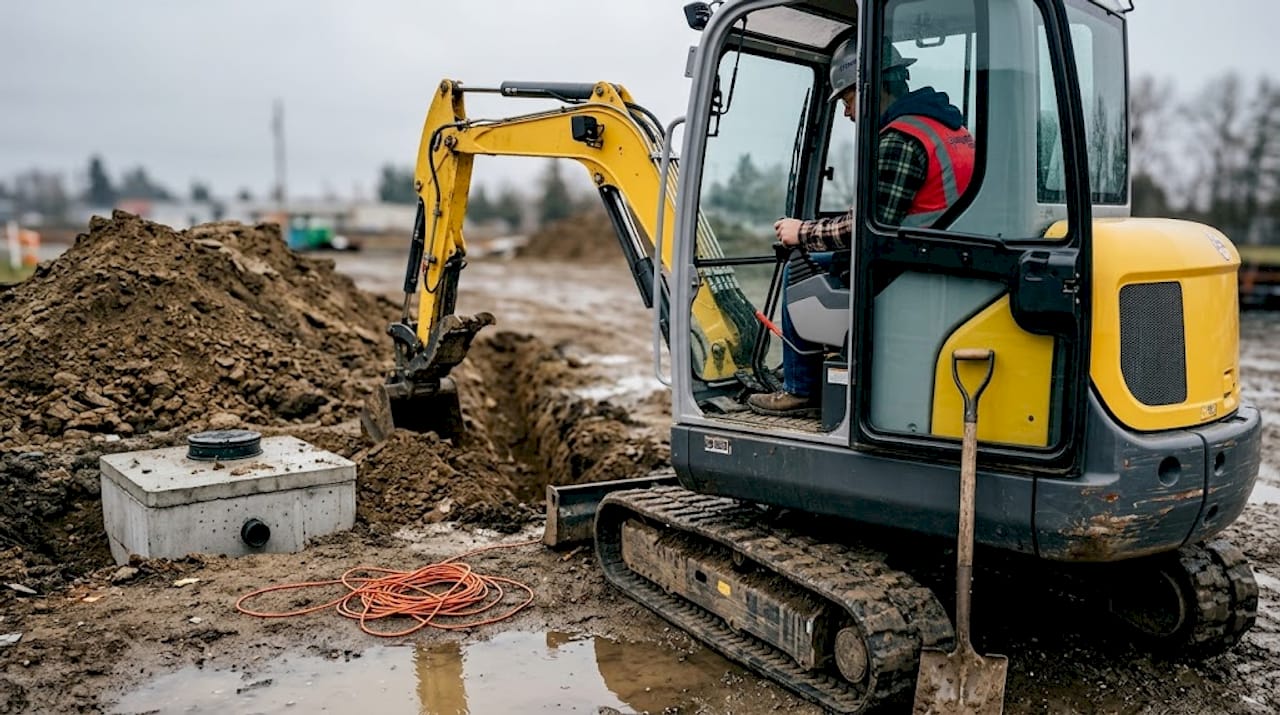
Inspection and locating tools include pipe cameras, sewer locators, and probe rods. Cameras allow you to verify pipe integrity and confirm baffles are in place before backfilling. Sewer locators prevent accidental cuts to existing lines during excavation.
Cleaning and maintenance gear rounds out the toolkit: high-pressure jetting equipment, sludge sampling devices (called sludge judges), and gas detectors for confined space work.
Top 7 items you must have on site
- Vacuum truck or pump truck with adequate capacity
- Mini excavator or backhoe sized to the lot constraints
- Pipe inspection camera system
- Sewer line locator
- Sludge judge for tank depth measurement
- Personal protective equipment (PPE): respirators, gloves, gas detectors
- High-pressure jetting unit for line cleaning
Critical safety note: Septic environments are classified as confined spaces under OSHA regulations. Hydrogen sulfide and methane gas are real hazards. Never allow a worker near an open septic tank without a four-gas monitor, proper respiratory protection, and a trained attendant on the surface.
| System type | Excavator | Vacuum truck | Inspection camera | Jetting unit | Gas monitor |
|---|---|---|---|---|---|
| Conventional gravity | Required | Required | Required | Optional | Required |
| Chamber/pressure | Required | Required | Required | Optional | Required |
| ATU/mound system | Required | Required | Required | Recommended | Required |
| Drip irrigation | Required | Optional | Required | Required | Required |
Pro Tip: Label and log all tools against a site manifest before mobilization. Equipment loss on large sites is more common than most contractors admit, and missing tools mid-installation can push your schedule by a full day or more. Review equipment security considerations to reduce that risk.
Key criteria for selecting septic equipment
Having identified your toolkit, the next step is knowing what distinguishes high-value, compliant equipment in today’s market.
Key criteria for selecting septic tools include durability, precision, ease of use, compatibility, and built-in safety features. Each criterion maps directly to either cost control or regulatory compliance, so cutting corners on any one of them is a false economy.
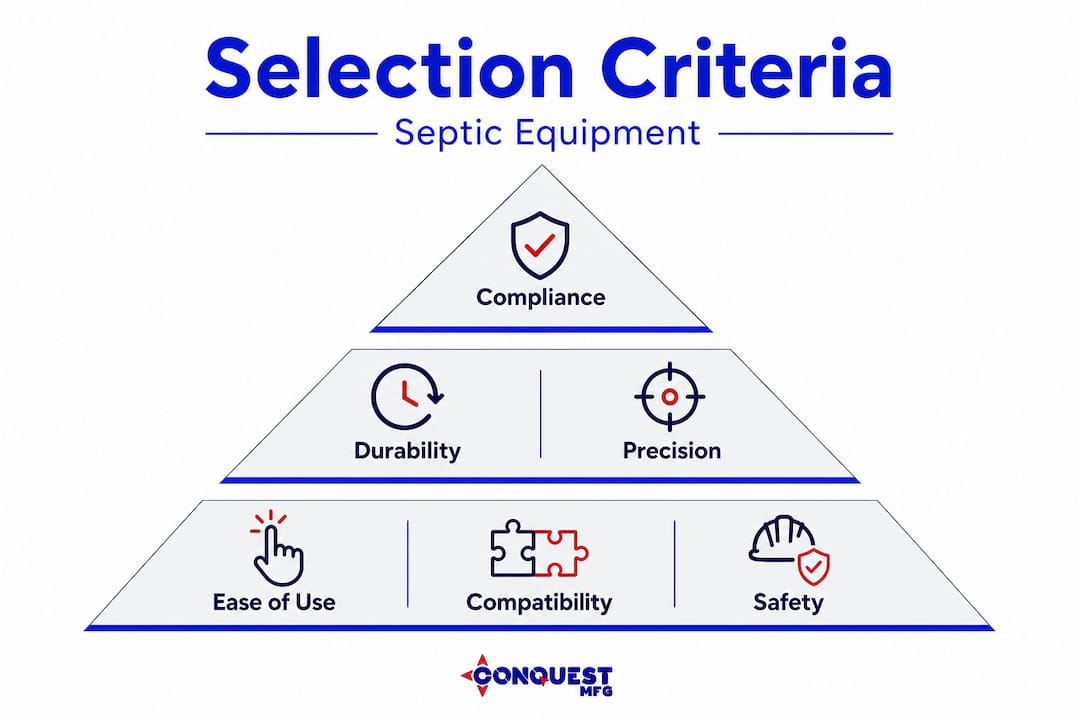
Material durability is the foundation. Septic environments expose tools and tanks to corrosive gases, hydrogen sulfide, and biological waste. Stainless steel tanks and components outperform mild steel in these conditions by years. Aluminum vacuum tanks offer a strong weight-to-strength ratio for transport applications. Fiberglass components resist both corrosion and ground movement, making them a reliable choice in environments with soil settlement.
Precision determines diagnostic accuracy. A pipe camera that delivers blurry footage or a sludge judge with inaccurate calibration leads to misdiagnoses, repeated service calls, and eventually, unhappy clients. Invest in tools that return accurate, repeatable results. The upfront cost is always lower than the cost of getting it wrong.
Compatibility is an area many contractors underestimate. New equipment must integrate with your existing fleet and workflow. A pump with a non-standard fitting, or a tank with a port configuration that does not match your vacuum hose connection, creates downtime that eats into your margins. Before purchasing, confirm specs align with your current equipment.
Ease of use reduces labor errors and speeds up turnaround. Tools with clear controls, ergonomic designs, and simple calibration let less experienced crew members work productively and safely. This matters especially when scaling up for larger projects with rotating crews.
An industrial equipment safety compliance checklist should be part of every equipment purchase review. Compliance is not optional, and equipment that does not meet current OSHA or EPA standards is a liability you cannot afford.
Non-negotiable buying criteria
- Corrosion-resistant materials rated for septic environments
- Compatibility with existing fleet connections and port sizes
- Meets or exceeds OSHA confined space and safety standards
- Availability of replacement parts within a reasonable lead time
- Manufacturer-supported service and warranty terms
Industry data shows that more than 30% of failures in septic operations can be traced to improper equipment selection rather than installation error. That statistic alone should drive a more disciplined procurement process.
Pro Tip: Before committing to a supplier, verify that replacement parts ship within your project’s standard repair window. Equipment that sits idle for two weeks waiting on a specialty valve is more expensive than paying a slight premium for a brand with immediate parts availability.
Septic tanks and system components: Types and compliance
After selecting general equipment, focus on tanks and system components, the heart of every septic installation.
Septic tanks must be approved types, such as precast concrete or fiberglass, properly sized by number of bedrooms per minimum capacity requirements, and installed with inlet and outlet tees or baffles per regulation. Using uncertified tanks or skipping baffle installation is one of the fastest ways to fail a pre-cover inspection.
The three most common tank materials each have trade-offs:
| Tank material | Durability | Installation ease | Corrosion resistance | Cost range |
|---|---|---|---|---|
| Precast concrete | Very high | Moderate (heavy) | Moderate | Low to mid |
| Fiberglass | High | Easy (lightweight) | High | Mid |
| Polyethylene (poly) | Moderate | Easy | High | Low to mid |
Concrete tanks are widely accepted by regulators and are built to last decades. Their weight makes transport more demanding and requires proper tank transport safety protocols to prevent shifting during delivery. Fiberglass and poly tanks are lighter and easier to place but require proper backfill compaction to prevent flotation in high water table areas.
Minimum tank capacities by number of bedrooms (typical U.S. standards):
| Number of bedrooms | Minimum tank capacity (gallons) |
|---|---|
| 1 to 2 | 750 |
| 3 | 1,000 |
| 4 | 1,200 |
| 5 to 6 | 1,500 |
“Proper sizing and installation is required by U.S. regulations to ensure long-term function and prevent groundwater contamination.”
Step-by-step compliance checklist for tank installation
- Confirm tank type is on your state or county’s approved products list.
- Verify tank capacity matches the number of bedrooms per local code.
- Inspect inlet and outlet tees or baffles before placement.
- Check that access risers and lids meet the required height above grade.
- Place tank on a stable, level base material to prevent settling and cracking.
- Complete pre-cover inspection with the local health department or regulatory authority.
- Document all installation details and retain permits for the record.
Never accept tanks or tees without manufacturer certification documents. Regulators are increasingly strict about paperwork, and missing certifications can hold up a final inspection even when the physical installation is correct.
Choosing pumps, aerators, and advanced system options
Knowing the tank is only part of the story. Delivering and moving wastewater efficiently means choosing the right pumps and supporting options.
For pumps: submersible sewage pumps for efficiency and stability; centrifugal for larger systems; grinder pumps for long or uphill lines. Each pump type matches a specific site condition, and mismatching them is both costly and potentially noncompliant.
Conventional gravity systems run without pumps or electricity and cost roughly $3,000 to $8,000. Chamber and pressure systems run $5,000 to $12,000 and require a pump. ATU (aerobic treatment unit) and mound systems range from $10,000 to $20,000 and require both aerators and pumps along with a continuous electrical connection. NSF/ANSI 40 certification is required for all ATUs installed in the U.S.
Aerators are essential for ATUs. They inject oxygen into the treatment chamber to accelerate biological breakdown of waste. When sizing an aerator, match airflow output in liters per minute to the system’s daily flow volume. Undersizing an aerator leads to incomplete treatment and regulatory violations.
| Installation scenario | Recommended pump type | Aerator required | NSF/ANSI 40 needed |
|---|---|---|---|
| Level lot, good soil | None (gravity) | No | No |
| Level lot, moderate depth | Submersible sewage pump | No | No |
| Long or uphill line | Grinder pump | No | No |
| Large commercial system | Centrifugal pump | No | No |
| Poor soil/ATU | Submersible pump | Yes | Yes |
| Mound system | Submersible or centrifugal | Yes | Yes |
Find the full range of equipment for large-scale septic works to support complex installations.
Edge cases that demand advanced equipment
- Poor soil percolation rates requiring an ATU or mound system
- High water table areas requiring elevated or pressurized drain fields
- Small lot sizes limiting drain field footprint, favoring chamber or ATU designs
- Properties on shallow bedrock requiring engineered alternatives
- High-volume use sites like multi-family housing requiring commercial-grade pumps
Avoid the common pitfall of specifying a residential-grade pump for a system with daily flows above what the pump’s rated capacity can handle. Pump burnout on an active system is an emergency repair situation, and the costs extend well beyond the pump itself.
Inspection, maintenance, and regulatory steps
Once your system is built, ongoing inspection and record-keeping protect your investment and your client’s compliance.
Compliance requires a site soil and percolation test costing $500 to $1,500, permits ranging from $200 to $1,000, pre-cover and final inspections, setback requirements of 50 to 100 feet from wells and 10 feet from property lines and buildings, and engineered designs for systems serving more than five bedrooms or using alternative technologies.
Pumping benchmarks are well established: pump every 3 to 5 years at a cost of $300 to $600, use a sludge judge to confirm sludge does not exceed one-third of tank depth, and inspect baffles, scum layers, and sludge levels at each service visit.
Step-by-step inspection and regulatory sign-off process
- Schedule a soil evaluation and percolation test before design finalization.
- Submit permit application with engineered design to the local authority.
- Complete installation per approved design, documenting every phase.
- Request pre-cover inspection before backfilling tank or drain field.
- Final inspection with local authority after surface restoration.
- Deliver as-built drawings and permit records to the property owner.
- Schedule the first maintenance visit within 12 months for ATU systems.
Tools for ongoing inspection and maintenance
- Sludge judge (a clear acrylic tube used to sample sludge depth)
- Pipe inspection camera for baffle and line condition checks
- Four-gas personal monitor for confined space entry
- High-pressure jetting unit for clearing partial blockages
- Service records log, whether digital or paper
ATU systems require annual maintenance performed by a licensed operator, with costs running $200 to $600 per year. Budget this into client proposals from day one. Surprises on maintenance costs are one of the main drivers of client dissatisfaction after project completion. Revisit septic system safety steps before every service event to keep your crew protected.
The reality most guides miss: Matching equipment to site and usage
Most septic equipment guides give you a list and walk away. What they rarely address is that every site is genuinely different, and the same equipment that performs flawlessly on a flat lot with sandy loam soil will fail in clay-heavy ground with a high seasonal water table.
Poor soil and high water table conditions require ATUs and mound systems, which carry higher equipment costs, ongoing maintenance obligations, and electricity requirements. Small lots favor ATUs and chamber systems because they reduce the drain field footprint. These are not edge cases. In many regions of the U.S., particularly the Southeast, Northeast, and Pacific Northwest, challenging site conditions are the norm rather than the exception.
What most guides also ignore is the impact of local rule variations. State and county regulations on setbacks, tank certifications, and installer licensing vary more than most contractors expect. A tank approved in one state may not meet the certification requirements in the next. Equipment that works perfectly in a jurisdiction with loose oversight can trigger a rejection in a county with a strict environmental compliance record.
Verify that your contractors are licensed, insured, and experienced in the specific system type you are installing. A low bid from a contractor who skips the pre-cover inspection or installs a non-certified tank will always cost more in the long run. We have seen projects where saving $2,000 on installation led to $15,000 in corrective work and permit violations.
The equipment decisions shaped by environmental site conditions are exactly where experience separates reliable contractors from costly ones. Before finalizing any equipment list, walk the site with the system designer, review the soil report together, and cross-check every spec with local code officials.
Pro Tip: Always triple-check equipment specifications against both the system designer’s recommendations and the local code requirements before placing your purchase order. A single incompatible component caught before delivery avoids a change order that can derail your timeline and your budget.
Trusted solutions for your septic equipment needs
You understand the stakes. Here is where to find compliant, contractor-grade solutions and get started on your next project.
At Conquest Manufacturing, we build specialist equipment trusted by contractors and project managers across the U.S. Our steel and aluminum vacuum tank solutions are designed for the demanding conditions of septic service operations, built for durability and long-term reliability. Explore our full range of construction-grade equipment to match the right tools to your project scope.
When it comes to moving heavy tanks safely, our guidance on compliant equipment transport gives your team the protocols to do it right every time. Contact us today for a consultation or to get a quote tailored to your project requirements. We are here to help you finish strong, on spec, and on schedule.
Frequently asked questions
What size septic tank do I need for a three-bedroom home?
Most states require a minimum of 1,000 gallons for a three-bedroom home, as tank sizing is tied to bedroom count per local regulations, so always confirm with your county authority before purchasing.
How often should a septic system be pumped?
Septic systems should be pumped every 3 to 5 years, following established pumping benchmarks, or sooner if a sludge judge shows sludge has reached one-third of the tank depth.
What is the difference between a conventional septic system and an aerobic treatment unit (ATU)?
A conventional system uses gravity alone and requires no electricity, while an ATU needs continuous power for aeration and delivers higher treatment levels, as shown in system type comparisons by installation cost and equipment requirements.
Which pumps should be used for challenging site conditions?
Grinder pumps handle long or uphill pressure lines, while submersible aerator pumps suit ATU and mound systems in poor soil, as supported by current pump selection guidance from industry specialists.