
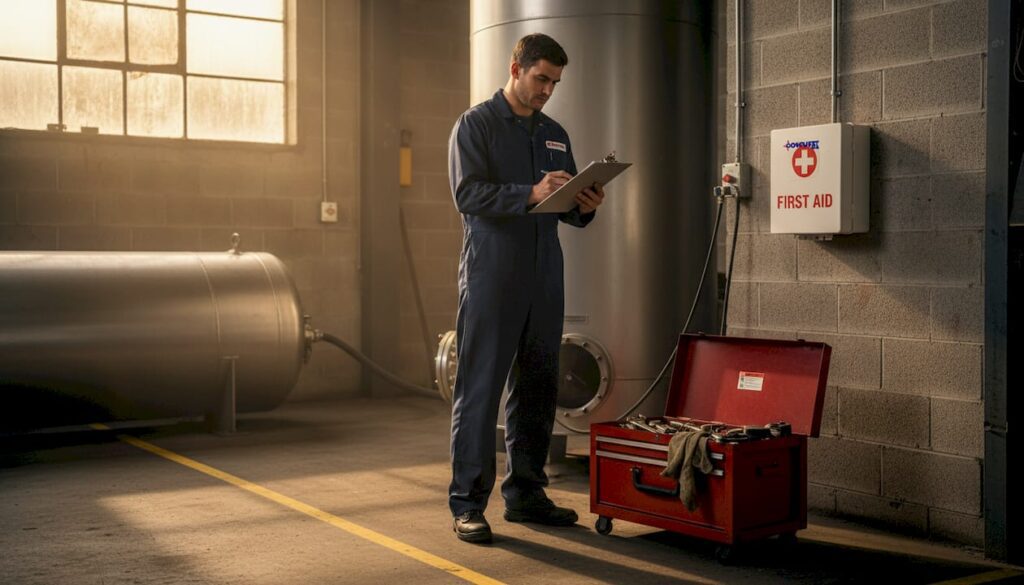
One missed valve check or a skipped grounding test can shut down your entire operation, trigger a regulatory citation, or worse, cause a serious safety incident on an active oil, gas, or construction site. Vacuum tank failures do not announce themselves in advance. They show up as blown hoses, contaminated loads, or static discharge events at the worst possible moment. The good news is that a structured, repeatable maintenance workflow eliminates most of these risks before they become problems. This guide walks your team through every stage, from preparation and daily inspection to documentation and continuous improvement.
Table of Contents
- Essential requirements and preparation for vacuum tank maintenance
- Step-by-step daily inspection and maintenance workflow
- Safety compliance and special scenarios
- Documentation, troubleshooting, and continuous improvement
- Why most vacuum tank workflows fall short—and what really works
- Take your vacuum tank maintenance to the next level
- Frequently asked questions
Key Takeaways
| Point | Details |
|---|---|
| Start with compliance | Verify all certifications and standards before initiating maintenance on vacuum tanks. |
| Follow a daily workflow | Use clear, step-by-step inspections to prevent overlooked safety and mechanical issues. |
| Document everything | Keep accurate and timely records of inspections, repairs, and permits for at least 12 months. |
| Address special scenarios | Implement extra precautions for combustible dust and flammable liquids as regulatory gaps pose major risks. |
| Troubleshoot and improve | Regularly review logs to spot patterns, address root causes, and boost equipment performance. |
Essential requirements and preparation for vacuum tank maintenance
Before you get hands-on, thorough preparation ensures maintenance is efficient and error-free.
Skipping the preparation stage is where most teams lose ground. They arrive on site, grab a wrench, and start working without confirming that the right permits are in place, the tank is properly grounded, or the pump configuration matches the material being handled. That shortcut costs time and money when something goes wrong.
Start by confirming your regulatory baseline. Vacuum tank standards and protocols require that tanks meet ASME certification and remain compliant with DOT transportation rules at all times. The ASME stamp on your tank is not just a sticker. It represents a verified pressure rating and construction standard that determines what materials the tank can safely carry and at what operating limits.
Vacuum truck tanks must meet ASME certification; only specific pumps like liquid ring models rated up to 1300 CFM are permitted for flammable liquid service. Using the wrong pump is not just a compliance violation. It creates a real ignition risk when handling hydrocarbons or other volatile materials.
Key preparation requirements include:
- Verify ASME certification documentation is current and accessible on site
- Confirm DOT compliance status for the specific route and load type
- Test grounding resistance before any connection to the tank (must be below 10 ohms)
- Confirm all valve positions match the material and flow direction for the job
- Secure the correct work permits, especially for flammable or hazardous material jobs
- Inventory your PPE: chemical-resistant gloves, face shield, steel-toe boots, and hearing protection where applicable
- Gather your tools including torque wrenches, pressure gauges, and leak detection solution
Use your equipment safety checklist to confirm every item above before starting work. A missing permit or an unverified grounding connection is a mandatory stop, not a “we’ll fix it after” situation.
Preparation requirements by task type:
| Task type | Certification required | Work permit needed | PPE level |
|---|---|---|---|
| Non-hazardous liquid removal | ASME verified | No | Standard (gloves, safety glasses) |
| Flammable liquid handling | ASME + DOT compliant | Yes | Full chemical-resistant PPE |
| Combustible dust removal | ASME verified | Yes (supervisor approval) | Respiratory protection added |
| Routine cleaning (water/rinse) | ASME verified | No | Standard |
| Oil field sludge removal | ASME + DOT compliant | Yes | Full chemical-resistant PPE |
Pro Tip: Always verify grounding resistance with a calibrated ohmmeter before connecting any hose or opening any valve. A reading above 10 ohms means you stop and address the grounding system immediately, regardless of schedule pressure.
Step-by-step daily inspection and maintenance workflow
With preparation complete, here’s how to execute a thorough daily maintenance routine step by step.
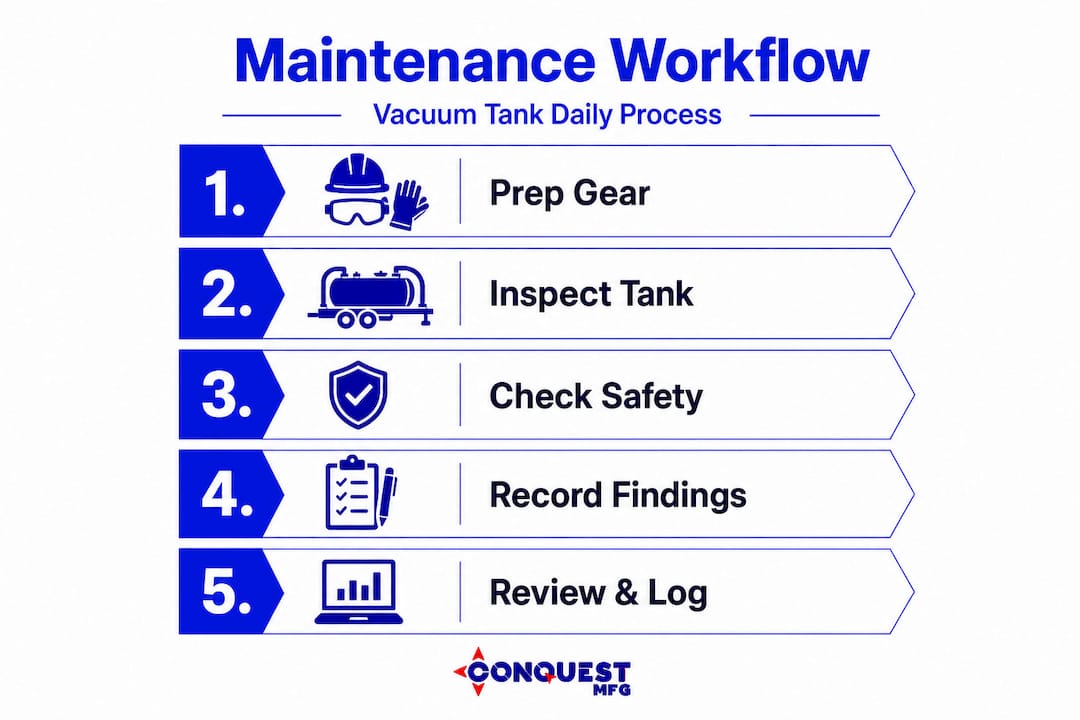
A daily inspection is not optional. It is the primary mechanism that keeps your equipment reliable and your crews safe. Daily pre-trip inspections are essential for vacuum trucks, covering tank integrity, hoses, valves, gauges, and grounding continuity. Treating this as a quick walk-around rather than a structured sequence is a common and costly mistake.
Here is the correct daily sequence your team should follow:
- External walk-around. Inspect the tank shell, saddles, and mounting hardware for visible corrosion, cracks, dents, or weld failures. Look underneath for fluid stains that indicate leaks from the previous job.
- Tank integrity check. Confirm pressure relief valves and vacuum relief valves are free of debris and functioning. Check all manway covers for proper seating and gasket condition.
- Hose inspection. Look for cuts, abrasions, collapsed sections, and fitting wear on all suction and discharge hoses. Replace any hose showing cracks near couplings. A failed hose under suction can collapse and stop production instantly.
- Valve inspection. Cycle all ball valves and gate valves through their full range of motion. Confirm they open and close without sticking. Verify that valve positions match the required configuration for the day’s material.
- Gauge verification. Check vacuum and pressure gauges against a known calibrated reference monthly. Daily, confirm gauge needles return to zero when the system is off. A stuck needle is a warning sign of a damaged gauge or blocked port.
- Grounding continuity test. Use your ohmmeter to verify the static grounding cable and clamp deliver a reading below 10 ohms from the cable clamp to the tank body.
- Pump inspection. Check pump oil level, coupling condition, and inlet strainer for blockage. Confirm the pump type matches the material. Liquid ring pumps are required for flammable liquids. Running a dry-running vane pump on hydrocarbon service is a serious hazard.
- Documentation sign-off. Record all findings, corrective actions taken, and the technician’s name. No signature means the inspection did not happen from a compliance standpoint.
Regulatory reference: DOT regulations under §396.11 and §396.13 require drivers and maintenance personnel to complete and sign driver vehicle inspection reports (DVIRs) every operating day. Defects affecting safe operation must be repaired and certified before the vehicle returns to service. Failure to comply results in out-of-service orders and potential civil penalties.
Inspection workflow comparison:
| Inspection step | Correct outcome | Incorrect/skipped outcome |
|---|---|---|
| External walk-around | Corrosion or damage caught before operation | Structural failure during suction cycle |
| Valve position check | Material flows correctly; no cross-contamination | Load contaminated; potential release event |
| Hose inspection | Worn hoses replaced before job | Hose rupture; spill; crew injury |
| Grounding test | Static discharge risk eliminated | Ignition of flammable vapors |
| Documentation sign-off | Full compliance trail maintained | Regulatory violation; no liability protection |
Linking vacuum tank inspection routines to your broader operational process means your inspection is not an isolated task. It feeds directly into scheduling, repair prioritization, and fleet readiness decisions.
Pro Tip: Use a digital checklist platform rather than paper forms. Digital records are time-stamped, cannot be altered retroactively, and are accessible to supervisors in real time. Teams using digital checklists catch defects an average of 30% faster than paper-based crews because the prompts prevent skipped steps.
Safety compliance and special scenarios
Besides standard maintenance, special scenarios require attention to extra compliance steps you can’t afford to overlook.
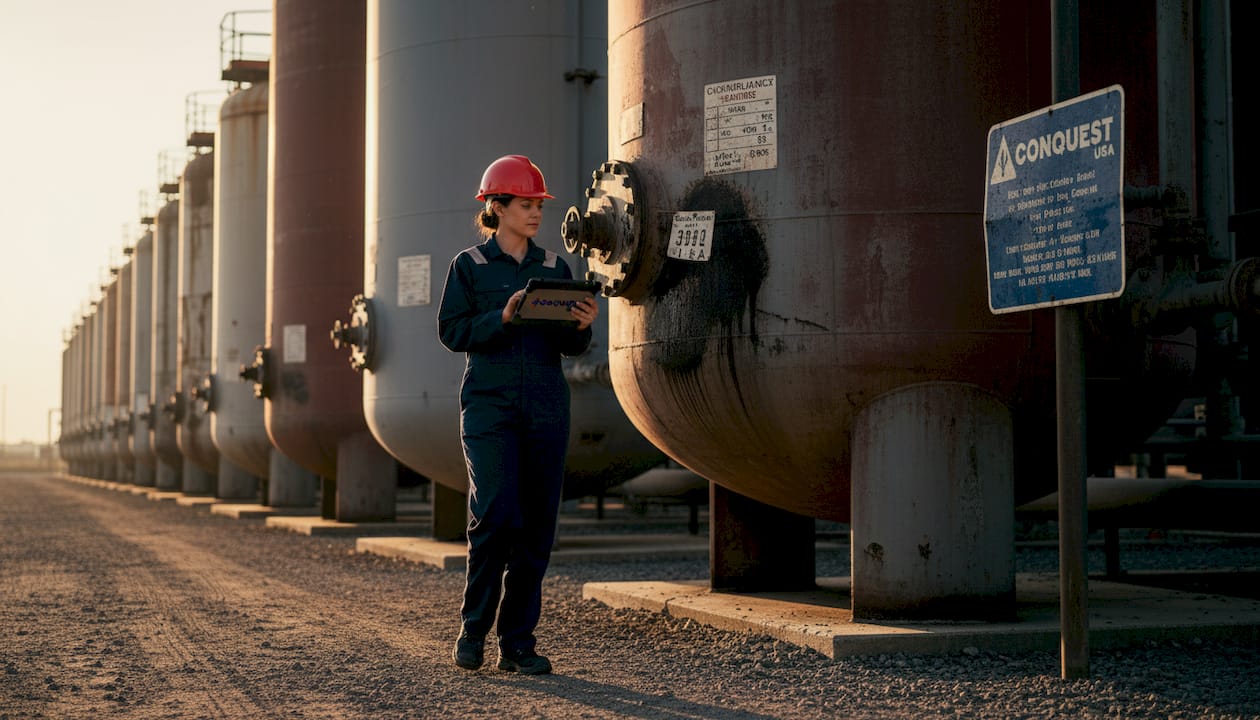
Oil and gas refinery environments introduce hazards that standard vacuum service does not. Flammable liquid handling, combustible dust, high-temperature materials, and confined space proximity all require specific protocols that go beyond the daily inspection sequence.
Critical compliance requirements for oil, gas, and hazardous material sites:
- A work permit signed by the site supervisor is required before beginning any vacuum work involving flammable liquids or classified hazardous materials
- Static grounding cables must be connected before any hose connections are made, and the connection must be verified at below 10 ohms
- Only liquid ring pumps rated for flammable service are permitted in hydrocarbon environments. Do not substitute vane pumps or rotary lobe pumps without written authorization
- Pump RPM must remain within the manufacturer’s specified range. Overspeeding a pump in flammable liquid service creates heat and ignition risk
- All personnel must be briefed on the site’s emergency response plan before work begins, not at the end of the job
For teams working in oil and gas compliance environments, these requirements are non-negotiable.
Grounding resistance matters more than most teams realize. Grounding resistance must be below 10 ohms; any reading above that threshold means you have a break in the grounding path that could allow static charge to build up and discharge across a flammable vapor cloud.
Edge case warning: Never vacuum combustible dust in a dry state. Dry combustible dust suspended in a suction stream inside a vacuum tank creates a fuel-air mixture capable of detonating. Always slurry combustible dust with water before vacuuming, and get explicit supervisor approval before starting. Additionally, do not exceed manufacturer-specified RPMs during any pumping operation, and always confirm valve positions match the intended flow direction before engaging the pump.
Reviewing oil industry equipment compliance standards helps facility managers understand how equipment specifications directly connect to site safety performance.
Documentation, troubleshooting, and continuous improvement
With hands-on work complete, proper recordkeeping and continuous review close the loop on safety and performance.
Documentation is where many otherwise solid maintenance programs fall apart. Crews complete the physical work correctly but fail to record what they did, what they found, or what was repaired. That gap becomes a serious liability during audits, incident investigations, or DOT roadside inspections.
Here is the minimum documentation your team must maintain:
- Daily driver vehicle inspection reports (DVIRs). Completed and signed before every operating day per DOT §396.11.
- Defect repair records. Every defect noted on a DVIR must have a corresponding repair record signed by the mechanic, confirming the issue is resolved or noting it is not safety-related and explaining why.
- Hazardous material manifests. Required for every load of regulated material. These are legal shipping documents and must reflect the actual contents of the tank.
- Permit records. Copies of all work permits issued for flammable or hazardous material jobs, retained with job records.
- Preventive maintenance logs. Scheduled PM tasks completed, parts replaced, and torque specifications recorded for future reference.
Maintain logs for 3-5 years on manifests and a minimum of 12 months on maintenance records. DOT §396.11 and §396.13 compliance requires accessible records at any time during a roadside inspection.
Retention requirements by document type:
| Document type | Minimum retention period | Who maintains it |
|---|---|---|
| Hazardous material manifests | 3 years minimum | Carrier and shipper |
| Driver vehicle inspection reports | 3 months | Motor carrier |
| Defect repair records | 3 months | Motor carrier |
| Preventive maintenance logs | 12 months minimum | Maintenance department |
| Work permits (hazardous jobs) | Duration of project plus 1 year | Facility/site manager |
Common troubleshooting scenarios and solutions:
- Pump losing vacuum: Check inlet strainer for blockage, inspect hose for air leaks at couplings, verify liquid ring pump has adequate water supply
- Gauge reads zero under load: Suspect a blocked gauge port or failed Bourdon tube. Replace the gauge before continuing
- Valve sticking or leaking past seat: Disassemble, clean, and inspect the seat and ball for scoring. Do not operate with a leaking valve on hazardous material jobs
- Grounding cable reads above 10 ohms: Inspect the full cable length for breaks, check clamp contact surface for corrosion, and replace the cable if continuity cannot be restored
Your transport protocol logs should be reviewed at least monthly by a supervisor with the authority to act on patterns. If three separate DVIRs in 30 days flag the same valve, that valve needs a rebuild or replacement, not another notation.
Pro Tip: Create a recurring monthly log review meeting attended by your maintenance lead and operations supervisor. Thirty minutes of pattern analysis prevents equipment failures that could cost thousands in downtime and repairs.
Why most vacuum tank workflows fall short—and what really works
We have seen the same pattern repeat across maintenance programs in the oil, gas, and construction sectors. Teams adopt a workflow, train their crews once, and assume the system will hold. Six months later, documentation gaps reappear, inspection steps get compressed under schedule pressure, and edge-case protocols are forgotten entirely because no one has encountered that specific scenario since the initial training.
The core problem is not that teams lack the right procedures. It is that procedures alone do not produce reliable behavior. Paper checklists create the illusion of compliance. A signed paper form looks the same whether the technician completed every step carefully or rushed through the list in two minutes. Digital documentation changes that dynamic. Time-stamped entries, photo attachments, and real-time supervisor visibility create accountability that paper simply cannot replicate. Teams that transition to digital logs consistently report fewer repeat defects and faster audit responses.
What expert maintenance teams do differently is they treat root cause analysis as a standard part of the workflow, not an exception triggered only by incidents. When a hose fails, they do not just replace it. They ask why it failed, whether the failure mode is appearing on other units, and whether the inspection process would have caught it earlier. That question drives continuous improvement rather than reactive repair cycles.
The transport standards guide we recommend provides a strong structural foundation, but the teams that truly set new safety standards build a culture on top of that structure. That means regular scenario training, including edge cases like combustible dust and flammable liquid spills, and briefings where technicians talk through what they saw during the week’s inspections. When your crew is comfortable raising concerns about equipment condition before a job rather than after, your maintenance workflow is working.
Take your vacuum tank maintenance to the next level
For teams ready to streamline maintenance and compliance further, a range of expert resources and products are available.
Solid maintenance starts with equipment built to handle the demands of real-world oil, gas, and construction operations. At Conquest Manufacturing, we design and build steel and aluminum vacuum tanks engineered for reliability under the exact conditions your team faces every day. Our custom-built units meet ASME certification requirements and are configured to support proper pump integration, grounding system installation, and valve layouts that simplify your daily inspection workflow.

Explore our vacuum tank protocols guide to deepen your team’s understanding of transport safety and regulatory compliance. For operational insights on improving service efficiency, our resource on vacuum tank efficiency offers practical perspectives. When your next procurement decision comes around, we are ready to be your manufacturing partner. Contact us to discuss your fleet’s specific requirements and get a quote tailored to your operation.
Frequently asked questions
How often should vacuum tank maintenance logs be reviewed?
Logs should be reviewed at least monthly and after each repair to ensure compliance and catch recurring issues early. Maintain logs for 3-5 years on manifests and 12 months on maintenance records to meet regulatory requirements.
What is the acceptable grounding resistance for vacuum tanks in refineries?
Grounding resistance must be below 10 ohms to ensure safe static discharge when handling flammable materials. Any reading at or above that threshold requires immediate corrective action before work continues.
Are work permits required for standard cleaning or only for hazardous materials?
Work permits are required for handling flammable or hazardous materials, not for standard non-hazardous cleaning operations. Always confirm the material classification before starting to determine whether a permit applies.
How should combustible dust be handled in a vacuum tank?
Do not vacuum combustible dust dry; always slurry it with water first and obtain supervisor approval before starting. Dry combustible dust in a suction stream creates a serious deflagration risk inside the tank.
What records must be kept for compliance—inspection, manifests, or all documents?
You must keep all relevant maintenance, inspection, and manifest records for full compliance. Manifests require 3-5 years of retention while maintenance logs require a minimum of 12 months, and both are subject to review during DOT audits or incident investigations.
Recommended
- Safe vacuum tank transport: Standards and protocols guide – CONQUEST MFG USA
- How Vacuum Tanks Streamline Septic Service Operations – CONQUEST MFG USA
- Industrial equipment safety checklist: Essential steps for compliance – CONQUEST MFG USA
- Boost efficiency with bulk transportation equipment in 2026 – CONQUEST MFG USA