
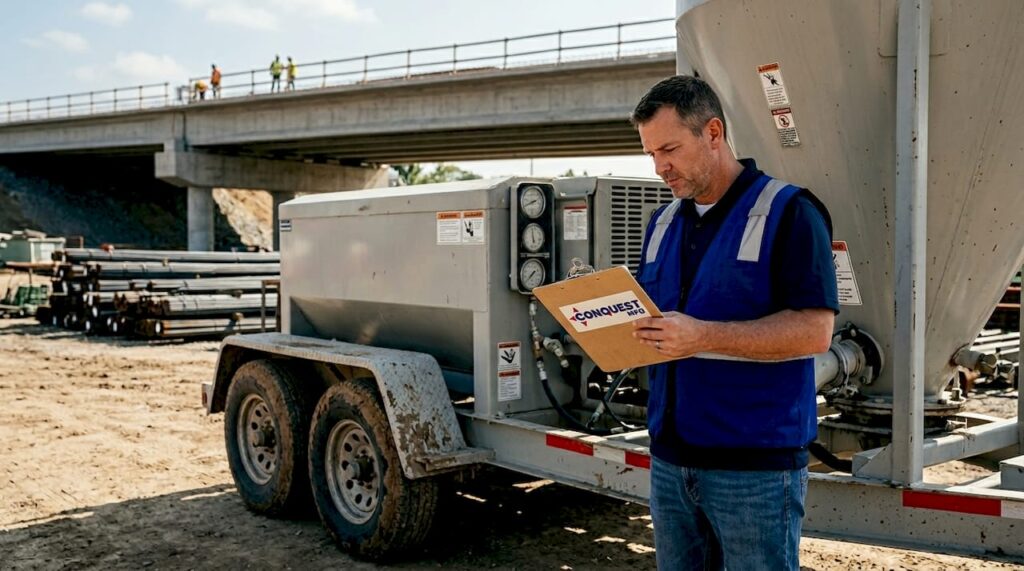
Cement delivery delays and bulk material bottlenecks cost construction crews real money every single day. When your batch plant sits idle waiting on the next truckload, or your crew stands around because material ran out mid-pour, those inefficiencies add up fast. Portable cement pig silo trailers solve this problem directly. They store 4 to 5 truckloads of material on-site, cut downtime, and move with your operation from job to job. This guide walks you through everything from selecting the right unit to running it safely and optimizing it for maximum efficiency.
Table of Contents
- What is a pig silo and why use one?
- What you need before setup: Equipment, requirements, and safety
- Step-by-step: Operating a pig silo for bulk cement transfer
- Troubleshooting and optimizing your pig silo system
- Evaluating results and next steps
- A practical perspective: Learning from real-world pig silo operations
- Find the right pig silo solution for your operation
- Frequently asked questions
Key Takeaways
| Point | Details |
|---|---|
| Maximize efficiency | Pig silos cut downtime by handling 4-5 truckloads and speeding up bulk transfers. |
| Prepare thoroughly | Use a clear checklist of equipment and safety steps for smooth operation. |
| Follow key steps | A step-by-step process ensures safe, reliable material handling every time. |
| Address common issues | Routine troubleshooting and maintenance keep your pig silo system running at its best. |
| Plan for growth | Assess results and consider scaling with additional or upgraded pig silos as your operation expands. |
What is a pig silo and why use one?
A pig silo is a trailer-mounted, portable bulk storage unit designed to hold cement, fly ash, and other dry powdered materials directly on your jobsite. Unlike a stationary silo that gets poured in concrete and stays put, a pig silo connects to a standard semi-truck, rolls to your site, and gets to work immediately. That portability is its defining advantage.
Here is how a pig silo compares to other bulk storage options:
| Feature | Pig silo trailer | Stationary silo | Bulk tanker delivery |
|---|---|---|---|
| Portability | High, moves with your project | None | Delivery only, no on-site storage |
| Setup time | Hours | Days to weeks | N/A |
| Material buffer | 4 to 5 truckloads | Large but fixed | Single load per delivery |
| Cost for temp sites | Cost-effective | High capital cost | Repeated delivery fees |
| Terrain flexibility | Built for rough conditions | Requires stable foundation | Road access only |
The core benefit is buffer capacity. When you store 4 to 5 truckloads of cement on-site, you are not dependent on the next truck arriving exactly on schedule. Batch plants keep running. Pours stay on schedule. Your crew stays productive.
Key benefits of pig silo trailers include:
- On-site material buffer that eliminates pour interruptions
- Fast deployment with no permanent foundation required
- Lower cost than installing a stationary silo for temporary or mid-length projects
- Mobility to relocate between job phases or project sites
- Durability built to handle rough, uneven, and demanding jobsite conditions
Typical applications include highway and bridge construction, large commercial concrete pours, precast operations with rotating locations, and any project where consistent material supply is critical but a permanent silo is not practical.
Pro Tip: If your project involves variable terrain or remote access, our industrial pig silo designs are engineered with reinforced frames and heavy-duty landing gear to handle ground conditions that would compromise lesser equipment.
What you need before setup: Equipment, requirements, and safety
Understanding what a pig silo is, you will need the right preparation before you can operate one safely and effectively. Skipping this step is where most operational problems begin. A well-prepared site and a properly equipped crew make every subsequent step faster and safer.
Here is a practical equipment and site checklist before you begin:
| Requirement | Details |
|---|---|
| Tow vehicle or positioning equipment | Capable of maneuvering the loaded trailer |
| Level ground or stabilization pads | Prevents tipping during fill and discharge |
| Air compressor or pneumatic supply | Matched to the silo’s pressure specifications |
| Fill hoses and pneumatic lines | Inspected for wear, cracks, and seal integrity |
| Personal protective equipment (PPE) | Dust masks, safety glasses, hard hats, gloves |
| Pressure relief valve check | Confirm it is functional before every fill |
| Trained operators | Certified on trailer movement and pressurization |
Site preparation matters more than most crews realize. The trailer needs to sit on ground that will not shift under load. A fully loaded pig silo carries significant weight, and even a slight grade can create stability issues during discharge. Use leveling pads or compacted gravel pads when working on soft or uneven ground.
Before every operation, your team must follow this safety sequence:
- Inspect all hoses and seals for wear, cracking, or loose fittings
- Verify the pressure relief valve opens and closes correctly
- Confirm landing gear is fully deployed and locked
- Check that all fill and discharge valves are closed before connecting air supply
- Review the equipment safety checklist specific to your unit
“All staff must be trained on trailer movement and pressurization safety before operating a pig silo. Pressurized systems carry real risk when handled by untrained personnel, and no project schedule justifies cutting corners on operator training.”
The industry-specific considerations for construction versus transportation operations also differ. A highway project may require faster repositioning cycles, while a precast plant may prioritize high-volume fill rates. Know your application and configure your setup accordingly. Pig silos are durable in rough conditions, but durability is not a substitute for proper preparation.
Step-by-step: Operating a pig silo for bulk cement transfer
Once you are equipped and safe, it is time to run the silo. The process has five distinct phases: positioning, connecting, filling, pressurizing, and discharging. Each one matters, and skipping steps creates problems that cost more time than the shortcut saved.
Phase 1: Positioning
- Identify a stable, level area close to your batch plant or mixing equipment.
- Back the trailer into position using a spotter.
- Deploy all landing gear legs and verify they are locked under load.
- Chock the wheels to prevent any trailer movement.
Phase 2: Connecting
- Connect the pneumatic fill line from the delivery tanker to the silo’s fill inlet.
- Inspect every connection point for proper seating and seal integrity.
- Open the vent valve to allow air to escape during fill.
Phase 3: Filling
- Signal the delivery driver to begin transfer.
- Monitor the fill level indicator throughout the process.
- Never exceed the rated capacity. Overfilling creates pressure buildup and risks seal failure.
Phase 4: Pressurizing for discharge
- Close the fill inlet valve completely.
- Connect your on-site air compressor to the discharge pressurization port.
- Slowly bring pressure up to the operating specification for your unit. Do not rush this step.
- Confirm the pressure gauge reads within the correct operating range before opening the discharge valve.
Phase 5: Discharging
- Open the discharge valve slowly and direct material flow to your batch plant or mixer.
- Monitor flow rate and pressure throughout discharge.
- When the silo is empty, depressurize fully before disconnecting any lines.
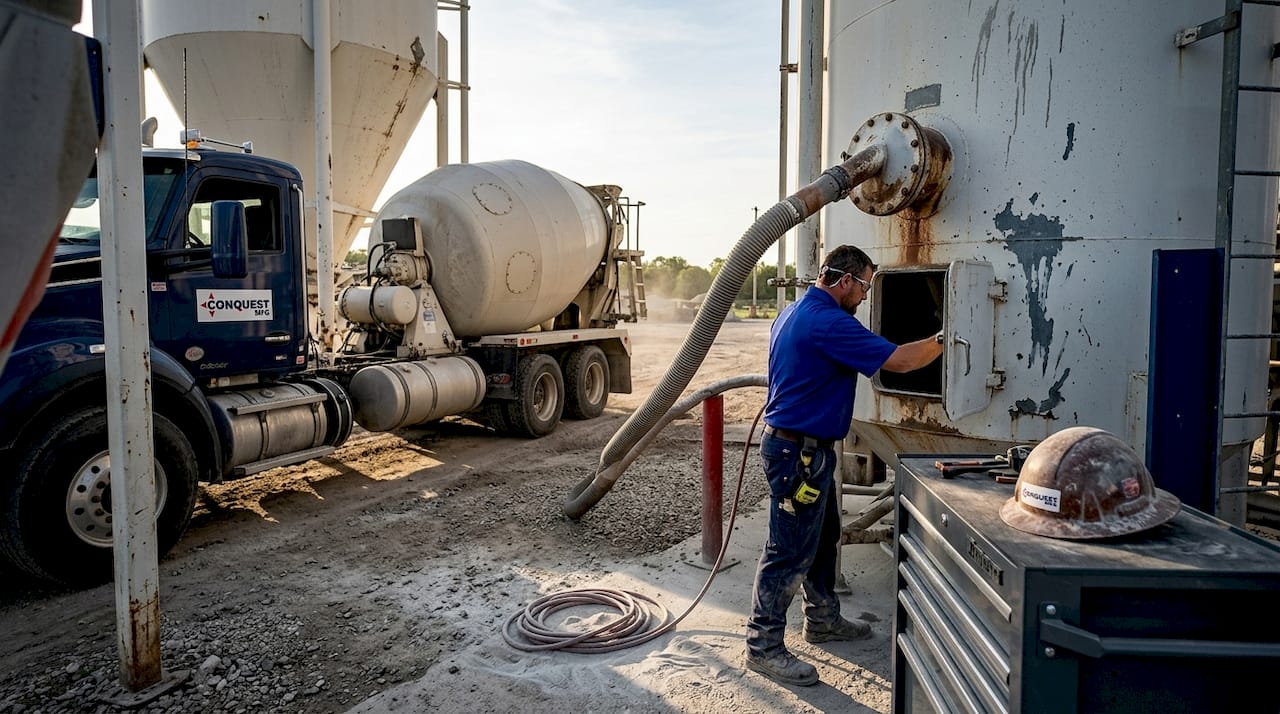
The most common mistakes operators make are failing to vent during fill, overfilling past capacity, and skipping seal checks between cycles. Each of these mistakes is preventable with disciplined process adherence. The secure material handling protocols we recommend are designed to keep your crew safe and your equipment in service longer.
Pro Tip: Always check pressure gauges before activating any pneumatic system. A gauge that reads incorrectly is more dangerous than one that reads zero. Replace gauges at the first sign of inconsistency.
Because pig silos store 4 to 5 truckloads of material, you can often complete an entire pour cycle without waiting for resupply. That is a direct, measurable reduction in project downtime. For more on using pig silos in construction applications, our product pages include detailed specifications for each unit we manufacture.
Troubleshooting and optimizing your pig silo system
Even the best equipment needs maintenance and troubleshooting. Here is how to keep your silo running efficiently and catch problems before they become costly shutdowns.
Common problems and quick fixes:
- Material flow blockage: Usually caused by moisture in the material or a clogged discharge cone. Tap the cone gently to break up bridging, and check that your material meets moisture specifications before fill.
- Pressure loss during discharge: Check all hose connections and the discharge valve seal. A small leak at a fitting can drop pressure enough to stall material flow entirely.
- Trailer stabilization issues: If the unit shifts during operation, check landing gear engagement and ground conditions. Add stabilization pads if the site is soft.
- Slow fill rate: Often caused by a blocked vent or a partially closed fill valve. Confirm both are fully open during the fill cycle.
Here is how troubleshooting compares between stationary and portable silo systems:
| Issue | Stationary silo | Pig silo trailer |
|---|---|---|
| Blockage resolution | Requires maintenance crew and downtime | Operator-level fix in most cases |
| Pressure leak repair | Scheduled maintenance window | Field repair with standard fittings |
| Relocation for access | Not possible | Reposition in hours |
| Wear inspection | Periodic scheduled checks | Pre-operation checklist every cycle |
Routine maintenance keeps your pig silo delivering peak performance. Follow this schedule:
- Before every use: Inspect hoses, seals, pressure relief valves, and landing gear
- Weekly: Lubricate all moving parts including valve stems and landing gear mechanisms
- Monthly: Replace any hose showing surface cracking or stiffness
- Quarterly: Full inspection of the frame, welds, and structural components
The maintenance checklist we provide with every unit gives you a structured format to document each inspection. Documentation matters when you are managing multiple units across multiple sites.
Signs that your pig silo system is running at its best:
- Consistent fill times from cycle to cycle
- No pressure drop during discharge
- Material flow that starts and stops cleanly
- Zero unplanned downtime between pours
- Crew completing setup and teardown within your target time window
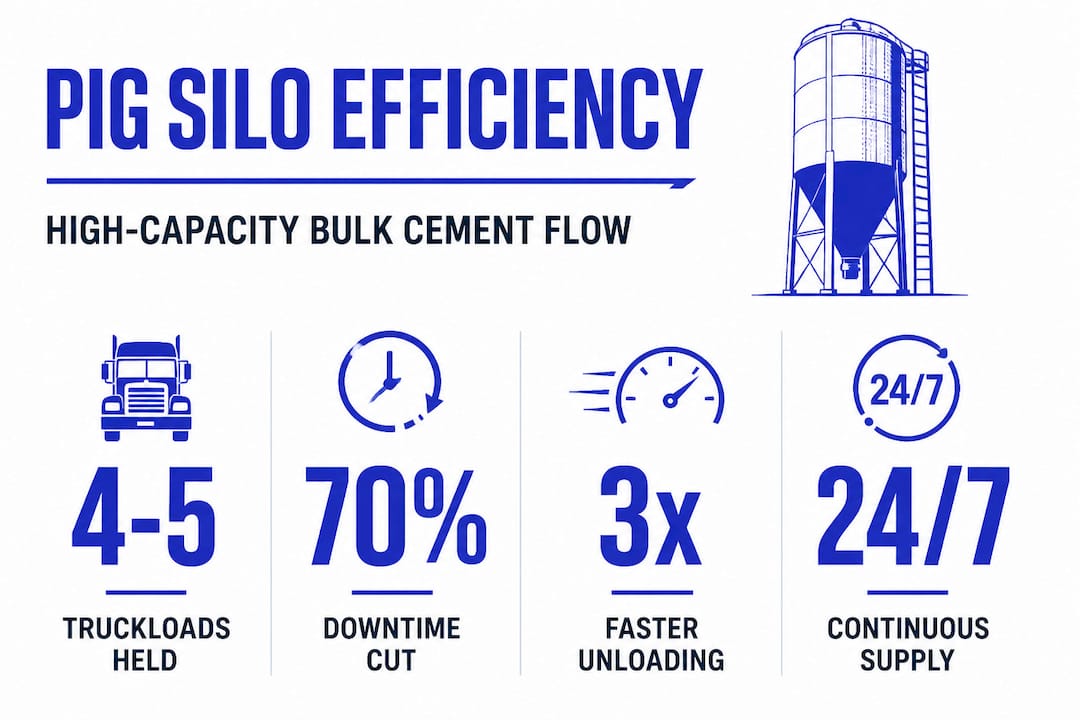
The fact that pig silos store 4 to 5 truckloads means that when your system is optimized, you are effectively insulating your operation from supply chain variability. That buffer is only valuable if the equipment is maintained well enough to use it.
Evaluating results and next steps
After optimizing your current setup, it is time to assess what your pig silo system is actually delivering and plan for growth or new projects.
Measure your results against these key performance indicators:
- Downtime reduction: How many pour interruptions did you eliminate compared to before?
- Cost per cubic yard: Has your material handling cost decreased with on-site storage?
- Project schedule adherence: Are pours completing on time more consistently?
- Equipment utilization rate: Is the silo being filled and discharged efficiently across shifts?
- Maintenance cost per cycle: Are you catching wear items early enough to avoid emergency repairs?
When to consider expanding or upgrading your system:
- Your project volume has grown beyond what a single unit can buffer
- You are running multiple simultaneous pours that require independent material supply
- You are moving into new material types like fly ash or lime that require different discharge configurations
- Your current unit is aging and maintenance costs are rising faster than replacement cost justifies
A practical review checklist for your pig silo system:
- Compare actual downtime data before and after deployment
- Review maintenance logs for recurring issues that signal wear patterns
- Survey your operators for friction points in the daily workflow
- Assess whether your current unit’s capacity matches your peak demand cycles
- Evaluate whether scaling across industries with additional equipment types would improve your overall operation
The cost-effective advantage over stationary silos becomes even clearer when you calculate total cost of ownership across multiple projects. A portable unit that moves with your work delivers value on every job, not just the one where it was first deployed.
A practical perspective: Learning from real-world pig silo operations
Theory is important, but practical insights make your silo investment deliver the most value. After working with construction and transportation professionals across the country, we have seen a consistent pattern: the operations that get the most from their pig silos are not necessarily the ones with the newest equipment. They are the ones with the most disciplined processes.
Conventional wisdom says any heavy-duty silo will perform on a tough jobsite. That is not wrong, but it is incomplete. The equipment has to match the specific demands of mobile operations. A unit built for stationary use will struggle with the repeated repositioning, road vibration, and variable ground conditions that define a real construction project. That is why purpose-built insider logistics analysis of mobile operations consistently points to portable, trailer-based designs as the right tool for temporary and rotating sites.
What seasoned operators know is that regular maintenance beats any marketing claim about heavy-duty construction. We have seen crews run inexpensive units for years with no major failures simply because they followed a disciplined pre-operation checklist. We have also seen premium equipment fail early because the team assumed the build quality meant they could skip inspections.
The hidden value that most operations overlook is team training on quick changeovers. When your crew can reposition, reconnect, and restart a pig silo in under an hour, your project flexibility increases dramatically. That speed comes from repetition and training, not from the equipment alone. Invest in both.
Site-specific needs also matter more than most buyers anticipate. A pig silo deployed on a coastal project faces different corrosion challenges than one running in the desert Southwest. Know your environment and spec your equipment accordingly. Paying attention to those details upfront saves significant time and money over the life of the unit.
Find the right pig silo solution for your operation
If you are ready to upgrade your bulk material handling, tailored equipment is just a step away. At Conquest Manufacturing, we build portable cement pig silo trailers engineered for the demands of real construction and transportation operations across the USA.
Our units are custom-built for durability, mobility, and efficient material transfer. Whether you need a single unit for a specific project or a fleet of trailers to support large-scale operations, we have the expertise and manufacturing capability to deliver. Explore construction pig silo trailers to see full specifications, or browse our full range for transportation professionals. When you are ready to move forward, shop pig silo equipment directly or contact our team for a custom quote tailored to your specific requirements.
Frequently asked questions
What materials can be stored in a pig silo?
Pig silos are designed for cement and other bulk powders including fly ash, lime, and dry sand, making them versatile for a wide range of construction and industrial applications.
How many truckloads can a typical pig silo hold?
A standard pig silo holds 4 to 5 truckloads of material, giving your operation a meaningful buffer against delivery delays and supply interruptions.
Are pig silos suitable for rough construction sites?
Yes, pig silos are built for durability and engineered to handle harsh site conditions including uneven ground, heavy vibration, and demanding weather environments.
What is the main advantage over stationary silos?
Pig silos are cost-effective for temporary sites because they require no permanent foundation, move with your project, and eliminate the capital cost of installing fixed infrastructure for short or mid-length jobs.