
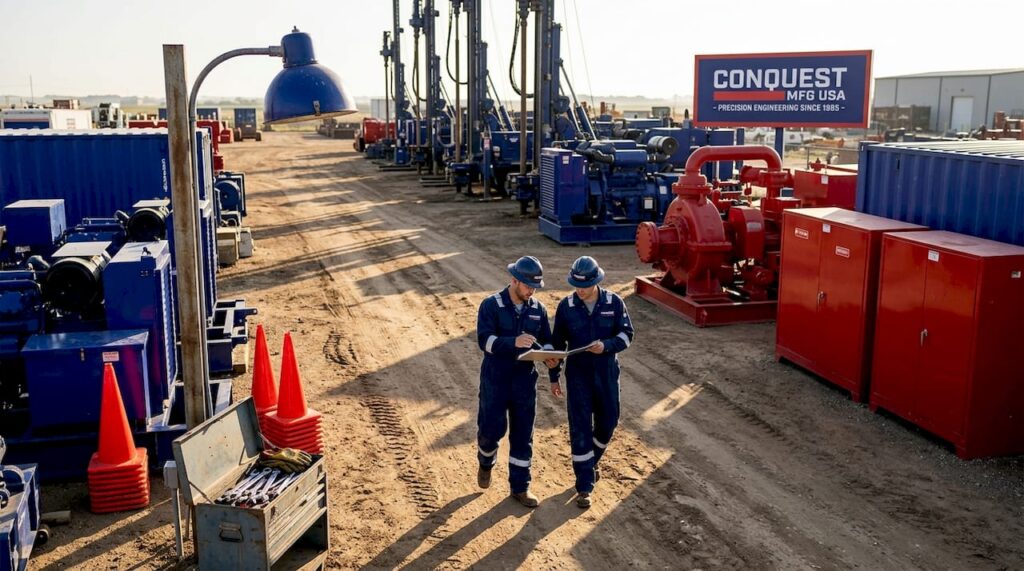
Reliability centered maintenance (RCM) reduces unscheduled outages by 31% while improving mean time between failures by 22% and cutting maintenance costs by 15%. Yet many oil and gas facilities still rely on outdated, one-size-fits-all equipment strategies that leave significant efficiency gains on the table. Whether you operate a shale play in the Permian Basin or manage an offshore platform in the Gulf of Mexico, the equipment types you select and how you maintain them directly determine your facility’s uptime, safety record, and cost structure. This guide walks you through the core equipment categories, asset prioritization frameworks, and monitoring strategies that drive real operational results.
Table of Contents
-
Monitoring and maintenance strategies: Beyond time-based routines
-
Why operators should think differently about equipment selection
-
Enhance your operations with specialized equipment solutions
Key Takeaways
| Point | Details |
|---|---|
| Critical assets first | Allocate resources to top-priority equipment, such as compressors and wellheads, for maximum reliability impact. |
| Embrace smarter maintenance | Shift from time-based schedules to condition-based or predictive monitoring to reduce costs and prevent failures. |
| Specialized gear matters | Select equipment tailored to operational context, especially for shale and offshore environments facing unique risks. |
| Management of change | Regularly review processes to prevent reliability setbacks when equipment or procedures change. |
| Continuous improvement | Investing in data, training, and new technologies continually enhances operational efficiency and safety. |
Overview of oil industry equipment types
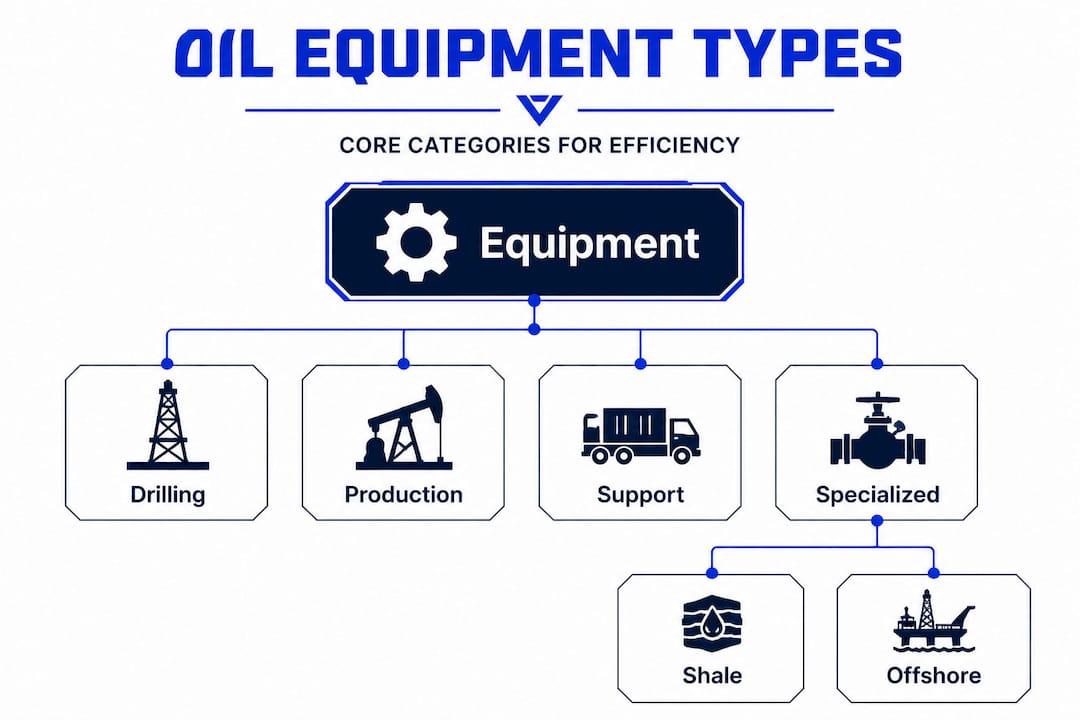
Now that you know the stakes, let’s organize the major equipment categories essential to industry operations. Oil and gas facilities in the USA rely on four primary equipment groups: drilling equipment, production equipment, transportation equipment, and support infrastructure. Each group plays a distinct role in the operational workflow, and selecting the right mix within each group is what separates high-performing facilities from those constantly fighting unplanned downtime.
Drilling equipment includes rotary rigs, blowout preventers, drill strings, and mud circulation systems. Production equipment covers wellheads, separators, compressors, and processing units. Transportation equipment spans pipelines, tanker trailers, pneumatic bulk trailers, and intermodal chassis. Support infrastructure includes concrete batch plants, sand hoppers, surveillance towers, and site utilities. The oil and gas industry growth trend in the USA continues to push demand for more specialized and mobile versions of each category, particularly in shale plays where pad drilling requires rapid equipment repositioning.
USA shale operations have specific needs that differ sharply from conventional vertical well setups. Mobile frac support equipment, portable concrete batch plants for rapid pad construction, and dry bulk pneumatic trailers for proppant delivery are now standard tools in high-volume shale environments. Offshore operations, on the other hand, require corrosion-resistant materials, vibration-dampening mounts, and redundant systems because offshore equipment faces extreme corrosion and vibration, making hidden failures a serious operational risk.
Here is a comparison of common versus specialized equipment across key operational categories:
| Equipment category | Common equipment | Specialized equipment | Primary application |
|---|---|---|---|
| Drilling support | Standard batch mixers | Mobile concrete batch plants | Rapid pad construction |
| Bulk material handling | Fixed silos | Portable cement pig silo trailers | Frac site logistics |
| Fluid transport | Fixed pipelines | Aluminum vacuum tanks | Fluid recovery and transfer |
| Proppant delivery | Conventional trucks | Dry bulk pneumatic trailers | High-volume sand transport |
| Site security | Fixed cameras | Rapid-deployed surveillance towers | Remote site monitoring |
You can explore the full range of oil and gas equipment categories we manufacture to support your specific operational setup. For a broader view of the industries we serve, the manufacturing industry overview covers the full scope of our capabilities.
Key characteristics that define specialized oil industry equipment:
-
Mobility: Equipment must relocate quickly between well pads or platforms without major downtime.
-
Corrosion resistance: Materials must withstand hydrogen sulfide, saltwater, and chemical exposure.
-
High load capacity: Trailers and tanks must handle the volumes demanded by modern frac operations.
-
Rapid deployment: Surveillance towers and batch plants must be operational within hours of arrival.
-
Regulatory compliance: All equipment must meet DOT, OSHA, and EPA standards for USA operations.
Prioritizing critical assets for operational reliability
Once you recognize the scope of equipment options, it’s crucial to spotlight assets that impact uptime most. Not all equipment deserves equal attention or equal budget. The most effective operators we work with apply a disciplined prioritization model that concentrates resources where failure consequences are highest.
The guiding principle here is straightforward. Top 20% critical assets such as compressors and wellheads should receive 60 to 70% of your maintenance resources. These are the assets whose failure triggers production shutdowns, safety incidents, or environmental violations. Everything else gets maintained on a risk-adjusted schedule, not a uniform one.
RCM and risk-based inspection (RBI) are the two primary frameworks that support this prioritization. RCM uses failure mode and effects analysis (FMEA) to identify how each asset can fail and what the consequences are. RBI ranks assets by the probability and consequence of failure, then schedules inspections accordingly. Together, these frameworks ensure you’re not spending equal time on a secondary pump and a primary gas compressor.
Here is an illustrative breakdown of how prioritization translates into resource allocation and measurable results:
| Asset type | Criticality level | Resource allocation | Maintenance approach | Typical result |
|---|---|---|---|---|
| Gas compressors | High | 25% of budget | Predictive + RCM | 22% MTBF improvement |
| Wellheads | High | 20% of budget | RBI + condition-based | Reduced leak incidents |
| Pneumatic trailers | Medium | 15% of budget | Scheduled + CBM | Extended service life |
| Batch plant components | Medium | 15% of budget | Time-based + visual | Consistent output quality |
| Secondary pumps | Low | 10% of budget | Run-to-failure | Acceptable risk level |
Steps to build a working asset prioritization system at your facility:
-
Inventory all assets with their function, location, and replacement cost documented.
-
Score each asset on consequence of failure (safety, production, environment, cost).
-
Score each asset on probability of failure based on age, condition, and operating history.
-
Rank assets by combined criticality score and segment into high, medium, and low tiers.
-
Assign maintenance strategies based on tier, not convenience or habit.
-
Review the ranking at least annually or after any major operational change.
Pro Tip: Every time you modify a process, add new equipment, or change operating parameters, you must run a formal management of change (MOC) review. Skipping MOC is one of the fastest ways to introduce reliability regression into a facility that was previously performing well.
We build critical asset manufacturing solutions designed to support this kind of structured, reliability-focused operation. For facilities that also need mobile infrastructure for security alongside their production assets, we offer rapid-deployed surveillance towers that integrate into your overall site management plan. Staying current with priority asset marketing trends can also help you benchmark your strategy against what leading operators are doing.
Monitoring and maintenance strategies: Beyond time-based routines
After identifying your critical equipment, how you care for it can make or break your facility’s performance. The maintenance methodology you choose is just as important as the equipment itself. Three primary approaches define the current landscape: time-based maintenance (TBM), condition-based maintenance (CBM), and predictive maintenance (PdM).
Time-based maintenance means servicing equipment on a fixed schedule regardless of actual condition. It’s simple to administer but often wasteful. CBM monitors real-time equipment condition using sensors, vibration analysis, and oil sampling, then triggers maintenance only when readings indicate a developing fault. PdM takes CBM further by using AI and machine learning models to forecast failures before they become detectable through conventional monitoring.
“Condition-based monitoring using vibration analysis and oil sampling is preferred over time-based maintenance schedules, and predictive maintenance programs can detect developing issues weeks before failure occurs.”
The gap in effectiveness between these approaches is significant. AI fault prediction models now achieve 98% accuracy in identifying compressor faults, giving operators a reliable early warning system that time-based schedules simply cannot match. For gas compressors running at high utilization rates, catching a bearing fault three weeks early versus discovering it during a shutdown is the difference between a planned repair and a costly emergency replacement.
Key technologies driving modern condition monitoring in oil and gas:
-
Vibration sensors: Detect imbalance, misalignment, and bearing wear in rotating equipment like compressors and pumps.
-
Oil analysis: Identifies metal particles, viscosity changes, and contamination that signal internal wear.
-
Acoustic emission monitoring: Detects high-frequency stress waves from active cracks or leaks in pressure vessels.
-
Thermal imaging: Identifies hot spots in electrical panels, heat exchangers, and mechanical connections.
-
Wireless IoT sensors: Enable continuous monitoring of remote or hard-to-access equipment without manual rounds.
You can review the equipment monitoring technologies we incorporate into our manufactured equipment to understand how we build reliability into the design itself. It’s also worth understanding the risk of unnecessary PM that comes with over-relying on time-based schedules, which can introduce new failure modes during unnecessary disassembly.
Pro Tip: Transitioning from reactive or time-based maintenance to a predictive model is not just a technology investment. It requires training your maintenance team to interpret sensor data, building a data infrastructure to store and analyze readings, and establishing clear escalation protocols when thresholds are exceeded. Start with your highest-criticality assets and expand the program as your team builds confidence.
Specialized equipment for shale and offshore operations
Finally, both the environment and application often demand custom solutions. Here’s what it takes to operate where the risks are highest. USA shale operations and offshore platforms represent the two most demanding environments in the domestic oil and gas sector, and each requires a fundamentally different equipment approach.
USA shale operations emphasize mobile frac support equipment as a core efficiency driver. The economics of pad drilling depend on fast equipment moves, minimal setup time, and consistent material delivery. A mobile concrete batch plant that can be set up and producing in under four hours is not a luxury in this environment. It’s a competitive necessity. Similarly, dry bulk pneumatic trailers that can transfer proppant directly to blenders without manual handling reduce labor costs and minimize contamination risk.
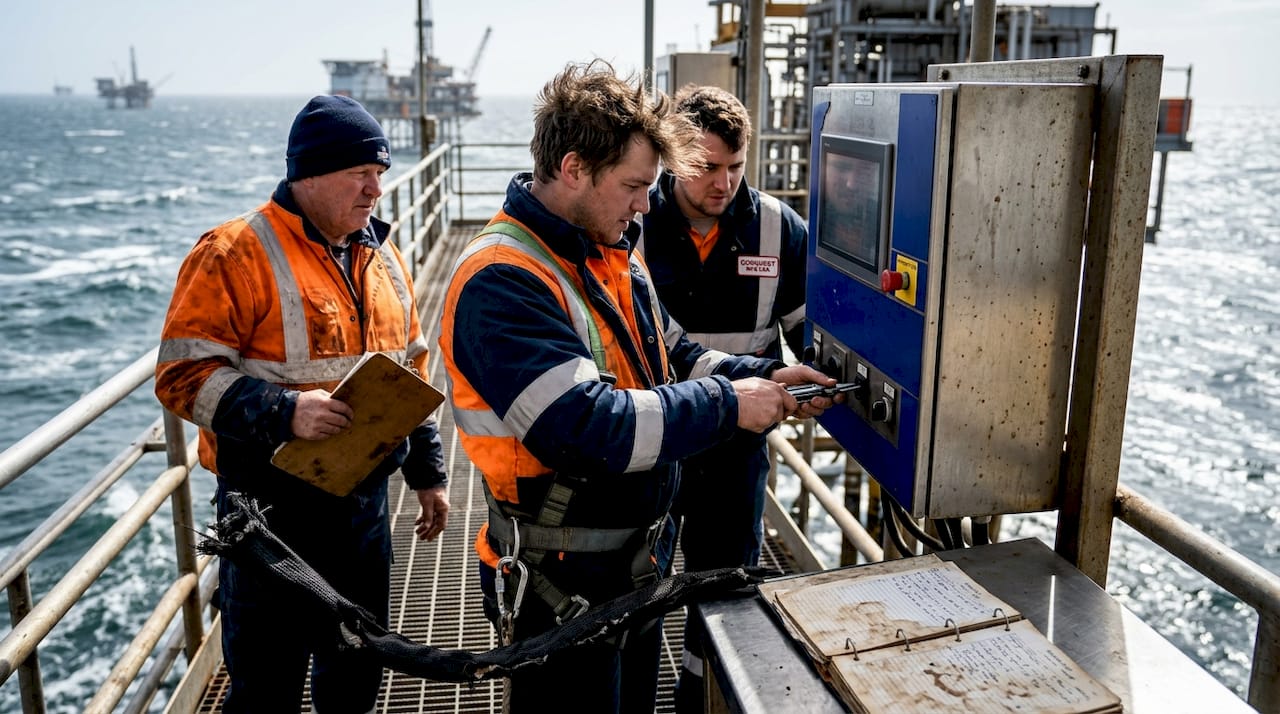
Offshore environments introduce a completely different set of challenges. Saltwater exposure, constant vibration from wave action and rotating machinery, and the logistical difficulty of getting replacement parts to a platform 100 miles offshore all demand equipment designed with redundancy and durability as primary design criteria.
Specific equipment considerations for each environment:
Shale operations:
-
Mobile concrete batch plants for rapid pad construction and wellbore cement jobs
-
Portable cement pig silo trailers for on-site cement storage and delivery
-
Dry bulk pneumatic trailers for high-volume proppant transport
-
Sand hoppers and sand chassis for efficient last-mile proppant handling
-
Rapid-deployed video surveillance towers for remote site security
Offshore operations:
-
Stainless steel and coated aluminum components to resist chloride corrosion
-
Vibration-isolated mounting systems for compressors and pumps
-
Redundant instrumentation to catch hidden failures before they escalate
-
Sealed electrical enclosures rated for marine environments
-
Lightweight aluminum vacuum tanks to minimize topside load
The technical demand for offshore equipment continues to grow as operators push into deeper water and more challenging geological formations. Our mobile frac support solutions are built to handle the mobility and volume demands of modern shale operations. If capital constraints are a factor, our equipment financing options make it practical to upgrade your fleet without disrupting your operating budget.
Why operators should think differently about equipment selection
Looking beyond the standard playbook, there’s a smarter way to approach equipment strategies. The conventional wisdom in many facilities is to apply uniform preventive maintenance across all equipment and buy the most broadly capable equipment available. We’ve seen what that approach actually delivers in practice, and the results are rarely what operators expect.
Time-based PM is wasteful in roughly 30% of cases, introducing unnecessary wear and creating new failure opportunities during disassembly. Blanket schedules treat a critical gas compressor the same as a secondary water pump, which misallocates both labor and parts inventory. The real cost isn’t just the wasted PM hours. It’s the subtle failures that slip through because the team is too busy running scheduled tasks to notice early warning signs on the assets that actually matter.
The operators who consistently outperform their peers share one common trait. They treat equipment selection and maintenance strategy as connected decisions, not separate ones. When you buy a mobile concrete batch plant designed for rapid deployment, you also need a maintenance plan that accounts for the increased wear from frequent moves. When you invest in dry bulk pneumatic trailers built for high-cycle frac operations, your maintenance intervals need to reflect actual cycle counts, not calendar dates.
The shift from theory to actionable, risk-based frameworks requires discipline and sometimes a willingness to challenge long-standing facility practices. But the ROI is real. Facilities that have moved to CBM and RCM-based prioritization consistently report lower total maintenance costs, fewer emergency shutdowns, and better asset utilization. The data supports this direction clearly. The question is whether your organization is ready to act on it. Explore our range of advanced oil industry equipment to see how purpose-built equipment supports this kind of performance-focused operation.
Enhance your operations with specialized equipment solutions
When you’re ready to upgrade or expand your operational toolkit, consider equipment built specifically for the challenges you face.
At Conquest Manufacturing, we design and build equipment that addresses the real demands of USA oil and gas operations. Our concrete batch plants are engineered for rapid deployment and consistent output in demanding field conditions. Our pneumatic trailers are built to handle the high-cycle demands of frac operations with durability and efficiency as core design priorities. From portable cement pig silo trailers to aluminum vacuum tanks and rapid-deployed surveillance towers, our full range of specialized industry equipment is designed to support your operational reliability goals. Contact us today to discuss your specific requirements and get a quote tailored to your facility’s needs.
Frequently asked questions
What are the most critical equipment types for oil and gas operations?
Compressors, wellheads, frac support equipment, and corrosion-resistant offshore units are typically the most critical due to their direct impact on uptime and safety. Top 20% critical assets like compressors and wellheads warrant the majority of your maintenance budget and attention.
Why is condition-based monitoring better than time-based maintenance for oil industry equipment?
Condition-based monitoring detects faults earlier and prevents unnecessary maintenance, leading to fewer failures and lower costs. Condition-based monitoring using vibration analysis and oil sampling is the preferred approach over fixed-interval time-based schedules.
How can I decide which equipment to prioritize for maintenance and upgrades?
Focus maintenance efforts on the small number of assets that cause most downtime and risk, typically guided by reliability centered maintenance (RCM) and risk-based inspection (RBI). Top 20% critical assets should receive 60 to 70% of resources, with RBI replacing uniform PM schedules.
What unique challenges do offshore oil equipment face?
Offshore equipment suffers from extreme corrosion and vibration, requiring special materials and advanced failure-detection strategies. Offshore equipment faces hidden failure modes that require specific failure-finding tasks beyond standard inspection routines.
Is a shift to predictive maintenance realistic for smaller operators?
Yes, smaller operators can benefit, but it requires investing in sensors, data analysis tools, and team training to be effective. AI fault prediction models achieve 98% accuracy and can detect issues two to four weeks before failure, making the investment worthwhile even at smaller scale.