
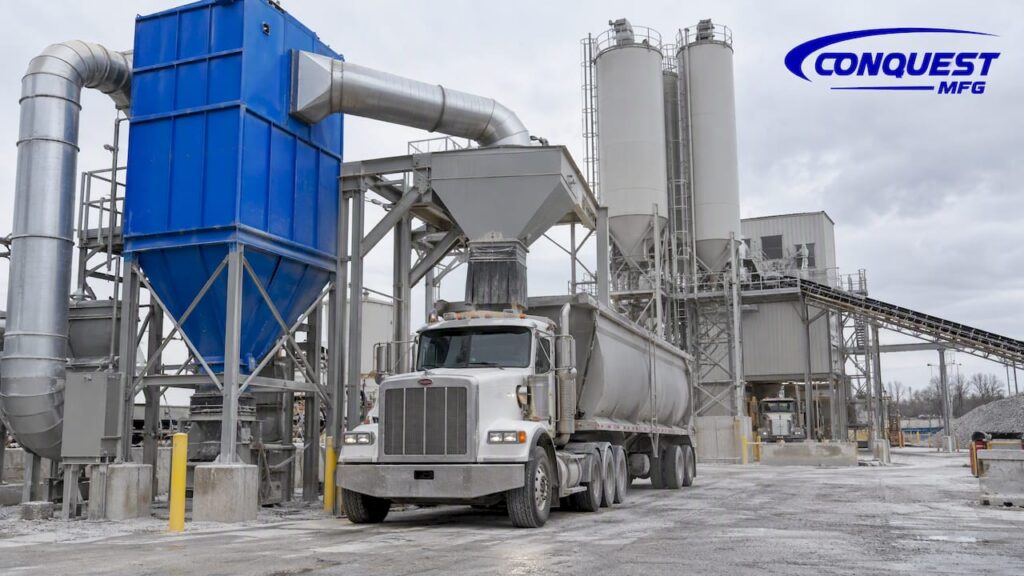
A concrete batch plant controls dust with two layers. Filters and collectors capture dust at the points where air leaves equipment, mainly silo tops, weigh hoppers and truck loading. Site practices contain what escapes those points, such as wetting stockpiles, managing haul roads and cleaning up spills. A plant that does only one of the two will struggle at inspection. This guide covers where the dust comes from, which collection equipment fits each point, what a permit such as the Texas standard permit expects, and how to specify dust control when you buy a plant.
TL;DR
- Cement and pozzolan dust is the main pollutant at a batch plant, according to the EPA’s AP-42 chapter on concrete batching. The three big point sources are silo filling, weigh hopper venting and truck loading.
- Most plants combine a silo-top filter, a central or local collector at the batcher, and a loading-zone control. One device rarely does everything.
- The Texas standard permit sets a minimum control efficiency of 99.5% at 2.5 microns and smaller. It also requires records kept for inspection.
- A good collector does not excuse bad housekeeping. Unpaved roads, open conveyors and stockpiles can fail a plant that has excellent filters.
- Decide dust control before you order the plant. Layout, silo count and airflow all depend on it.
Table of Contents
- Where dust comes from in a batch plant
- Types of dust collection used on batch plants
- What the Texas standard permit expects
- How to size and choose a collector
- Maintenance habits that keep a plant compliant
- Our perspective on dust control and plant design
- Plan dust control with your batch plant
- Bulk cement handling off the plant
- FAQ
- Sources
Where dust comes from in a batch plant
Cement is naturally dusty. The Texas Commission on Environmental Quality (TCEQ) says so plainly in its guide to the concrete batch plant standard permit: dust can be released when raw materials are delivered and when they are mixed. The EPA identifies cement and pozzolan dust as the primary pollutant, with some aggregate and sand dust on top.
In practice, a dry-batch plant has six places to watch.
| Source | What happens | Typical control |
|---|---|---|
| Silo filling | A bulk tanker blows cement or fly ash into the silo and displaces air through the roof | Silo-top filter or collector, plus a working high-level alarm and pressure relief |
| Weigh hopper or batcher | Cement drops into the weigh hopper and displaces dusty air | Batcher vent filter or connection to a central collector |
| Truck loading | Dry materials fall into the truck mixer drum | Loading-zone collector or boot that draws air from the drum opening |
| Aggregate bins and conveyors | Dry sand and stone drop at transfer points | Enclosure, moisture, chutes, and a collector where needed |
| Stockpiles | Wind lifts fines from open piles | Water spray, windbreaks, covers |
| Roads and yard | Truck traffic stirs up settled dust | Paving, wetting, sweeping, speed limits |
The first three rows are point sources, where you can put a filter on a vent. The last three are fugitive sources, where dust leaves in the open and you control it with design and discipline. The EPA’s fugitive dust best practices list unpaved roads and unenclosed storage piles among the common fugitive sources.
Types of dust collection used on batch plants
Silo-top filters
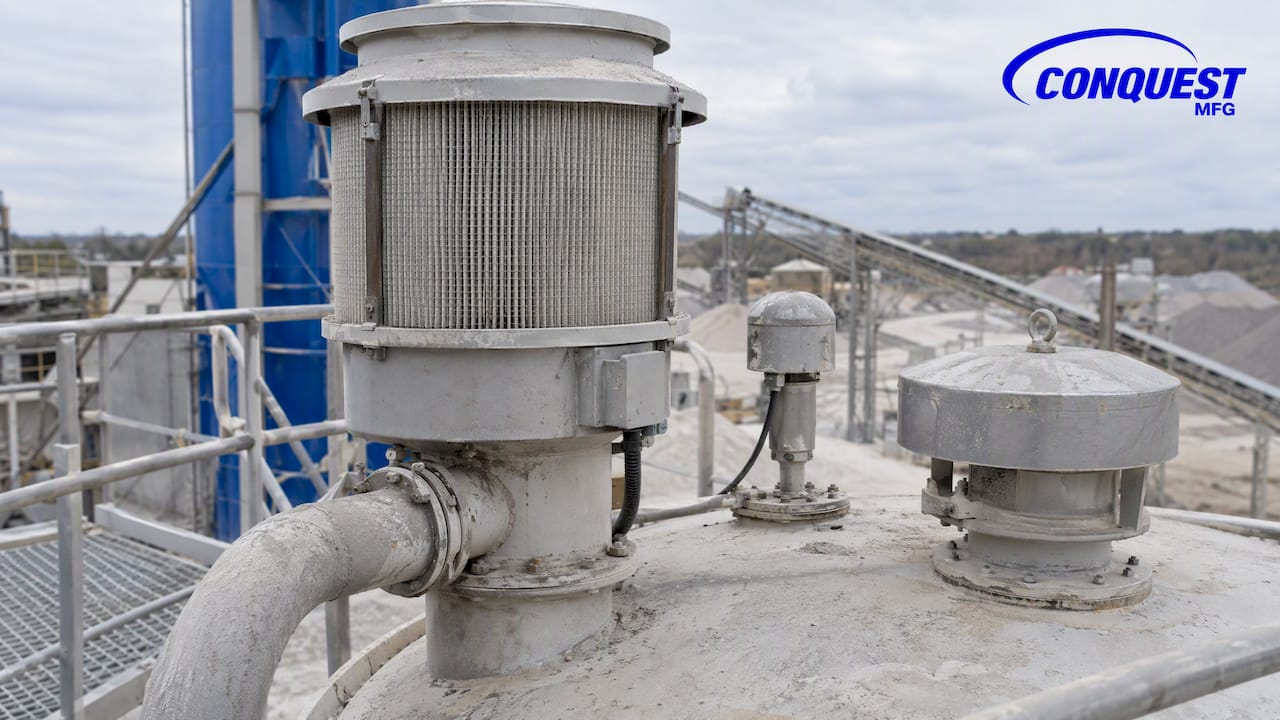
Every cement and fly ash silo needs a way to vent the air that the incoming load displaces. A silo-top filter, either bag or cartridge, holds the dust back and lets clean air out. Most use a reverse-pulse cleaning cycle that shakes the dust back into the silo. They are simple, sit at the source and do not need ductwork.
Their weakness is what happens when the silo is overfilled or the pressure relief is blocked. That is why the silo’s warning and shut-off devices matter as much as the filter. The TCEQ permit requires operators to test silo devices monthly, and a failed device can turn a routine delivery into a large uncontrolled release.
Batcher and weigh hopper vent filters
When cement drops from the weigh hopper into the mixer or truck, it pushes air out. A small vent filter on the hopper catches the dust at that point. This is the cheapest way to cover the batcher, and it suits plants with a single cement weigh hopper.
Central baghouse or cartridge collector
A central collector connects several points through ducts and pulls air with one fan. It handles larger volumes and gives you one place to maintain filters. The tradeoff is ductwork, a bigger fan and careful balancing, so that the point farthest from the collector still gets enough draw.
Truck loading collectors
The loading zone is where dry-batch plants lose the most dust, because cement, sand and stone fall into an open drum. A collector built for this job draws air from the drum opening while the truck is being charged. Central-mix plants have a different arrangement, since the drum is closed during discharge into the truck, but the charge point still needs attention.
Hybrid systems
Many plants use a hybrid arrangement. One industry source, a dust collector manufacturer’s ready-mix page, describes a central collector for large volumes combined with smaller local collectors at high-intensity points. The logic is practical: the central unit carries the bulk of the airflow, and local units cover the spots where long ductwork would be wasteful.
What the Texas standard permit expects
Texas is a useful benchmark because it has a detailed, public standard for concrete batch plants and a large volume of construction. Rules differ by state and county, so treat this as a Texas example, not a national rule. Check your own state agency before you buy.
The TCEQ standard permit for concrete batch plants, effective January 24, 2024, sets several requirements that shape equipment choices:
- Control efficiency. Systems must reach a minimum of 99.5% at 2.5 microns and smaller.
- Visible emissions. Visible emissions from point sources such as conveyors must not exceed 30 seconds in any six-minute period.
- Records. Operators keep documentation on site for a rolling 24-month period. It covers production rates, abatement system maintenance, quarterly visible emissions observations and monthly silo device tests.
The records requirement is easy to overlook when you specify equipment. A collector with a differential pressure gauge, easy filter access and a clear maintenance schedule makes the log simpler to keep.
Point sources and fugitive sources are judged together
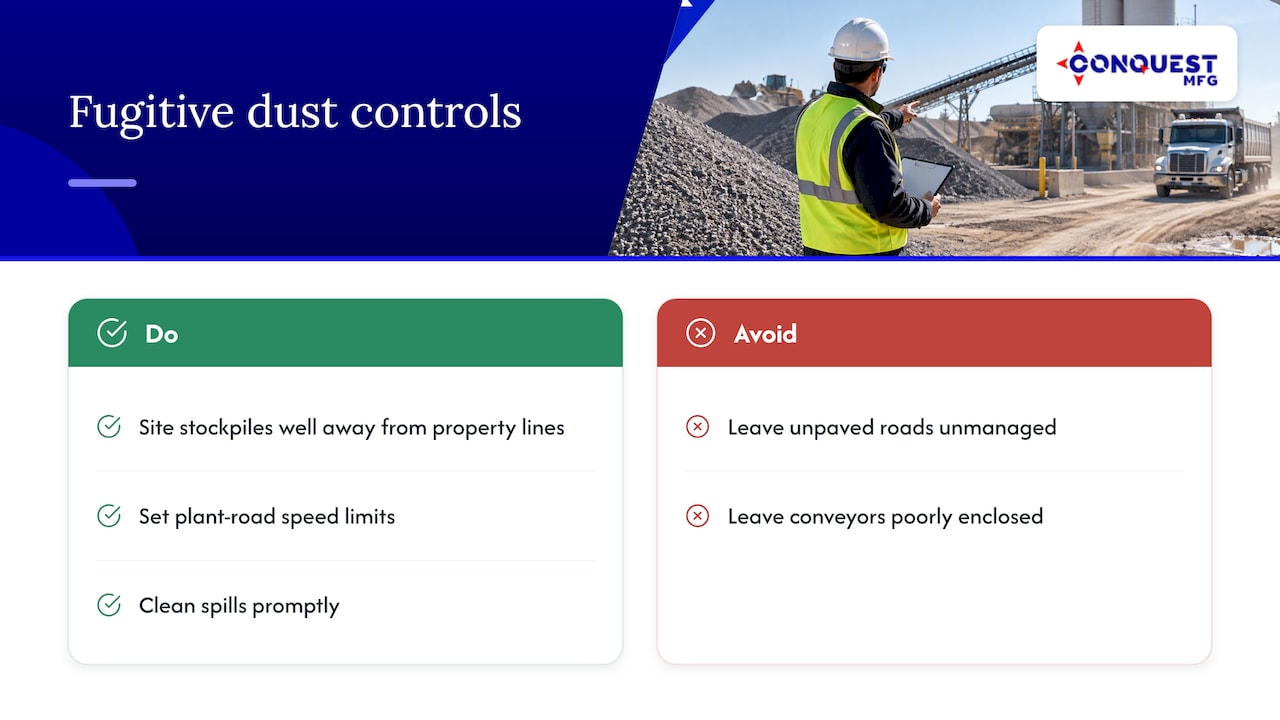
The TCEQ’s own explanatory material is direct about this. A system with excellent filtration can still fail if fugitive emissions from unpaved roads or poorly enclosed conveyors go unmanaged. The agency also points to site design: mixing equipment and stockpiles placed well away from property lines, speed limits on plant roads and prompt cleanup of spills.
The Air Central Texas dust control article for quarries and batch plants makes the neighbor’s side of the argument. Dust that looks like a minor nuisance to an operator can be a health concern for a homeowner nearby. Complaints are often what bring an inspector to a site.
How to size and choose a collector
Buying a standard collector off the shelf and bolting it on is the most common mistake. One industrial dust collector supplier notes that choosing the right unit depends heavily on the moisture content of the material and the airflow volume. Skipping that analysis often leads to early filter failure and high maintenance cost.
Work through these questions before you commit.
- What are the points you need to cover? List each silo, the batcher, the loading zone and every transfer point. Each one needs a plan, even if the plan is “enclose and keep wet”.
- How much air does each point move? Pneumatic silo filling displaces air at the rate the tanker blows. Truck loading draws air at the rate needed to keep the drum opening under negative pressure. Size the filter area to those figures.
- How dusty and how damp is the material? Dry cement and fly ash are fine and tend to pack. Damp aggregate dust can blind filters. Match the media to the dust.
- How will the dust be returned? Captured cement is usually valuable. Most plants return it to the silo or batcher, so the collector design has to allow that.
- Who will maintain it? Choose filters your crew can change without special tools, and put the gauges where a person can read them from the ground.
- What will your permit say? Confirm the required efficiency and record-keeping with your state agency before the layout is final.
A worked example of the planning logic
Say a plant has two cement silos and one fly ash silo, one weigh hopper and a single truck loading bay. A sensible starting point would be a filter on each silo top, since each fills independently. The batcher and loading bay are close together, so one local collector or a short duct run may serve both. Add a high-level alarm and pressure relief on each silo, then enclose the aggregate conveyor and wet the stockpile. That is a design conversation, and the details change with throughput, climate and the permit. It is shown only to illustrate how the points are split up.
Maintenance habits that keep a plant compliant
Filters wear out and gauges drift. The plants that stay out of trouble treat dust control as a routine, not as a project.
- Test silo warning and shut-off devices on a schedule. If they fail, pneumatic filling can over-pressurize the silo. That can damage equipment or release a large cloud of dust.
- Watch differential pressure. A rising reading usually means filters are loading up. A sudden drop can mean a torn bag.
- Do quarterly visible emissions checks and write down the result. Walk the plant, look at every vent and conveyor, and log what you see.
- Clean up spills the same day. Settled cement gets driven over, ground up and lifted again.
- Keep the log. Production rates, maintenance dates and test results are what an inspector asks for first.
Our perspective on dust control and plant design
We have built concrete batch plants and bulk cement equipment for 35 years, and our view is simple: dust control belongs in the first drawing, not in a punch list at commissioning. When a plant is designed around its collectors, the silos sit where tankers can reach them, the batcher and loading bay are close enough to share a collector, and the filters can be reached safely for service. When collectors are added afterwards, the layout often fights them.
That is why we build to the customer’s site and permit. A stationary dry plant in a populated area has different needs from a mobile plant moving between highway jobs, and a plant on a lease near an oilfield has different needs again. We ask about throughput, local rules and the materials you use before we talk about equipment, so that the dust collection, the silo arrangement and the loading zone work together. Our batch plant layout guide explains how we think about placement, and our guide to selecting a batch plant covers the wider decision.
One point we repeat to buyers: a collector is only as good as the habits around it. Equipment gets you to compliance. Daily discipline keeps you there.
— Sam
Plan dust control with your batch plant
If you are buying or replacing a plant, specify dust collection while the layout is still open. We manufacture stationary dry and mobile concrete batch plants, custom-engineered to the site, the materials and the permit you work under. Tell us your throughput, location and silo needs, and we will quote a plant with the dust control points planned in. See our concrete batch plants or request a quote.
If budget is the first question, our concrete batch plant cost guide walks through what drives the price. For installation sequence, including where dust control fits, see our concrete plant installation guide.
Bulk cement handling off the plant
Dust control does not stop at the plant fence. Cement arrives by pneumatic tanker and may be stored in portable pig silos at jobsites and remote locations. Each transfer is another place where air is displaced, so the same rules apply: a filter on the vent, a working level alarm and a careful operator. Our guides on using pig silos for bulk cement transport and loading a storage pig trailer cover those handling steps.
FAQ
What is the difference between dust collection and dust control at a batch plant?
Dust collection means capturing dust from vents and loading points with filters and fans. Dust control is the wider job, and it includes collection plus wetting stockpiles, managing roads, enclosing conveyors and cleaning up spills. Regulators look at both, so a plant needs both.
Do I need a baghouse or are silo-top filters enough?
That depends on the layout. Silo-top filters handle silo filling well because they sit at the source. The batcher and truck loading zone usually need a local or central collector, and many plants use a mix of the two. Size each point to its airflow and the material, and confirm the permit requirements before you buy.
How efficient does a batch plant collector need to be?
In Texas, the standard permit calls for a minimum control efficiency of 99.5% at 2.5 microns and smaller. Other states and counties set their own limits, so check with your state air agency. Efficiency on paper also does not help if fugitive dust from roads and stockpiles goes unmanaged.
What records should a plant keep?
Under the Texas standard permit, operators keep on-site records for a rolling 24 months. They include production rates, abatement system maintenance, quarterly visible emissions observations and monthly silo device tests. Check your own permit for the exact list.
Sources
- TCEQ Air Quality Standard Permit for Concrete Batch Plants, effective January 24, 2024
- TCEQ: Standard Permit for Concrete Batch Plants, Learning More
- EPA AP-42 Section 11.12, Concrete Batching
- EPA: Fugitive Dust Control Measures and Best Practices
- Air Central Texas: Dust Control Practices for Quarries and Concrete Batch Plants
- Ready-Mix and Concrete Dust Collectors, C&W DustTech
- High-Volume Cement Dust Collection Systems, Qiaoda