
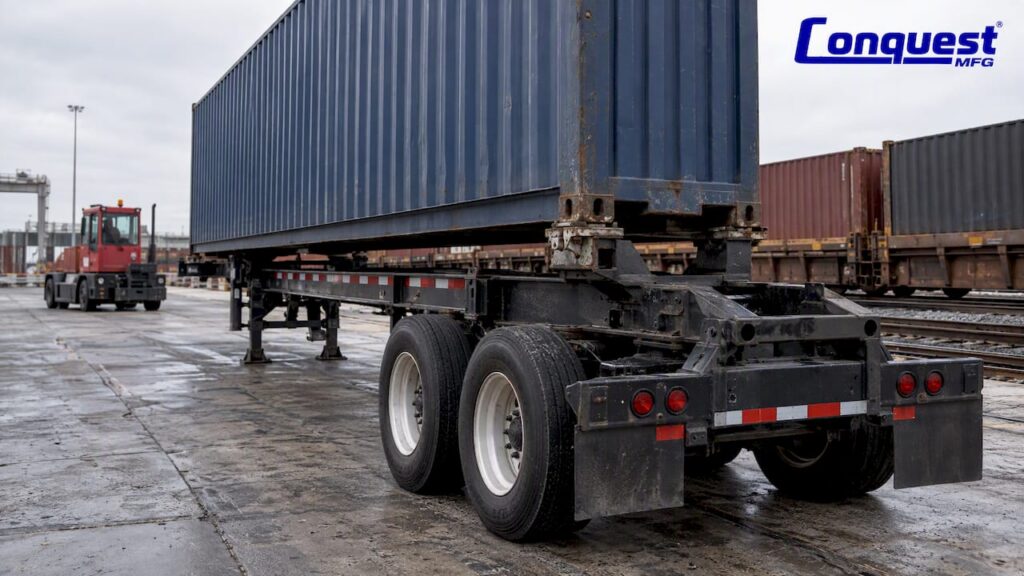
Intermodal chassis fall into three broad groups: domestic, ocean (marine) and specialty, according to the Intermodal Association’s industry factbook. Within those groups, the designs you will actually spec are fixed-length, extendable (slider), gooseneck, tri-axle, combo, tank and heavy-duty lowboy-style chassis. The right choice depends on the container you haul, the weight you carry, the roads you run and who supplies the chassis.
This guide explains each type, what it suits, and how to match it to your freight, so you can write a clear specification before you ask for a quote.
TL;DR
- Chassis come in domestic, ocean and specialty groups. Most buyers then choose between fixed-length and extendable frames.
- Fixed frames are simpler and lighter. Extendable frames carry more container sizes with one unit.
- Tri-axle, tank and lowboy-style designs exist for heavy, liquid or tall loads.
- Federal limits cap Interstate gross weight at 80,000 lbs and width at 102 inches. States set their own rules off the Interstate.
- Confirm container size, axle count, twist-lock layout and lighting before you order. We build custom chassis to those specifications.
Table of Contents
- What an intermodal chassis does
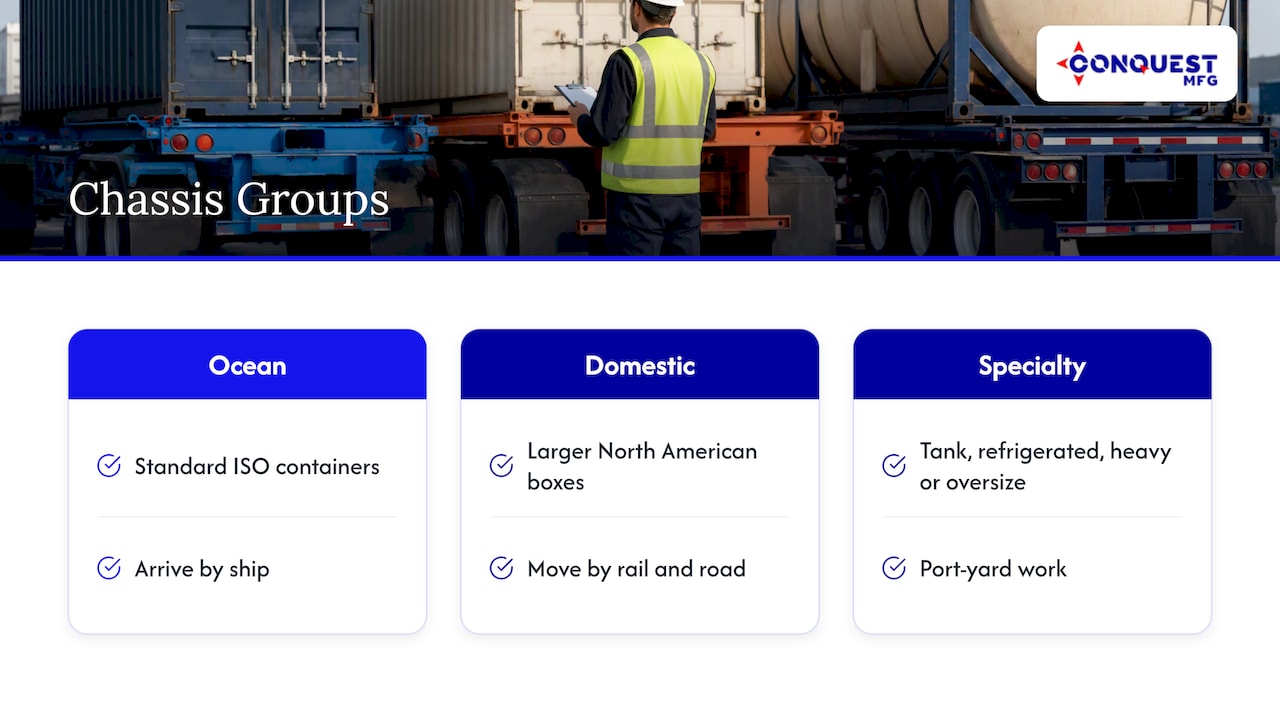
- The three main groups: domestic, ocean and specialty
- Main intermodal chassis types compared
- Fixed-length chassis
- Extendable (slider) chassis
- Tri-axle and heavy-duty chassis
- Combo, tank and other specialty chassis
- Federal and state road rules that shape your choice
- Match the chassis to the container and the supply model
- A short specification checklist
- Our perspective
- Get an intermodal chassis built to your specification
- FAQ
- Sources
What an intermodal chassis does
An intermodal chassis is a rectangular trailer with twist-locks that gives a shipping container the frame it needs for road transport, as described in the Intermodal Association factbook. Drivers use it to move containers between ports, rail yards, depots and customer sites. The container is the cargo box. The chassis supplies the wheels, axles, brakes, lights and the coupling to the tractor.
For a wider look at how containers move across truck, rail and ship, this overview of intermodal shipping basics is a useful companion to the equipment detail below.
The same factbook lists the main components of every chassis:
- Frame
- Suspension and axle system
- Wheels and tires
- Brakes
- Lighting and electrical system
- Coupling for the tractor
- Twist-locks that secure the container
Newer and remanufactured chassis may add asset tracking or GPS, weight sensors and automatic tire inflation. These options matter more for fleets than for single-unit owners, because they turn a chassis into a unit you can monitor.
The three main groups: domestic, ocean and specialty
The factbook’s grouping is the starting point for any specification.
Ocean (marine) chassis carry containers that arrive by ship. They are built for the standard ISO container sizes, and the frame and twist-lock positions match those corner castings.
Domestic chassis carry containers that move mostly by rail and road inside North America. They are built around the larger domestic box lengths, so the frame, pin positions and locks differ from ocean designs.
Specialty chassis cover everything else: tank containers, refrigerated units needing power, heavy or oversize boxes, and port-yard work. These are the units most often built to order.
If you are not sure which group you need, start with the container. Its length, height, weight and ownership usually decide the group before any other choice.
Main intermodal chassis types compared
The table sets the common configurations side by side. Use it to narrow the field, then confirm details against your container and your route.
| Chassis type | Best for | Main advantage | Main consideration |
|---|---|---|---|
| Fixed-length (standard) | One container size, repeated lanes | Simple, light frame | Carries only the sizes it was built for |
| Extendable (slider) | Mixed 20, 40 and 45 ft containers | One unit covers several lengths | Heavier and more complex than a fixed frame |
| Gooseneck | 40 and 45 ft containers | Lower, stable load position | Built for specific container lengths |
| Tri-axle | Heavier loads | Spreads weight over more axles | Higher cost and tare weight |
| Combo | Mixed 20 and 40 ft work | Flexible twist-lock positions | Layout must match your container mix |
| Tank chassis | ISO tank containers | Lower deck height for liquids | Built for tank containers only |
| Lowboy-style heavy duty | Tall or heavy boxes | Low deck height | Special handling and route planning |
Fixed-length chassis
A fixed-length chassis is built for one container length. It is the simplest design and the one most operators picture first. Marine chassis in the United States are generally designed for specific container sizes and have two axles, which keeps them light.
A UK trade review of skeletal trailers makes the same engineering point: fixed frames are lower and lighter, with a lower center of gravity than sliders. That favors fuel economy and stability on a single repeated lane.
Choose a fixed chassis when:
- You haul one container length almost every day.
- You want the lowest tare weight for the payload.
- You prefer fewer moving parts to inspect and maintain.
Domestic 53-foot and gooseneck frames
Gooseneck chassis are built for 40 and 45 foot boxes and sit the container in a lower, stable position over the front of the frame. Domestic 53-foot chassis serve the larger boxes that move mainly inside North America. Both are fixed designs, so the same logic applies: pick them when the box length never changes.
Extendable (slider) chassis
An extendable chassis has an adjustable frame that can be lengthened or shortened to carry different container sizes, such as 20, 40 and 45 foot boxes. One unit can therefore cover work that would otherwise need several fixed chassis.
The trade-off is weight and complexity. Sliding sections add frame mass and mechanical parts that need regular inspection. Decide honestly whether you need the adjustable length. If your lanes mix container sizes weekly, an extendable chassis can cut the number of units you own. If they do not, a fixed frame is usually the leaner choice.
Our trailer fleet optimization guide covers how to size a fleet around the lanes you actually run.
Tri-axle and heavy-duty chassis
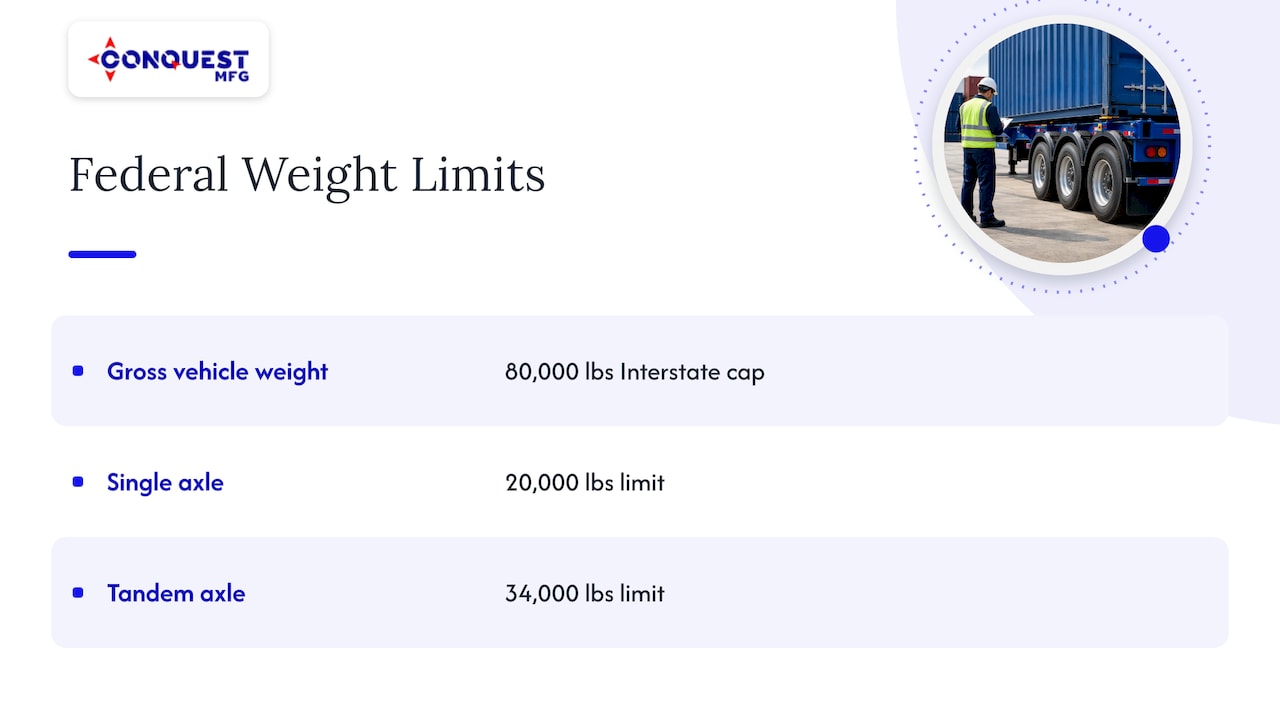
A tri-axle chassis adds a third axle to spread weight, which suits heavier containers. The federal weight rules explain why this matters. Interstate operations are capped at 80,000 lbs gross vehicle weight, with 20,000 lbs on a single axle and 34,000 lbs on a tandem axle, and the Federal Bridge Formula governs the relationship between axle spacing and allowable weight. These limits come from 23 CFR Part 658.
Axle spacing is therefore a design variable, not a detail. A chassis that looks capable on paper can still put a combination over a bridge-formula limit if the spacing is wrong. Run the numbers with the tractor, the chassis and the heaviest container you expect.
Lowboy-style heavy-duty chassis sit low to the ground for tall or heavy boxes. Containers come in the same lengths as standard units, but high-cube containers are 9 feet 6 inches tall rather than 8 feet 6 inches. That extra foot matters for clearance on overpasses and in yards, and a lower deck helps keep total height manageable.
Combo, tank and other specialty chassis
Combo chassis carry more than one container length by offering several twist-lock positions on one frame. They fit operators with a predictable mix of 20 and 40 foot work.
Tank chassis carry ISO tank containers for bulk liquids. They typically sit lower and are built to suit the tank’s frame. Operators in the oilfield and liquid-waste sectors often pair them with tank trailers and vacuum equipment. Our guide to safe vacuum tank transport covers the handling side of that work.
Straight-frame and light-weight chassis trade features for lower tare weight, useful when payload is the limiting factor.
As a rule, the more unusual the cargo, the more likely you need a custom build. Specialty chassis usually start from a conversation about the container, not from a catalog page.
Federal and state road rules that shape your choice
Weight is only one limit. Federal width for commercial vehicles on the National Network is 102 inches, excluding safety devices such as mirrors. Under 23 CFR Part 658, state-specific regulations may apply off the Interstate System.
In practice, that means three checks before you finalize a spec:
- Gross vehicle weight on the Interstate: stay within 80,000 lbs, and check axle and bridge-formula limits for your configuration.
- Width: keep the combination within 102 inches on the National Network.
- State and local routes: confirm the limits and permits for every state on your lane. Many states set lower limits or specific bridge laws off the Interstate.
A chassis that is legal on the Interstate can still need a permit on the last stretch to a customer’s gate. Ask your dispatcher for the actual route, not the highway map.
Match the chassis to the container and the supply model
Choosing the physical type is half the decision. The other half is who provides the chassis and what the container requires.
The Government Accountability Office notes that operators should match the container to the chassis required by the ocean carrier or equipment provider. Some requirements limit which chassis may move a given container, so extra care is needed.
The same GAO work describes four models for making chassis available to motor carriers:
- Single chassis provider
- Motor carrier-controlled
- Gray pool
- Pool-of-pools
Ownership is mixed too. Chassis may be owned by equipment providers, ocean carriers, rail carriers, motor carriers or beneficial cargo owners, and chassis use tends to stay within regional drayage markets. GAO also reports that many ocean carriers have moved out of chassis ownership to equipment providers, which can make matching container and chassis less efficient.
For a fleet owner, the lesson is practical. If you depend on pool chassis, you accept the provider’s equipment. If you own chassis, you control the spec, the maintenance and the availability. That control is the main reason fleets and private haulers choose to buy.
A short specification checklist
Before you request a quote for any chassis, write down:
- Container lengths and heights: 20, 40, 45 or 53 foot, and standard or high-cube.
- Maximum loaded weight: for the heaviest container on your heaviest lane.
- Axle configuration: two or three axles, and spacing relative to bridge-formula limits.
- Twist-lock layout: fixed positions or a combo arrangement. Our guide to chassis twist-lock types explains the options.
- Lighting and electrical: compliant lamps, wiring and connectors. Fleets that want to avoid roadside violations will find this note on trailer light maintenance practical.
- Options: tracking, weight sensors, automatic tire inflation.
- Operating region: the states and ports where the unit will run.
With that list in hand, a manufacturer can quote precisely instead of guessing. For broader context on specifying other trailers in the same fleet, see our freight equipment selection guide.
Our perspective
Most chassis problems we see start before the build, at the specification. A buyer orders for the container on today’s invoice and not for the lanes the unit will run for the next ten years.
We approach it the other way around. We ask about container mix, loaded weights, axle spacing and the states on your routes, then design the frame around those answers. Our team brings 35 years of engineering and manufacturing experience to that process, and our approach is built on premium materials, practical design and durability in demanding environments.
Owning your chassis puts the specification in your hands. You choose the axle count, the twist-lock layout and the lighting and electrical package, and you plan maintenance on your schedule. That is the reason we offer intermodal chassis alongside custom trailer fabrication: a standard frame suits many jobs, and a tailored one suits the rest.
Tell us what you haul and where you run it. We will tell you what we would build.
Sam
Get an intermodal chassis built to your specification
We manufacture intermodal chassis in the USA for contractors, transportation and freight businesses and oilfield operators, alongside tank trailers, dump trailers, sand chassis and other semi-trailers. Every unit is custom-engineered to the requirements you give us.
Browse our transportation equipment range, or send us your container sizes, weights and routes through our custom trailer fabrication page to start a quote.
FAQ
What are the different types of container chassis?
The main groups are domestic, ocean and specialty, per the Intermodal Association. Common configurations include fixed-length, extendable, gooseneck, tri-axle, combo, tank and heavy-duty lowboy-style chassis. The right one depends on container length, loaded weight and route.
Should I choose a fixed or an extendable chassis?
Choose fixed if you haul one container length on repeated lanes, because fixed frames are generally lighter and lower. Choose extendable if your work mixes container sizes and you want one unit to cover them. Count how often your container lengths actually change before you decide.
What are the legal weight and width limits for a chassis in the US?
On the Interstate, gross vehicle weight is capped at 80,000 lbs, with 20,000 lbs single-axle and 34,000 lbs tandem-axle limits and the Federal Bridge Formula applying, per 23 CFR Part 658. Width is 102 inches on the National Network. States may set different rules off the Interstate, so check each state on your route.
Can I use any chassis with any container?
Not always. GAO reports that some ocean carrier or provider requirements limit which chassis may move a container. Confirm the requirement for each container before dispatch.
Sources
- Intermodal Association of North America, Intermodal Factbook
- eCFR, 23 CFR Part 658: Truck Size and Weight, Route Designations
- Federal Highway Administration, Commercial Vehicle Size and Weight Program
- GAO-21-315R, Commercial Shipping: Information on How Intermodal Chassis Are Made Available
- GAO product page for GAO-21-315R
- National Academies, Intermodal Chassis Provisioning and Supply Chain
- Transport Engineer, Trailer specification: skeletal trailers