

The language of business is shifting faster than most organizations can track. Industry terminology explained 2026 reveals a striking reality: professionals who cannot decode current jargon are not just out of the loop. They are making slower decisions, misreading reports, and losing ground to peers who understand what the words actually mean. AI, digital transformation, and restructured workplaces have injected dozens of new terms into everyday operations. This guide breaks down the most consequential business terminology 2026 has introduced or reshaped, with practical context for decision-makers who need clarity, not noise.
Table of Contents
- Key Takeaways
- How AI vocabulary is reshaping industry terminology
- Terminology management: glossaries, semantic layers, and context layers
- Buzzwords versus business terminology that actually works
- Strategies for mastering and applying industry terms
- My take on why most organizations get this wrong
- How Conquestmfgusa supports operational clarity in manufacturing
- FAQ
Key Takeaways
| Point | Details |
|---|---|
| AI vocabulary is now baseline | Terms like agentic AI and silicon workforce are no longer niche. Decision-makers must recognize and apply them. |
| Glossaries are production infrastructure | A business glossary in 2026 is a live, machine-readable system, not a PDF in a shared folder. |
| Buzzwords cost you credibility | Overused jargon like “synergy” signals vague thinking. Precise language builds stakeholder trust. |
| Terminology gaps create operational risk | Fragmented definitions across teams lead to conflicting reports, failed audits, and AI errors. |
| Audit before you act | Organizations should review their current terminology stack before adopting new tools or frameworks. |
How AI vocabulary is reshaping industry terminology
The most significant driver of 2026 industry jargon is artificial intelligence. Not just its adoption, but the speed at which its vocabulary is expanding and entering mainstream professional conversation. According to research, AI agent terminology expanded from a handful of active compound terms to nearly 30 within six months before May 2026. That pace is not slowing.
Here are the core AI-related terms every professional needs to understand right now:
- Agentic AI: AI systems that operate autonomously to complete multi-step tasks without constant human instruction. This is different from a simple chatbot. An agentic system can plan, decide, and act across connected tools.
- Copilot culture: An organizational model where AI tools function as active collaborators alongside human workers, not just passive assistants. The term reflects a cultural and structural shift, not just a technology feature.
- Silicon workforce: A phrase describing AI-powered agents and automated systems that perform roles previously held by human workers, particularly in middle management and operations functions.
- AI fluency: The ability to understand, evaluate, and communicate about AI capabilities and limitations without necessarily being a programmer. Research confirms that AI fluency has replaced technical coding skills as the baseline expectation for leaders in 2026.
Why does this matter operationally? Because 20% of organizations plan to use AI to automate more than 50% of middle management responsibilities by end of 2026. If your team does not share a working definition of “agentic AI,” they cannot evaluate whether a vendor proposal actually delivers it.
Pro Tip: Build a short internal glossary of AI terms specific to your sector. Distribute it before any AI-related vendor meeting or procurement discussion to align your team before the conversation starts.
AI vocabulary evolves first in developer communities before reaching leadership. Waiting too long to adopt these terms risks misalignment with vendors, partners, and your own technical teams.
Terminology management: glossaries, semantic layers, and context layers
Knowing the words is not enough. Organizations that manage terminology well are building structural systems to govern how terms are defined, used, and connected to data. This is where explaining industry vocabulary moves from communication advice into operations strategy.
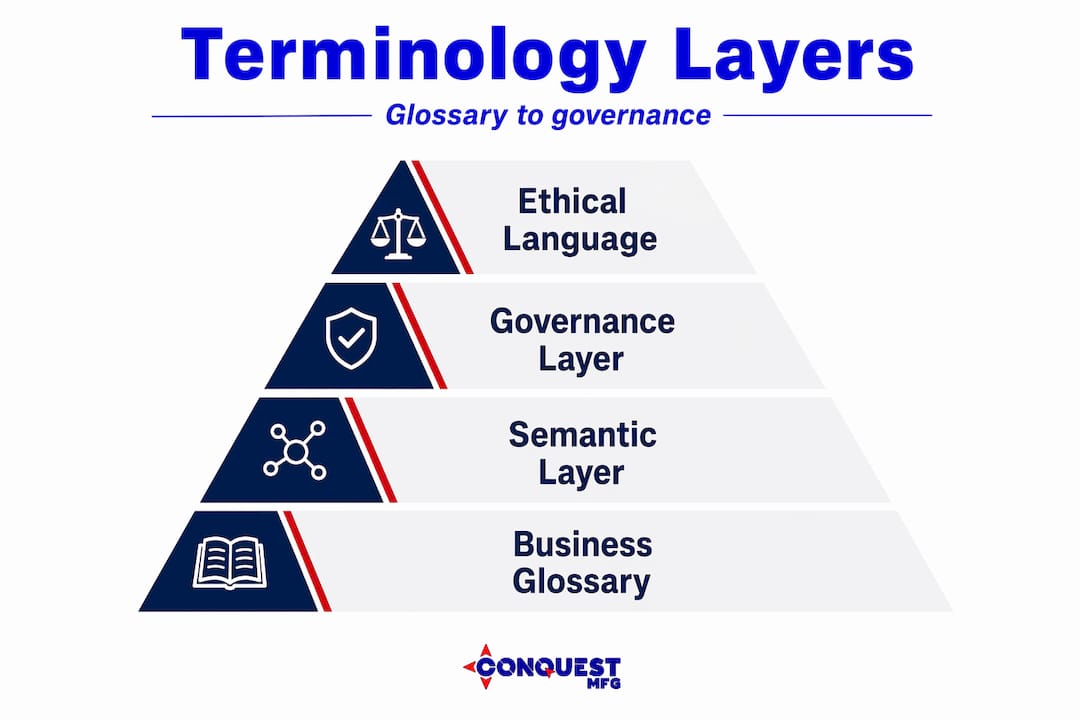
The three-layer model now used in data-mature organizations breaks down as follows:
| Layer | Function | Example |
|---|---|---|
| Business glossary | Defines what a term means in plain language | “Revenue” = net recognized sales per quarter |
| Semantic layer | Translates that definition into a computed data model | Calculation rules applied to database fields |
| Context layer | Makes definitions machine-readable for AI systems | Enables AI to use “revenue” correctly in reports |
A business glossary in 2026 is not a static document. It is production infrastructure that links terms directly to data assets, workflows, and governance rules. When your glossary says “active customer,” every report, dashboard, and AI model uses the same definition. Without that link, you get conflicting outputs from systems that each interpret the term differently.

The Terminology Management Tools Market is growing at a 5.0% CAGR through 2026, which reflects the accelerating investment organizations are making in this infrastructure. This is not an IT project. It is a governance priority.
One often overlooked point: no single glossary should be treated as universally authoritative across sectors. The NIST Cybersecurity Resource Center guidance makes this explicit. Terms vary by regulatory and technical context, so citing the source publication and the sector context for any defined term is a compliance requirement, not just good practice.
Pro Tip: When building your business glossary, assign a data steward to each high-stakes term. That person owns the definition, approves changes, and monitors how the term is used across reporting tools. This prevents quiet definitional drift over time.
Ethical language is also now part of the governance layer. Ethical business vocabulary must be embedded in operational directives, not kept in a compliance document no one reads. Terms like “responsible AI,” “algorithmic accountability,” and “data stewardship” are being written into vendor contracts and internal policy in 2026.
Buzzwords versus business terminology that actually works
Not all 2026 industry jargon is worth learning. Some terms are precise and functionally necessary. Others are filler that signals vague thinking. Knowing the difference protects your professional credibility and improves the quality of your team’s communication.
Here is a direct comparison of what to retire and what to use instead:
| Retire this | Use this instead | Why it matters |
|---|---|---|
| Synergy | Cross-functional alignment | Describes the actual mechanism, not a vague outcome |
| Pivot | Strategic reallocation | Clarifies what changed and why |
| Empower | Authorize or delegate | Removes ambiguity about decision rights |
| Circle back | Follow up by [date] | Adds accountability through specificity |
| Bandwidth | Capacity or availability | Eliminates misreading in cross-cultural teams |
The problem with buzzwords is not just aesthetics. When a manufacturing manager says “we need more bandwidth to support this initiative,” a logistics coordinator might interpret that as a network capacity issue. Precise common terms in industry 2026 conversations prevent that kind of misread before it becomes a scheduling failure or a missed delivery.
Some terms that are trending but carry real meaning include:
- Orchestration debt: The accumulated inefficiency caused by fragmented tools and workflows that were never properly integrated. Research on interpreting technology shows that fragmented workflows cause significant operational breakdown. This term gives decision-makers a label for a real and costly problem.
- Headless operations: A tech architecture term now crossing into operational management, describing systems that separate the front-end presentation from back-end processes for greater flexibility.
- Ambient computing: Technology that operates in the background without requiring active user interaction, increasingly relevant for plant floor and logistics environments.
Evaluating jargon for usefulness comes down to one test: can the person using the term define it, explain why it matters to this specific context, and measure the outcome it describes? If the answer to any of those is no, the term is not ready for your operational vocabulary.
Strategies for mastering and applying industry terms
Getting fluent in current business terminology 2026 requires a structured approach, not just reading trend reports. Here is a practical process for decision-makers who want to move from awareness to application:
-
Audit your current terminology. Survey your team to identify the 20 to 30 terms used most often in reports, meetings, and documentation. Flag any where definitions differ between departments. That gap is your first governance priority.
-
Build a living glossary. Create a centralized, editable document that defines each term, identifies its data source, names a steward, and tracks when the definition was last reviewed. This is the foundation your semantic and context layers build from.
-
Govern with stewardship. Assign ownership. Terminology gaps cause operational failures, and the organizations that close those gaps fastest are the ones that treat vocabulary as a managed asset, not a shared assumption.
-
Integrate terminology into AI workflows. Before deploying any AI analytics or reporting tool, confirm that the system is drawing on your governed definitions. An AI model that defines “on-time delivery” differently than your contracts do will produce numbers that cannot be used for compliance purposes.
-
Review terminology quarterly. Set a schedule. New terms enter circulation fast, and deprecated terms cause confusion when they linger in legacy documents. A quarterly review keeps your glossary current without requiring constant manual intervention.
Pro Tip: When onboarding new hires or new vendors, share your internal terminology reference on day one. It cuts the time to productive communication in half and prevents the silent misalignments that surface months later in audit findings or project delays.
Avoiding orchestration debt starts here. When your tools, teams, and definitions are synchronized, you are not spending operational energy on reconciliation. You are spending it on outcomes.
My take on why most organizations get this wrong
I have worked with enough industrial and manufacturing organizations to recognize a consistent pattern. Leaders invest heavily in technology and almost nothing in the language that makes that technology usable. A new ERP goes in, a new AI reporting tool gets deployed, and within six months, the finance team and the operations team are producing numbers that contradict each other. Nobody questions the software. The problem is that the two teams started with different definitions of the same five terms.
What I have learned is that terminology is not a soft skill issue. It is an infrastructure issue. The organizations that treat their business glossary as production infrastructure, not documentation, are the ones that get clean AI outputs, pass audits on the first try, and onboard new systems without a six-month reconciliation phase.
The uncomfortable truth about 2026 industry jargon is that most leaders are adding new words to their vocabulary without removing the old ones that no longer mean what they think. “Digital transformation” used to signal a strategic shift. Today it is a filler phrase that no one can measure. Letting that kind of language persist in your organization quietly erodes the precision your teams need to make fast, accurate decisions.
My strongest recommendation: pick five terms your organization uses daily and ask three different people to define them. If you get three different answers, you have found your first terminology governance project. Fix that before you worry about adopting any new AI vocabulary.
— Peter
How Conquestmfgusa supports operational clarity in manufacturing
At Conquestmfgusa, we understand that clear terminology and standardized operational language are not academic exercises. They are the foundation of safe, efficient, and compliant manufacturing and transport operations. Whether you are specifying a concrete batch plant for a large-scale project or evaluating dry bulk pneumatic trailers for your material handling fleet, using the right terms ensures that specifications, safety requirements, and compliance standards translate correctly from design to deployment.

We build custom equipment across concrete production, bulk transport, vacuum systems, and oil industry applications. Our teams work directly with procurement managers, operations leads, and logistics directors who need equipment that meets precise technical and regulatory definitions. When your team understands bulk transport terminology at the same level your equipment does, projects run on schedule and on spec. Explore our full range of manufacturing solutions or get a quote tailored to your operational requirements at conquestmfgusa.com.
FAQ
What does industry terminology explained 2026 cover?
Industry terminology explained 2026 covers the most current and consequential professional terms across AI, operations, data governance, and sector-specific jargon, with context for how each term affects decision-making and communication.
What is agentic AI in business terminology?
Agentic AI refers to AI systems that autonomously plan and execute multi-step tasks without constant human direction. It is one of the most actively used new terms in corporate vocabulary heading into the second half of 2026.
Why is a business glossary considered production infrastructure?
A business glossary in 2026 functions as a live system that links defined terms to data assets, semantic models, and AI workflows, making it critical to consistent reporting and trustworthy AI outputs, not just a reference document.
What is orchestration debt and why should managers care?
Orchestration debt is the operational inefficiency that builds up when fragmented tools and inconsistent terminology are never properly integrated. Fragmented interpreting workflows are a documented cause of operational breakdown across industries.
How can decision-makers stay current with 2026 industry jargon?
Conduct a terminology audit of your most-used terms, assign definition ownership to data stewards, and review your business glossary on a quarterly schedule. AI vocabulary in particular requires more frequent review given how rapidly new compound terms enter circulation.