

Oilfield equipment terminology is the standardized vocabulary defining tools, assemblies, and procedures used across oil and gas operations to maintain precision, safety, and project coordination. Terms like “Christmas tree,” “landing nipple,” and “mud cap drilling” are not informal labels. They carry specific technical meanings governed by bodies like the International Association of Drilling Contractors (IADC), the American Petroleum Institute (API), and the International Organization for Standardization (ISO). For engineers, operators, and project managers, knowing the correct oilfield equipment terms is the difference between a well-coordinated operation and a costly miscommunication. This guide covers the core categories, key assemblies, safety terminology, and project management applications you need.
What are the key categories of oilfield equipment terminology?
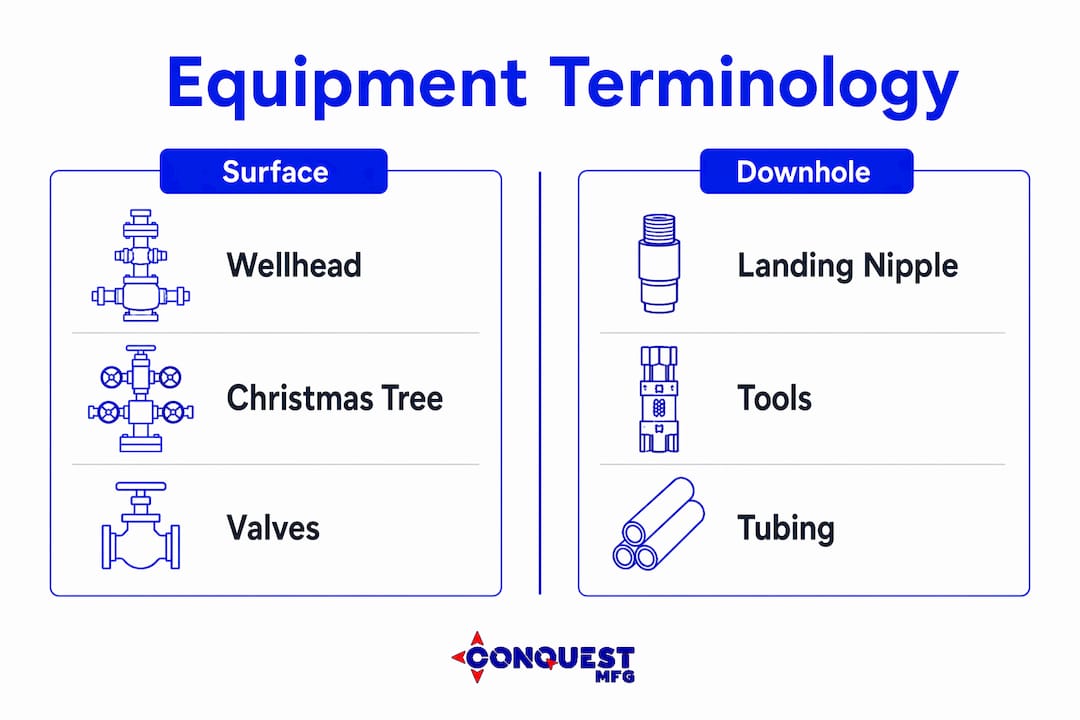
Oilfield equipment terminology divides into two primary domains: surface equipment and downhole tools. Understanding which domain a term belongs to tells you immediately where the equipment operates, who is responsible for it, and which standards apply.
Surface equipment covers everything installed at or above the wellhead. The wellhead itself is the pressure-containing structure at the top of the well casing. The Christmas tree sits above the wellhead and controls flow from the well. Flowlines, choke manifolds, and separators are also surface equipment terms you will encounter on any production site.
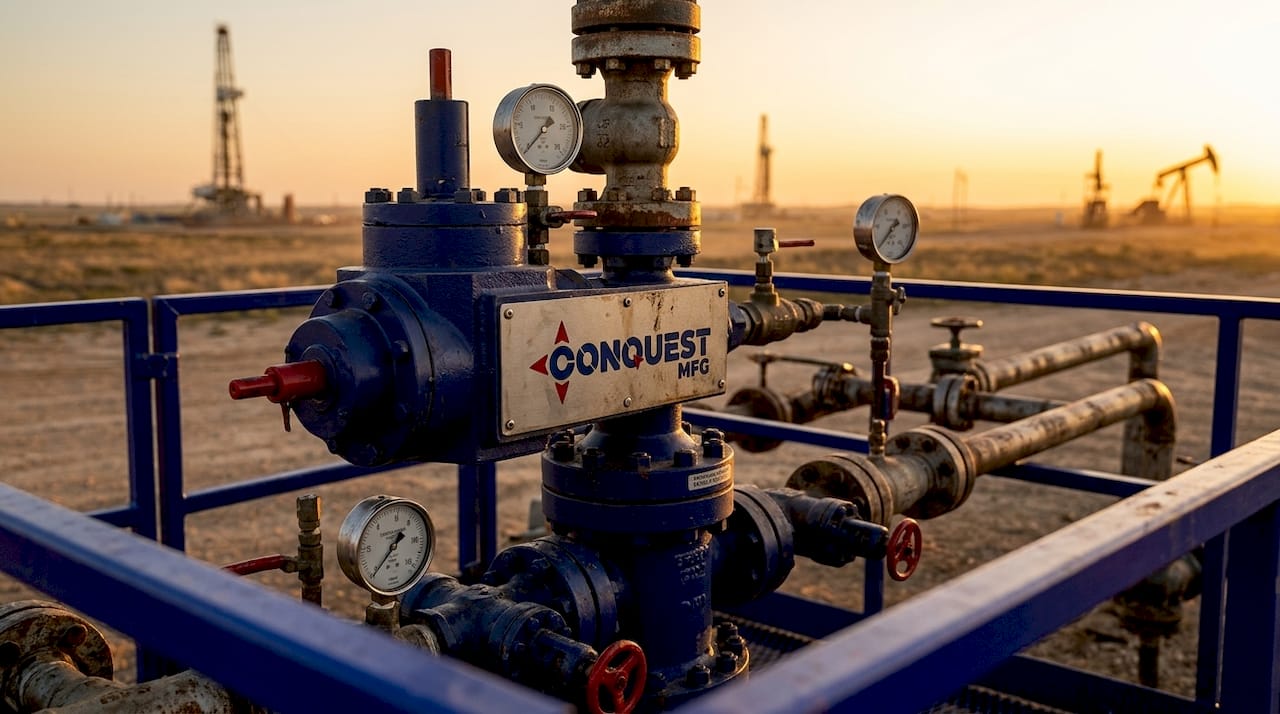
Downhole tools are deployed inside the wellbore. Landing nipples, packers, plugs, and perforating guns all fall into this category. The terminology here is more specialized because tool selection depends on wellbore geometry, pressure ratings, and completion design. Field teams consistently differentiate “in-well” from “on-surface” equipment language when planning interventions, since landing nipple profiles and locking features directly dictate tool seating depths and intervention strategies.
Beyond the surface/downhole split, oilfield terminology also organizes by operational phase:
- Drilling equipment terms cover the drill string, bottom hole assembly (BHA), mud systems, and well control tools. Floating mud cap drilling, for example, is a managed pressure drilling technique that uses continuous pumping of sacrificial fluid to prevent formation fluid migration to surface when drilling without returns.
- Completion equipment terms include the tubing string, packers, landing nipples, and Christmas tree components installed after the well is drilled.
- Production equipment terms cover valves, separators, meters, and artificial lift systems that manage ongoing hydrocarbon extraction.
API and IADC standards anchor each of these categories. API Spec 6A governs wellhead and Christmas tree equipment. API Spec 14A covers subsurface safety valves. IADC publishes a regularly updated lexicon that assigns precise definitions sourced from legislation, standards, and regulations rather than informal field usage. Using official IADC definitions reduces ambiguity across contractors and regions, which is especially critical on multi-operator projects.
Pro Tip: When onboarding new contractors or entering a new region, distribute a one-page terminology reference sheet aligned to the governing API or IADC standard for that specific work scope. It takes 20 minutes to prepare and prevents hours of rework.
How do common oilfield equipment assemblies differ?
Two assemblies generate more terminology confusion than any others: the Christmas tree and the landing nipple. They operate in different parts of the well, serve different functions, and are governed by different API specifications. Knowing the distinctions precisely is non-negotiable for completion engineers and well intervention teams.
Christmas tree: components and valve roles
A Christmas tree is an assembly of valves) installed on top of the wellhead to regulate well flow, and it is distinct from the wellhead itself. The tree contains several valve types, each with a defined role:
- Master valve: The primary barrier between the wellbore and surface. Surface trees typically have upper and lower master valves.
- Kill wing valve: Connects to the kill line for well intervention fluids.
- Swab valve: Located at the top of the tree, used for wireline and coiled tubing access.
- Production wing valve: Controls flow to the production flowline.
Surface Christmas trees are used on land and platform wells. Subsea Christmas trees are installed on the seabed and governed by API Spec 17D rather than API Spec 6A. The terminology shifts between these two variants, and confusing surface tree valve nomenclature with subsea tree nomenclature creates real procedural errors during commissioning.
Landing nipple: types and selection criteria
A landing nipple is a short tubular component in the production tubing string with an internal seal bore and locking profile. Its function is to provide a precise landing point for downhole flow control devices like plugs and safety valves. Two primary types exist:
- Selective nipple: Has a profile that accepts a specific locking mandrel, allowing tools to pass through and land at a chosen depth.
- No-go nipple: Has a reduced bore that physically stops a tool from passing further into the wellbore, providing a positive depth stop.
Material grades and pressure ratings for landing nipples are governed by API Spec 5CT and API Spec 14A. Selecting the wrong nipple type for an intervention job is not a minor error. It can result in a tool landing at the wrong depth or failing to seal, requiring a costly fishing operation.
Comparison: Christmas tree vs. landing nipple
| Feature | Christmas tree | Landing nipple |
|---|---|---|
| Location | Surface or seabed, above wellhead | Inside the production tubing string |
| Primary function | Flow control and well barrier at surface | Downhole landing point for intervention tools |
| Key valve/profile types | Master, kill wing, swab, production wing | Selective and no-go profiles |
| Governing API spec | API Spec 6A (surface), API Spec 17D (subsea) | API Spec 14A, API Spec 5CT |
| Operational phase | Completion through production | Completion and well intervention |
Pro Tip: Always confirm whether a project’s Christmas tree specification references API Spec 6A or 17D before ordering components. The pressure ratings, material requirements, and testing protocols differ significantly between the two.
What terminology supports safety compliance and maintenance?
Safety and maintenance terminology in oilfield operations is not interchangeable with general industrial language. Each term maps to a specific protocol, regulatory requirement, or procedural step. Using the wrong term in a work permit or maintenance order can create compliance gaps that surface during audits or, worse, during incidents.
Four categories of safety and maintenance terminology matter most for operators and engineers:
-
Pre-start safety checklist: A shift-by-shift assessment of PPE readiness, site hazards, machine guards, and emergency stop functionality completed before drilling begins. A pre-start checklist is behavioral and role-specific. Skipping it leaves crews starting operations without verified readiness. This term is distinct from a maintenance inspection and should not be used interchangeably with one.
-
Lockout/tagout (LOTO): An OSHA and MSHA-mandated procedure that isolates energy sources before maintenance work begins. In oilfield contexts, LOTO applies to wellhead valves, pump drives, and electrical systems. Lockout/tagout and PPE are core upstream HSE training subjects, and their definitions must align with the site’s governing regulatory framework.
-
Maintenance categories: Oil and gas maintenance terminology recognizes three distinct strategies. Preventive maintenance is scheduled regardless of equipment condition. Condition-based maintenance is triggered by observed signs of wear or performance change. Predictive maintenance uses sensor data and software to detect failure before it occurs. Misapplying these terms in a maintenance management system leads to scheduling errors and asset integrity failures.
-
Decommissioning terminology: When piping or equipment is permanently removed from service, precise language governs the process. Decommissioned piping is defined as piping with no future use that has been fully purged of hydrocarbons and physically disconnected or air-gapped from all energy sources per API 570. These terms are not cosmetic. They map directly to safety isolation expectations in mechanical integrity audits and QA/QC documentation.
“Decommissioning terms like ‘purged’ and ‘air-gapped’ are audit-critical. An inspector reviewing your mechanical integrity records will look for these exact terms to verify isolation status. Vague language like ‘taken out of service’ does not satisfy API 570 requirements.”
For a structured approach to compliance steps, the industrial equipment safety checklist framework from Conquestmfgusa provides a practical reference aligned to OSHA and MSHA standards.
How does consistent terminology improve project management?
Standardized oilfield equipment terminology is a project management tool, not just a technical reference. When every contractor, engineer, and operator on a project uses the same definitions, procurement runs cleaner, QA/QC documentation is defensible, and handover packages are complete.
The practical benefits of terminology alignment across project teams include:
- Procurement accuracy: Specifying a “no-go landing nipple per API Spec 14A, Grade L80” leaves no room for substitution errors. Generic descriptions like “downhole plug landing device” generate RFIs and delays.
- QA/QC documentation: Inspection records that use API and IADC-aligned terms satisfy third-party verification requirements without additional clarification. Auditors and certifying authorities recognize standard terminology immediately.
- Work scope clarity: The same term can carry different meanings depending on the work scope. Cementing, for example, is defined as the hydraulic application of pressure to casing to force cement outside the wellbore, with casinghead valves closed to prevent annular returns. That definition is specific to a completion context. Using “cementing” loosely in an abandonment scope creates confusion about whether a packer is required.
- Cross-regional alignment: Terminology varies between the Gulf of Mexico, North Sea, and Middle East operations. Anchoring all project documentation to IADC lexicon definitions or the applicable API specification creates a common reference that survives contractor changes and regional differences.
- Handover and decommissioning packages: Projects that use precise terminology throughout their lifecycle produce handover documents that new operators can act on without reinterpretation. This is especially true for industry terminology standards applied during abandonment and decommissioning phases.
For engineers managing multi-contractor projects, the investment in a project-specific terminology register aligned to API and IADC standards pays back in reduced change orders, fewer non-conformance reports, and faster regulatory approvals.
Key takeaways
Precise oilfield equipment terminology, anchored to API and IADC standards, is the single most effective way to reduce miscommunication, compliance gaps, and procurement errors across oil and gas projects.
| Point | Details |
|---|---|
| Surface vs. downhole distinction | Categorizing equipment by location determines which API standard and which team owns the terminology. |
| Christmas tree vs. landing nipple | These two assemblies serve different functions, operate in different locations, and are governed by different API specs. |
| Safety terms are protocol-specific | Pre-start checklist, LOTO, and decommissioned piping each map to distinct regulatory requirements under OSHA, MSHA, and API 570. |
| Maintenance categories matter | Preventive, condition-based, and predictive maintenance are not synonyms. Misapplying them causes scheduling and asset integrity failures. |
| Terminology alignment drives project efficiency | A project-specific terminology register aligned to IADC and API definitions reduces RFIs, non-conformances, and audit findings. |
Why terminology precision is the most underrated project management skill
I have reviewed project documentation from operators across the Gulf Coast and Permian Basin, and the pattern is consistent. The projects that run over budget or fail audits almost always have one thing in common: loose terminology in their work scopes and maintenance records. Not inadequate equipment. Not undertrained crews. Loose terminology.
The most common pitfall I see is treating “wellhead” and “Christmas tree” as interchangeable. They are not. The wellhead is the pressure-containing structure at the casing. The Christmas tree sits on top of it and controls flow. Confusing the two in a work permit means the wrong team shows up with the wrong tools and the wrong isolation procedure. That is a safety event waiting to happen.
The second pitfall is using maintenance terms without precision. When a maintenance order says “inspect pump” without specifying whether the task is preventive, condition-based, or predictive, the technician makes a judgment call. Sometimes that call is right. Sometimes it results in a missed failure mode that a predictive sensor would have caught three weeks earlier.
My practical advice: build a terminology register at the start of every project. Pull definitions from the IADC lexicon and the applicable API specifications. Make it a living document that every contractor signs off on during mobilization. It is not bureaucracy. It is the foundation that every other project process depends on.
— Peter
Conquestmfgusa: built for oil and gas equipment demands
At Conquestmfgusa, we manufacture equipment for the oil and gas industry with the same precision that the sector’s terminology demands. Our product line includes dry bulk pneumatic trailers, vacuum tanks, sand hoppers, sand chassis, and specialized oilfield transport equipment, all custom-built to meet the operational requirements of upstream and midstream projects. When your project documentation specifies exact equipment standards, our manufacturing process is designed to deliver against those specifications without compromise. Explore our oil and gas equipment solutions to find the right fit for your next project, or review how batch plants support oilfield operations for production quality and efficiency. Contact us to discuss your project requirements.
FAQ
What is oilfield equipment terminology?
Oilfield equipment terminology is the standardized vocabulary used to define tools, assemblies, and procedures in oil and gas operations, governed by bodies like API and IADC. Precise terminology reduces miscommunication between contractors, engineers, and operators across all project phases.
What is the difference between a wellhead and a Christmas tree?
The wellhead is the pressure-containing structure installed at the top of the well casing, while the Christmas tree is a separate valve assembly mounted on top of the wellhead to control well flow. Confusing the two creates errors in work permits and isolation procedures.
What are the types of landing nipples?
Landing nipples come in two primary types: selective nipples, which accept specific locking mandrels at chosen depths, and no-go nipples, which use a reduced bore to physically stop a tool at a fixed depth. Both types are governed by API Spec 14A and API Spec 5CT.
Why does maintenance terminology matter in oilfield operations?
Preventive, condition-based, and predictive maintenance are distinct strategies with different triggers and outcomes. Misapplying these terms in a maintenance management system leads to scheduling errors, missed failure modes, and asset integrity failures.
What does “decommissioned piping” mean under API 570?
Decommissioned piping is piping with no future use that has been fully purged of hydrocarbons and physically disconnected or air-gapped from all energy sources, as defined by API 570. This precise definition is required for mechanical integrity audits and QA/QC verification.