

When a blowout preventer fails at a Permian Basin rig running at $8,000 per hour in downtime costs, waiting three days for an LTL carrier to consolidate your load is not a logistics strategy. It is a financial emergency. Rig downtime benchmarks put losses between $5,000 and $15,000 per hour, and one documented case showed a single on-time hot shot delivery of a 4,200 lb BOP component over 142 miles in 5.5 hours saved an operator $24,000 in avoided downtime. This guide covers everything logistics managers in oil and gas need to know: what hot shot transportation actually is, how it works on the ground, how it compares to alternatives, and how to use it without running into compliance pitfalls.
Table of Contents
- What is hot shot transportation?
- How hot shot transportation works in the oil and gas industry
- Hot shot vs. LTL and expedited freight: Choosing the best method for urgent freight
- Regulatory requirements and operational best practices
- What most logistics managers miss about hot shot’s impact in oil and gas
- Explore specialized freight solutions for oil and gas logistics needs
- Frequently asked questions
Key Takeaways
| Point | Details |
|---|---|
| Hot shot is ultra-fast | Hot shot transportation offers direct and rapid solutions, often enabling same-day delivery for urgent oil and gas equipment. |
| Minimizes downtime costs | By avoiding shipment delays, hot shot can save tens of thousands of dollars in potential oilfield or industrial downtime. |
| Uses specialized vehicles | Medium-duty pickups with gooseneck or flatbed trailers are standard for handling partial or oversize urgent freight. |
| Rigorous compliance needed | Operators must navigate weight thresholds, DOT/MC requirements, and oilfield-specific HOS exemptions to stay legal and effective. |
| Choose the right freight method | Hot shot is ideal when speed and reliability matter more than lowest unit cost, especially for high-stakes oil and gas logistics. |
What is hot shot transportation?
With the urgency of oilfield deliveries established, let’s define exactly what sets hot shot transportation apart from other freight solutions.
Hot shot transportation is a specialized freight service using medium-duty pickup trucks, specifically Class 3 through Class 5 vehicles like the Ram 3500 or Ford F-350, paired with gooseneck or flatbed trailers. These rigs are designed to haul time-sensitive, partial, or oversized loads that are too small for a full semi-trailer. Typical payloads fall between 12,000 and 16,500 lbs, occupying the niche between less-than-truckload (LTL) consolidation and full truckload service.
This mode of freight did not originate in a corporate boardroom. Hot shot trucking’s roots trace directly to Texas oilfields where drilling crews needed pipe fittings, pump components, and wellhead assemblies delivered to remote locations before a scheduled LTL route could even pick up the freight. Operators paid a premium to a driver with a capable truck and trailer to run a single, dedicated load as fast as legally possible. That model never changed. It just scaled.
Today, hot shot is used nationwide across oil and gas, construction, agriculture, and industrial machinery sectors. But it remains most critical in oilfield logistics, where equipment failure and delivery delays translate directly into quantifiable revenue loss. For oil industry equipment types ranging from wellhead components to pumping unit parts, hot shot is often the only method that matches the urgency of the job.
Loads best suited for hot shot transportation:
- Wellhead assemblies and BOP components
- Pump jacks, rod strings, and downhole tools
- Pipes, valves, and fittings under 16,500 lbs
- Control panels, generators, and compressor parts
- Cement pig silo trailers and portable batch plant components
| Feature | Hot shot | Standard freight |
|---|---|---|
| Payload range | 12,000 to 16,500 lbs | 40,000 to 48,000 lbs |
| Pickup timeline | Same-day to 2 hours | 1 to 3 business days |
| Dedicated driver | Yes, single driver | No, multi-handled |
| Ideal use case | Urgent, partial loads | Full truckload non-urgent |
The critical insight here is that hot shot is not just a smaller truck. It is a dedicated, rapid-response freight model built around eliminating the waiting, consolidation, and hub-to-hub handling that make standard shipping incompatible with oilfield urgency.
How hot shot transportation works in the oil and gas industry
Understanding the equipment and definition is just the start. Now let’s break down exactly how hot shot shipments support time-sensitive oilfield operations.
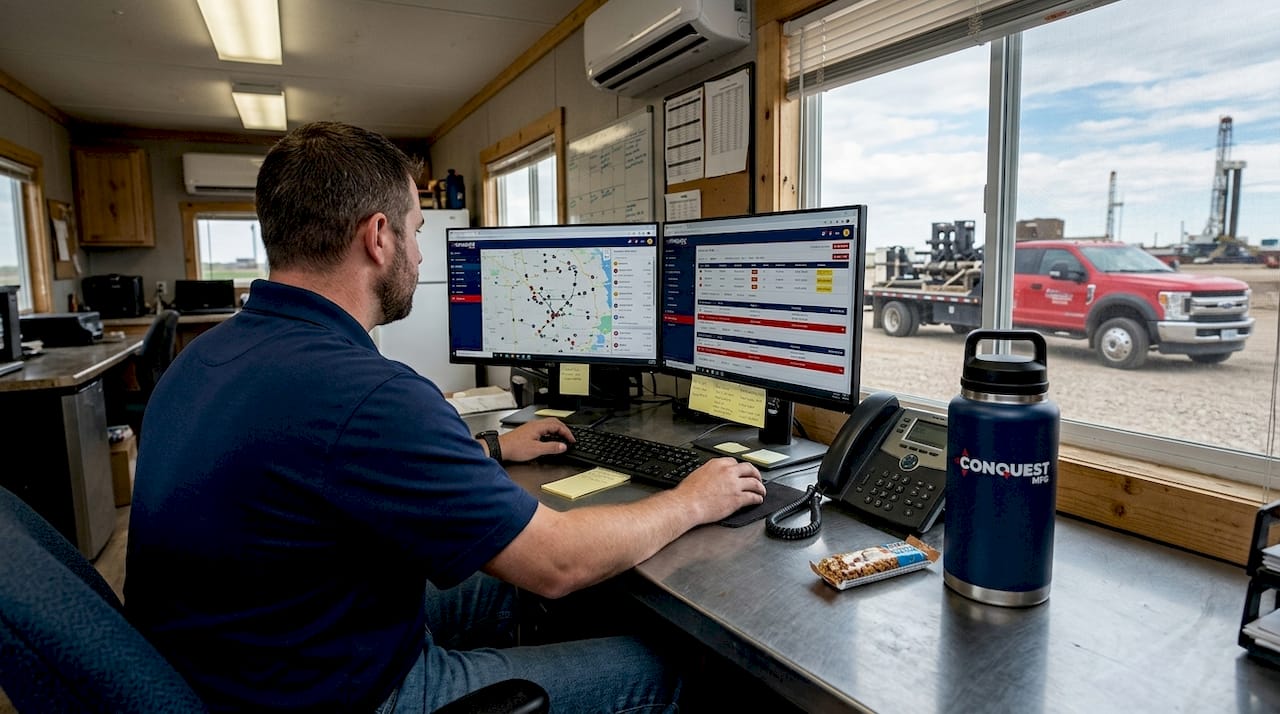
The operational model is direct point-to-point delivery by a single driver, with no terminals, no hubs, and no intermediate freight handling. Dispatch runs 24/7. Booking happens through load boards like DAT and Truckstop.com, freight brokers, or direct shipper contracts. This is not a scheduled network. It is an on-demand response system.
A typical hot shot workflow in an oilfield scenario looks like this:
- Incident identified: A rig supervisor confirms a failed pump component at 10:00 PM on a Sunday.
- Load posted or dispatched: The logistics manager contacts a dedicated hot shot carrier or posts to a load board within 30 minutes.
- Driver assigned: A qualified driver with the correct trailer configuration accepts the load and confirms pickup location, weight, and dimensions.
- Pickup executed: Driver arrives at the equipment yard, loads using proper rigging, secures the freight, and documents the bill of lading.
- Direct transit begins: The driver travels point-to-point without stops at freight terminals or consolidation hubs.
- On-site delivery: The component arrives at the wellsite, often within hours of the failure being identified.
- Confirmation and close: Proof of delivery is logged, and downtime is minimized or avoided entirely.
The economic case is not abstract. When rig downtime runs $8,000 per hour in a basin like the Permian, a six-hour delivery that costs $1,200 in freight charges versus a 30-hour LTL option that costs $400 is an easy calculation. The premium freight option saves tens of thousands of dollars.
“Hot shot transportation is not a cost center in oil and gas. It is a downtime prevention tool with a measurable return. Every hour of avoided rig standby is a direct line to the bottom line.”
Pro Tip: Establish direct contracts with two or three hot shot carriers who specialize in your operating basin before you need them. Emergency booking during a rig crisis is slower and more expensive than activating a pre-qualified partner.
This 24/7 model connects directly to how we support transportation industry solutions at Conquest MFG USA, where reliability across all hours and conditions is a non-negotiable standard. The industries served by these rapid-response freight systems demand nothing less.
Hot shot vs. LTL and expedited freight: Choosing the best method for urgent freight
Once the hot shot workflow is clear, the next step is evaluating how these solutions stack up to traditional freight methods in urgent industrial scenarios.
The comparison matters because logistics managers are regularly pressured to reduce freight spend. That pressure can push operations toward LTL options that appear cheaper per mile but carry significant hidden costs. Hot shot consistently outperforms LTL in oil and gas applications where urgency exceeds $5,000 per hour in downtime exposure.
| Freight method | Transit time | Handling | Ideal scenario | Risk level |
|---|---|---|---|---|
| Hot shot | Same-day to 24 hours | Single load, no hubs | Urgent, partial oilfield loads | Low |
| LTL | 3 to 7 business days | Multi-handled, hub-to-hub | Non-urgent, cost-sensitive | Medium to high |
| Expedited freight | 1 to 3 days | Semi-dedicated or air | Regional or national urgent | Medium |
| Full truckload | 1 to 5 days | Dedicated trailer | Large, full loads | Low to medium |
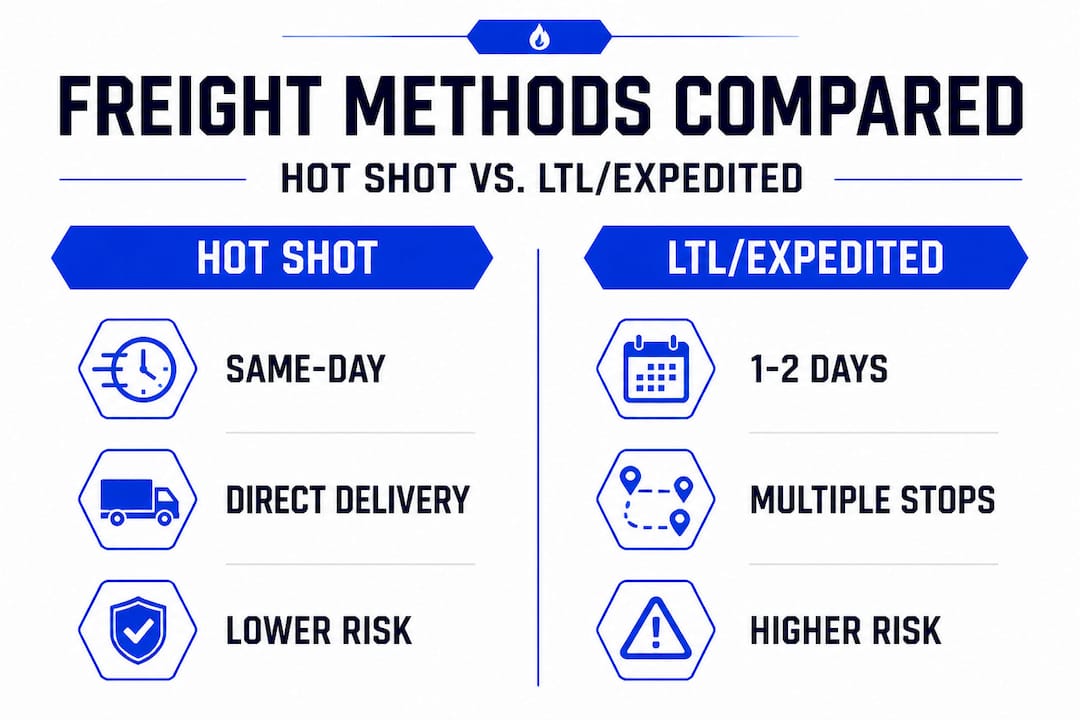
Hot shot versus LTL comes down to a fundamental tradeoff: dedicated speed versus shared economy. LTL can be the right choice when the load is not urgent, the part is not on the critical path, and downtime costs are minimal. But in oilfield operations, that scenario is rarer than most managers plan for.
The hidden costs in LTL that most freight budgets undercount:
- Damage risk: Multi-handled freight through terminals sees higher rates of impact damage. Precision components like pump assemblies or wellhead fittings cannot tolerate rough handling.
- Detention fees: When LTL deliveries arrive incomplete or damaged, re-delivery and claims processing add days and administrative cost.
- Downtime exposure: A 72-hour LTL transit during a rig standby is not a $200 freight saving. It is potentially $240,000 in lost production.
- Limited visibility: LTL shipments moving through hub networks offer less real-time tracking than direct hot shot routes.
When LTL is genuinely the better choice:
- Scheduled maintenance parts with a 5 to 7 day lead time
- Non-critical equipment spares being pre-positioned to a yard
- Low-value materials where rig uptime is not dependent on delivery timing
- Multiple low-weight items that can be consolidated without urgency
The honest answer is that many oil and gas logistics teams overuse LTL out of habit and underuse hot shot out of a narrow focus on per-mile cost rather than total operational impact.
Regulatory requirements and operational best practices
After comparing methods, effective hot shot transportation also hinges on mastering compliance and field-tested best practices.
The regulatory landscape for hot shot is straightforward once you understand the key thresholds. Any vehicle operating in interstate commerce with a Gross Vehicle Weight Rating or Gross Combined Weight Rating over 10,001 lbs is classified as a commercial motor vehicle and requires a DOT number, MC number, and commercial insurance with at least $1 million in liability coverage. Hours of Service rules and Electronic Logging Device requirements apply. If the GCWR exceeds 26,001 lbs, the driver must hold a CDL.
Oilfield operations carry specific exemptions that logistics managers and their carriers must understand precisely. The FMCSA oilfield HOS exemptions allow for a non-consecutive 24-hour restart and permit well-site waiting time to be logged as off-duty. These are legitimate tools that improve driver flexibility in remote locations. However, misapplying these exemptions, such as claiming off-duty status during active driving periods, creates serious CSA (Compliance, Safety, Accountability) score risk and potential fines.
Compliance checklist for hot shot carriers serving oil and gas operations:
- Verify active USDOT and MC numbers through the FMCSA SAFER database before every contract.
- Confirm insurance certificates show minimum $1 million general liability and cargo coverage.
- Check driver CDL status against the actual GCWR of the loaded vehicle combination.
- Review ELD logs for proper classification of well-site wait time under oilfield exemptions.
- Confirm load securement meets FMCSA 49 CFR Part 393 standards for flatbed and gooseneck cargo.
- Document hazmat classifications for any wellsite chemicals or pressurized components.
Pro Tip: Request a copy of your carrier’s most recent CSA Safety Measurement System score before assigning any oilfield run. A carrier with violations in unsafe driving or vehicle maintenance is a liability your operation cannot afford, regardless of the rate they offer.
“Compliance is not paperwork overhead in hot shot logistics. It is the operational baseline that protects your crew, your equipment, and your ability to move freight without interruption.”
Beyond compliance, operational best practices focus on reducing deadhead miles, which are empty return miles that inflate your effective cost per usable mile. Carriers who work within a defined geographic region and maintain consistent lane relationships in basins like the Permian, Eagle Ford, or Bakken operate more efficiently and deliver better rates over time.
Reviewing an industrial equipment safety checklist before loading custom-built oilfield equipment ensures your freight arrives in field-ready condition. For liquid-carrying assets, following vacuum tank transport standards is equally critical. Operations can also benefit from reviewing cybersecurity guidance for manufacturers to protect sensitive logistics and dispatch data.
What most logistics managers miss about hot shot’s impact in oil and gas
With regulations and methods covered, let’s reframe how logistics leaders should evaluate the ROI of hot shot services in real-world oil and gas operations.
Here is the perspective most industry guides will not give you: the real problem in oilfield hot shot logistics is not a lack of carriers. It is a lack of precision in how managers assign value to freight decisions.
We consistently see operations that treat hot shot as an emergency-only option and then overbid on a panicked call at 2:00 AM for a load that could have been pre-positioned 24 hours earlier at a third of the cost. That reactive pattern is expensive. Building a proactive hot shot network, with pre-qualified carriers, standardized rate agreements, and scheduled hot shot runs for predictable maintenance cycles, transforms the cost profile entirely.
The second missed insight is about carrier relationships versus broker dependence. Load boards and freight brokers serve a function, especially for irregular lanes. But in a high-density operating area like the Permian Basin, logistics managers who build direct relationships with basin-specific hot shot operators gain access to carriers who know the lease roads, understand wellsite delivery protocols, and can navigate access gate procedures without a 45-minute delay. That local knowledge is not captured in a broker’s database.
We also observe a consistent tendency to evaluate hot shot on cost-per-mile when the correct metric is cost-per-operational-hour-preserved. A $3.50 per mile hot shot run that prevents a four-hour rig standby at $8,000 per hour has a measurable ROI of approximately 90 to 1. No other freight method in that scenario even approaches that return.
The overuse case is equally worth addressing. Not every urgent-seeming request actually requires hot shot. When parts are non-critical-path and operations can absorb a 48-hour delay without rig standby, LTL is the responsible choice. Operational hot shot insights from the field consistently show that the best logistics teams apply hot shot selectively and strategically, not reflexively.
Explore specialized freight solutions for oil and gas logistics needs
For those ready to implement or upgrade their urgent freight strategy, specialized solutions can make all the difference.
At Conquest MFG USA, we build the equipment that rides on these trucks. Our custom-built vacuum tanks, dry bulk pneumatic trailers, sand hoppers, sand chassis, and oil industry equipment are engineered for reliability under real oilfield conditions. We understand the freight requirements because we manufacture the assets that move through them every day.
When your operation needs equipment that performs from the moment it arrives on location, partner with a manufacturer who knows how critical that delivery timeline is. Browse our full range of transportation industry solutions or visit our equipment shop to find the purpose-built assets your logistics team depends on. Contact us directly to discuss custom configurations tailored to your operational requirements. We are here to help you keep production moving.
Frequently asked questions
What kind of equipment is used for hot shot transportation?
Hot shot transportation uses Class 3-5 pickup trucks such as the Ram 3500 or Ford F-350 paired with flatbed or gooseneck trailers, typically handling loads between 12,000 and 16,500 lbs.
How quickly can a hot shot shipment be delivered?
Hot shot deliveries are typically same-day or overnight using direct point-to-point routing, with 24/7 dispatch availability to support urgent oilfield requests at any hour.
What are typical rates for hot shot transportation in 2026?
Standard flatbed hot shot rates run $1.50 to $2.50 per mile, while oilfield and oversized loads in basins like the Permian can reach $2.00 to $4.50 per mile depending on urgency and load complexity.
Is a CDL required for all hot shot drivers?
A CDL is required when the gross combined weight rating of the truck and loaded trailer exceeds 26,001 lbs. Loads under that threshold can be operated by non-CDL drivers who still must comply with DOT commercial vehicle requirements.
How does hot shot transportation minimize rig downtime?
By delivering critical components directly from origin to wellsite without hub stops or consolidation delays, hot shot service has demonstrated savings of up to $24,000 in a single delivery by preventing extended rig standby at rates of $8,000 per hour or more.