
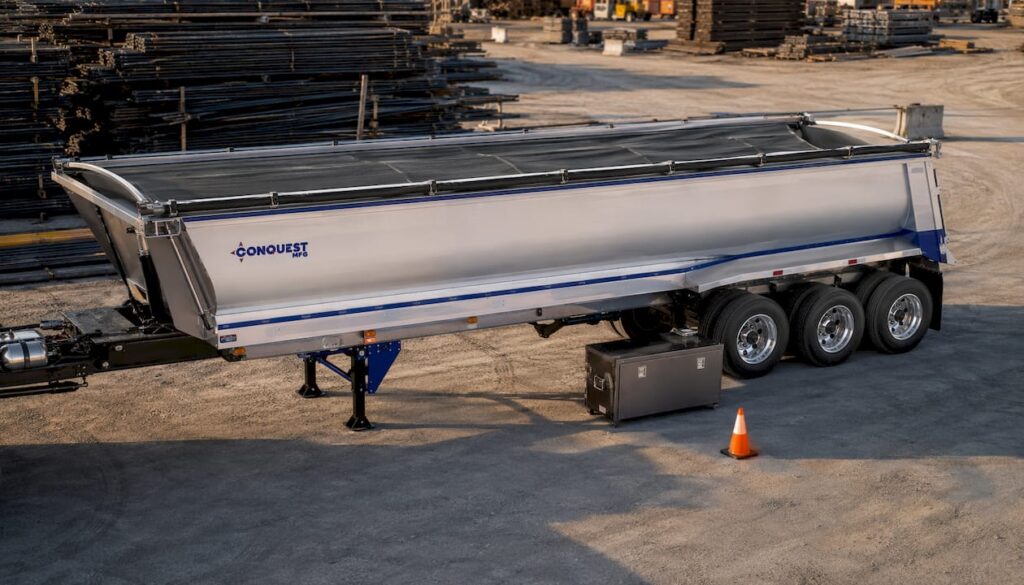
What makes a half round end dump trailer the right choice?
A half round end dump trailer is a semi-trailer built with a curved, semi-cylindrical tub that delivers higher payload capacity, better material flow, and longer service life than a flat-floor rectangular design. The curved tub eliminates the sharp corners where material packs and sticks, so discharge is faster and more complete. For construction and transport professionals hauling asphalt, rip rap, gravel, or demolition debris, that geometry translates directly into fewer delays and lower operating costs.
Two models that define the category are the MAC Trailer Half Round Dump Trailer and the Rock Master Half Round Trailer. Both reflect the industry’s move toward lighter, stronger builds that carry more per trip without sacrificing structural integrity.
Key benefits at a glance:
- Higher payload per trip due to the curved tub’s efficient use of legal weight limits
- Lower center of gravity compared to rectangular trailers, improving stability during transport and dumping
- Faster, cleaner discharge because material rolls out rather than dragging across a flat floor
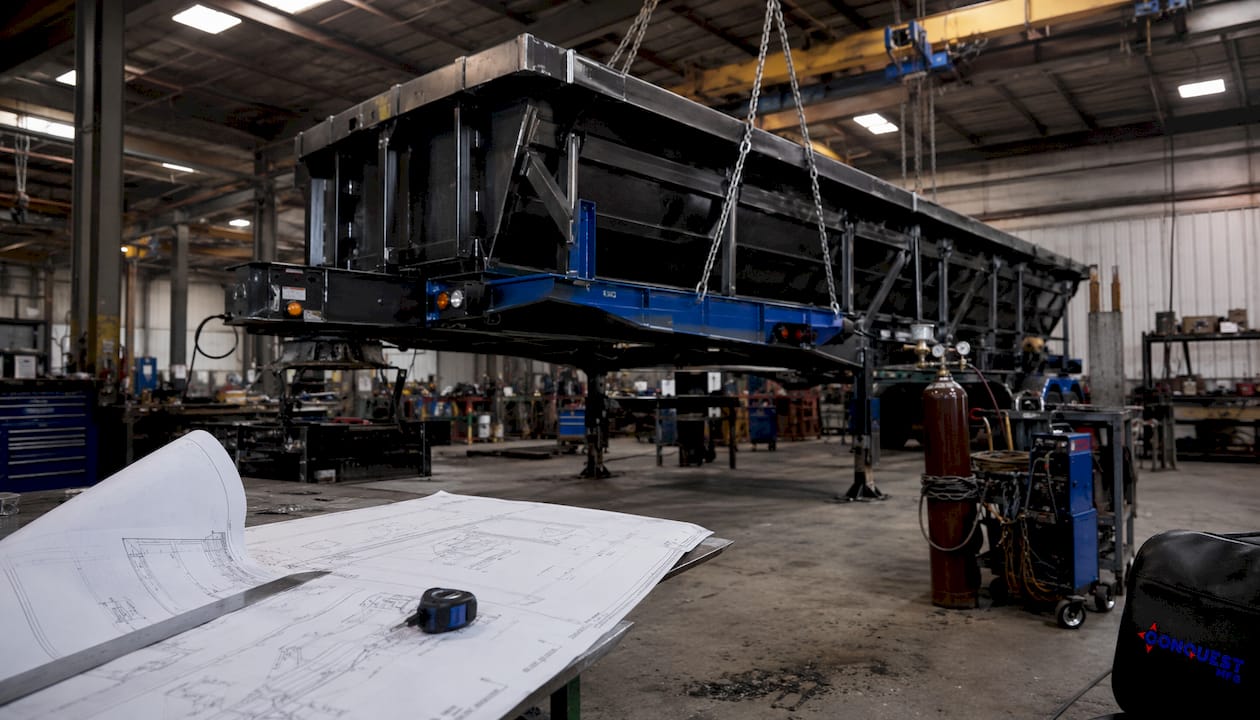
- Longer tub life when built with AR Hardox steel grades rated for constant impact and abrasion
- Reduced material hang-up, especially critical for sticky loads like hot mix asphalt
Detailed specifications and construction features
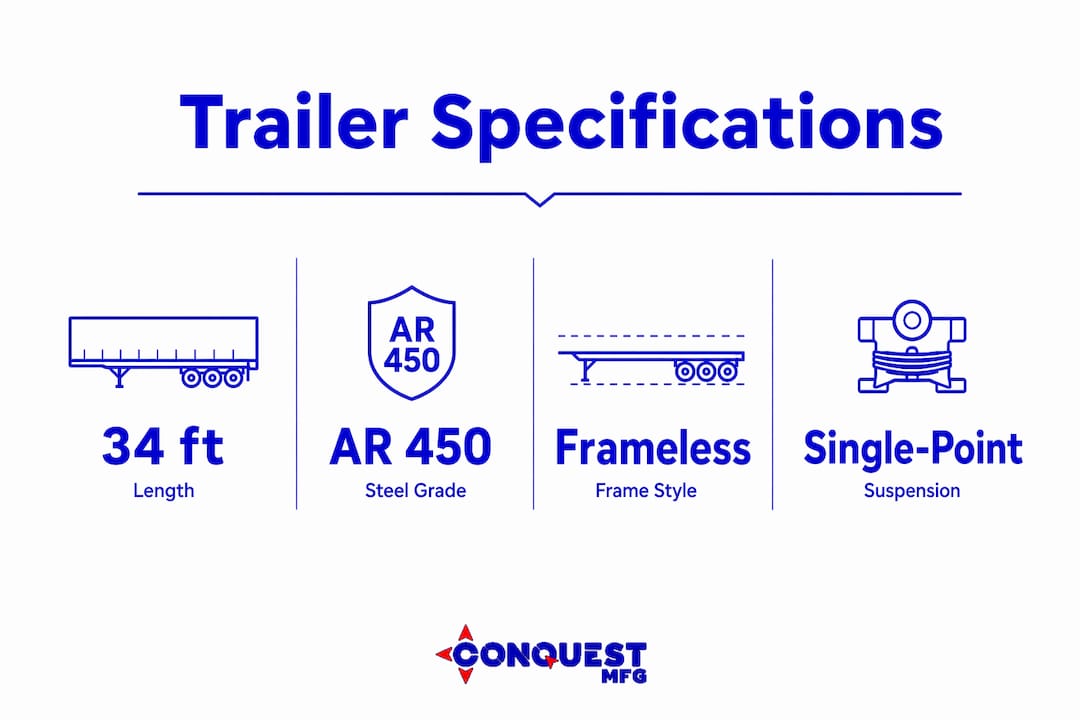
The 34-foot total length configuration is the most common industry standard, balancing payload volume with the maneuverability needed on active job sites. Side heights are kept lower than rectangular designs, which directly supports the trailer’s reduced center of gravity.
| Specification | Typical Standard |
|---|---|
| Total length | 34 ft |
| Tub steel grade | AR Hardox 400, 450, or 500 |
| Welding process | Flux core |
| Weld quality assurance | Liquid penetration testing |
| Suspension | Hutch H-900 Single Point 50K |
| Suspension behavior | All four wheels remain on ground when dumping |
| Gate options | Bulkhead door or standard tailgate |
| Tarp system | Electric mesh tarp (standard) |
| Ladder | Included on most configurations |
Steel grades and weld integrity
The tub is the most punished component on any end dump trailer. AR Hardox 450 is the workhorse grade for most applications, with Hardox 400 used where weight savings take priority and Hardox 500 reserved for the most abrasive loads. All welding uses a flux core process, and liquid penetration tests are conducted on each weld to confirm structural integrity before the trailer leaves the factory.
Frame styles
Frameless construction is the lightest build option. MAC Trailer’s frameless half round design relies entirely on the tub’s structural strength, which demands higher-grade steel but delivers maximum payload. Full-frame configurations add a steel undercarriage for additional rigidity, making them better suited to rough terrain and demolition applications where the trailer takes more punishment from below.
Hydraulic and suspension systems
The Hutch H-900 Single Point 50K suspension keeps all four wheels on the ground during dumping, a feature that prevents tip-overs on uneven ground. Hydraulic tipping systems are designed for high-pressure, quick-cycle operation so drivers can dump and return to the pit without extended wait times. Stability during the dump cycle is non-negotiable on active construction sites, and the single-point suspension design addresses that directly.
Standard and specialized features
- Bulkhead doors for controlled front-end discharge
- Electric mesh tarps for regulatory compliance and load containment
- Integrated ladders for safe tub access during inspection and cleaning
- Spreader aprons for controlled material distribution during discharge
- Reinforced tailgates rated for heavy aggregate loads
How customization matches your hauling application
No two hauling operations are identical, and the right half round dump trailer spec depends heavily on what you’re moving. Evaluating your primary haul material before finalizing specs is the single most consequential step in the purchasing process. Liners, steel thickness, and gate type all shift dramatically based on whether you’re running asphalt, rip rap, or mixed demolition debris.
- Rip rap and large aggregate: Thicker Hardox 500 tub steel or bolt-in AR liner plates absorb the impact of heavy, angular rock without cracking the tub floor.
- Hot mix asphalt: Smooth tub interiors without liners allow the asphalt to release cleanly. Some operators add a heated tub option to prevent premature cooling and sticking.
- Gravel and sand: Standard Hardox 450 tub construction handles these loads well. Weight savings through frameless construction often make sense here since the material is less punishing.
- Demolition debris: Full-frame construction with reinforced tub sides handles irregular, heavy loads that shift unpredictably during transport.
- Spreader apron applications: When precise material placement matters, a spreader apron attached to the rear gate controls the discharge width and rate.
Tarp systems also vary by application. Electric mesh tarps are standard for aggregate hauling and satisfy most state DOT requirements for load containment. Solid tarps are available for finer materials where dust control is a compliance requirement. Gate selection follows the same logic: bulkhead doors suit operations where the driver needs to control discharge from the front, while standard tailgates work for bulk dump scenarios.
Frame weight savings versus structural ruggedness is a trade-off worth quantifying before you buy. A frameless trailer running Hardox 450 may carry several hundred additional pounds of payload per trip compared to a full-frame model. Over a full operating season, that difference compounds into real revenue.
Pro Tip: Before finalizing your trailer spec, request a material analysis from your quarry or plant supplier. Knowing the exact abrasion index and bulk density of your primary haul material lets you match steel grade and liner choice with precision, avoiding both over-engineering and premature wear.
Practical usage: which design fits your operation?
The lower center of gravity in a half round trailer is its most operationally significant advantage over a rectangular design. Shorter side walls mean the load sits lower, reducing the risk of rollover during transport on crowned roads or during the dump cycle on sloped ground.
Frameless trailers perform best on paved or well-graded surfaces where the tub itself isn’t exposed to flex stress from rough terrain. Full-frame trailers absorb that flex through the undercarriage, making them the better choice for quarry roads, demolition sites, and any operation where the trailer regularly travels off pavement.
Material behavior during discharge separates the half round from other designs in a practical way. Sticky materials like asphalt or wet clay release more completely from a curved tub because there are no corners to trap the load. Rectangular trailers often require manual cleanup after each dump, adding time and labor to every cycle.
Common maintenance priorities in the field:
- Tub floor inspection: Check for wear-through at the highest-impact zones, typically the front third of the tub where material first contacts during loading.
- Weld inspection: Inspect weld seams at the tub-to-frame junction quarterly, or more frequently in high-cycle operations.
- Hydraulic cylinder seals: Replace seals on a scheduled basis rather than waiting for failure, since a cylinder leak during a loaded dump is a serious safety event.
- Tarp mechanism: Lubricate the electric tarp motor and track monthly to prevent binding.
Safety and compliance standards for half round end dump trailers in the United States are governed by Federal Motor Carrier Safety Administration (FMCSA) regulations, state DOT weight limits, and load securement rules under 49 CFR Part 393. Tarp systems must meet load containment requirements in most states, and gross vehicle weight ratings must align with the trailer’s axle configuration and the legal limits of the routes you operate.
Expert recommendations for selecting the right trailer
Aligning your trailer spec with your actual hauling conditions is where most purchasing mistakes happen. Buyers who select a trailer based on price alone often find themselves replacing tub steel or dealing with hydraulic failures within the first two operating seasons.
- Steel grade first: Match the Hardox grade to your material’s abrasion index. Hardox 450 covers most aggregate and gravel operations. Hardox 500 is worth the added cost for rip rap and demolition debris.
- Frame choice second: Frameless for paved routes and weight-sensitive operations; full-frame for rough terrain and demolition.
- Suspension quality: Specify a single-point suspension system that keeps all wheels grounded during dumping. It’s a direct safety investment.
- Hydraulic system: Confirm the system’s pressure rating and cycle speed match your operational tempo. A slow hydraulic system on a high-cycle quarry route costs real time.
- Customization versus off-the-shelf: A bespoke build with the right liner, gate, and tarp configuration will outlast a generic model by years in demanding applications.
- Maintenance planning: Budget for scheduled hydraulic seal replacement, tub inspections, and tarp servicing from day one. Reactive maintenance on a loaded trailer is always more expensive than planned upkeep.
Pricing for half round end dump trailers varies by steel grade, frame style, and added features. Frameless Hardox 450 builds represent the entry point for professional-grade trailers, while fully customized full-frame configurations with Hardox 500 tubs, electric tarps, spreader aprons, and upgraded hydraulics sit at the higher end of the market. Getting a detailed quote that itemizes each specification lets you make a genuine cost-versus-performance comparison rather than comparing headline prices on different builds.
Conquest Mfg brings over 35 years of engineering expertise to end dump trailer manufacturing for construction and transport professionals across the United States. Our team works directly with buyers to match trailer specifications to their exact hauling requirements, from steel grade selection through hydraulic system configuration. If you’re evaluating a half round end dump purchase, fleet optimization strategies and detailed spec consultations are part of how we support long-term operational reliability.

Key Takeaways
A half round end dump trailer built with AR Hardox steel, a single-point suspension system, and application-matched customization delivers the best combination of payload capacity, durability, and operational safety for professional hauling.
| Point | Details |
|---|---|
| Standard length | The 34-ft configuration is the most common industry standard, balancing payload and maneuverability. |
| Steel grade selection | AR Hardox 450 suits most aggregate operations; Hardox 500 is recommended for rip rap and demolition debris. |
| Suspension safety | Single-point suspension keeps all four wheels on the ground during dumping, preventing tip-overs. |
| Frame choice | Frameless builds maximize payload on paved routes; full-frame designs handle rough terrain and demolition sites. |
| Spec before you buy | Evaluating your primary haul material before finalizing specs directly determines liner choice, steel grade, and gate type. |