
The Federal Bridge Formula caps how much weight your rig can carry across any group of consecutive axles, based on how many axles are in that group and how far apart they sit. It works alongside, not instead of, the standard federal weight caps. That means a truck can sit under 80,000 pounds gross and still get cited if an inner axle group carries too much weight for its spacing. Every driver and dispatcher running the Interstate system needs to check both.
TL;DR:
- Checking the entire span from the first to last axle, especially on the 1-5 group, is crucial because it often exceeds spacing limits even when individual axles pass.
- Adjusting trailer tandem positions or redistributing freight can quickly resolve weight violations without needing to reduce total load.
- State-specific weight allowances may differ from federal rules and can require permits or route adjustments once crossing onto Interstate highways.
- Using the FHWA Bridge Formula calculator or read-the-chart methods helps operators confirm compliance easily before weighing.
- Properly spec’d equipment, such as trailers with adjustable tandems and additional axles, reduces the risk of violations and roadside delays.
Table of Contents
- How the Federal Bridge Formula Works: The Equation Explained
- How Do You Calculate Bridge Formula Compliance?
- Federal Weight Limits and the Exceptions That Change the Math
- How to Check Your Truck for Bridge Formula Compliance
- What Happens When You Get Cited for a Bridge Formula Violation
- Where to Find Official Bridge Formula Guidance
- Planning Routes When State and Federal Limits Don’t Match
- Fleet Strategies That Reduce Bridge Formula Risk
- How Conquest Mfg Equipment Supports Bridge Formula Compliance
- The Bridge Formula Deserves More Attention Than It Gets
- Sources
How the Federal Bridge Formula Works: The Equation Explained
The math behind the Bridge Formula looks intimidating on paper but boils down to a simple relationship: more axles spread over more distance means more allowable weight. The formula is written as:
W = 500 (LN / (N−1) + 12N + 36)
Here’s what each letter means in practical terms:
- W = the maximum weight, in pounds, allowed on any group of two or more consecutive axles
- L = the distance, in feet, between the extreme axles of that group (rounded to the nearest whole foot)
- N = the number of axles in the group being checked
Once you run the numbers, the result gets rounded down to the nearest 500 pounds before it’s compared against the axle group’s actual scaled weight. A “group” simply means any two or more axles in a row on the vehicle, not the whole rig. This is why fleets get tripped up: they check the tractor’s tandem and the trailer’s tandem separately, but never check the combined span that runs from the first axle of the tractor to the last axle of the trailer.
The engineering logic is straightforward. A bridge deck absorbs stress based on how concentrated a load is over a given span. Spread the same weight across more feet of roadway, using more axles, and the stress on any single point drops. Cram it onto a short wheelbase, and you’re punching a harder hit into the same square footage of pavement or bridge deck.
One thing worth flagging: this formula governs weight limits on the Interstate highway system. State roads and some local routes can carry different rules, which matters when you’re routing around a bridge formula violation rather than fixing the load itself.
How Do You Calculate Bridge Formula Compliance?
Running the numbers by hand isn’t complicated once you know the sequence. Here’s the order that keeps you from missing a group:
- Identify every consecutive axle group on the vehicle — not just the single and tandem axles, but combinations like axles 1 through 3, 1 through 5, and 2 through 5.
- Count N (the number of axles) for that specific group.
- Measure L (the distance in feet between the first and last axle in the group).
- Plug L and N into the formula, solve inside the parentheses first, then multiply by 500 and round down to the nearest 500 pounds.
- Compare the calculated W against the actual scaled weight for that same axle group.
The FHWA’s published example shows how this plays out. A 3-axle group (N=3) spanning 20 feet (L=20) yields an allowable weight of 51,000 pounds. Stretch that same group across five axles (N=5) and a 51-foot span (L=51), and the allowable weight can reach the federal gross cap of 80,000 pounds.
Here’s where operators get caught: a tractor with a tight wheelbase and a trailer with a forward-slid tandem can each pass their individual single and tandem checks, yet the 1–5 group spanning the whole combination comes up short on spacing for the combined weight being hauled. The fix is rarely complicated. Sliding the trailer tandem back a few feet, or shifting freight rearward, often closes the gap without touching the total load.
If you’d rather skip the arithmetic, the FHWA bridge formula calculator and the published Bridge Table let you plug in axle counts and spacing directly and read the allowed weight off the chart.
Federal Weight Limits and the Exceptions That Change the Math
Three fixed caps sit underneath the Bridge Formula, and every one of them can be the binding limit on a given axle group: single axles have a federal maximum limit, tandem axle groups have their own maximum, and gross vehicle weight also has a maximum cap as defined by federal law.
The Bridge Formula doesn’t replace these numbers. It can only push the ceiling lower, never higher, for a given axle group.
There’s one major exception every 5-axle operator should understand: two consecutive tandem-axle sets can each carry the full federal tandem-axle weight limit if the distance between the first axle of the front tandem and the last axle of the rear tandem meets the required minimum spacing of 36 feet or more(https://www.fhwa.dot.gov/policy/otps/truck/wusr/chapap.cfm). This exception is exactly what lets a standard tractor-semitrailer combination reach the full 80,000-pound gross limit without violating the inner-group math.
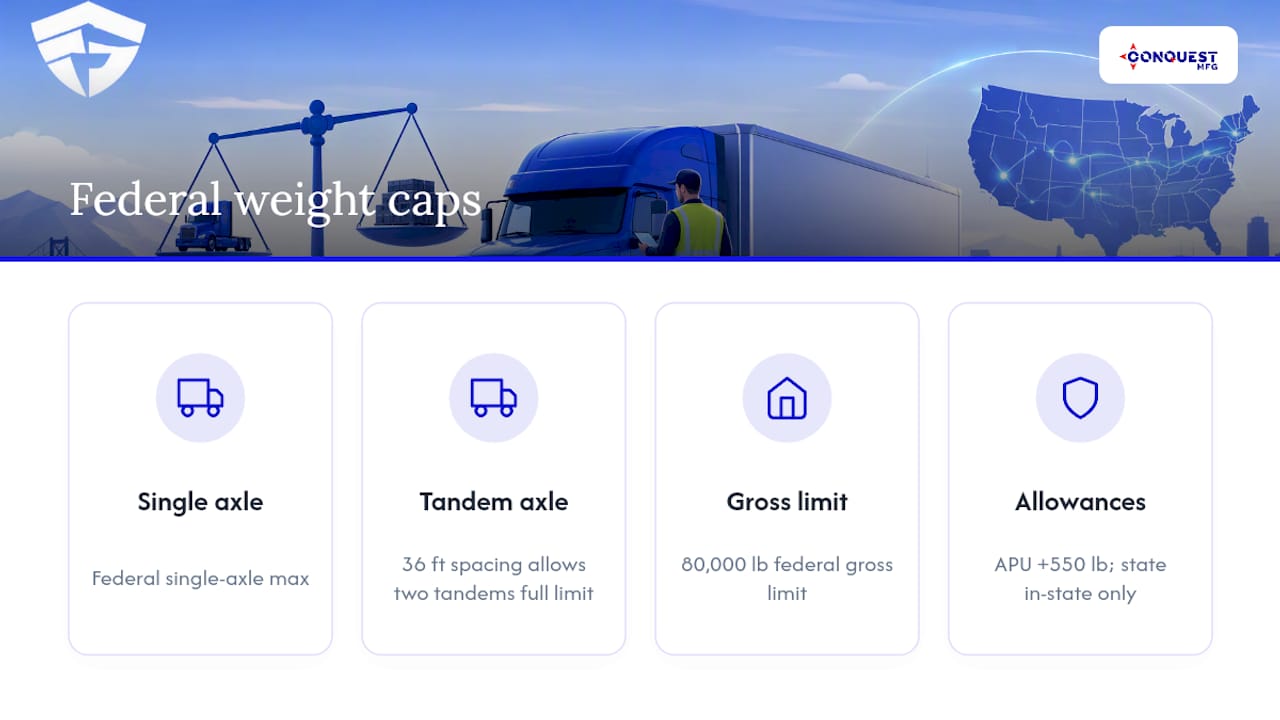
A couple of smaller allowances round out the picture. Auxiliary power units and idle-reduction technology qualify for up to 550 extra pounds beyond the gross cap, provided the added weight is documented. Separately, some states retain “grandfathered” weight allowances predating the federal formula, which only apply within that state’s own highway network, not universally across the Interstate system.
How to Check Your Truck for Bridge Formula Compliance
A five-minute check at the yard beats a citation and a delay at the scale house. Run through this sequence before dispatch:
- Pull certified scale tickets confirming gross weight, each single axle, and each tandem group.
- Measure the outer-axle spacing (L) for every candidate group, especially the 1–3, 1–5, and 2–5 combinations that span across the tractor and trailer.
- Run each group through the formula or the FHWA calculator, then compare the calculated allowable W against your actual scaled weight for that group.
- Flag anything under 12 inches short of compliance for immediate correction rather than hoping it slides at the scale.
- If a group fails, offload part of the freight, shift the load rearward or forward, slide an adjustable tandem within its legal range, or secure an overweight permit for the specific route before you leave the yard.
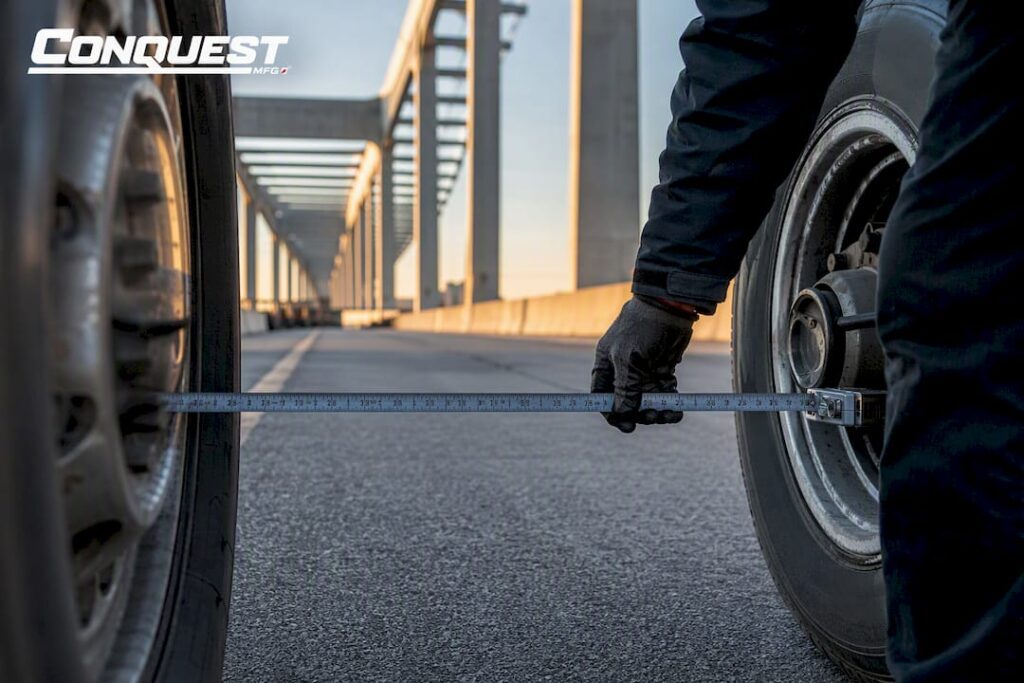
Pro Tip: If you’re running sliding tandems to hit a compliant spacing, take a photo of the slider position next to a tape measure before you leave the yard. Enforcement officers generally accept documented spacing at the time of weighing, and that photo is your proof if the slider shifts in transit.
Operators frequently discover their gross weight and both tandems check out fine, only to find the 1–5 group across the whole combination is short on spacing and does not meet Bridge Formula limits. Catching that at the yard costs you five minutes. Catching it at the scale house costs you an afternoon.
What Happens When You Get Cited for a Bridge Formula Violation
Inspectors don’t usually catch violations on the gross weight or the individual tandem groups. Those get checked at every scale, and drivers know their numbers. The inner axle-group combinations, particularly the full tractor-trailer span, are where citations pile up because they require calculation, not just a glance at the display.
A few things to keep straight:
- Enforcement can issue separate citations for single axle, tandem axle, gross weight, and Bridge Formula violations on the same stop, even if only one number is out of line.
- Consequences range from fines to being sidelined at the scale until the load is corrected, which turns a paperwork issue into a lost delivery window.
- Bring your scale tickets and load manifest to any roadside stop. Documentation showing you weighed and calculated before dispatch can support your case if a borderline reading gets questioned.
- The fastest remedy on the shoulder is almost always offloading a portion of the load or adjusting a sliding tandem, not arguing the math with an inspector.
Where to Find Official Bridge Formula Guidance
Skip the secondhand explainers when the numbers actually matter for a citation or a permit application. Go to the source:
- The FHWA bridge formula calculator computes allowed weight for any axle count and spacing you enter, and it matches what enforcement uses in the field.
- The Bridge Formula Weights pamphlet from the FHWA Office of Operations walks through the same worked examples used across the industry.
- 23 U.S.C. §127 and its implementing regulation at 23 C.F.R. Part 658 give you the actual legal text behind every number in this article.
- Your state DOT’s commercial vehicle page is the right stop for permit applications and any state-specific routing rules that interact with federal limits.
Planning Routes When State and Federal Limits Don’t Match
Some states allow weight combinations on their own highways that exceed what the federal formula permits on the Interstate system. These “grandfathered” allowances predate the current federal rule and stay valid only within that state’s own network, not once you cross onto an Interstate.
That mismatch changes how you plan a load:
- A load legal under a state’s grandfathered limits may need a different route, or a permit, the moment it touches Interstate pavement.
- Dispatch should confirm which roads a load will actually travel before assuming a state allowance covers the whole trip.
- When a load only works under a state exception, document that allowance and keep it in the cab in case a trooper questions a reading that looks high by federal standards.
Routing around this in advance is far cheaper than negotiating it at a scale house.
Fleet Strategies That Reduce Bridge Formula Risk
Equipment specification decisions made months before a load ever gets dispatched do more to prevent violations than any amount of roadside troubleshooting. A few moves consistently pay off:
- Spec adjustable sliding tandems on trailers so drivers can correct spacing issues without touching the freight itself.
- Consider spread-axle suspensions or an added axle on equipment that regularly hauls dense loads, since more axles or more spacing raises the allowable weight without cutting payload.
- Load dense freight to spread weight across a longer wheelbase rather than concentrating it toward one end of the trailer.
- Build a Bridge Formula check into pre-trip and load-planning routines, not just a gross-weight glance before leaving the yard.
- Keep scale tickets in the driver’s paperwork for every load that runs close to any axle group’s limit.
Pro Tip: Adding a single axle to a chronic problem trailer often does more for compliance than any load-shifting trick. It changes the N value in every group calculation that axle touches, which can raise your allowable weight by thousands of pounds without adding a pound of tare.
Specifying equipment with these features in mind from the start beats retrofitting a fleet after a string of roadside delays. Conquest Mfg’s freight equipment selection guide walks through how axle configuration choices affect compliance margins on new builds.
How Conquest Mfg Equipment Supports Bridge Formula Compliance
Trailer and chassis specifications set the ceiling on how much flexibility a driver has to correct a spacing problem in the field. Some manufacturers build dry bulk pneumatic trailers, bottom and end dump trailers, intermodal chassis, and vacuum tank trailers with axle configurations engineered for the load types they’re designed to carry, giving fleets a wider margin against inner-group violations before the truck ever leaves the yard.
A compact pre-dispatch checklist, adapted from standard equipment inspection workflows used in the industry, covers the basics every crew should run:
- Confirm the trailer’s axle spacing against its factory spec sheet, not a remembered number from a similar unit.
- Match the spec sheet to the load plan before the trailer leaves the yard, not after it’s loaded.
- Record scale tickets for gross, single, and tandem weights, and file them with the trip paperwork.
- Keep the manufacturer’s spec sheet in the cab alongside those tickets for any roadside verification.
Fleets running Conquest Mfg’s trailer fleet optimization methods build these steps into standard dispatch routines rather than treating them as an afterthought. For fleets specifying new equipment with compliance margin in mind, Conquest Mfg’s construction industry product line covers trailer and chassis configurations built around axle spacing and load-distribution needs. Vehicle configuration also matters here: this guide to specialized cargo vehicles breaks down how axle layout differs across trailer types, which is useful context before specifying a new unit.
The Bridge Formula Deserves More Attention Than It Gets
Most trucking compliance content treats the Bridge Formula as a footnote to the gross weight limit, something you glance at once and forget. That’s backwards. The gross cap and the single and tandem limits are simple enough that drivers rarely violate them by accident. The inner axle groups are where the real risk sits, precisely because checking them requires actual calculation rather than a glance at a display.
What the research here makes clear is that spec decisions matter more than roadside fixes. A trailer with adjustable tandems gives a driver options a fixed-spread trailer never will. Fleets that treat axle configuration as a compliance tool, not just a hauling capacity question, spend a lot less time sidelined at scale houses.
If there’s one habit worth building, it’s running the 1–5 group calculation on every combination before it leaves the yard, not just the individual tandem checks. That single step catches most of the violations this article describes, and it costs five minutes against an afternoon lost to a citation.
— Sam
Sources
For calculations that need to hold up at a scale house or in a permit application, rely on these directly:
- Bridge Formula Weights – FHWA Office of Operations
- Electronic Code of Federal Regulations — Title 23, Part 658