
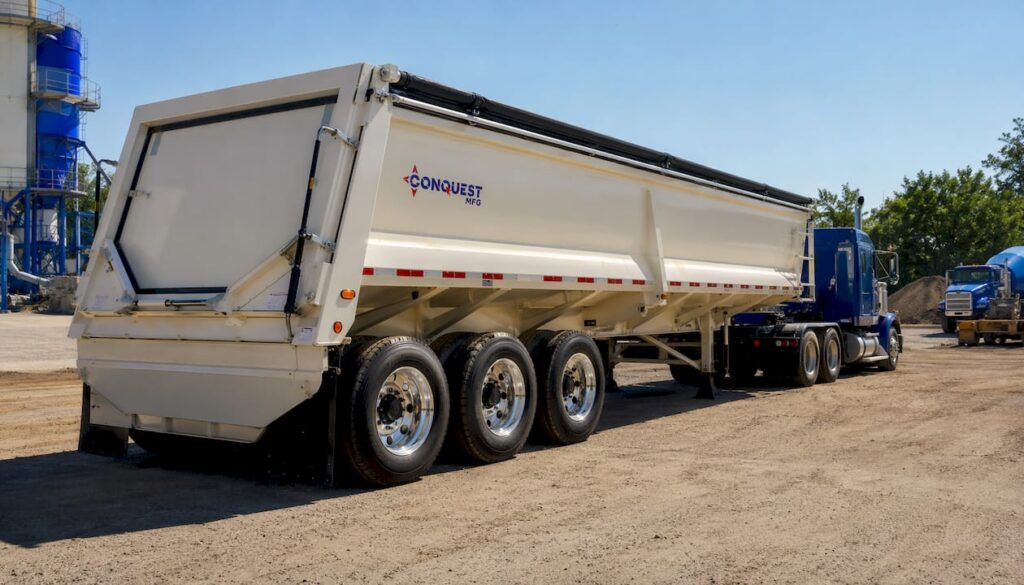
A belly dump trailer, also called a bottom dump trailer, unloads materials through a clamshell gate on the underside of the hopper rather than tipping the entire bed. That design enables windrowing and controlled spreading as the truck moves forward, making it the preferred choice for road construction, base layer distribution, and aggregate paving work across the US.
Key advantages that drive adoption on American job sites:
- Controlled unloading: The driver manages gate opening from the cab, spreading material in a continuous, even line without stopping.
- Lower tip-over risk: Because the bed never lifts, the trailer stays stable throughout the dumping process.
- Windrowing capability: Material deposits in a long, uniform row, ideal for paving crews and base-layer contractors.
- Efficiency on large sites: The truck unloads while moving, so paving machines do not wait for the load to clear.
- Material suitability: Best suited for free-flowing bulk materials like gravel, sand, road base, asphalt, and coal.
What are the standard specs and features of a belly dump trailer?
A typical 40-foot trailer carries approximately 21 cubic yards and weighs around 11,000 lbs. empty with two axles. That weight-to-capacity ratio reflects the design priority: maximize payload while keeping tare weight low for faster turnaround cycles.
| Specification | Typical Range |
|---|---|
| Length | 40–42 ft (standard); some models to 42 ft with bang boards |
| Hopper capacity | 23.5 cubic yards |
| Empty weight (2-axle) | ~11,000 lbs |
| Weight capacity | varies depending on construction material and design |
| Gate operation | Hydraulic clamshell, cab-controlled |
| Suspension options | Spring, air ride, single-point |
Common features and options include:
- Tapered hopper design: Wider at the top than the bottom, so material flows freely without bridging.
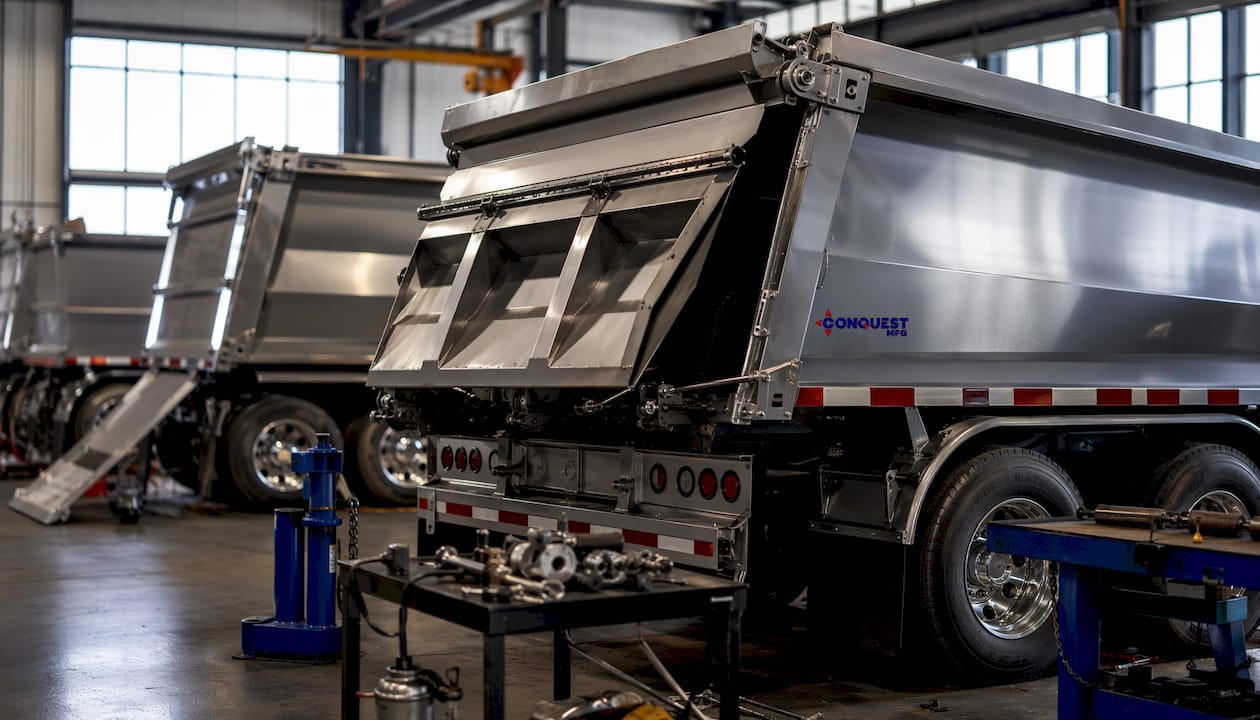
- Hydraulic clamshell gates: Hydraulic cylinders open and close the bottom doors, giving the operator precise control over discharge rate and spread width.
- Tarp systems: Manual flip tarps or electronic motorized systems cover irregular or heaped loads during transport.
- Push blocks: Bolted or welded contact points protect the frame and body when the trailer needs to be pushed free on a job site.
- Steel or aluminum construction: Steel offers durability for heavy aggregate; aluminum reduces tare weight for payload-sensitive hauls.
- Bang boards: Optional extensions that increase hopper capacity to 23.5 cubic yards on some 42-foot configurations.
Types of belly dump trailers: which configuration fits your work?
Three main configurations cover most job-site requirements, and the right one depends on how much control you need over discharge and how your site is laid out.
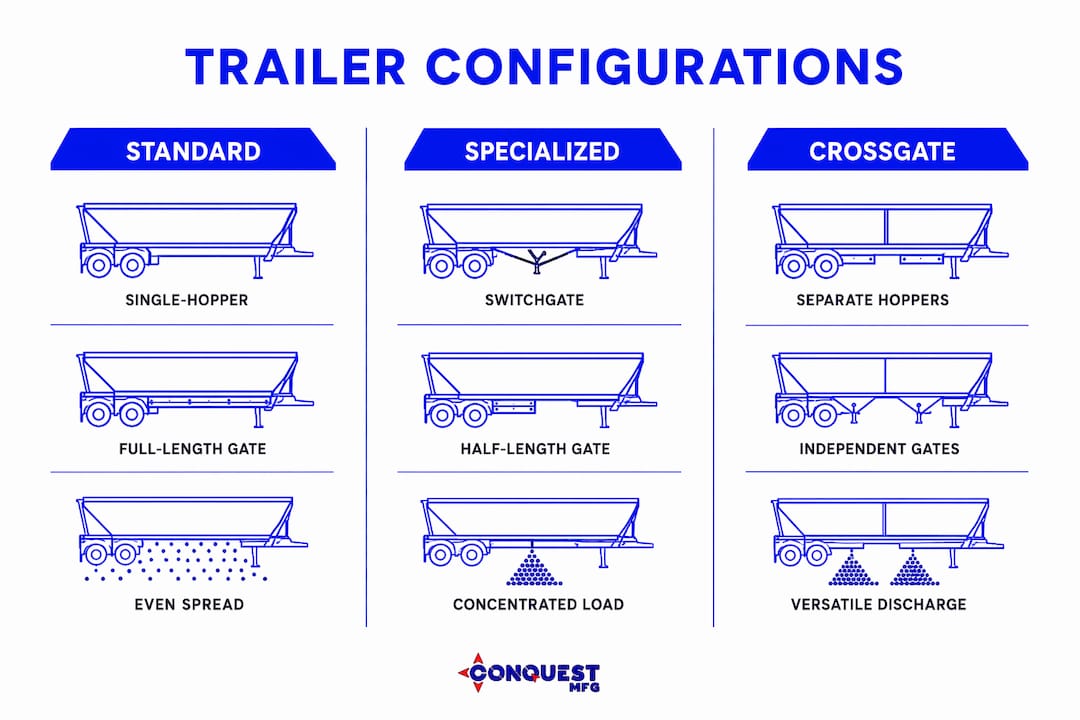
Standard single-hopper bottom dump trailers use one continuous hopper with a full-length clamshell gate. They deliver the highest volume per pass and work well for straightforward windrowing on long, flat road sections.
Switchgate trailers use a single gate that opens only half the trailer’s length at a time. That shorter opening concentrates material discharge, giving operators tighter control over spread width. It suits projects where you need a narrower windrow or want to stage material in shorter runs.
Crossgate trailers feature separate gates controlling independent hoppers. These configurations allow versatile discharge control, letting operators open one hopper while keeping the other closed. That flexibility is valuable when material placement must be staged or when different sections of a pour require different volumes.
Manufacturers including Ranco, SmithCo, and Construction Trailer Specialists each offer variations across these configurations, with differences in gate geometry, hydraulic system design, and chassis materials. Ranco’s bottom dump line, SmithCo’s side and bottom dump catalog, and Construction Trailer Specialists’ belly dump inventory are established reference points when evaluating real-world options in the US market.
How to choose the right bottom dump trailer for your hauling needs
Start with the material. Belly dump trailers perform best with free-flowing bulk materials: gravel, sand, road base, asphalt, and similar aggregates. They are not suited for liquids, very fine powders that leak through gate seals, or large, irregularly shaped material that can hang up on suspension components.
- Match capacity to payload limits: A 21-cubic-yard trailer loaded with dense aggregate can approach or exceed legal axle weight limits. Know your material’s bulk density before spec’ing capacity.
- Assess terrain: Bottom dumps excel on flat, open sites. Steep grades or tight turning radii reduce their advantage and can stress the chassis.
- Evaluate gate type: Switchgate for narrow windrows; crossgate for staged or split-hopper discharge; standard single-hopper for maximum volume and simplicity.
- Check hydraulic system compatibility: Confirm the trailer’s hydraulic requirements match the tractor’s PTO output to avoid pressure mismatches that damage cylinders.
- Factor in maintenance access: Hydraulic lines, gate hinges, and hopper liners all require periodic inspection. Trailers with accessible undercarriage designs reduce downtime.
Proper weight distribution inside the hopper is critical. Uneven loading causes bridging at the gate, strains hydraulic cylinders, and creates instability during discharge. Load evenly from the start, not as an afterthought.
Pro Tip: Train operators specifically on gate operation and loading technique before putting a new trailer into service. Consistent, even loading within the hopper prevents bridging and protects hydraulic components, directly extending trailer service life.
What does a belly dump trailer cost, and what drives the price?
Purchase prices vary widely based on configuration, materials, and manufacturer. New trailers from established US manufacturers typically run from the mid-$30,000s into the $80,000-plus range for fully optioned aluminum units with advanced tarp systems and air-ride suspension. Used trailers offer entry points well below those figures, though hydraulic system condition and gate wear require careful inspection before purchase.
Factors that move the price:
- Chassis material: Aluminum commands a premium over steel but pays back in payload capacity over time.
- Gate configuration: Crossgate and switchgate models cost more than standard single-hopper units.
- Suspension type: Air-ride suspension adds cost but reduces wear on both trailer and cargo on rough hauls.
- Tarp system: Electronic motorized tarps add convenience and compliance value but increase upfront cost.
Operational costs favor belly dump trucks on large, flat job sites. Faster unloading without stopping reduces fuel burn per cycle and cuts labor costs by eliminating manual spreading. Financing through equipment lenders and USDA-backed programs is widely available for construction hauling equipment. Insurance carriers typically classify bottom dumps as commercial semi-trailers, so fleet policies covering your tractors often extend to the trailer with a rider. Confirm coverage specifics with your broker before adding a unit to the fleet.
Safety considerations for operating belly dump trailers
Operating a bottom dump trailer safely requires more than a CDL. Drivers must hold a valid commercial driver’s license and demonstrate competence in loading technique, weight distribution, and gate operation before working independently.
Pre-trip inspection covers tire pressure, axle alignment, hydraulic fluid levels, and gate latch mechanisms. A gate that fails to close fully mid-haul creates a serious road hazard. Modern trailers increasingly integrate anti-lock braking systems (ABS) and stability control to reduce braking distance and flag load imbalance automatically.
Payload weight limits protect both the road infrastructure and the trailer itself. Overloading stresses the hopper structure and hydraulic system, and it exposes operators to federal bridge law violations under FHWA regulations. Keep loads within the manufacturer’s rated capacity and verify axle weights at certified scales when hauling dense materials. For fleet-level safety protocols, dry bulk trailer safety guidance covers inspection and load management practices directly applicable to bottom dump operations.
Industries and applications that rely on belly dump trailers
Road construction drives the largest share of bottom dump usage in the US. Paving crews depend on the windrowing capability to pre-position road base and asphalt ahead of the paving machine, keeping the machine moving without waiting for material.
Other active sectors include:
- Mining and quarry operations: Transporting bulk ore, crushed stone, and overburden across flat haul roads.
- Agriculture: Distributing fertilizers, grain, and bulk feed across large fields quickly and evenly.
- Landscaping and site development: Delivering sand, topsoil, and mulch with controlled placement.
- Infrastructure and utility projects: Spreading granular bedding material for pipeline and utility trenching backfill.
The semi-trailer’s role in construction extends well beyond simple hauling. On large highway projects, a coordinated fleet of bottom dumps can maintain continuous material flow to multiple paving machines simultaneously, compressing project timelines.
Belly dump vs. end dump vs. side dump: which trailer type fits the job?
Each trailer type solves a different problem, and choosing the wrong one costs time and money.
| Feature | Belly dump | End dump | Side dump |
|---|---|---|---|
| Unloading method | Bottom clamshell gate, material drops in a windrow | Bed lifts hydraulically, material piles at rear | Tub tilts laterally, material deposits to the side |
| Stability during dump | High, bed stays level | Lower, raised bed raises center of gravity | Moderate, lateral tilt requires level ground |
| Unloading control | High, continuous spread while moving | Low, dumps as a pile | Moderate, controlled lateral deposit |
| Best materials | Gravel, sand, road base, asphalt | Rock, demolition debris, heavy bulk loads | Aggregate, sand, some demolition material |
| Terrain suitability | Flat, open sites | Versatile, handles rough terrain better | Requires relatively level ground |
| Typical capacity | Good, limited by gate clearance | Often higher due to taller sidewalls | Comparable to belly dump |
The decision comes down to job type. Choose a bottom dump when the work demands a controlled, even spread across a long run. Choose an end dump for high-volume, heavy-material hauls where spreading is not required. Side dumps offer a middle ground for sites where lateral placement is preferred and the ground is reasonably level.
Key Takeaways
Belly dump trailers deliver the most value when controlled material spreading and job-site efficiency matter more than raw hauling volume.
| Point | Details |
|---|---|
| Core function | Clamshell bottom gate enables windrowing and controlled spreading while the truck moves. |
| Standard capacity | A typical 40-foot trailer carries approximately 21 cubic yards at roughly 11,000 lbs. empty. |
| Configuration choice | Switchgate suits narrow windrows; crossgate suits staged discharge; single-hopper suits maximum volume. |
| Safety priority | Even loading and adherence to payload limits protect hydraulic systems and prevent gate failures. |
| Best application | Road construction, aggregate paving, and large flat sites where spreading precision drives project outcomes. |
Conquest Mfg builds trailers for the demands you face
Conquest Mfg brings over 35 years of engineering expertise to bottom dumps, end dumps, sand hoppers, and the full range of construction and transportation semi-trailers. Every unit is built for reliability under real working conditions, not just spec-sheet performance.

If you are evaluating equipment for your next project, explore Conquest Mfg’s construction trailer lineup or contact the team directly to discuss your exact hauling requirements.