
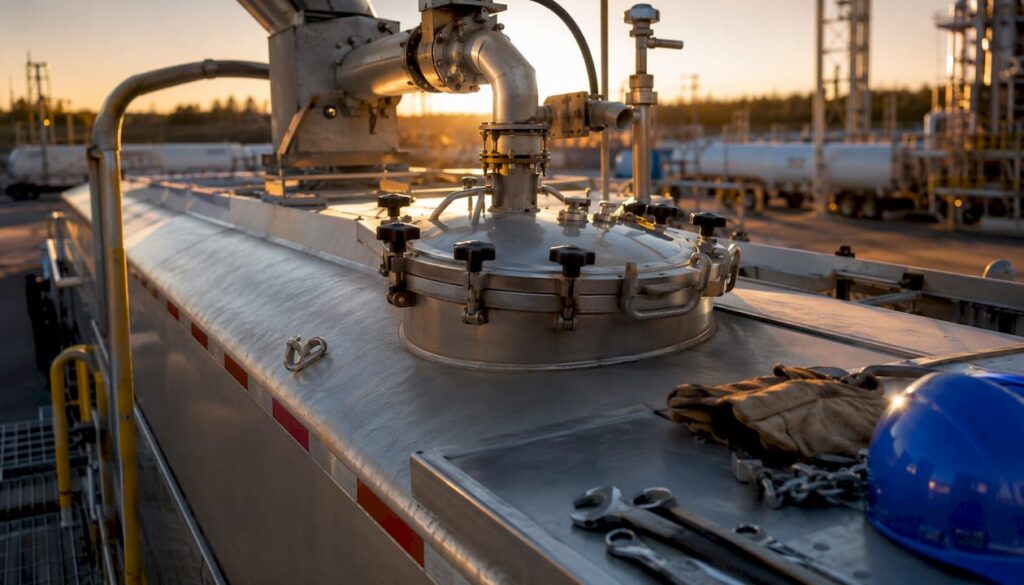
What is a storage pig trailer and why does it matter for bulk material logistics?
A storage pig trailer is a large, mobile tank trailer designed to hold bulk dry powders, such as cement, lime, and fly ash, directly at a jobsite. The industry term “PIG” refers specifically to this type of pressurized, horizontal tank trailer, which functions as a mobile silo during operations. Unlike a delivery truck that drops material and leaves, a pig trailer stays on site, giving your crew a steady, accessible supply buffer.
In terms of capacity, standard storage pig trailers measure approximately 60.5 feet long, 11 feet wide, and 13 feet tall, holding roughly 100–120 tons (4,000 cubic feet) of dry bulk material. That equates to 4–5 pneumatic trailer loads in a single stationary unit. For operations running high-volume concrete production or soil stabilization, that buffer can be the difference between a productive shift and a crew standing idle.
Key facts about storage pig trailers at a glance:
- Capacity: Approximately 100–120 tons (4,000 cubic feet) of dry bulk powder
- Typical materials stored: Cement, hydrated lime, quicklime, fly ash, bed ash, and blended powders
- Operational mode: Stationary during use; must be fully emptied before relocation
- Primary function: Onsite supply buffering to support batch plants, spreader trucks, and silos
- Setup time: Can be positioned and ready in a matter of hours
- Dimensions: Roughly the footprint of a standard tractor-trailer, making site access straightforward
Key features and structural components that make pig trailers work
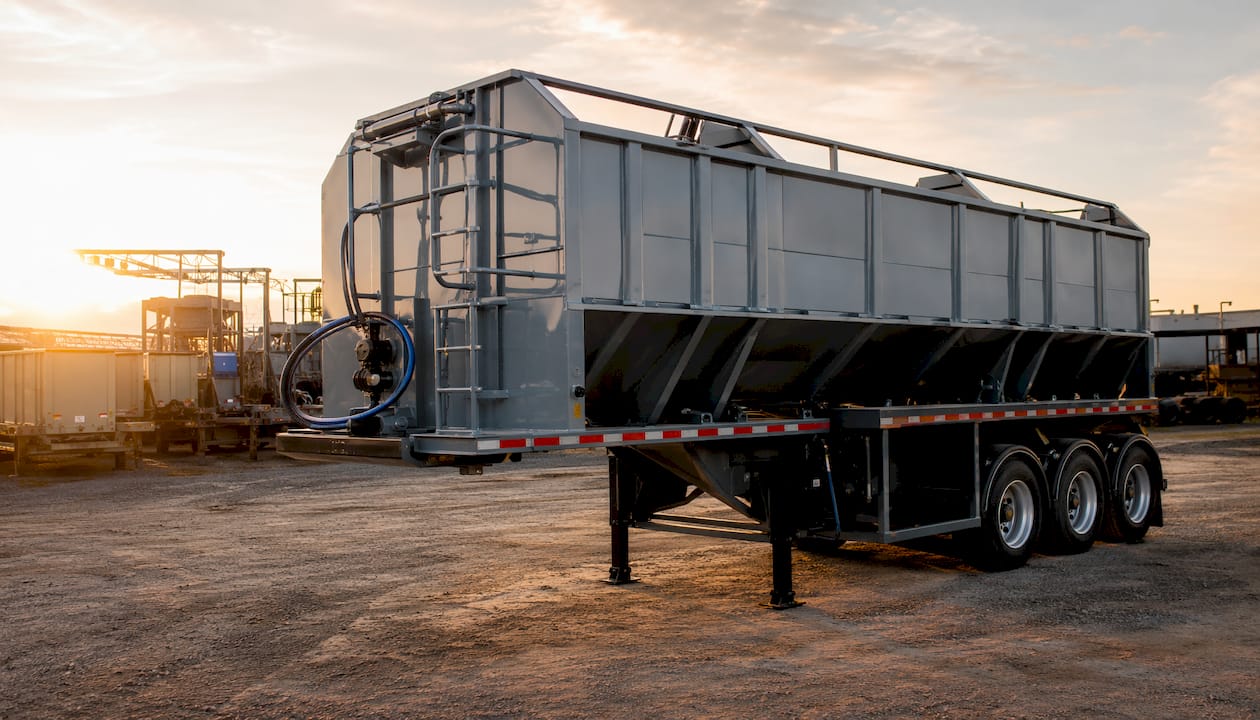
Understanding the physical design of a storage pig trailer helps you spec the right unit and avoid costly setup errors. These trailers are purpose-built for pressurized bulk powder storage, and every component serves a specific function.
Trailer frame and support structure:
- Heavy-duty steel frame sized to carry a substantial load of material
- Multiple support legs that must be fully lowered and locked before any loading begins
- Wood pads or stabilizer plates used under legs on soft or uneven ground
Blower systems and power requirements:
- Electric blowers are the standard option, requiring a 3-phase power source capable of at least 175 kW at startup and approximately 100 kW during normal operation
- Diesel blowers are available for sites without reliable grid power or generator access
- Blower packages typically include a power pack with a start button and circuit protection
Pressure systems and safety controls:
- Built-in pressure control valves to regulate tank pressure during loading and discharge
- Visible pressure gauges on both the tank line and the product delivery line
- Pressure safety valves that automatically vent if pressure exceeds safe limits
- Aeration valves to introduce air into the product for controlled flow
Internal hoppers and product flow components:
- A series of connected hoppers that allow material to accumulate during loading and discharge during transfer
- Flexible hose connections at both ends of the trailer for delivery truck hookup
- Aerators and fluidizers integrated at the hopper level to maintain consistent material movement
Dust control and environmental features:
- Vent pipes fitted with filter socks or portable baghouses to capture dust during pressurization and depressurization
- Check valves to prevent backflow through the system
- Sealed hatch covers on all access points to contain material and pressure
How storage pig trailers function in material handling operations
The operational workflow for a pig trailer loading system follows a clear sequence. Each step builds on the last, and skipping any one of them creates pressure, flow, or safety problems downstream.
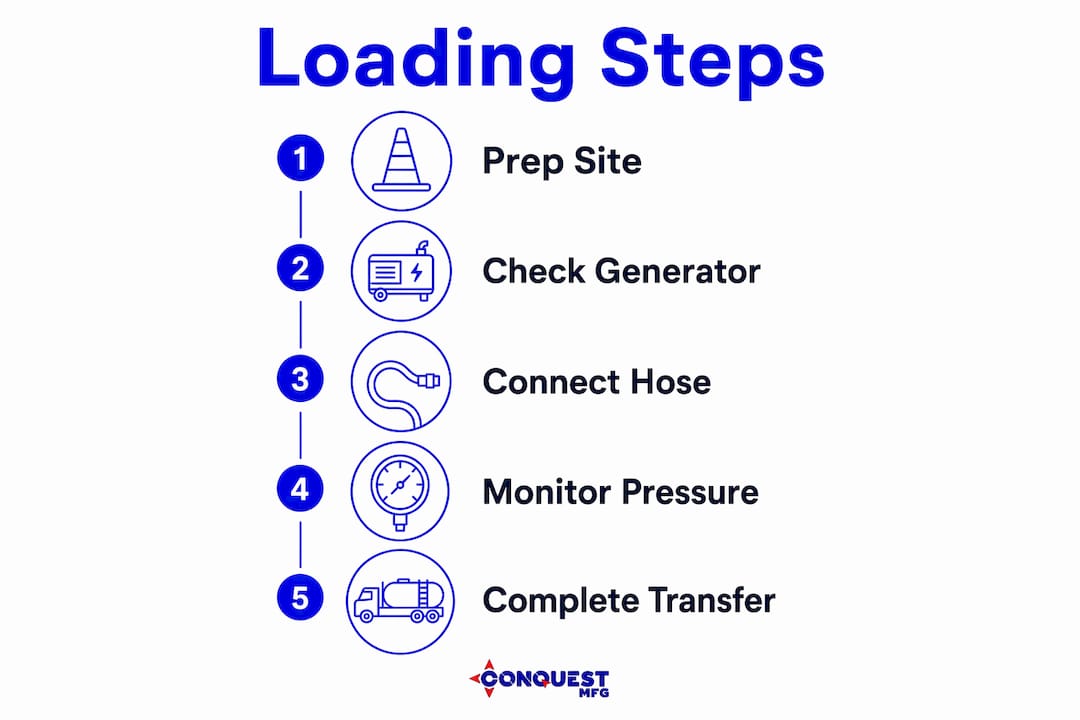
- Site placement: Position the trailer on a hard, level surface with clear access for delivery trucks. Lower all support legs completely and secure them before any material enters the tank.
- Pre-operation inspection: Check all hatches, aerator seals, pressure gauges, hoses, and valves. Clear any debris and replace damaged components before proceeding.
- Loading connection: Close all hatches and valves on the pig trailer. Connect the delivery truck to the pig trailer’s loading pipe via a flexible product hose.
- Vent pipe setup: Attach a filter medium, such as a filter sock or portable baghouse, to the vent pipe. Open the vent pipe valve to allow displaced air to escape safely during loading.
- Material transfer in: The delivery driver begins unloading product into the pig trailer. Material flows through the connected hoppers and accumulates inside the tank.
- Blower activation for discharge: When transferring material out, close all hatches and the vent pipe valve. Connect the discharge hose from the pig trailer to the spreader truck’s intake pipe. Start the generator and blower.
- Pressurization and aeration: Close the pressure control valve and open the aeration valve. Allow tank pressure to build, keeping it below 15 psi at all times.
- Controlled discharge: When tank pressure approaches 9–10 psi, slowly open the pressure control valve to half position. Gradually open the first hopper valve to begin material flow, adjusting both valves to maintain steady pressure around 10 psi.
- Stopping discharge: Close the hopper valve slowly once the spreader truck nears capacity. Keep the pressure control valve open until the product hose clears, then close it, shut off the blower, and open the vent pipe valve to depressurize the tank.
- Safe disconnection: Only disconnect product hoses after confirming zero gauge pressure. Never detach a hose from a pressurized tank.
Key benefits of using storage pig trailers in industrial settings
The core operational advantage of a pig trailer is supply continuity. Onsite stockpiling of bulk powders cushions your operation against delivery delays caused by traffic, driver availability, route issues, or weather. When a delivery truck is late, your crew keeps working.
Key benefits for logistics and operations teams:
- Reduced delivery frequency: Holding 4–5 pneumatic loads onsite means fewer truck trips and less scheduling pressure on your logistics team
- Elimination of idle crews: Material is available on demand, so workers and equipment are not waiting on the next truck to arrive
- Flexible site deployment: Mobile design allows the unit to be positioned at virtually any site with hard ground access and then relocated once empty
- Dust containment: Integrated filter media and sealed systems keep dust emissions within acceptable limits during both loading and discharge
- Extended delivery windows: With a pig trailer onsite, deliveries can happen during off-peak hours or in larger batches, reducing congestion and scheduling conflicts
- Weather independence: Onsite inventory means a rain delay or road closure does not immediately halt production
For operations running pneumatic trailer systems alongside pig trailers, the combination creates a highly resilient supply chain that absorbs disruption without stopping output.
Step-by-step guide to loading a storage pig trailer safely and efficiently
Loading a pig trailer correctly from the start prevents pressure problems, material loss, and equipment damage. The preparation phase is where most errors occur.
- Select and prepare the site: Choose a hard, mostly level surface that drains away from the trailer. Keep the area clear of pedestrian traffic and accessible for delivery trucks. If the ground is soft, place wood pads or stabilizer plates under the support legs.
- Lower and secure all support legs: All support legs must be fully lowered and locked before any material enters the tank. Failure to do so risks major structural damage as the loaded weight distributes unevenly.
- Inspect all components: Walk the trailer and confirm all hatches are closed and sealed, all valves are in the closed position, and gauges are reading zero. Replace any damaged seals, hoses, or fittings before proceeding.
- Connect the delivery truck: Attach the flexible product hose from the delivery truck to the pig trailer’s loading pipe. Confirm the connection is secure and the hose is free of kinks or damage.
- Set up the vent pipe filter: Attach a filter sock, portable baghouse, or equivalent filter medium to the vent pipe. This step is mandatory. Without it, displaced air carries dust out of the system and into the surrounding environment.
- Open the vent valve: Open the vent pipe valve to allow air to escape as material fills the tank. This prevents pressure buildup during loading.
- Begin delivery truck unloading: Signal the delivery driver to start transferring product. Monitor the process from a safe position, watching for hose movement, pressure gauge readings, and any signs of leakage.
- Monitor pressure throughout: Keep an eye on the tank pressure gauge during loading. If pressure rises unexpectedly, check that the vent valve is fully open and the filter medium is not clogged.
- Complete loading and disconnect: Once the delivery truck has finished, close the vent pipe valve and confirm all valves are secured. Disconnect the product hose only after pressure has equalized and the gauge reads zero.
Pro Tip: Before the delivery truck arrives, confirm your generator meets the 175 kW startup requirement for electric blowers. Inadequate power at startup will overheat the system and trip the breaker, delaying your entire loading operation.
Step-by-step guide to unloading material from storage pig trailers
Unloading a pig trailer requires careful pressure management. Moving too fast through valve adjustments is the most common cause of line plugging and spreader truck overfill.
- Pre-unload setup: Close and secure all hatches. Close the vent pipe valve and all valves connected to pipes used for material transfer or venting. Open the pressure control valve and close all hopper valves.
- Connect discharge hoses: Attach one end of the product delivery hose to the pig trailer’s discharge pipe and the other end to the spreader truck’s intake pipe. Confirm both connections are tight and the hose runs clear.
- Start the generator and blower: For electric blower units, plug the power cord into a suitable 3-phase generator. Start the generator, then press the start button on the blower power pack.
- Aerate and pressurize: Close the pressure control valve and open the aeration valve. Allow the tank to pressurize gradually. Do not allow pressure to exceed 15 psi at any point during the unloading process.
- Begin material flow: When tank pressure reaches 9–10 psi, slowly open the pressure control valve to half position. Then gradually open the first hopper valve. Opening too fast will plug the line.
- Regulate flow and monitor capacity: Adjust the pressure control valve and hopper valve together to maintain approximately 10 psi. Watch the spreader truck’s capacity closely. If the truck has a high-level alarm or weigh cell, use it. Overfilling the spreader truck is a serious operational hazard.
- Switch hoppers as needed: When a hopper empties, the line gauge drops first, followed by the tank gauge. When tank pressure drops to 7–8 psi, slowly close the current hopper valve and open the valve on the next full hopper.
- Stop unloading: Close the hopper valve slowly once the spreader truck is full. Keep the pressure control valve open until the product hose clears. Then close the pressure control valve and shut off the blower.
- Depressurize and disconnect: Open the vent pipe valve to release remaining tank pressure. Confirm the gauge reads zero before disconnecting any hose. Disconnecting under pressure can cause blowback severe enough to injure personnel or damage equipment.
Pro Tip: When unloading lime or cement grades that tend to pack, activate the aerator vibration function during cleanout. This loosens compacted material from hopper walls and helps you recover more product from each load.
Critical safety measures and best practices for loading and unloading
Safety in pig trailer operations comes down to a short list of non-negotiables. Each one addresses a specific failure mode that has caused equipment damage or personnel injury in real operations.
- Always use filter media on vent pipes: A filter sock or portable baghouse must be connected to the vent pipe during every loading and unloading cycle. Skipping this step releases dust into the air, creating both an environmental violation and a respiratory hazard for workers nearby.
- Never move a loaded pig trailer: Loaded pig trailers must not be relocated under any circumstances. The weight and center of gravity of a full tank create serious tipping and structural risks. The trailer stays in place until it is completely empty.
- Depressurize fully before disconnecting hoses: Confirm the pressure gauge reads zero before touching any hose connection. Blowback from a pressurized line can spray material at high velocity, causing injury or equipment damage.
- Lower all support legs before loading: Every support leg must be fully extended and secured. Partial leg deployment under a loaded tank has caused major structural failures.
- Inspect equipment before every operation: Check hoses, seals, valves, and gauges at the start of each loading or unloading cycle. Damaged components under pressure fail without warning.
- Control personnel access during pressurized operations: Keep non-essential workers away from the trailer while the blower is running and the tank is pressurized.
Pro Tip: For materials like quicklime or fine cement that tend to bridge inside hoppers, open the aerator valve briefly before starting hopper discharge. This breaks up any packed material and prevents the sudden pressure drops that signal a plugged line.
For broader dry bulk trailer safety protocols that apply across your fleet, the same core principles of pressure management and equipment inspection apply.
Common operational challenges and expert tips for storage pig trailers in the U.S. market
Operations managers running pig trailers in 2026 face a consistent set of field challenges. Knowing them in advance lets you build solutions into your site plan rather than troubleshoot them under pressure.
- Material bridging and packing: Certain lime grades and fine cement powders pack inside hoppers during storage, especially in humid conditions. Aerators and fluidizers integrated into the hopper system address this directly by introducing air through the material to restore flow. For sites handling these materials regularly, confirm the unit you rent or purchase includes active aeration at each hopper.
- Dust control compliance: U.S. Environmental Protection Agency (EPA) regulations under 40 CFR Part 60 and state-level air quality rules govern fugitive dust emissions from bulk material handling. Filter socks and portable baghouses on vent pipes are the standard compliance solution, but the filter medium must be rated for the particle size of your material. A filter sock designed for fly ash may not perform adequately for fine hydrated lime.
- Power supply planning: Electric blower packages require a generator capable of 175 kW at startup. Many sites underestimate this requirement and arrive with a generator sized only for steady-state operation. Confirm generator capacity before the trailer arrives, not after. Diesel blower options eliminate the generator dependency but require fuel management and additional operational support onsite.
- Maintenance and inspection routines: Pressure safety valves, hose fittings, and aerator seals are the components most likely to degrade with repeated use. A pre-operation inspection checklist that covers these items specifically, rather than a general walkthrough, catches problems before they become mid-shift failures.
- Site visibility and traffic management: Pig trailers occupy significant footprint on active construction sites. Proper site visibility equipment and traffic control around the trailer position reduce the risk of vehicle contact with support legs or hose connections during operations.
- Transition between hoppers during cleanout: As individual hoppers empty, operators must switch hopper valves smoothly to maintain pressure and flow. Rushing this transition causes pressure spikes or drops that plug the product line. The correct technique is to close the emptying hopper valve slowly while simultaneously opening the next one, keeping tank pressure in the 7–10 psi range throughout.
What to consider before, during, and after loading and unloading
Consistent performance across multiple loading cycles depends on structured attention at each phase of the operation, not just during the transfer itself.
Before loading or unloading
Confirm the site surface is hard and level. Soft or uneven ground under support legs creates instability as the tank fills. Verify that all required equipment is on hand: product hoses, filter media, power source, and any stabilizer pads needed for the specific ground conditions. Review the material safety data sheet for the powder being handled, particularly for reactive materials like quicklime, which require additional handling precautions.
During loading or unloading
Assign one operator to monitor pressure gauges continuously throughout the transfer. Pressure readings are your primary indicator of system health. A rising tank pressure during loading with the vent valve open signals a clogged filter medium. A dropping line pressure during discharge signals a plugged hopper or product line. Neither condition resolves itself; both require immediate intervention.
Watch the spreader truck capacity in real time during discharge. The unloading process requires active attention to the volume transferred, particularly when the truck does not have an automated high-level alarm. Overfilling a spreader truck creates a material waste problem and a potential equipment overload situation.
After loading or unloading
Once transfer is complete and the system is fully depressurized, inspect all hose connections, valve seats, and filter media before storing or repositioning equipment. Replace any filter sock that shows signs of saturation or damage. Log the volume transferred and any pressure anomalies observed during the cycle. This record supports maintenance scheduling and helps identify components approaching end of service life.
Regulatory compliance and standards for storage pig trailer operations
Pig trailer operations in the United States fall under several overlapping regulatory frameworks. Understanding which rules apply to your specific site and material keeps your operation compliant and your crew protected.
Occupational Safety and Health Administration (OSHA): OSHA 29 CFR 1910.119, the Process Safety Management standard, applies when facilities handle certain hazardous chemicals above threshold quantities. For most construction sites using cement or lime, the more directly applicable standards are 29 CFR 1926.20 (general safety and health provisions for construction) and the general duty clause, which requires employers to protect workers from recognized hazards including pressurized equipment failures and dust exposure.
EPA fugitive dust regulations: The EPA’s National Emission Standards for Hazardous Air Pollutants (NESHAP) and state implementation plans govern dust emissions from bulk material handling. Operations handling fly ash, which may contain trace heavy metals, face stricter scrutiny than those handling standard Portland cement. Filter media selection must account for the specific material’s particle size distribution and any regulated constituent content.
Department of Transportation (DOT): While pig trailers are stationary during use, they are transported on public roads between sites. DOT regulations under 49 CFR govern the transport of the empty trailer, including lighting, braking, and weight compliance. Trailers must be completely empty before road transport, consistent with the safety requirement that loaded pig trailers cannot be moved.
State and local permits: Many states require air quality permits for bulk powder handling operations above certain throughput thresholds. Some municipalities add local dust control ordinances on top of state requirements. Check with your state environmental agency and local authority having jurisdiction before setting up a pig trailer at a new site, particularly in urban or residential-adjacent locations.
Equipment standards: Pressure vessels and associated safety valves on pig trailers are typically designed and tested to American Society of Mechanical Engineers (ASME) standards. Confirm that any unit you operate carries current ASME certification for its pressure-bearing components, and that safety valves have been tested and tagged within the required inspection interval.
For operations where pig trailers feed directly into construction batch plant systems, compliance with both the trailer-level and plant-level regulatory requirements must be coordinated as a single material handling system, not managed separately.
Key Takeaways
A storage pig trailer holding 100–120 tons of bulk dry powder gives your operation the onsite supply buffer needed to keep crews and equipment productive regardless of delivery timing.
| Point | Details |
|---|---|
| Capacity and dimensions | Standard pig trailers hold 100–120 tons (around 4,000 cubic feet) across approximately 60.5 by 11 by 13 feet, equal to 4–5 pneumatic loads. |
| Power requirements | Electric blowers need a generator rated for at least 175 kW at startup; undersized power trips the breaker and halts operations. |
| Loading sequence | All support legs must be fully lowered and filter media attached to the vent pipe before any material enters the tank. |
| Pressure management | Tank pressure during discharge must stay below 15 psi; maintain approximately 10 psi for steady, controlled material flow. |
| Safety non-negotiable | Never disconnect hoses under pressure and never move a loaded pig trailer; both actions carry serious injury and equipment damage risk. |
Conquest Mfg: Built for bulk material operations
Conquest Mfg has over 35 years of engineering experience designing and manufacturing semi-trailers and bulk material handling equipment for construction, infrastructure, and industrial operations across the United States. Our portable cement pig silo trailers are built to the same performance standards that demanding jobsites require, with durability and reliability engineered into every component.
Whether your operation needs a pig trailer for a short-term project or a long-term fleet addition, Conquest Mfg delivers equipment configured for your site conditions and material requirements. Contact our team to discuss your bulk storage and transfer needs.