
Expect $12,000 to $35,000 for a used 500 bbl frac tank, well over $40,000 for a new build, and roughly $500 to $1,500 per month to rent one. Renting makes sense for a single short job; buying pays off once you need capacity across multiple projects or years. Get three quotes before committing, and confirm delivery, setup, and disposal fees separately from the base price.
TL;DR:
- Renting a 500 bbl frac tank is cost-effective for jobs under one month, with monthly rates between $500 and $1,500, but ownership is better for multi-year use.
- Used tanks cost between $12,000 and $35,000 depending on condition and fittings, while new tanks start above $40,000, with delivery and setup fees separate from the base price.
- The price of a tank depends on material grade, tank design features, coatings, and regional demand, which can increase costs significantly beyond basic capacity.
- Logistics, such as delivery distance, permits, and site access, can add hundreds or thousands of dollars to rental costs and are often overlooked in budgeting.
- A thorough inspection, including verified hydrotest certificates and physical condition checks, is essential before purchasing a used tank to avoid costly repairs or leaks.
Table of Contents
- Frac Tank Cost Breakdown: Purchase Prices vs Rental Rates
- What Drives the Price of a Frac Tank Up or Down?
- Should You Rent or Buy a Frac Tank?
- How to Inspect a Used Frac Tank Before You Buy
- Manufacturer Perspective: How Fabrication Choices Change Cost
- A Field-Tested Tip on Budgeting and Negotiation
- Get a Custom Frac Tank Quote From Conquest Mfg
- Sources
Frac Tank Cost Breakdown: Purchase Prices vs Rental Rates
Getting a straight answer on frac tank cost starts with separating three distinct markets: new builds, used inventory, and rentals. Each moves on its own logic, and mixing them up is how buyers end up with a budget that misses reality by tens of thousands of dollars.
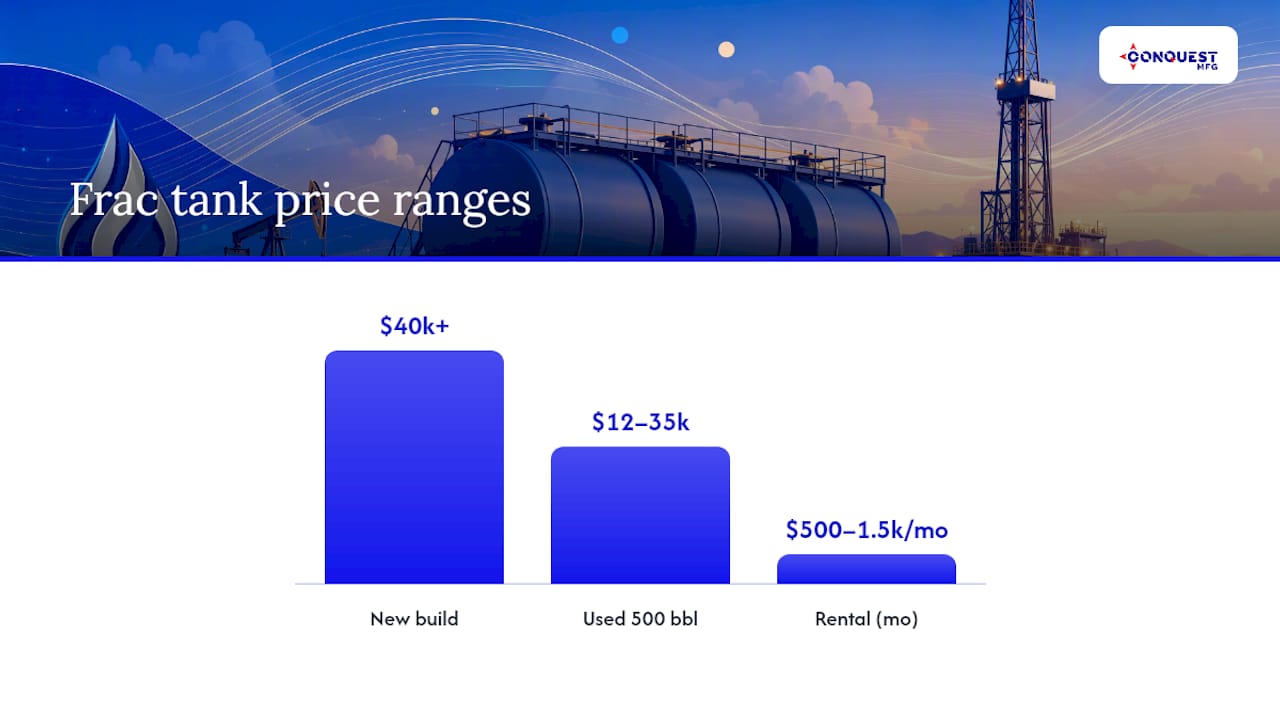
New-build 500 bbl tanks commonly start above the mid five-figure price range once you factor in steel grade, coatings, and add-on features, since custom specs and current steel pricing push list prices upward fast. Used 500 bbl units (roughly 21,000 gallons) commonly list between $12,000 and $35,000, with condition, hydrotest status, and fittings driving where a given tank lands in that range. Trailer-mounted units tend to average in the mid five figures on major equipment marketplaces, which gives buyers a useful benchmark when a private-party price seems out of line.
Rental math looks different. Standard monthly rentals for a 500 bbl tank generally run $500 to $1,500, though some regional operators advertise daily rates as low as $35 for late-model units before delivery and setup charges apply. Short-term and one-off jobs almost always favor renting; the moment a project stretches past several months, the math shifts toward ownership.
| Scenario | Typical Cost Range | Notes |
|---|---|---|
| Short job (under 30 days) | $500 to $1,500 rental + delivery | Daily rates apply for very brief use |
| Mid-term (1 month or more) | $1,500 to $6,000 total rental | Monthly rate x duration + mobilization |
| Long-term / multi-year (buy) | $12,000–$35,000 used, $40,000+ new | Breakeven often hits in 18–24 months |
Three quick scenarios illustrate this: a two-week completion job almost always costs less to rent than buy; a six-month project can go either way depending on how many tanks you need; and any operation running frac tanks continuously across multiple pads usually comes out ahead buying used, once repeated rental fees are added up.
What Drives the Price of a Frac Tank Up or Down?
Capacity is the starting point, but it’s rarely the only variable that separates a $15,000 tank from a $30,000 one. The 500 bbl (about 21,000 gallon) size is the industry reference point, and pricing scales up from there as tanks grow into 750 bbl and larger configurations built for higher-volume operations.
Material and pressure rating account for a large share of the spread between similarly sized units. A few factors that consistently move price:
- Steel gauge and grade: heavier wall thickness and higher-grade steel add material cost but extend service life.
- Vapor-tight vs open-top design: sealed, pressure-rated tanks cost more to fabricate and inspect.
- Add-on features: weir walls, side stairs, double-wall containment, and internal vacuum boxes each add to the base price.
- Coatings and linings: corrosion-resistant linings raise upfront cost but reduce maintenance later.
Logistics adds a second layer that’s easy to underestimate. Delivery distance, mobilization crews, and overweight or oversize permits can add hundreds to thousands of dollars depending on the route and state requirements. Regional demand matters too. Areas with heavy drilling activity, like the Permian Basin and Gulf Coast, routinely show higher rental and purchase pricing simply because equipment turns over faster and local supply tightens.
Should You Rent or Buy a Frac Tank?
The right call comes down to how long you’ll actually need the tank and how often you’ll need it again. Run through this checklist before requesting quotes:
- Project duration: under six months generally favors renting; longer or recurring work favors ownership.
- Frequency of use: one job a year rarely justifies purchase costs; monthly or continuous use usually does.
- Storage and yard space: owning a tank means you need somewhere to keep it between jobs.
- Maintenance capacity: buying means you own hydrotesting, cleaning, and repair responsibilities too.
The breakeven math is straightforward once you plug in real numbers. If a used tank costs $20,000 and standard rental runs $1,000 a month, payback lands around 18 to 24 months of continuous or near-continuous use. Anything shorter than that timeline, and rental almost always wins on pure cost.
A few things skew that math in either direction, so operators often consult industry advice like frac-out prevention: a field-ready guide for HDD crews to manage containment and site-specific challenges:
- Mobilization and disposal fees add up fast across repeated short rentals, sometimes eroding the savings rental appears to offer.
- Financing a purchase changes the monthly cash outlay and can make ownership viable sooner than a straight cash comparison suggests.
- Companies running a fleet across several sites often find owned tanks cheaper per unit than a company renting occasionally, since delivery costs get spread across more use.
How to Inspect a Used Frac Tank Before You Buy
A used frac tank can look fine in photos and still hide expensive problems. Before money changes hands, request documentation and walk the tank in person whenever possible.
Ask the seller for a valid hydrostatic test certificate, a strapping chart for volume verification, and a service history showing prior repairs or lining work. Missing paperwork isn’t automatically a dealbreaker, but it’s leverage to negotiate the price down.
On a physical walkthrough, check these points directly:
- Manway condition and gasket seal integrity.
- Floor pitting, corrosion, or signs of previous patch welds.
- Valve and fitting operation, including whether they turn freely without leaking.
- Interior lining condition if the tank has one.
- Axle, tire, and hitch condition on trailer-mounted units, since highway eligibility affects whether you can legally move the tank without additional repairs.
Pro Tip: Never rely on a seller’s verbal assurance about hydrotest status. Ask for the actual certificate date and pressure rating in writing before you agree to a price.
Walk away, or push hard on price, if the tank shows active leaks at seams, has no verifiable test history, or the strapping chart doesn’t match the physical dimensions you measure yourself.
Manufacturer Perspective: How Fabrication Choices Change Cost
Every dollar in a frac tank’s price traces back to a fabrication decision. Wall thickness, steel grade, interior linings, and fitting quality all move material and labor cost in predictable directions, and understanding those tradeoffs helps buyers ask sharper questions when requesting quotes.
Trailered units cost more upfront than fixed tanks because of the chassis and axle work, but they add mobility that fixed tanks can’t match. Aluminum construction cuts weight and can reduce hauling costs over the tank’s life, while steel remains the standard choice for durability under heavy industrial use. Vapor-tight designs cost more to build and certify than open-top tanks, but they’re often required for specific fluid handling.
Custom builds ordered directly from a manufacturer typically involve longer lead times than buying off a lot, but manufacturing control over specs reduces the risk of mismatched features later. Financing options are commonly available for buyers ordering custom specifications rather than paying the full amount upfront.
Key factors that shift a manufacturer quote:
- Steel gauge and certified grade
- Interior coating or lining requirements
- Number and type of fittings, valves, and access points
- Trailer chassis specs if the unit needs to move between sites
A Field-Tested Tip on Budgeting and Negotiation
The line item buyers overlook most often is logistics. Bundling delivery and return pickup into one negotiated rate, rather than paying separately for each leg, can meaningfully cut mobilization costs on any rental agreement. Always ask vendors to itemize cleaning, hydrotesting, and disposal fees before signing, since these often get buried in a lump sum. And before a tank ever leaves the yard, confirm highway eligibility and liability insurance coverage in writing. Skipping that step is how a good deal turns into an expensive delay.
— Sam
Get a Custom Frac Tank Quote From Conquest Mfg
Conquest Mfg builds an alternative to the used-tank guessing game: instead of hoping a secondhand tank’s hydrotest and linings hold up, you get a unit fabricated to your exact fluid handling, capacity, and site access requirements from the start.
As an in-house manufacturer, Conquest Mfg controls steel grade, wall thickness, lining choices, and fitting configurations on every build, which means the specs on your quote match what actually rolls off the line. To get an accurate price, have your capacity needs, expected fluid type, and site access details ready. That information determines lead time and whether standard configurations or custom features fit your budget. Financing options are available for buyers ordering custom builds rather than paying the full amount upfront. If your operation is comparing specialized oilfield trailers against another rental cycle, request a quote through the construction and oil industry equipment page and get real numbers back for your specific project.
Sources
- Fractanks
- Frac tank guide: dimensions, capacity, uses & rental cost (TankAuthority)
- Frac tank rental cost: price guide (Selector/Kurlon)
- Frac tank trailers for sale listings (Machinery Trader)