
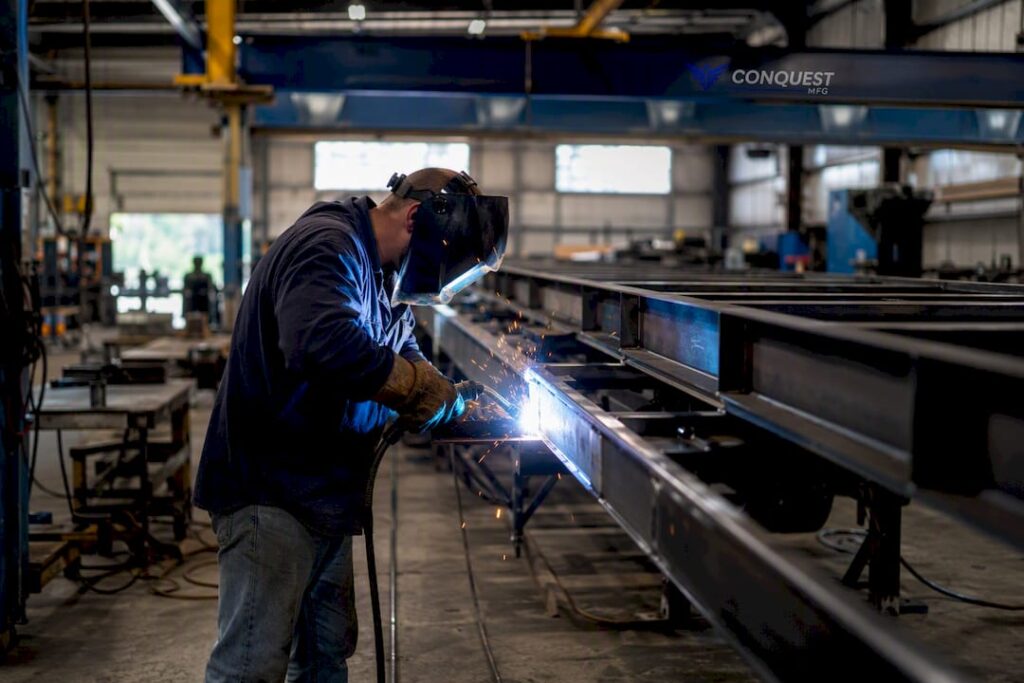
If off-the-shelf trailers force workarounds, a custom-fabricated trailer, built to your load, towing vehicle, and operating environment, is the better investment. Conquest MFG designs and delivers that solution for commercial and industrial fleets across construction, oilfield, and municipal work.
Custom trailer fabrication makes sense when:
- Your loads are nonstandard in shape, weight distribution, or handling requirements
- Crews need integrated workspaces (shelving, power, tie-downs) rather than aftermarket add-ons
- Regulatory or site-specific rules demand axle, brake, or material configurations a stock unit can’t meet
Conquest MFG backs these builds with in-house engineering and published specs, including its Half Round End Dump Trailers buyer guide, so procurement teams can benchmark requirements before requesting a quote.
Key Takeaways
Custom trailer fabrication delivers the best return when off-the-shelf units force compromises on load capacity, safety compliance, or daily workflow.
| Point | Details |
|---|---|
| Lock specs before quoting | Nail down GVWR, axle configuration, and material choice before sending an RFQ to any fabricator. |
| Match material to use case | Choose steel for high-abrasion, repair-heavy work and aluminum where payload capacity matters more. |
| Engineering happens early | Prototype sign-off, not final delivery, is when design changes are still cheap to make. |
| Standardize your RFQ | Send identical specs to every fabricator so quotes are comparable rather than guesswork. |
| Conquest MFG offers in-house builds | Conquest MFG engineers, fabricates, and tests trailers directly, with published spec guides for buyers to reference. |
Table of Contents
- What Is Custom Trailer Fabrication?
- Which Customizations and Features Do Buyers Request Most?
- Steel or Aluminum: Which Material Fits Your Application?
- How Does the Custom Trailer Fabrication Process Work?
- What Should You Include in a Trailer Fabrication RFQ?
- What Drives Cost and Lead Time on a Custom Build?
- Conquest MFG’s Track Record in Custom Trailer Manufacturing
- Why RFQ Discipline Matters More Than Vendor Comparison
- Ready to Request a Custom Trailer Quote?
- Sources
What Is Custom Trailer Fabrication?
Custom trailer fabrication is the process of designing and building a trailer from the ground up (or substantially modifying a base platform) to match a specific cargo, workflow, or regulatory need instead of adapting a stock unit after purchase. Bespoke trailer manufacturing differs from simple aftermarket customization because engineering happens before fabrication starts, not after a problem shows up in the field. That distinction matters for anyone comparing trailer fabrication services: a shop that welds on a rack after the fact is not doing the same job as one that specs the frame, axles, and skin together from day one.
Which Customizations and Features Do Buyers Request Most?
Most requests fall into a handful of functional categories, and knowing which ones apply to your operation helps you prioritize before you ever call a fabricator.
Cargo handling is usually first. Buyers ask for beavertail or dovetail ramps, hydraulic winches, and tie-down patterns spaced for specific equipment or pallet sizes. Interior and workspace features come next: shelving, cubbies, climate control, wired electrical circuits, and task lighting matter as much on a service trailer as horsepower does on a truck.
Branding and customer-facing details round out many builds, especially for mobile service and law enforcement units:
- Full graphic wraps and raised lettering for fleet visibility
- Built-in service counters or fold-down work surfaces
- Specialty mounts for vacuum tanks, pneumatic bulk systems, or surveillance towers
- Tool and equipment racks rated for the specific gear being hauled
Bulk material haulers, for instance, often need pneumatic loading systems rather than gravity dumps. Conquest MFG’s guide on why pneumatic trailers win at industrial material handling breaks down when that system outperforms a standard dump configuration.
Steel or Aluminum: Which Material Fits Your Application?
Material choice drives weight, corrosion resistance, repairability, and lifecycle cost, and picking wrong is one of the more expensive mistakes a buyer can make. Steel frames handle high-stress, high-abrasion work (oilfield, aggregate hauling) well and are typically cheaper to repair in the field. Aluminum cuts weight, which raises usable payload under a fixed gross vehicle weight rating, but it costs more upfront and requires different welding expertise.
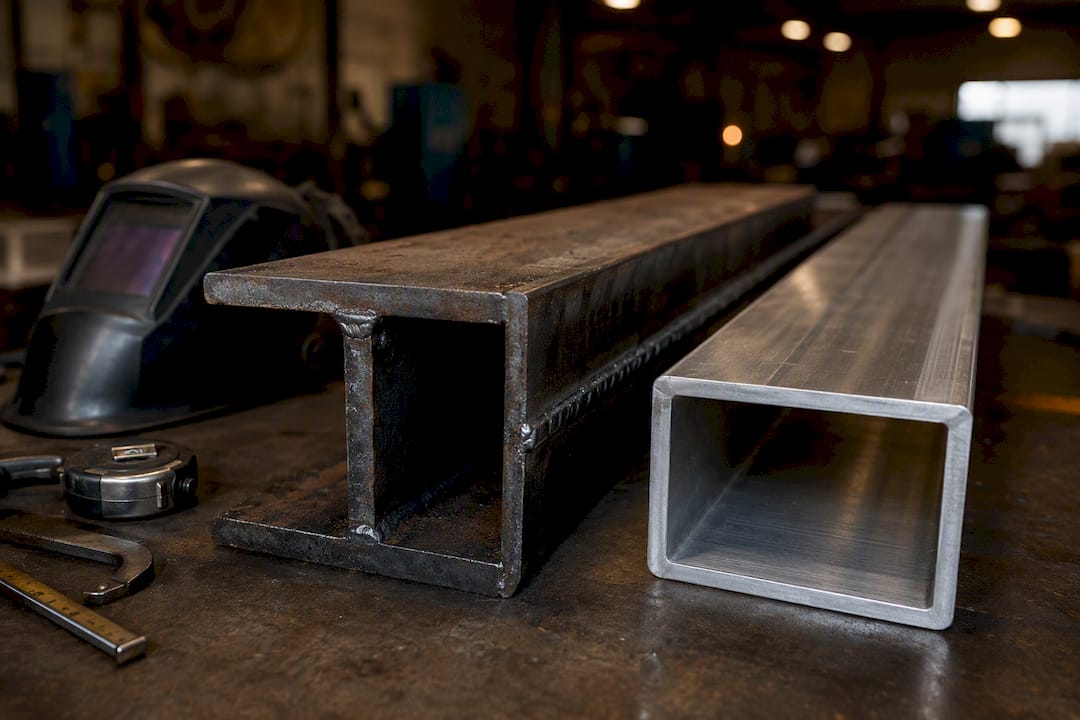
Frame and crossmember spacing need to match the load profile, not a generic template, a principle discussed in detail in why choose made-in-USA fabrication for your business. Certified welders and documented weld procedures aren’t optional details. Axle and brake sizing has to be matched to GVWR and expected payload, and getting that wrong creates both a safety liability and a compliance problem down the road. The National Association of Trailer Dealers (NATDA) publishes guidance that manufacturers and dealers use to stay current on brake, lighting, and GVWR standards, and it’s worth checking before you finalize a spec.
Pro Tip: Ask any fabricator whether they offer third-party load testing or engineering certification on custom axle configurations. If they hesitate, that’s a signal to keep looking.
For trailers where GVWR-to-axle pairing gets complicated, Conquest MFG’s Half Round End Dump Trailers: 2026 Specs and Buyer Guide lays out recommended pairings by trailer class.
How Does the Custom Trailer Fabrication Process Work?
A structured build moves through five stages, and knowing them in advance helps you plan internal approvals and avoid schedule surprises.
- Scoping and RFQ intake. The fabricator collects load dimensions, gross weight, towing vehicle specs, and use frequency to draft an initial design.
- Engineering and CAD. This is where axle placement, frame geometry, and material choice get locked in, and where most cost decisions actually happen.
- Prototype sign-off. You review drawings or a mockup before steel gets cut. Changes here are cheap; changes after fabrication starts are not.
- Fabrication milestones. Frame construction, decking, systems integration (electrical, hydraulic, pneumatic), and finish work proceed in sequence, often with buyer check-ins at each stage.
- QA, testing, and delivery. Load testing, paperwork, and final inspection happen before the unit ships or gets installed on-site.
Buyers who stay engaged during the engineering phase, not just at delivery, consistently get builds that need fewer post-delivery adjustments.
What Should You Include in a Trailer Fabrication RFQ?
An incomplete RFQ is the single biggest cause of quote delays and mismatched bids. Give every fabricator the same core inputs and you’ll get quotes you can actually compare.
Essential specs to include:
- Cargo envelope (length, width, height) and maximum single-item weight
- Towing vehicle make, model, and tow rating
- Intended terrain, route conditions, and expected use frequency
High-impact optional details:
- Electrical loads (lighting, outlets, climate control circuits)
- HVAC requirements for enclosed workspaces
- Tie-down spacing and security or lock requirements
Attach photos of comparable equipment, any CAD drawings you already have, inspection requirements, and any certifications your industry mandates.
Pro Tip: Send the same RFQ document to every fabricator you’re evaluating, word for word. It’s the only way to know whether a lower bid reflects efficiency or a missing line item.
What Drives Cost and Lead Time on a Custom Build?
Material and component choices set the floor. Aluminum, heavy-duty axles, and specialty welds all add cost over a standard steel configuration. Complexity adds more on top of that: unique frame geometry, multiple system integrations (electrical plus pneumatic plus hydraulic, for example), and required regulatory testing all extend both price and schedule.
Vendor pages across the industry generally agree that small cosmetic customizations barely move the needle, while structural changes like added width or upgraded axles materially raise price and lead time. You can shorten your timeline in a few ways:
- Start from a proven base model instead of a from-scratch design
- Rank your must-have features and treat the rest as phase-two additions
- Accept a realistic delivery window rather than compressing engineering time
Fabricators who work from established platforms, a practice Felling Trailers documents across its municipal and construction builds, tend to deliver customized function faster than shops building pure one-offs.
Conquest MFG’s Track Record in Custom Trailer Manufacturing
Conquest MFG’s product line spans the range most commercial and industrial buyers need:
- Semi trailers engineered for construction hauling and heavy equipment transport
- Pneumatic and dry bulk trailers for material handling operations
- Steel and aluminum vacuum tanks for septic, industrial, and oilfield service
- Portable surveillance towers for construction sites and security deployments
Custom mounting, decking layout, and tie-down placement, when engineered correctly, directly improve site cycle times rather than just adding convenience features.
That principle plays out in Conquest MFG’s own case documentation. The Role of Semi Trailers in Construction Projects walks through real deployment examples, and the Half Round End Dump buyer guide gives the technical specs behind those decisions. Sam, who covers trailer engineering and buyer guidance for Conquest MFG, points readers to those two resources for the deepest technical detail available on current builds.
Why RFQ Discipline Matters More Than Vendor Comparison
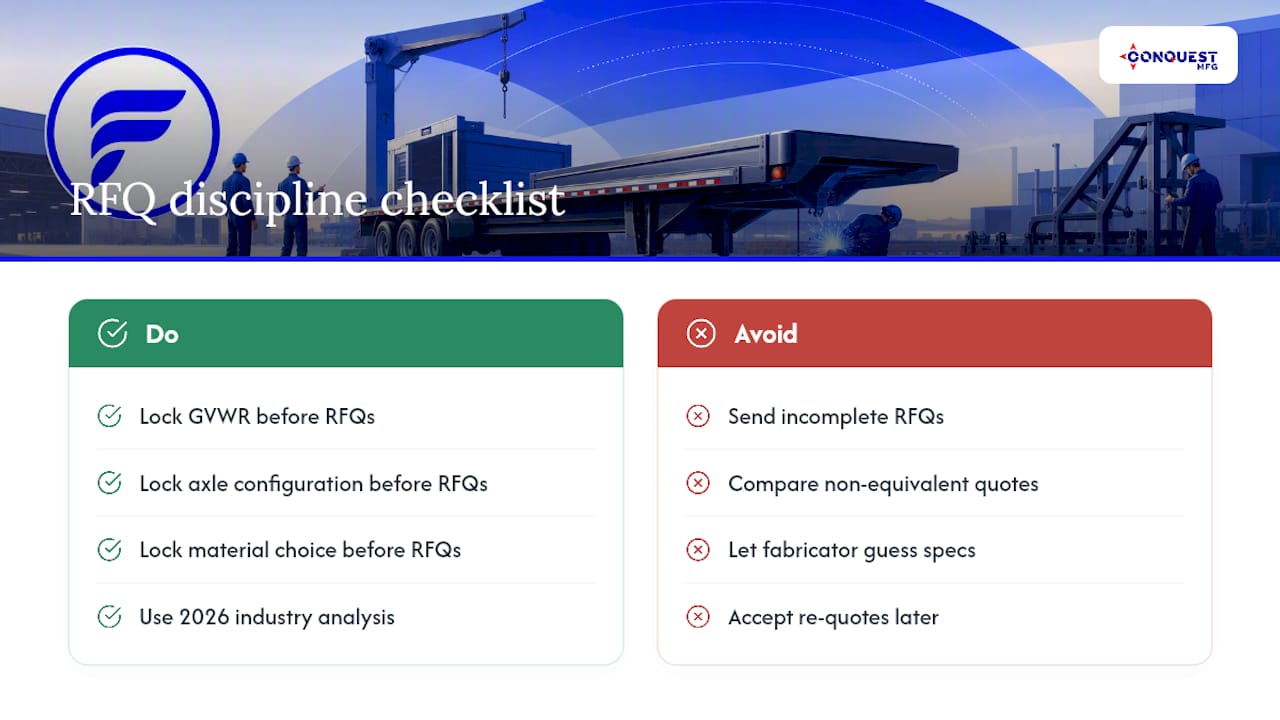
Most buyer guides spend their energy comparing fabricators feature by feature. That misses the actual point of failure. The gap that sinks most custom trailer projects isn’t a bad vendor choice, it’s an incomplete RFQ that forces a fabricator to guess at load specs, then re-quote three weeks later when the guess turns out wrong.
The conventional advice tells buyers to “get multiple quotes and compare.” Fine advice, but useless if the underlying spec varies from one RFQ to the next. Two fabricators pricing two different mental models of your project will never give you comparable numbers, no matter how detailed either quote looks on paper.
What actually works: lock your GVWR, axle configuration, and material choice before you request a single quote. Treat the Future of Industrial Trailers 2026 analysis as a planning input, not just background reading, since materials and electrical integration trends shift what “standard” even means year to year. Buyers who show up with locked specs get faster, more accurate quotes and fewer change orders once fabrication starts. That’s the leverage point, not vendor selection.
Ready to Request a Custom Trailer Quote?
Conquest MFG designs and builds every trailer in-house, which means the same engineers who draft your CAD drawings sign off on your load testing. No subcontracted fabrication, no guesswork about who actually built the axle mounts under your unit.
When you’re ready to request a quote, include your cargo envelope, towing vehicle specs, expected payload, and any regulatory requirements specific to your industry. Conquest MFG serves construction, oilfield, and industrial fleets directly. Start your project on the construction industry solutions page, and a Conquest engineer will follow up to confirm feasibility before you commit to a full spec review.
Sources
- National Association of Trailer Dealers (NATDA)