
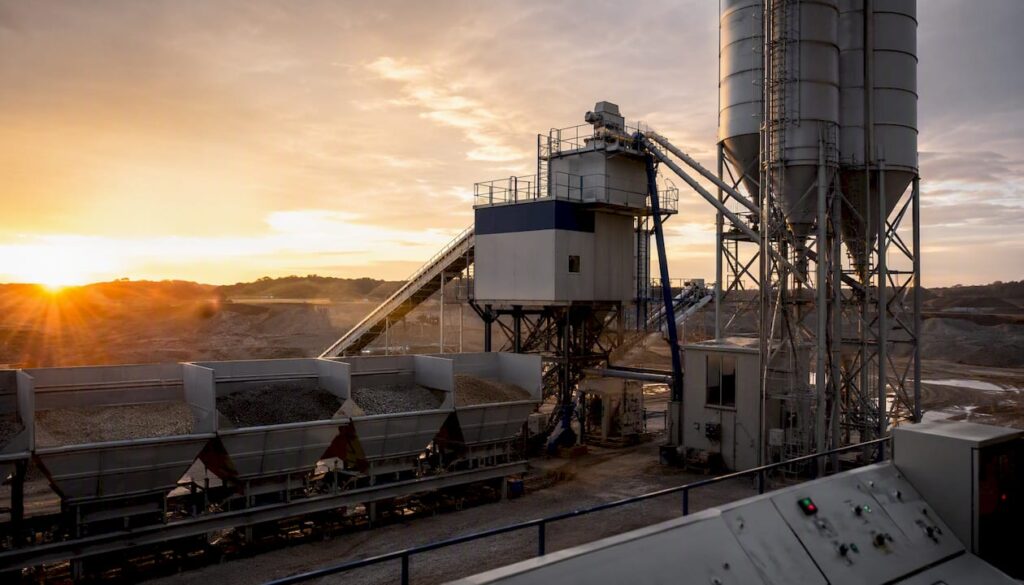
A new concrete batch plant in the U.S. costs anywhere from $80,000 for a small portable dry-batch unit to well over $2.5 million for a high-capacity automated wet-batch plant, equipment only. Installed project budgets once you add civil work, silos, controls, and commissioning typically run $1.2 million to $6.5 million for full-scale ready-mix operations. Used units can cut that entry price significantly, but the total cost of ownership depends heavily on what’s included.
Quick cost anchors:
- Small used portable dry-batch unit: $30,000–$60,000 (equipment only, often missing silos or modern controls)
- New small portable dry-batch unit: typically costing a moderate amount for equipment only
- Mid-range new stationary plant: costs can vary widely depending on capacity and features
- High-capacity automated wet-batch plant: $2.5 million+ (equipment only); $4 million–$6.5 million installed
Verdict: Buying makes financial sense when your annual concrete demand exceeds roughly 20,000–30,000 cubic yards and you have a stable project pipeline. Below that threshold, leasing a portable unit or sourcing from a ready-mix supplier often delivers a better return on capital.
Pro Tip: Always request a quote for the fully installed cost, not just the equipment price. The gap between the two is frequently 30–50% of the equipment-only figure, and that gap is where most first-time buyers get surprised.
Key Takeaways
| Point | Details |
|---|---|
| Equipment-only price range | New plants run $80,000–$2.5M+; used units typically sell 30–60% below equivalent new prices. |
| Biggest hidden cost | Silos, controls, civil work, and permitting add 30–50% above the equipment-only quote on stationary plants. |
| OpEx structure | Raw materials (primarily cement) represent 70–80% of operating costs; lock in supplier pricing early. |
| Order-to-first-pour timeline | Budget several months from order to first production, permitting is the most common schedule risk. |
| Conquest Mfg | Manufactures custom stationary dry-batch and mobile/portable plants; request a quote with your capacity target and site details. |
Table of Contents
- How plant type and capacity drive your concrete batch plant cost
- Breaking down the CapEx line items for a U.S. batch plant purchase
- What operating costs actually look like for a batch plant
- Used vs. new: where to find plants and what to inspect
- Site preparation, permitting, and hidden costs in the U.S.
- Financing options, tax treatment, and a sample ROI calculation
- Your budgeting checklist and worksheet for a concrete plant purchase
- How Conquest Mfg’s plant lineup maps to these cost ranges
- What buyers consistently get wrong about batch plant costs
- Get a tailored quote from Conquest Mfg
- Sources
How plant type and capacity drive your concrete batch plant cost
The two biggest price levers are plant type (dry-batch vs. wet-batch) and production capacity. Getting these two variables right before you talk to any vendor will save you from over-specifying or under-building.
Dry-batch vs. wet-batch (central mix)
A dry-batch plant weighs and loads cement, aggregates, and water into a transit mixer truck separately. The truck drum does the mixing in transit. These plants are simpler, less expensive to build, and easier to relocate. A wet-batch (central mix) plant mixes all ingredients in a stationary mixer before loading, producing a more consistent product. That mixer, whether a pan mixer, twin-shaft, or drum type, adds $40,000–$250,000 or more to the equipment cost depending on size and configuration. For most highway and infrastructure contractors, the consistency premium of wet-batch is worth it. For residential and light commercial work, dry-batch is typically sufficient.
Stationary vs. mobile/portable
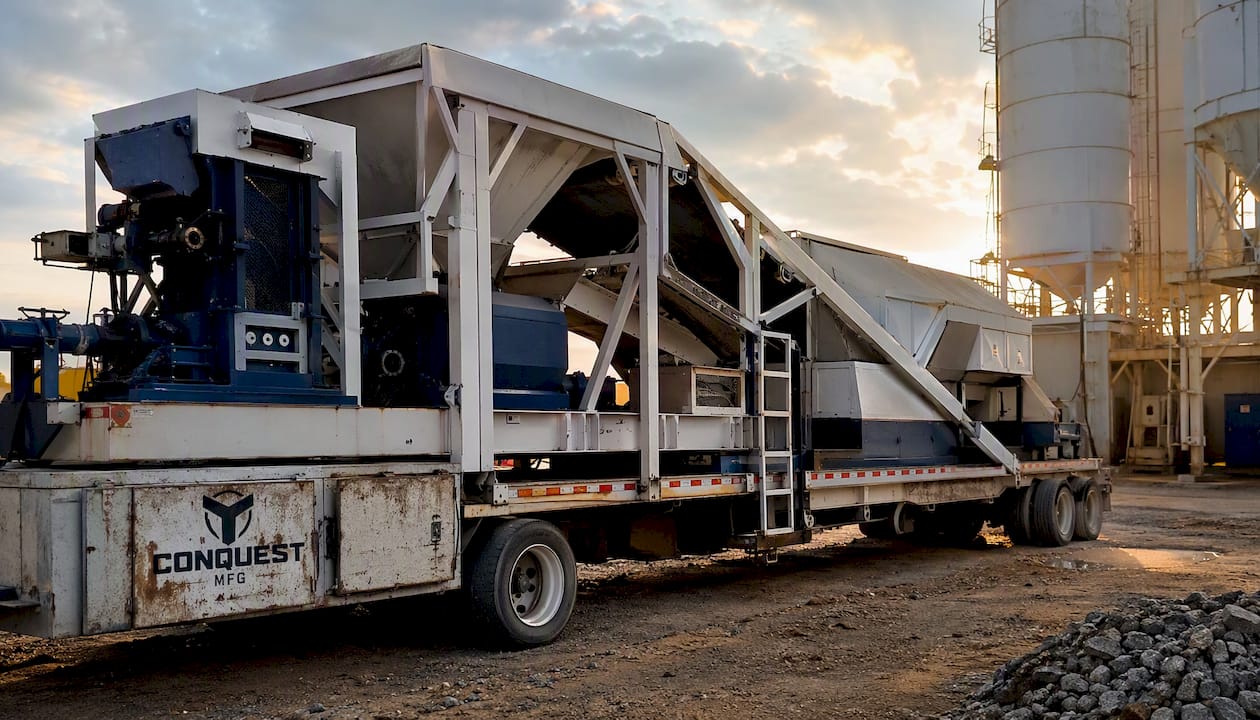
Stationary plants are permanent or semi-permanent installations on a prepared pad. They support higher throughput, larger silo capacity, and more sophisticated controls, but they require significant civil work and permitting. Mobile and portable plants mount on trailers or skids, reducing site prep costs to $5,000–$20,000 versus $30,000–$150,000 for stationary setups. The stationary vs. mobile trade-off comes down to whether your production location is fixed for three or more years.
Capacity bands and typical price ranges
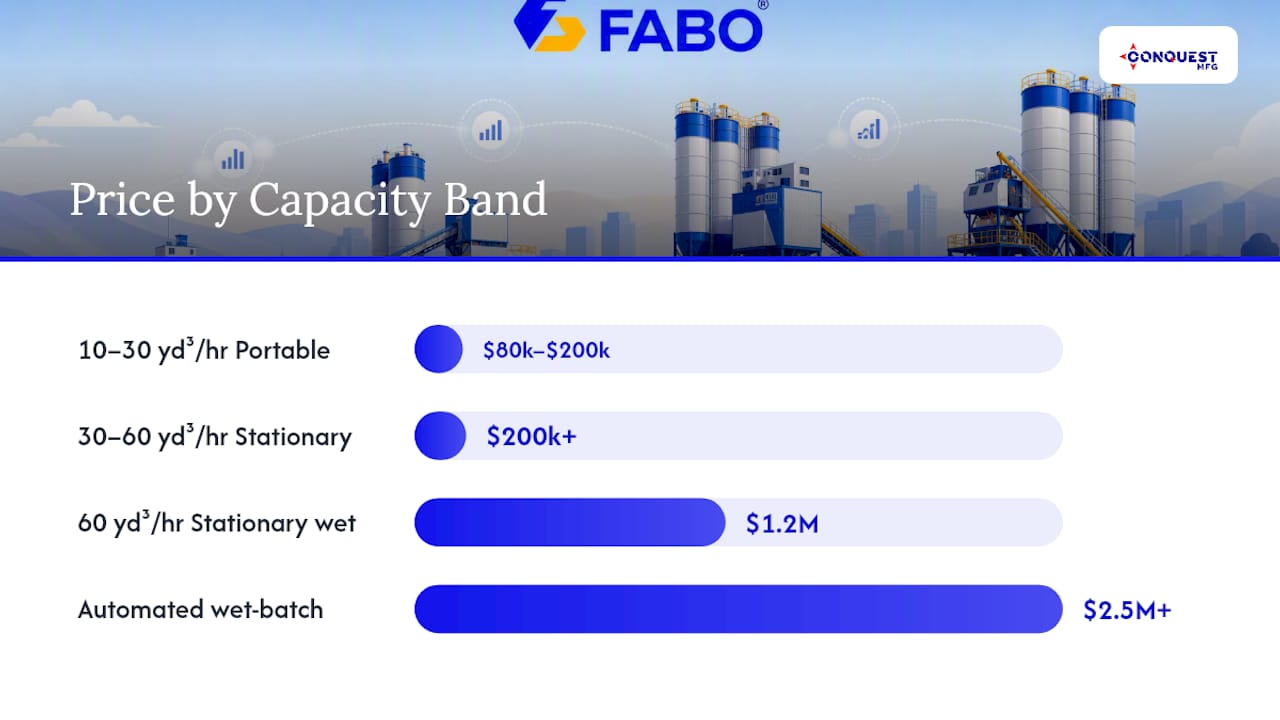
| Capacity Band | Plant Type | Typical Equipment-Only Price Range |
|---|---|---|
| 10–30 yd³/hr | Portable dry-batch | $80,000–$200,000 (new) |
| 30–60 yd³/hr | Stationary dry-batch | $200,000+ (new) |
| 60 yd³/hr | Stationary wet-batch | $1.2 million (new) |
| — | Automated wet-batch | $2.5 million+ (new) |
Automation level, silo count, and aggregate bin configuration each add cost on top of these ranges. A second cement silo, for example, runs $40,000–$80,000 for a 500-bbl stationary unit. A full batch controller and SCADA-level control system upgrade adds another $30,000–$100,000. These are not optional line items on a production plant; they are operational necessities that belong in your budget from day one.
Breaking down the CapEx line items for a U.S. batch plant purchase
Understanding the full CapEx picture before you request quotes prevents the most common budgeting error: treating the equipment price as the project cost. For a mid-range stationary dry-batch plant at 60 yd³/hr, the installed budget typically runs 40–60% above the equipment-only price.
Price ranges above reflect current U.S. market pricing for new equipment. Used units shift the batching unit and mixer lines down by 30–60%, but often require a controls upgrade ($30,000–$100,000) and may arrive without silos, which adds back $25,000–$160,000 depending on configuration.
Pro Tip: When reviewing vendor quotes, confirm in writing whether the price includes silos, the control system, electrical panels, and commissioning labor. These four items are the most frequently excluded from “equipment price” quotes and collectively represent $80,000–$350,000 in additional spend.
What operating costs actually look like for a batch plant
Capital cost gets most of the attention, but OpEx determines whether the plant pays for itself. Raw materials dominate the operating cost structure, typically accounting for 70–80% of total OpEx, with cement being the largest single input. Utilities run a moderate share of operating expenses. Labor, maintenance, and overhead fill the remainder.
Per-yard cost sample calculation
For a 60 yd³/hr stationary plant producing 40,000 cubic yards per year at 65% utilization:
- Cement and raw materials: $85–$110 per yard (varies by mix design and regional pricing)
- Labor (plant operator + loader operator): $8–$14 per yard
- Utilities (power, water): $3–$6 per yard
- Maintenance and wear parts: $2–$5 per yard
- Overhead and insurance: $2–$4 per yard
- Total estimated OpEx per yard: $100–$139
At a typical ready-mix sale price of $150–$200 per yard in most U.S. markets, that leaves a gross margin of $11–$100 per yard before debt service on the plant. Locking in long-term supplier pricing on cement is one of the fastest levers to stabilize that margin. For a more precise aggregate and material quantity estimate tied to your specific mix designs, a material calculator helps build the per-yard inputs before you finalize your OpEx model.
Annual recurring budget items to plan for include conveyor belt replacement (every 2–4 years, $3,000–$12,000 per belt), wear liner replacement in mixers and bins (annually, $5,000–$25,000 depending on throughput), and batch controller software support contracts ($2,000–$8,000 per year). Higher automation reduces labor cost per yard but adds software maintenance overhead. Complex mix designs with admixtures or supplementary cementitious materials also increase per-yard OpEx through additional weighing systems and storage requirements.
Tracking plant efficiency metrics from the first month of operation gives you the baseline data to identify where OpEx is running above target and where maintenance investment pays back fastest.
Used vs. new: where to find plants and what to inspect
Used concrete plants on platforms like IronPlanet typically sell for 30–60% less than equivalent new units, but that range is wide because condition, included accessories, and controls generation vary enormously. A 10-year-old portable dry-batch unit with original pneumatic controls and no silos at $45,000 is not the same value proposition as a 5-year-old stationary plant with a modern PLC controller and two silos at $280,000.
Used-plant buying checklist:
- Service and maintenance records: Confirm hours of operation, mixer drum wear, and conveyor history. No records is a red flag.
- Control system generation: Older relay-logic or DOS-based controllers may have no vendor support. Budget $30,000–$100,000 for a modern PLC upgrade if needed.
- Silo inventory: Confirm whether silos are included, their capacity in barrels, and whether they are portable or require a crane for relocation.
- Wear parts condition: Inspect mixer blades, liner plates, conveyor belts, and aggregate bin liners in person or via third-party inspection.
- Transportability: For portable units, verify axle ratings, DOT compliance, and whether the unit has been moved recently.
- Calibration records: Batch accuracy depends on load cell and scale calibration. Request the last calibration certificate.
- Parts availability: Confirm the OEM still supports the model with replacement parts. Orphaned equipment can strand your operation.
MachineryTrader lists dozens of portable plant listings at any given time and is useful for benchmarking asking prices before you negotiate. Cross-referencing listings across IronPlanet and MachineryTrader gives you a realistic market range for any capacity class you are targeting.
Site preparation, permitting, and hidden costs in the U.S.
Site readiness is where budgets most often go wrong. Buyers focus on the equipment price and treat everything else as a rounding error. In practice, installation and civil works add $30,000–$150,000 for stationary plants and $5,000–$20,000 for portable setups, depending on site conditions.
Site prep line items
- Concrete pad and foundation: $15,000–$60,000 depending on slab thickness, soil bearing capacity, and plant weight
- Grading and drainage: $5,000–$25,000; poor drainage causes aggregate contamination and equipment corrosion
- Aggregate storage pads: $8,000–$30,000 for compacted stone or concrete pads
- Electrical service upgrade: $10,000–$50,000 if the site lacks three-phase power at adequate amperage
- Water supply and washout pit: $5,000–$20,000 depending on municipal connection vs. well
Permitting checklist and typical costs
U.S. permitting requirements vary by state and county, but most stationary plant installations require:
- Local zoning and land use approval: $500–$5,000; lead time 4–12 weeks
- Air quality permit (dust control, cement handling): $2,000–$15,000; lead time 8–24 weeks in many states; California, Texas, and the Northeast tend toward the higher end
- Stormwater permit (NPDES or state equivalent): $1,000–$5,000 with a Stormwater Pollution Prevention Plan (SWPPP)
- Building permit for structures: $1,000–$8,000 depending on jurisdiction
Order-to-first-pour timeline
| Milestone | Typical Duration |
|---|---|
| Vendor quote and specification finalization | 2–4 weeks |
| Equipment lead time (manufacturing) | 8–20 weeks |
| Permitting (air, zoning, building) | 8–24 weeks (run parallel to manufacturing) |
| Civil / site work | 4–8 weeks |
| Equipment delivery and installation | 2–4 weeks |
| Commissioning and calibration | 1–2 weeks |
| Total: order to first pour | Several months |
Running permitting parallel to manufacturing lead time is the most reliable way to compress this schedule. Buyers who wait for equipment delivery before starting permit applications routinely add 3–6 months to their timeline.
Financing options, tax treatment, and a sample ROI calculation
Most U.S. construction businesses finance batch plant purchases through one of four channels: conventional bank term loans, equipment finance companies, equipment leasing, or vendor financing programs. Each has a different impact on cash flow and tax treatment.
- Bank term loans: Typically 5–7 year terms at current commercial rates; require strong financials and collateral. Best for established contractors with existing banking relationships.
- Equipment finance companies: Faster approval than banks, often 3–7 year terms, with the equipment itself as collateral. Rates are slightly higher but the process is more flexible for newer businesses.
- Equipment leasing (operating lease): Monthly payments with no ownership at term end; preserves capital and keeps the asset off the balance sheet. Best for contractors who need a plant for a defined project period (2–5 years) without a long-term commitment.
- Finance lease (capital lease): Structured like a loan; ownership transfers at term end. Allows depreciation deductions and is treated as an asset purchase for tax purposes.
- Vendor financing: Some manufacturers offer direct financing or work with preferred lenders. Terms vary; useful when bank financing is slow or unavailable.
U.S. tax treatment
Under Section 179 of the Internal Revenue Code, businesses can elect to deduct the full purchase price of qualifying equipment in the year of purchase rather than depreciating it over its useful life (typically 5–7 years for concrete plant equipment under MACRS). This can materially improve first-year cash flow on a $300,000–$700,000 plant purchase. Bonus depreciation provisions have also allowed additional first-year deductions in recent years, though the applicable percentage has been phasing down. Consult a qualified tax advisor to confirm current limits and eligibility for your specific purchase structure.
Sample ROI / payback calculation
Correcting for clarity: at $45 gross margin per yard and 30,000 yards per year, annual gross profit is —. Simple payback on a $500,000 installed plant is under 5 months at that utilization. At 15,000 yards per year (half utilization), payback extends to roughly 11 months. These figures exclude debt service, overhead allocation, and taxes. For a more rigorous NPV and sensitivity analysis tied to your bid pipeline, the construction market research framework for bidding provides a useful structure for modeling project-level returns.
Your budgeting checklist and worksheet for a concrete plant purchase
Use this worksheet to convert a vendor’s equipment quote into a complete installed project budget. Fill in your own figures as you collect quotes.
RFP checklist: what to specify so vendors give you comparable quotes
Before sending a request for proposal, confirm your spec sheet includes: rated output capacity (yd³/hr), mix design requirements (number of aggregate fractions, admixture systems), number and capacity of cement silos, control system requirements (PLC brand preference, ticketing software integration), site address and access constraints, power availability, and required delivery and commissioning timeline. The ready-mix equipment checklist from Conquest Mfg covers these items in detail and is worth reviewing before you finalize your RFP.
How Conquest Mfg’s plant lineup maps to these cost ranges
Conquest Mfg, with over 35 years of engineering experience, manufactures both stationary dry-batch and mobile/portable concrete batch plants designed specifically for U.S. construction operations. Their plants are custom-engineered, which means the configuration, capacity, and included components are specified to your project requirements rather than pulled from a fixed catalog.
What Conquest Mfg typically covers in a quote:
- Stationary dry-batch plants across multiple capacity bands, from small portable units to high-output stationary configurations
- Mobile and portable plants on trailer-mounted frames for contractors who need production flexibility across job sites
- Optional cement silo packages (portable pig silo trailers are a Conquest specialty) that integrate directly with their batch plant configurations
- Control system options and integration guidance
- Installation support coordination and commissioning assistance through partner networks
How to prepare for a Conquest Mfg quote:
- Know your target output in cubic yards per hour
- Have your mix design requirements ready (number of aggregate fractions, cement types, admixture systems)
- Confirm your site address, power availability, and whether you need a portable or stationary configuration
- Estimate your annual production volume so the team can size silos and controls appropriately
Lead times for custom-manufactured plants vary by configuration and current production schedule. Engaging Conquest Mfg early in your planning process, before civil work begins, allows their team to provide installation guidance that reduces site prep costs and commissioning time. Their batch plant selection guide walks through the specification process in detail.
What buyers consistently get wrong about batch plant costs
The most expensive mistake in this category is not overpaying for equipment. It’s under-scoping the project before the purchase order is signed.
Buyers who focus on the equipment-only price and treat silos, controls, civil work, and permitting as “we’ll figure that out later” items routinely discover that their $350,000 equipment purchase becomes a $600,000 installed project with a 14-month timeline instead of 8. The controls age issue is particularly costly on used plants. A plant with a 15-year-old relay-logic controller may look like a bargain at $80,000, but a PLC retrofit to get it on a modern ticketing system adds $50,000–$100,000 and 6–10 weeks of downtime. At that point, a new plant with a current control system and a manufacturer warranty starts looking like the better financial decision.
The other underestimated variable is permitting in regulated states. Air quality permits for cement handling are not a formality. In states like California, New York, and New Jersey, the permit process can take 9–12 months and require engineering studies. Contractors who discover this after signing a lease on a production site have limited options.
The practical triage for a used plant listing: if the listing doesn’t include the control system model, the silo inventory, and at least a summary of service history, don’t spend money on a site visit until the seller provides all three.
Pro Tip: When negotiating a used plant purchase, budget for a controls upgrade rather than negotiating a lower purchase price. A seller who drops $20,000 off the price but leaves you with an unsupported controller has not done you a favor. The upgrade cost is fixed; the production risk from an unsupported system is not.
Get a tailored quote from Conquest Mfg
Concrete batch plant pricing is not a catalog exercise. The right configuration depends on your output target, site conditions, mix design requirements, and whether you need a portable or stationary setup. Conquest Mfg builds plants to your exact specifications, which means the quote you receive reflects your project, not a generic model.
To get a fast, accurate quote, have these five items ready: (1) your target output in cubic yards per hour, (2) your expected annual production volume, (3) plant type preference (stationary dry, mobile/portable), (4) site address and power availability, and (5) your target delivery timeline. With that information, the Conquest Mfg team can configure a plant, size the silo package, and provide a complete installed-cost estimate.
Visit the Conquest Mfg concrete plant product page to review configurations and start your quote request. For a deeper look at plant selection criteria before you engage, the batch plant production guide covers CapEx planning, specification, and installation in detail.
Sources
Before you request vendor quotes, cross-reference current market pricing using these vetted U.S. sources:
- How Much a Concrete Batch Plant Cost? 2026 Pricing Guide
- Ready Mix Concrete Manufacturing Plant Cost, DPR 2026
- Used Concrete Plants for sale
Use marketplace listings to validate that a vendor’s asking price is in line with current market conditions for the capacity class and configuration you are targeting.
This article is general information, not a substitute for advice from a qualified financial advisor. Consult a qualified financial professional about your own circumstances before acting on anything here.