
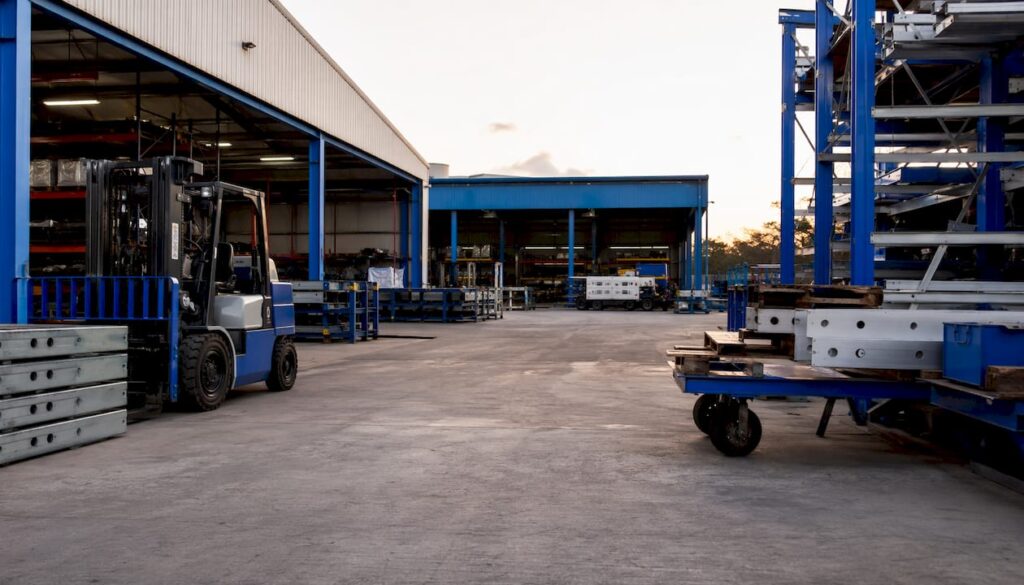
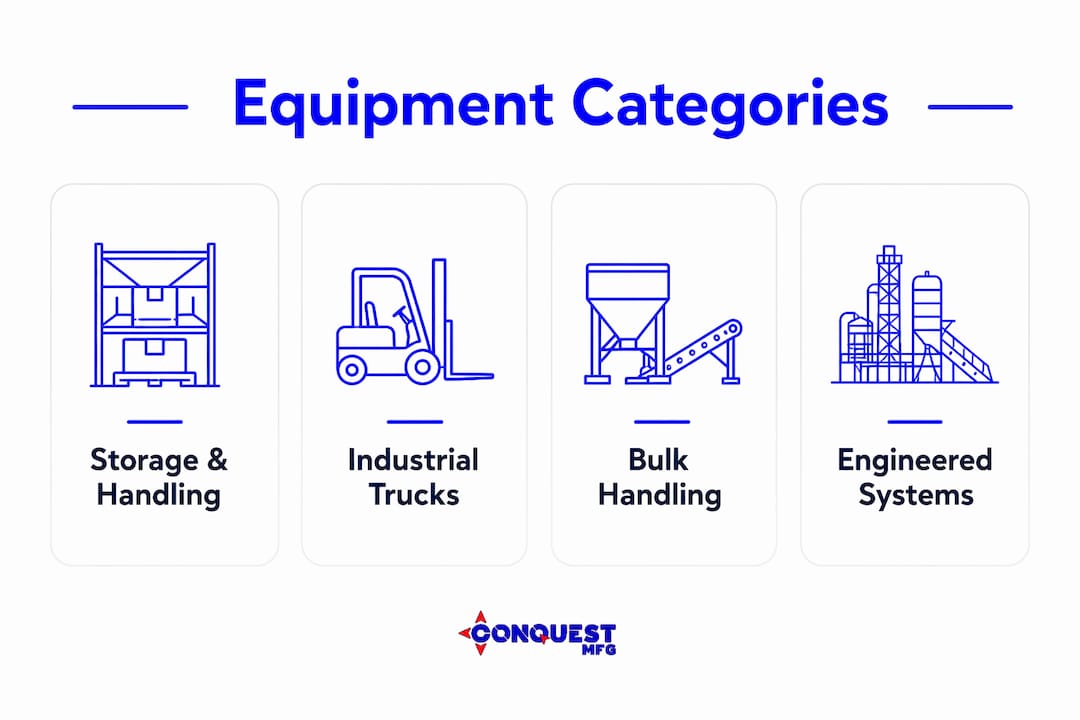
Facility logistics equipment covers the full range of mechanical devices and software systems that manage material flow, storage, and operational efficiency inside industrial manufacturing and transportation facilities. For US industrial purchasers, understanding this equipment landscape is the first step toward making procurement decisions that hold up under OSHA scrutiny, tight delivery windows, and multi-site operational demands. The four primary categories are:
- Storage and handling equipment: racks, pallets, shelving units, and drawers
- Industrial trucks and machines: forklifts, pallet jacks, and order pickers
- Bulk material handling equipment: conveyors, hoppers, and grain elevators
- Engineered automated systems: automated storage and retrieval systems (AS/RS), automated guided vehicles (AGVs), robotic delivery systems, and smart conveyors
Conquest Mfg brings over 35 years of engineering expertise to this space, manufacturing specialist equipment including concrete batch plants, pneumatic trailers, vacuum tanks, end dumps, and portable surveillance towers for construction, transportation, and oil and gas operations across the United States.
What are the major categories of facility logistics equipment?
Material handling equipment falls into four distinct categories, each serving a specific operational role in industrial facilities. Selecting the right mix directly affects floor space utilization, worker safety, and throughput capacity.
Storage and handling equipment forms the foundation of any warehouse or distribution operation. Racks enable vertical storage that multiplies usable floor space without expanding the building footprint. Pallets remain the universal unit load platform, while shelving units offer flexible configurations for mixed SKU environments. Drawers protect smaller or high-value components and keep them retrievable without disrupting adjacent inventory. Proper rack and shelving selection reduces physical strain on workers and lowers injury risk across shifts.
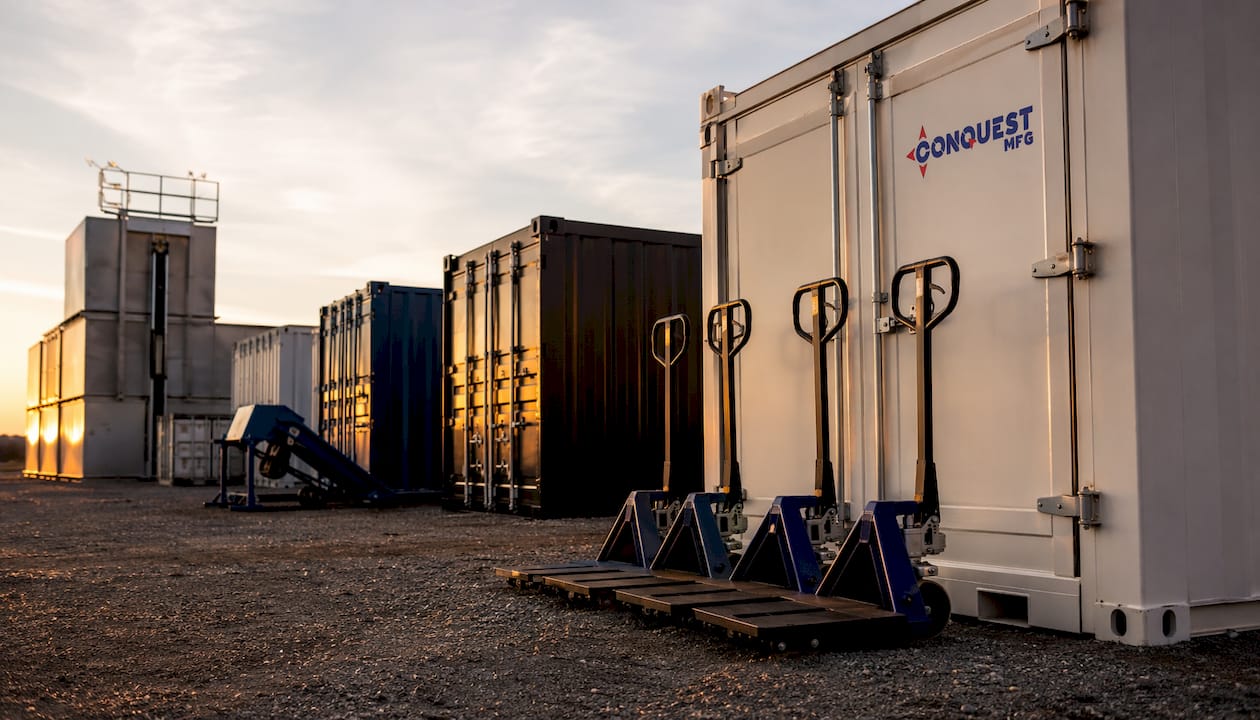
Industrial trucks and machines handle horizontal movement throughout a facility. Forklifts are the workhorse of loading docks, port facilities, and cargo terminals, capable of lifting heavy loads and turning in tight spaces. Pallet jacks cover shorter distances within distribution centers where a full forklift is impractical. Order pickers extend reach to high shelving levels, cutting retrieval time on dense pick operations.
Bulk material handling equipment moves large volumes of loose materials continuously. Conveyor belts adapt to horizontal and inclined transport paths, making them standard in aggregate, grain, and chemical processing. Hoppers receive, store, and meter bulk discharge with adjustable flow controls. Grain elevators move material vertically into storage silos, a configuration common in agricultural and feed processing facilities.
Engineered systems automate repetitive handling tasks at scale. AS/RS units retrieve and store palletized goods without direct human involvement, cutting labor costs in high-volume distribution centers. AGVs navigate facility floors using magnetic tape, floor rods, or AI-assisted sensors, with variants including conveyor-type, flat-body, low-floor, and tow configurations. Robotic delivery systems bring materials directly to production lines. Smart conveyors adjust speed and routing in real time based on sensor data.
| Equipment Category | Primary Use | Key Benefit | Typical Industries |
|---|---|---|---|
| Storage and handling | Organizing and storing goods | Space maximization, injury reduction | Warehousing, manufacturing |
| Industrial trucks | Moving loads horizontally | Mobility, load flexibility | Logistics, ports, factories |
| Bulk material handling | Transporting loose materials | Continuous high-volume throughput | Aggregate, chemical, grain |
| Engineered systems | Automating storage and transport | Labor reduction, precision | Distribution, automotive, e-commerce |
How does facility management software integrate with logistics equipment?
Facility management software centralizes asset tracking, maintenance scheduling, and compliance monitoring into a single platform, then connects with IoT sensors and ERP systems to deliver real-time lifecycle visibility across every piece of equipment on site. That integration reduces unplanned downtime and keeps service level agreements on track.
The compliance benefits are concrete. Digital platforms maintain searchable custody records, automate contractor and visitor check-ins, and generate exportable audit reports aligned with ISO 28000 and C-TPAT standards. OSHA expects documented equipment management and hazardous material controls, and a centralized system makes that documentation continuous rather than scrambled together before an inspection.
Key functions a capable facility management system delivers:
- Asset tracking: real-time location, condition, and movement records for every piece of equipment
- Maintenance scheduling: preventive alerts that extend asset lifespan and prevent costly breakdowns
- Compliance monitoring: automated contractor credential verification and access control logging
- Visitor and contractor management: digital check-in with credential screening at entry points
- Emergency response: digital muster lists and evacuation workflows tied to live site data
- ERP and IoT integration: unified data feeds that connect maintenance, procurement, and HR records
Pro Tip: Fix your manual workflows before deploying software. Automating a flawed process compounds the inefficiency rather than correcting it. Map and optimize your procedures first, then let the platform enforce them.
Operational insights from Conquest Mfg on specialist equipment
Conquest Mfg’s 35-plus years of manufacturing experience across concrete batch plants, pneumatic trailers, vacuum tanks, and oilfield equipment produces a clear picture of where industrial purchasers gain or lose operational ground. The guidance below reflects what that experience consistently surfaces.
Safety and compliance in equipment selection:
- Verify that every piece of equipment meets current OSHA standards before purchase, not after delivery
- Confirm DOT compliance for any trailer or transport unit operating on US public roads
- Require documentation of load ratings, pressure certifications, and material compatibility for bulk handling units
- Check that surveillance and security equipment meets applicable federal and state regulations for deployment
Maintenance and lifecycle management:
- Build a structured maintenance program that logs every service event with date, technician, and parts used
- Track chain-of-custody records for trailers and transport equipment to prevent detention and demurrage disputes
- Schedule preventive maintenance on pneumatic systems and batch plant components before wear indicators trigger failures
- Review the liquid waste equipment checklist for vacuum tank maintenance intervals specific to your application
Automation and robotics trends relevant to heavy industrial equipment:
- Concrete batch plants increasingly integrate automated batching controls that reduce operator error and improve mix consistency
- Pneumatic trailer systems benefit from automated pressure monitoring that flags deviations before a load is compromised
- Portable surveillance towers with solar power and cellular connectivity eliminate the need for hardwired infrastructure at remote sites
- Bulk material handling operations are adopting conveyor automation and load-sensing technology to reduce manual intervention
Purchaser evaluation checklist for logistics equipment:
- Define the load type, volume, and frequency before specifying any equipment category
- Confirm that the manufacturer provides engineering documentation and compliance certifications
- Evaluate total cost of ownership, including parts availability, service network, and expected service life
- Assess energy consumption for electrically driven systems and fuel efficiency for mobile equipment
- Confirm that the equipment configuration matches your facility’s physical constraints, including ceiling height, floor load rating, and access dimensions
- Request references from operators in your specific industry and application
Energy efficiency and sustainability considerations:
- Specify electric or hybrid drive systems for indoor material handling equipment to reduce emissions in enclosed spaces
- Evaluate solar-powered options for remote surveillance and monitoring equipment where grid power is unavailable
- Select trailer and transport equipment with aerodynamic designs that reduce fuel consumption over long hauls
- Prioritize manufacturers who offer lifecycle support, reducing the environmental cost of premature equipment replacement
Key considerations for US industrial purchasers
The right facility logistics equipment selection comes down to matching equipment capability to operational reality, then backing that selection with software that maintains visibility and compliance over the full asset lifecycle.
Critical considerations when evaluating logistics equipment for US industrial manufacturing and construction applications:
- Safety first: OSHA compliance and DOT certification are non-negotiable for any equipment operating in US facilities or on public roads
- Software integration: choose equipment from manufacturers who provide data outputs compatible with your CMMS or ERP platform
- Lifecycle documentation: structured asset management with full maintenance history prevents costly operational delays and supports audit readiness
- Specialist fit: general-purpose equipment rarely performs as well as purpose-built units in demanding applications like pneumatic bulk transport or concrete batching
- Supplier expertise: 35-plus years of engineering experience, as Conquest Mfg brings to the table, translates directly into equipment that performs reliably under field conditions
Manufacturing efficiency depends on equipment that fits the process, not equipment selected because it was available. Purchasers who align equipment specifications with operational requirements from the start avoid the costly cycle of retrofitting or replacing underperforming assets.
Key Takeaways
Selecting facility logistics equipment based on load type, compliance requirements, and lifecycle cost produces better long-term outcomes than purchasing on initial price alone.
| Point | Details |
|---|---|
| Four core equipment categories | Storage and handling, industrial trucks, bulk material handling, and engineered systems cover the full range of facility logistics needs. |
| Software integration is critical | Facility management software connected to IoT and ERP systems delivers real-time visibility and keeps compliance documentation audit-ready. |
| Fix workflows before automating | Deploying software or automation on flawed manual procedures compounds inefficiency rather than correcting it. |
| Compliance drives selection | OSHA standards, DOT certification, and ISO 28000 or C-TPAT requirements must be verified before equipment is purchased, not after. |
| Conquest Mfg specialist fit | With 35-plus years of engineering experience, Conquest Mfg manufactures purpose-built equipment for concrete, bulk transport, oilfield, and security applications across the US. |
Conquest Mfg builds the equipment your operation actually needs
Purpose-built equipment outperforms general-purpose alternatives in demanding industrial applications, and that gap widens under field conditions. Conquest Mfg manufactures heavy construction and transportation equipment engineered for the specific demands of concrete production, bulk pneumatic transport, vacuum service, oilfield operations, and remote site security. Every product line carries the engineering depth that comes from 35-plus years of working directly with US industrial operators.
Whether your operation needs a concrete batch plant configured for your site, a pneumatic trailer built for dry bulk transport, or a portable surveillance tower deployable without grid power, Conquest Mfg engineers the solution to your exact specifications. Contact Conquest Mfg to discuss your equipment requirements and get a quote tailored to your application.