

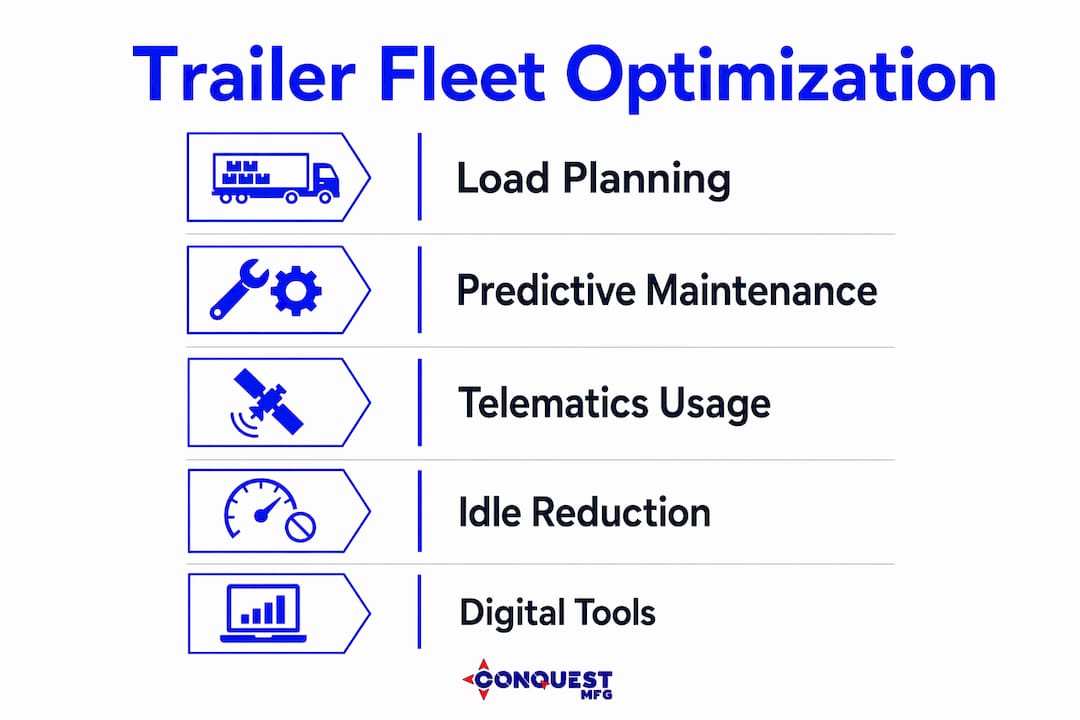
Trailer fleet optimization is defined as the systematic use of data-driven load planning, predictive maintenance, and real-time asset tracking to maximize trailer utilization and reduce operating costs. Fleet managers in transport and construction sectors face a measurable gap: manual load planning holds utilization at 60–80%, while AI-driven planning pushes that figure to 90–98%. That gap translates directly into freight spend, idle assets, and missed delivery windows. Applying the right trailer fleet optimization methods closes it faster than most managers expect.
What are the top trailer fleet optimization methods for loading and utilization?
Load building is the foundation of every effective trailer fleet management strategy. It is defined as the mathematical consolidation of orders by geometry, weight, and destination to maximize fill rate and eliminate wasted capacity. Shipping empty air accounts for 20–30% of trailer capacity in fleets that rely on manual planning. That unused space is a direct cost with no offsetting revenue.
Four loading techniques consistently deliver the highest gains:
- Reverse order loading: Freight for the last stop is loaded first. This eliminates mid-route reshuffling and cuts unloading time at each stop.
- Zone segregation: Cargo is grouped by geographic delivery zone inside the trailer. Drivers spend less time sorting at the dock and more time moving.
- Accessibility planning: High-frequency or time-sensitive items are positioned near the trailer doors. This reduces dwell time and detention charges.
- AI-based load building software: These platforms evaluate thousands of stacking and weight combinations in seconds. Manual planning takes 30–45 minutes per load; AI tools complete the same task in under two minutes while reaching 90–98% utilization.
Integrating load planning software with your warehouse management system (WMS) adds another layer of efficiency. The software pulls live order data, applies 3D visualization to confirm legal weight distribution, and flags loads that need dynamic re-planning before the trailer leaves the dock. One mid-market firm cut load-lock planning time from 21 days to 3 days after adopting AI-driven planning, alongside a 12% reduction in freight spend within eight weeks.
Pro Tip: Run a 30-day audit of your current trailer fill rates before selecting any load planning software. Knowing your baseline makes ROI calculations concrete and speeds up vendor approval.

How can predictive maintenance and telematics improve trailer fleet performance?
Predictive maintenance is the practice of triggering service based on real-time condition data rather than fixed calendar intervals. Calendar-based schedules over-service some trailers and under-service others. Mileage-based or hybrid condition triggers prevent both failure modes and reduce total maintenance spend.
Sensor-based telematics systems monitor brake wear, suspension load, tire pressure, and lighting circuits continuously. Sensors addressing brakes, lights, and tires cover more than 75% of out-of-service violations recorded at roadside inspections. Catching those faults before a DOT stop avoids fines, unplanned downtime, and the reputational cost of a failed inspection.
The maintenance gains from this approach are significant:
- Breakdown reduction: Predictive maintenance cuts unplanned breakdowns by up to 40%, avoiding repair events that routinely exceed $2,500 per incident.
- First-time fix rate improvement: Remote sensor data tells technicians exactly what part has failed before the trailer enters the shop. That eliminates diagnostic guesswork and reduces bay time.
- Automated work order creation: Integrating trailer sensor data directly with a computerized maintenance management system (CMMS) converts sensor alerts into work orders automatically. This removes manual data entry and prevents alert fatigue.
- Asset-level record keeping: Trailer maintenance requires dedicated records separate from tractor files. Trailers accumulate mileage differently, and mixing records causes missed service intervals and compliance gaps.
Pro Tip: Set alert thresholds in your telematics platform by trailer type and age. A five-year-old aluminum tank trailer has different brake wear curves than a new intermodal chassis. Generic thresholds generate noise; tailored thresholds generate work orders.
The future of industrial trailers points clearly toward condition-based maintenance as the standard, not the exception.
What operational strategies reduce idle trailers and improve fleet utilization?
Real-time asset visibility is the single most effective operational lever for reducing idle trailers. Fleet management platforms combining GPS tracking, inspection workflows, and utilization analytics improve fleet utilization by 25–40% compared to fleets without tracking. Well-managed fleets reach 70–85% utilization; untracked fleets average 50–60%.
Three operational practices consistently move the needle:
- Dwell time and detention analysis: Telematics dashboards show exactly how long each trailer sits at a shipper or receiver. Fleets that monitor dwell time can automate detention billing and renegotiate shipper agreements backed by hard data.
- Off-site staging yards: Positioning trailers at staging yards 15–30 miles from high-volume shippers keeps assets moving without congesting the primary terminal. Drop-and-hook staging reduces dwell time violations and improves driver productivity.
- Geofence alerts and redeployment triggers: Geofences around customer yards flag trailers that exceed a defined dwell threshold. Dispatchers receive an alert and can redeploy or recover the asset before it becomes a lost trailer.
Modern fleet management platforms reduce trailer loss by up to 30% through continuous location visibility. That figure matters because lost or unaccounted trailers represent both a capital loss and a utilization drag. Reviewing the role of semi trailers in construction projects shows how asset visibility directly affects project delivery timelines.
Pro Tip: Pull a quarterly utilization report segmented by trailer type. Trailers sitting below 50% utilization for two consecutive quarters are candidates for redeployment to a different lane or liquidation. Holding idle assets costs money every day.
What common pitfalls should fleet managers avoid in trailer fleet optimization?
The institutional knowledge trap is the most common failure point in fleet optimization programs. When load planning and dispatch decisions live inside the heads of veteran staff, the operation cannot scale and cannot recover quickly from turnover. Digitizing stacking logic and routing rules into software converts tribal knowledge into a repeatable, auditable process.
Five additional pitfalls consistently undermine optimization efforts:
- Treating trailer maintenance as a tractor add-on: Trailers are a distinct asset class with separate mileage accrual and wear patterns. Fleets that track trailer PM inside tractor records miss service intervals and create compliance exposure.
- Alert fatigue from unmanaged telematics data: Sensor platforms generate large data volumes. Without defined escalation rules and CMMS integration, technicians ignore alerts and the system loses credibility.
- Failing to address trailer “air”: Shipping partially filled trailers is the largest hidden cost in most fleets. Load building software directly targets this problem, but only if it is connected to live order data from the WMS.
- Ignoring software interoperability: A load planning tool that cannot exchange data with your transportation management system (TMS) creates manual reconciliation work. That work erodes the time savings the software was purchased to deliver.
- Single-layer approaches: Technology alone does not fix a broken dispatch process. Operational discipline, maintenance rigor, and digital tools must work together.
“Trailer PM programs are a distinct asset class from tractors. Good fleets treat trailer maintenance as a board-level metric, not just a yard task.” — Industry maintenance management standard
Which digital tools support effective trailer fleet management strategies?
Load planning software and trailer telematics hardware are the two foundational technology categories for fleet managers. Each solves a different problem, and both must integrate with existing systems to deliver full value.
| Tool category | Core function | Key selection criteria |
|---|---|---|
| Load planning software | 3D visualization, weight distribution, WMS integration | Planning time reduction, fill rate improvement, ease of use |
| Trailer telematics hardware | GPS, brake/tire/suspension sensors, connectivity | Sensor coverage, data transmission reliability, CMMS compatibility |
| Fleet management platforms | Real-time dashboards, dwell time analytics, utilization reports | TMS integration, alert customization, scalability |
| Maintenance management systems | Condition-based PM triggers, work order automation | Asset-level records, VIN tracking, compliance reporting |
Entry-level field apps handle basic GPS tracking and inspection checklists. Enterprise platforms add automated detention billing, predictive maintenance workflows, and direct TMS integration. The right choice depends on fleet size, trailer type mix, and existing system architecture.
Interoperability is the deciding factor for mid-to-large fleets. A telematics platform that cannot push sensor events directly into a CMMS forces manual data entry, which defeats the purpose of automation. Evaluate every tool against your current TMS and WMS before committing to a contract.
Pro Tip: Request a data export sample from any telematics vendor before signing. If the export format does not match your CMMS import schema, integration costs will exceed the software license fee.
Fleets managing specialized equipment, such as dry bulk pneumatic trailers or vacuum tanks, need platforms that support asset-specific inspection checklists rather than generic truck forms.
Key Takeaways
Effective trailer fleet optimization requires combining AI-driven load planning, condition-based maintenance, real-time asset visibility, and integrated digital tools to close the gap between 60% and 90%+ utilization.
| Point | Details |
|---|---|
| Close the utilization gap | AI load planning raises trailer fill rates from 60–80% to 90–98%, cutting freight spend measurably. |
| Separate trailer maintenance | Treat trailers as a distinct asset class with dedicated PM records and condition-based service triggers. |
| Eliminate idle assets | GPS tracking and dwell time analytics reduce trailer loss by up to 30% and improve utilization by 25–40%. |
| Digitize institutional knowledge | Convert manual planning rules into software logic to scale operations and reduce dependency on individual staff. |
| Require system integration | Load planning, telematics, TMS, and CMMS must exchange data automatically to avoid manual reconciliation. |
What I’ve learned after years of watching fleets leave money on the table
Fleet managers consistently underestimate how much idle trailer time costs them. The number is not abstract. Every trailer sitting in a shipper’s yard past its dwell threshold is a capital asset generating zero revenue while accumulating depreciation. The fleets that fix this fastest are the ones that stop treating visibility as a nice-to-have and start treating it as a financial control.
The second thing I’ve seen repeatedly is the maintenance blind spot. Trailer PM gets folded into tractor schedules, mileage thresholds get missed, and the first sign of trouble is a roadside failure. Treating trailers as a board-level asset class, with their own records, their own condition triggers, and their own reporting metrics, changes the conversation from reactive to planned.
The hardest shift is cultural. Veteran dispatchers who have planned loads manually for 20 years resist software because they believe their judgment is better. Sometimes it is. But software evaluates thousands of combinations simultaneously and never has a bad day. The right approach is to capture that veteran knowledge in the system’s rules, not to replace the person.
My honest recommendation: start with a utilization audit, not a technology purchase. Know your baseline fill rates, your average dwell times, and your breakdown frequency by trailer type. That data tells you exactly where to invest first, and it gives you the benchmark to measure ROI after implementation.
— Sam
Conquest Mfg trailers built for fleets that demand performance
Fleet managers running construction or oil industry operations need trailers that hold up under the conditions where optimization methods get tested hardest. Conquest Mfg manufactures semi trailers built for exactly those environments, including dry bulk pneumatic trailers, aluminum and steel vacuum tanks, bottom dumps, end dumps, sand hoppers, and intermodal chassis.
Every Conquest Mfg trailer is designed to work with modern fleet management systems, with consistent asset specifications that support accurate utilization tracking and maintenance scheduling. Explore the full range of construction industry trailer solutions to find the right equipment for your fleet. For operations in the oil sector, the role of semi trailers in oil industry work covers the specific demands those environments place on trailer design and durability.
FAQ
What is the standard trailer utilization rate for optimized fleets?
Well-managed fleets with tracking systems achieve 70–85% utilization. AI-driven load planning pushes that figure to 90–98%, compared to 60–80% for fleets using manual planning methods.
How does predictive maintenance reduce trailer operating costs?
Condition-based maintenance using brake, tire, and suspension sensors cuts unplanned breakdowns by up to 40% and avoids repair events that typically exceed $2,500 per incident.
Why do trailers need separate maintenance records from tractors?
Trailers accumulate mileage at different rates than tractors and have distinct wear patterns. Mixing records causes missed service intervals, compliance gaps, and inaccurate fleet reporting.
What is load building in trailer fleet management?
Load building is the mathematical consolidation of freight orders by geometry, weight, and destination to maximize trailer fill rate and eliminate unused capacity, which typically wastes 20–30% of trailer space.
How much can GPS tracking reduce trailer loss?
Modern fleet management platforms with real-time GPS and geofence alerts reduce trailer loss by up to 30% by providing continuous location visibility and automated dwell time alerts.