
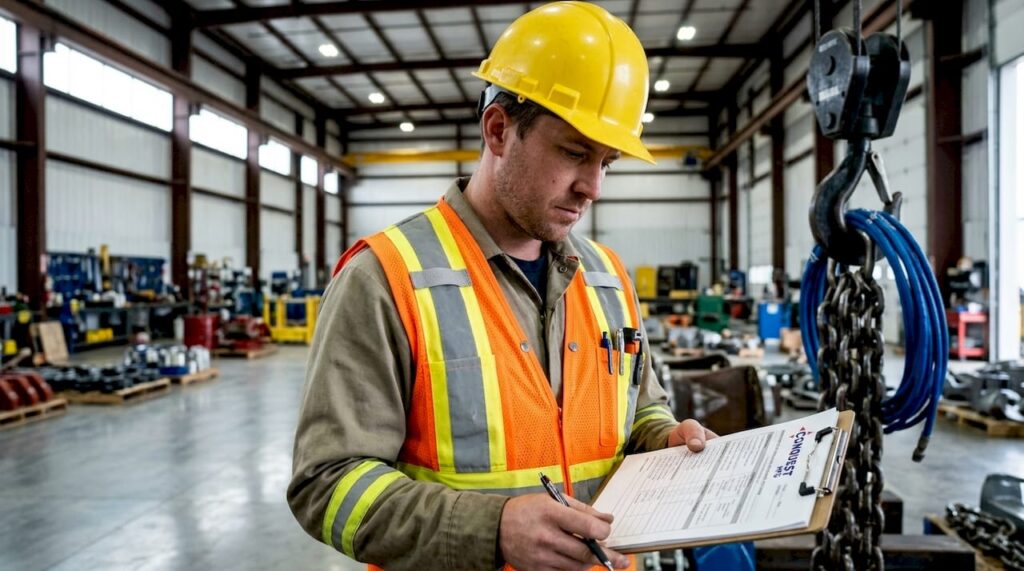
Oilfield material handling is defined as the engineered system of moving, storing, and controlling drilling equipment, bulk materials, and associated inputs across hazardous oil and gas environments. This system covers end-to-end material flows including inbound staging, internal transport, rig-floor placement, storage, and outbound dispatch. Safety compliance and operational reliability are not optional features in this system. They are core design requirements. Standards from API, DNV, and OSHA govern every stage, while equipment manufacturers like Bajaj Indef build those requirements directly into product engineering. For oil and gas decision-makers, understanding this system end-to-end is the foundation of cost-effective, incident-free operations.
What are the critical components and equipment types in oilfield material handling?
Oilfield material handling equipment falls into two broad categories: lifting and transport devices, and automated rig-floor tools. Each category serves a distinct function in the material flow chain.
Lifting and transport equipment
Specialized lifting devices reduce manual handling and the ergonomic injury risks that come with it. Flame-proof chain hoists, wire rope hoists, adjustable lifters, trolleys, and pallet jacks with locking features are standard across both onshore and offshore sites. The design goal is consistent: replace manual lifting with mechanical aids, standardize movement routes, and reduce the physical load on workers.
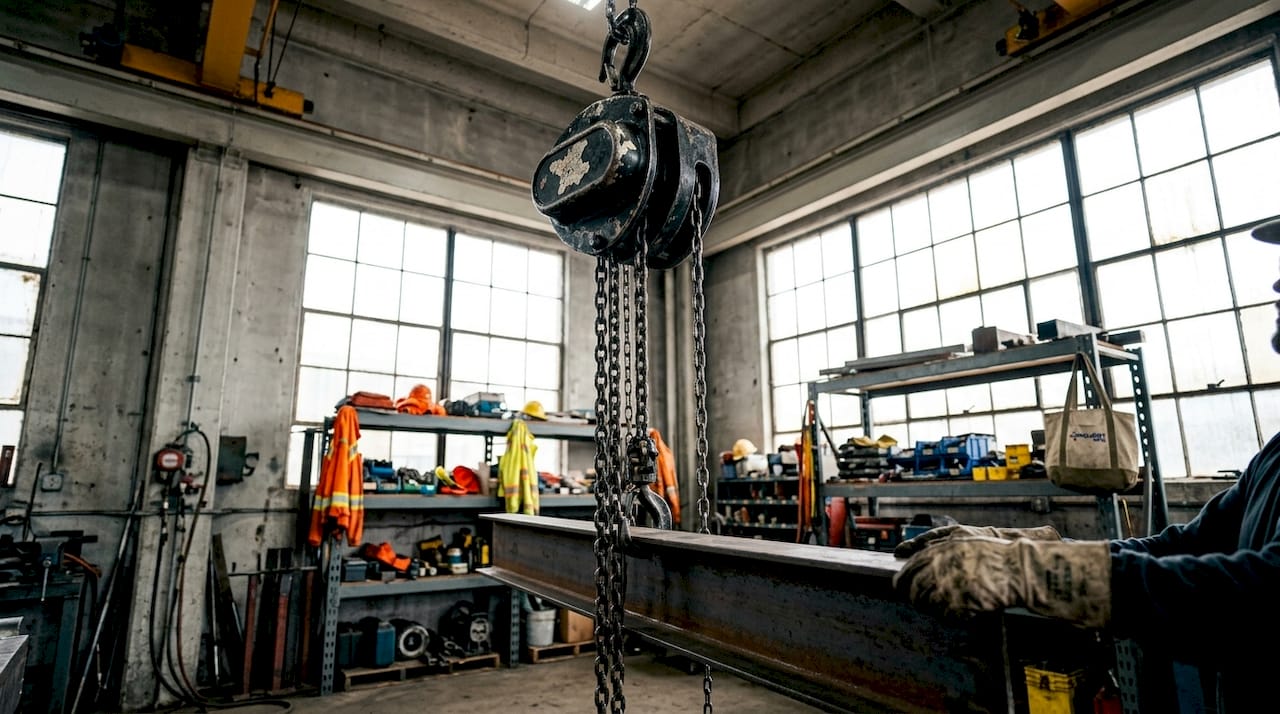
Offshore operations add another layer of complexity. Lifting appliances used on platforms must meet DNV-ST-0378 certification requirements, which govern design, manufacture, and functional testing before any equipment reaches a platform deck. This is not a paperwork formality. It is a structural requirement that determines whether a lift is approved for use at all.
Automated rig-floor handling tools
Rig-floor pipe handling has shifted significantly toward automation. Iron roughnecks and power tongs compliant with API Spec 7K now handle pipe positioning and connection operations with torque capacities reaching up to approximately 100,000 ft·lbs. These tools eliminate the need for workers to manually break or make pipe connections under load, which is one of the highest-risk tasks on any rig floor.
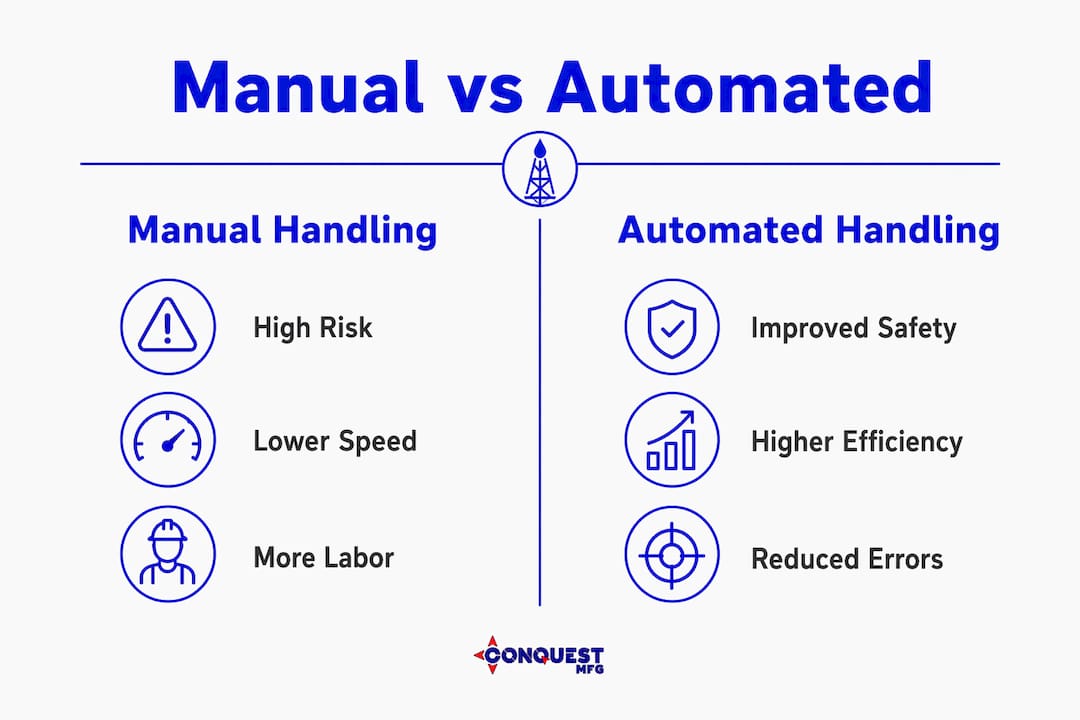
Manual vs. automated handling: a direct comparison
| Factor | Manual handling | Automated handling |
|---|---|---|
| Injury risk | High, especially for repetitive lifts | Significantly reduced |
| Throughput consistency | Variable, dependent on crew | Stable and repeatable |
| Compliance documentation | Prone to manual error | Digitally logged |
| Initial cost | Lower upfront | Higher upfront, lower long-term |
| Workforce dependency | High | Reduced |
The shift from manual to automated handling is not purely about speed. It directly affects safety records, compliance documentation quality, and the ability to maintain throughput when labor availability is tight.
How do safety standards and inspection regimes shape oilfield material handling operations?
Safety standards are built into oilfield material handling from the equipment design stage through daily operations. API RP 8B and OSHA-aligned inspection programs require hoisting equipment to be inspected on daily, monthly, and annual schedules, with formal load testing included. Equipment covered includes cranes, derricks, drawworks, elevators, and tongs.
Each inspection cycle produces documentation: wear and damage findings, maintenance actions taken, and next scheduled service. That documentation is the compliance record. Without it, operators face regulatory exposure and potential operational shutdowns.
Inspection requirements by frequency
- Daily inspections: Visual checks of hoisting equipment for visible damage, fluid leaks, and operational function before each shift.
- Monthly inspections: Detailed mechanical review covering wire rope condition, brake systems, load path components, and safety devices.
- Annual inspections and load testing: Full structural and functional assessment with documented load test results, conducted by qualified personnel.
- Offshore certification (DNV-ST-0378): Design verification, material acceptance per EN 10204, non-destructive testing (NDT), factory acceptance testing (FAT), and proof-load tests required before offshore deployment.
Pro Tip: Digital inspection platforms that support equipment-specific checklists, photo documentation, and offline capability eliminate the manual data entry bottlenecks that delay compliance reporting. Platforms built for API RP 8B workflows can cut report turnaround significantly and reduce transcription errors.
Digitizing inspection workflows replaces paper forms with structured digital records, accelerates report delivery to clients, and improves data accuracy across the inspection cycle. For operations running multiple pieces of hoisting equipment simultaneously, this is not a convenience upgrade. It is a compliance necessity.
What role does automation and digitalization play in modern oilfield material handling?
Automation and digitalization are the primary levers for improving throughput stability and reducing costs in oil and gas intralogistics. Software-controlled transport vehicles, conveyor systems, warehouse management systems (WMS), automated guided vehicles (AGVs), and autonomous mobile robots (AMRs) now operate across both onshore facilities and offshore support bases.
The operational benefits are concrete:
- Throughput stability: Automated systems maintain consistent material flow regardless of shift changes or crew availability.
- Error reduction: Digital tracking eliminates misrouted materials and mislabeled inventory, which are common sources of non-productive time (NPT).
- Workforce shortage mitigation: AMRs and AGVs perform repetitive transport tasks without requiring additional headcount.
- Inspection workflow efficiency: Digital platforms replace manual forms, accelerating compliance reporting and reducing documentation backlogs.
- System integration: Physical handling equipment connects to digital control and monitoring systems, giving operations managers real-time visibility into material location and status.
“OEMs now emphasize digitizing full intralogistics systems, linking physical flow with process control to improve transparency and cost control.” — Linde Material Handling
The integration of physical and digital systems is where the real efficiency gain appears. A WMS that tracks every pallet from the supply base to the rig floor eliminates the guesswork that causes staging delays and missed delivery windows. For offshore operations, where helicopter and vessel logistics add cost and time pressure to every material movement, that visibility is operationally critical. Connecting your dry bulk handling process to a digital control layer is one of the highest-return upgrades available to oilfield logistics managers today.
How to integrate oilfield material handling solutions into operational workflows
Successful material handling planning requires synchronizing safety and rigging compliance with production logistics timing. Separating equipment compliance schedules from production delivery windows creates operational risk. When an inspection is overdue and a critical lift is scheduled, the operation stops. That gap between compliance management and production planning is where most avoidable NPT originates.
Workflow integration priorities
| Priority | Action | Outcome |
|---|---|---|
| Synchronize schedules | Align material arrival and dispatch with rig and completion timelines | Eliminates staging delays and missed windows |
| Reduce manual lifting | Deploy mechanical aids on all standard routes before relying on crew | Lowers injury rates and fatigue-related errors |
| Digitize compliance records | Integrate inspection data into the production planning system | Prevents compliance-driven operational shutdowns |
| Cross-functional alignment | Involve engineering, QA, procurement, and operations early | Reduces late-stage procurement failures offshore |
| Customize equipment | Specify lifting and transport equipment to site-specific load and environment requirements | Improves reliability and reduces maintenance frequency |
Offshore procurement teams consistently underestimate the volume and complexity of certification documents required for lifting appliance acceptance. Design verification packages, NDT reports, FAT records, and proof-load test certificates must all be assembled before equipment clears acceptance review. Aligning engineering, QA, and procurement teams early in the process prevents the document-driven delays that push offshore project timelines.
Pro Tip: Build a compliance evidence checklist at the procurement stage, not the delivery stage. For DNV-ST-0378 certified equipment, the documentation package is as critical as the physical hardware. Missing a single NDT report can hold up an entire offshore lift program.
Staff training is the final integration layer. Equipment upgrades and digital systems only deliver their full value when the crew operating them understands both the mechanical function and the compliance requirements attached to each piece of equipment. Familiarizing your team with oilfield equipment terminology before deploying new systems reduces operational errors during the transition period. A manufacturing quality assurance checklist applied at the equipment acceptance stage catches specification gaps before they become field problems.
Key Takeaways
Effective oilfield material handling requires integrating specialized equipment, structured inspection regimes, and digital systems into a single coordinated workflow aligned with production schedules.
| Point | Details |
|---|---|
| End-to-end system design | Material handling covers inbound staging, transport, rig-floor placement, storage, and outbound dispatch as a connected flow. |
| Compliance is a design input | API RP 8B, OSHA, and DNV-ST-0378 requirements must be built into equipment selection and inspection schedules from the start. |
| Automation reduces risk and cost | AGVs, AMRs, and WMS platforms improve throughput stability and reduce manual handling injuries and documentation errors. |
| Synchronize compliance with production | Separating inspection schedules from production logistics creates avoidable NPT and operational shutdowns. |
| Documentation drives offshore acceptance | DNV-ST-0378 certification packages require design verification, NDT, FAT, and proof-load records assembled before delivery. |
What I’ve learned about where oilfield material handling actually breaks down
The technical side of oil and gas material handling is well understood. The equipment categories, the inspection standards, the automation options: these are documented and accessible. What gets less attention is the operational gap between compliance management and production logistics.
I’ve seen operations where the inspection program runs on a separate calendar from the production schedule. The hoisting equipment is technically compliant on paper, but the inspection timing creates windows where a critical lift falls due for annual testing right in the middle of a completion campaign. That is not a safety failure. It is a planning failure, and it costs real money.
The shift toward digital inspection platforms is the most underrated development in this space. Replacing paper forms with structured digital records does not just speed up reporting. It makes compliance data visible to production planners in real time, which is what closes the gap between the two calendars. The oil industry equipment types that deliver the most value in 2026 are the ones that generate usable data, not just physical output.
My advice to decision-makers: treat the documentation package as part of the equipment, not a separate administrative task. For offshore lifting appliances especially, the certification evidence is what gets the hardware approved for use. Build that into your procurement timeline from day one.
— Sam
Conquest Mfg equipment built for oilfield material handling demands
Oilfield operations require transport and handling equipment that performs reliably under demanding field conditions. Conquest Mfg designs and manufactures a range of specialized equipment for the oil and gas industry in the USA, including dry bulk pneumatic trailers, vacuum tanks, sand hoppers, sand chassis, and intermodal chassis built to handle the material transport demands of active oilfield sites.
Every piece of equipment Conquest Mfg produces is built to your operational specifications, not generic catalog dimensions. For operations managing frac sand, bulk cement, or drilling fluids, the right trailer or chassis configuration directly affects site throughput and compliance with transport regulations. Conquest Mfg’s oilfield semi trailer solutions and full product range are available through the Conquest Mfg product catalog. Contact the team directly to discuss your site-specific requirements.
FAQ
What is oilfield material handling?
Oilfield material handling is the engineered system of moving, storing, and controlling drilling equipment and bulk materials across oil and gas sites. It covers inbound staging, internal transport, rig-floor handling, storage, and outbound dispatch in hazardous environments.
What inspection standards apply to oilfield hoisting equipment?
API RP 8B and OSHA-aligned programs require daily, monthly, and annual inspections with load testing for cranes, derricks, drawworks, elevators, and tongs. Each inspection cycle must be documented with findings, maintenance actions, and next service dates.
What is DNV-ST-0378 and why does it matter for offshore lifts?
DNV-ST-0378 governs the design, manufacture, and certification of offshore lifting appliances. Compliance requires a full documentation package including material acceptance records, NDT reports, factory acceptance testing, and proof-load test results before equipment is approved for offshore use.
How does automation improve oilfield material handling efficiency?
AGVs, AMRs, and warehouse management systems maintain consistent material flow, reduce manual handling errors, and generate real-time tracking data. These systems also reduce dependence on headcount for repetitive transport tasks, which is critical when labor availability is constrained.
What causes the most avoidable non-productive time in oilfield material handling?
Separating compliance inspection schedules from production logistics timing is the leading cause of avoidable NPT. When inspection due dates are not visible to production planners, critical lifts get delayed by overdue certifications that could have been scheduled around the production calendar.