
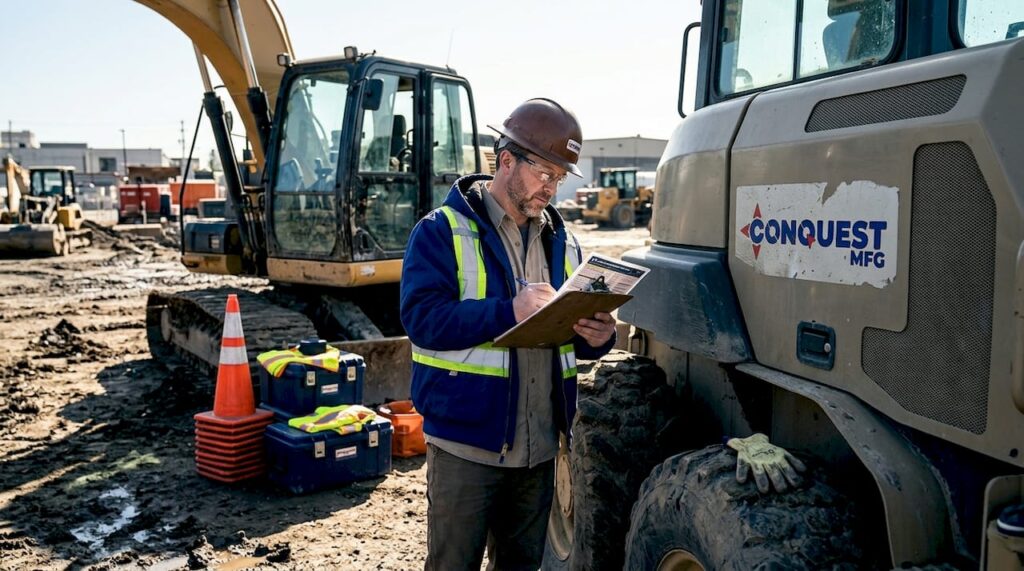
Keeping up with construction equipment terminology 2026 has become a real challenge. The vocabulary surrounding modern machinery has shifted dramatically, driven by AI integration, advanced telematics, GPS machine control, and tiered OEM product lines. Even experienced contractors are running into confusion on jobsites and in procurement meetings because terms that once had distinct meanings now overlap, and new designations appear every season. This guide breaks down the most critical terms across digital control systems, hydraulics, and manufacturer nomenclature so you can work, buy, and communicate with precision.
Table of Contents
- Key takeaways
- Construction equipment terminology 2026: digital and automation terms
- Hydraulic system terms every contractor must know
- Decoding OEM model naming and product tiers
- Applying updated terminology to daily jobsite decisions
- My take on where terminology confusion really costs you
- How Conquestmfgusa supports your equipment decisions
- FAQ
Key takeaways
| Point | Details |
|---|---|
| Digital terms overlap significantly | Grade control, GPS machine control, and 3D guidance are often used interchangeably but describe distinct system levels. |
| Hydraulic specs determine compatibility | Matching GPM and PSI ratings between machines and attachments prevents costly performance failures. |
| OEM model tiers affect procurement | Understanding base, pro, and premium tier designations helps you compare value accurately before purchasing. |
| Calibration prevents hidden errors | Always verify the loaded design model and coordinate system before running machine control operations. |
| Telematics now means much more | Modern telematics platforms manage entire fleets, not just GPS location, making terminology clarity critical. |
Construction equipment terminology 2026: digital and automation terms
The most active area of vocabulary change in 2026 is digital machine control. These terms are appearing in spec sheets, rental agreements, and jobsite meetings with increasing frequency, and the distinctions matter more than most people realize.
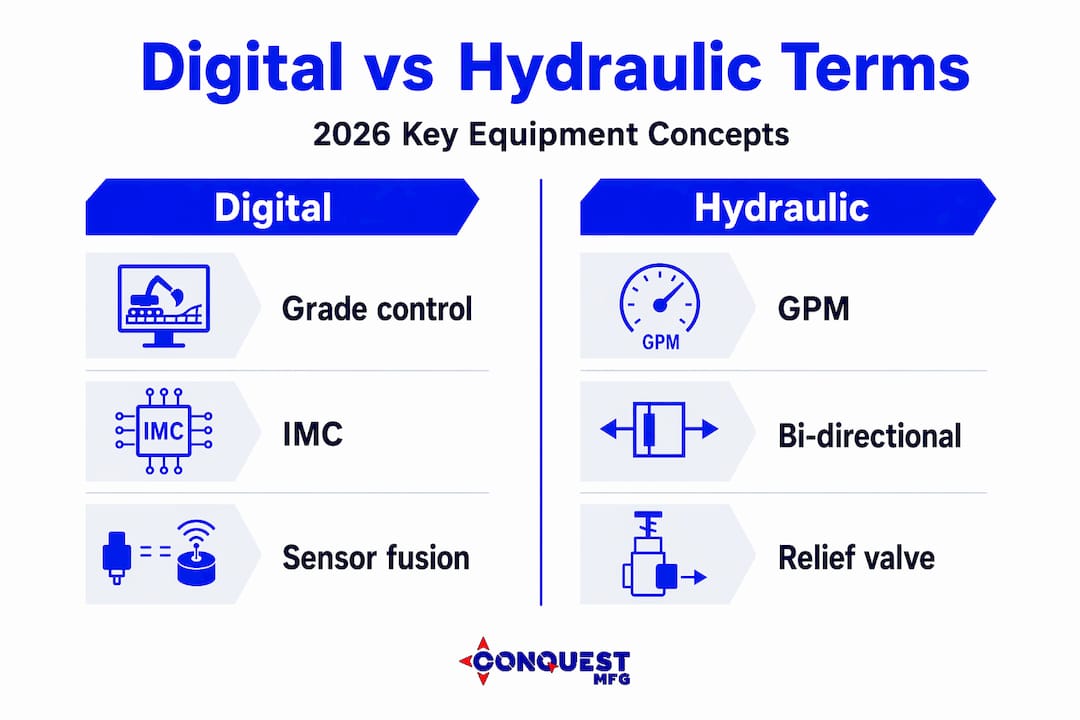
Grade control refers to any system that guides an operator toward a target elevation or slope. It ranges from simple sonic or laser systems mounted on a motor grader to fully automated hydraulic control on an excavator. GPS machine control is a subset of grade control that uses satellite positioning, typically with RTK correction, to place the machine in real space against a digital design model. GPS machine control with RTK achieves vertical accuracy of ±10 to 25mm, which is precise enough for finish grading without stakes.
3D machine guidance and Intelligent Machine Control (IMC) are terms that push this further. IMC typically refers to systems where the machine’s hydraulics respond automatically to the design model, reducing operator input on repetitive cuts. Digital machine control terms like grade control, GPS machine control, 3D guidance, and IMC are increasingly used interchangeably in 2026, which creates real confusion when you are trying to specify a system for a project.
Sensor fusion is another term worth knowing. It describes systems that combine GPS, inertial measurement units (IMUs), and sometimes total station data to maintain accuracy even when satellite signals drop or become unreliable. Understanding this matters because a machine described as “GPS-guided” may or may not include sensor fusion for tunnels, dense urban sites, or near structures.
| Term | What it means | Practical implication |
|---|---|---|
| Grade control | Elevation/slope guidance system | Broad category; confirm technology type |
| GPS machine control | Satellite-based position vs. design model | Requires RTK base station or correction service |
| 3D machine guidance | Full X/Y/Z positioning on screen or auto | Operator-guided vs. auto-hydraulic varies by brand |
| IMC | Auto-hydraulic response to design model | Highest automation level; impacts operator training |
| Sensor fusion | GPS + IMU + other data combined | Maintains accuracy when GPS signal degrades |
On the AI and safety side, AI cameras and operator-assist programs have moved from experimental features to standard tools in 2026. Terms like SmartDetect, 360-degree AI hazard detection, and in-cab proximity alerts now appear regularly in equipment brochures. These are not autonomous systems. They assist operators rather than replace them, and confusing partial automation with full autonomy creates serious safety and training gaps.
Telematics platforms have also evolved well beyond basic GPS fleet tracking. Today’s platforms manage fuel consumption, predictive maintenance alerts, geofencing, security, and jobsite productivity metrics across entire machine fleets. When a manufacturer says their equipment is “connected,” ask specifically what data flows into what platform and how it integrates with your project management software.
Pro Tip: When reviewing a spec sheet, look for whether GPS machine control is described as “guidance” or “control.” Guidance means the operator still makes all movements. Control means the system can move hydraulics automatically. The difference affects your training requirements and licensing on regulated projects.
Hydraulic system terms every contractor must know
Hydraulic terminology is where attachment compatibility problems quietly drain jobsite productivity. Getting this vocabulary right before you purchase or rent saves real money.
GPM (gallons per minute) measures hydraulic flow, meaning how much oil the pump moves through the system per minute. PSI (pounds per square inch) measures hydraulic pressure. These two values work together. Hydraulic power delivered to attachments follows the formula: HP = (PSI × GPM) / 1,714. A high-flow attachment running at low flow will underperform or fail to operate entirely.
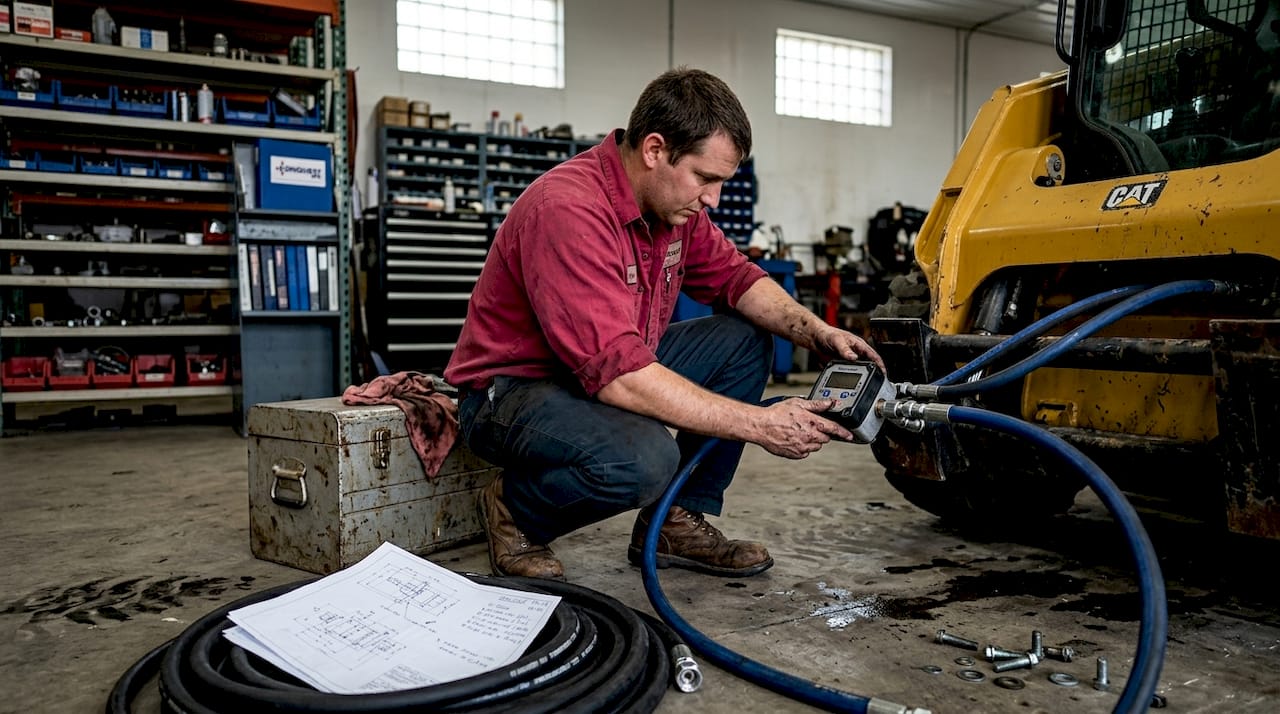
The standard flow vs. high flow distinction is one of the most common sources of attachment errors on skid steers and compact track loaders. Standard flow typically ranges 17 to 25 GPM while high flow reaches 30 to 45+ GPM. Running a high-flow mulcher on a standard-flow machine does not just reduce speed. It can damage the motor in the attachment and overheat the machine’s hydraulic system over time.
| System type | Typical GPM range | Best use case |
|---|---|---|
| Standard flow | 17 to 25 GPM | Buckets, forks, augers, light sweepers |
| High flow | 30 to 45+ GPM | Mulchers, cold planers, large brooms, stump grinders |
Bi-directional flow is another term worth locking in. Some attachments, like hydraulic thumbs and grapples, require oil to flow in two directions to open and close. Not all machines have this circuit active on the auxiliary port by default. Knowing whether your machine has a uni-directional or bi-directional auxiliary circuit before you connect an attachment prevents damage and downtime.
Relief valves protect the system by releasing pressure when it exceeds a set limit. If your attachment is running sluggishly and the machine is not showing an error, a mismatched relief valve setting is often the culprit. Always match the relief valve pressure rating to the attachment’s maximum operating PSI requirement.
Pro Tip: Before renting or purchasing any hydraulic attachment, pull the machine’s spec sheet and confirm both the flow rate and operating pressure at the auxiliary port. Do not rely on verbal confirmation from a salesperson. The spec sheet is the only document that holds up when a warranty claim is at stake.
Decoding OEM model naming and product tiers
Understanding manufacturer model designations is one of the most underrated skills in modern heavy equipment procurement. OEM manufacturers use alphanumeric model designations as unique identifiers to avoid ambiguity between machines that share a broad category name but differ significantly in specs, features, and intended application.
Take a skid steer catalog from any major manufacturer. You will see designations like a compact track loader with “T” indicating tracked configuration, followed by a number indicating approximate rated operating capacity, and sometimes a suffix like “V2” or “G3” indicating a generation update. Ordering parts without the exact alphanumeric model code is a reliable way to receive the wrong components, especially when a manufacturer runs parallel product generations.
OEMs now offer tiered machine lineups that go well beyond simple heavy and light categories. Common tier labels include:
- Base: Core machine with standard hydraulics, no telematics, minimal tech features. Lowest price point.
- Classic: Mid-range with selected comfort and productivity upgrades, sometimes legacy tech carried forward.
- Pro: Current-generation technology package including telematics, updated hydraulic performance, and operator assist features.
- Premium: Full technology stack with AI cameras, IMC capability, advanced connectivity, and manufacturer service packages included.
The practical implication is that two machines with nearly identical alphanumeric codes from the same OEM can behave very differently on a jobsite depending on their tier. When comparing quotes, always confirm which tier you are pricing. A base unit and a pro unit of the same model designation can differ by $30,000 or more and deliver completely different capabilities on a GPS-guided grading project.
Evaluating OEM innovation should always come back to uptime and operational efficiency, not just which features sound the most advanced. A premium tier machine with tech your operators have not been trained on is often outperformed in daily output by a well-maintained pro tier unit operated by experienced hands.
Applying updated terminology to daily jobsite decisions
Knowing the terms is one thing. Using them to make better decisions is what separates contractors who stay ahead from those who constantly troubleshoot avoidable problems.
- Verify machine control setup before every shift. Before machine control operations, confirm the correct design model version is loaded and the coordinate system calibration matches the project benchmark. A quick test dig in a known location confirms your system is reading correctly. Coordinate system mismatches are a hidden cause of costly rework.
- Match hydraulic specs before connecting any attachment. Pull both the machine’s hydraulic output spec and the attachment’s minimum and maximum operating range. If they do not align, do not connect and assume it will work out.
- Use telematics data to manage maintenance cycles, not just locations. Modern fleet platforms surface predictive maintenance windows based on actual usage hours and operating conditions. Using this data proactively reduces unplanned downtime.
- Reference OEM tier designations in purchase orders. When writing procurement documents, include the full alphanumeric model designation and the specific tier name. This eliminates substitution errors when vendors fulfill orders.
Pro Tip: Create a one-page terminology reference sheet for your project team at the start of each major project. Include the key digital, hydraulic, and OEM terms relevant to your specific equipment lineup. It takes 30 minutes to build and saves hours of miscommunication over the life of a project.
You can also strengthen your team’s foundational knowledge by reviewing resources like this guide on optimizing equipment usage and this overview of bulk transportation equipment to see how terminology applies across different equipment categories.
My take on where terminology confusion really costs you
I have seen contractors lose weeks of productivity not because their equipment failed, but because their team was using the same words to describe completely different things. The phrase “the machine has GPS” means almost nothing without knowing whether you are talking about basic asset tracking, 2D grade guidance, or full IMC with sensor fusion. Those three things require completely different operator skill sets, site preparation, and calibration workflows.
What I have learned is that confusing partial automation with full autonomy is one of the most dangerous and widespread misunderstandings in the industry right now. When operators believe a system is doing more than it actually is, they stop double-checking their work. Rework and safety incidents follow.
My honest advice is to treat terminology as part of your quality control process, not as background knowledge. When you are onboarding a new machine or technology, build a short definitions check into your pre-deployment checklist. Make sure every person who will operate or supervise that machine can define what the system does and what it does not do. That clarity pays for itself the first time it prevents a miscommunication from turning into a costly mistake.
— Peter
How Conquestmfgusa supports your equipment decisions
When you are working through the details of equipment specifications and terminology, having the right manufacturing partner matters. Conquestmfgusa builds specialist equipment including stationary and mobile batch plants engineered for high-demand construction and industrial applications. Our equipment is designed with the technical precision that modern jobsite terminology demands, from hydraulic system specifications to connectivity-ready builds.
Whether you are procuring concrete production equipment, dry bulk pneumatic trailers, or vacuum tanks for your construction operations, our team can walk you through the specs in plain language. Explore our full range of construction industry solutions and get the technical detail you need to make confident procurement decisions. Reach out to our team for a quote tailored to your project requirements.
FAQ
What does “grade control” mean in construction equipment?
Grade control is a broad term for any system that guides a machine operator toward a target elevation or slope. It includes basic laser and sonic systems as well as advanced GPS and IMC-based automatic hydraulic control systems.
What is the difference between standard flow and high flow on a skid steer?
Standard flow delivers 17 to 25 GPM at the auxiliary port, while high flow delivers 30 to 45+ GPM. Running a high-flow attachment on a standard-flow machine causes underperformance and can damage both the attachment motor and the machine’s hydraulic system over time.
Why do OEM model designations matter for procurement?
OEM alphanumeric model designations are unique identifiers that distinguish machines with similar names but different specs and technology tiers. Using the full designation in purchase orders prevents substitution errors and wrong-parts deliveries.
What is sensor fusion in construction equipment?
Sensor fusion combines GPS, IMU, and other positioning data to maintain machine control accuracy when satellite signals are weak or interrupted. It is common on machines operating near structures, in tunnels, or in dense urban environments.
How has telematics changed in 2026?
Modern telematics platforms manage fuel use, predictive maintenance, geofencing, security, and productivity metrics across entire fleets. They are no longer simple GPS trackers but function as connected jobsite management tools.