
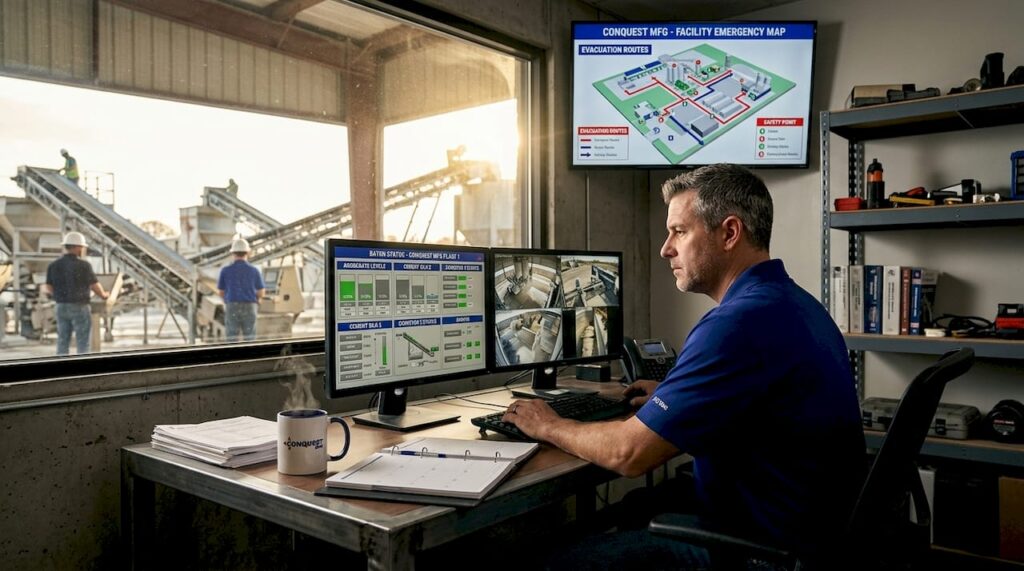
Most security professionals picture cameras, access cards, and perimeter fencing when they think about industrial site protection. Batch plants rarely enter that conversation. That’s a gap worth closing. The role of batch plants in security infrastructure goes well beyond concrete production. These facilities operate complex PLC and SCADA control systems, generate continuous operational data, and occupy strategically critical positions on industrial sites. Understanding how batch plant automation, environmental monitoring, and surveillance integration work together gives security decision-makers a real advantage when designing or auditing site safety programs.
Table of Contents
- Key takeaways
- The role of batch plants in security infrastructure
- Security risks specific to batch plant environments
- Strategies for integrating batch plants into security systems
- Compliance and monitoring for batch plant security
- Managing security across multiple batch plant sites
- My perspective on where batch plant security actually fails
- How Conquestmfgusa supports your batch plant security program
- FAQ
Key takeaways
| Point | Details |
|---|---|
| Batch plants run OT systems that need protection | PLC and SCADA controls are security infrastructure components that require network segmentation and access controls. |
| OT exposure creates safety risks | Publicly accessible control interfaces with weak credentials can allow attackers to alter critical operational parameters. |
| Mobile surveillance fills coverage gaps | Rapid-deploy surveillance trailers eliminate blind spots across multiple batch plant sites with minimal installation time. |
| Compliance and security data overlap | Environmental sensor feeds and permit requirements from TCEQ directly inform security monitoring thresholds and alarm tuning. |
| Centralized monitoring scales across sites | Combining PLC data, video feeds, and sensor signals into one platform supports faster incident resolution across distributed locations. |
The role of batch plants in security infrastructure
Batch plants are automated production systems that mix precise quantities of cement, aggregate, water, and admixtures under the control of programmable logic controllers (PLCs) and supervisory control and data acquisition (SCADA) systems. Those control systems are not isolated. They connect to corporate networks, remote monitoring platforms, and increasingly to cloud-based data services. That connectivity is exactly where security infrastructure professionals need to pay attention.
From a physical security standpoint, batch plants generate several data streams that directly support site monitoring:
- Operational metrics: Batch cycle timing, material weights, mixer temperatures, and discharge events all create timestamped logs useful for anomaly detection.
- Environmental sensors: Particulate monitors, humidity gauges, and emissions sensors feed continuous readings that support both compliance and perimeter awareness.
- Video feeds: Fixed cameras on silos, conveyors, and loading zones provide surveillance coverage of high-activity areas where unauthorized access is most likely.
- Access control events: Gate logs, keycard readers at control rooms, and truck entry records create a documented chain of custody for personnel and vehicles.
When these data sources are integrated into a unified security platform, the batch plant monitoring system becomes a real-time safety layer rather than a passive industrial record. Concrete batching facilities using 4G wireless gateways have demonstrated this by combining PLC operational data with environmental sensor metrics to generate automatic alerts when parameters deviate from expected ranges.
Pro Tip: Map every data output from your batch plant control system before designing your security monitoring architecture. Operational anomalies and security events often look identical at the sensor level. Treating them as the same alert stream cuts response time significantly.
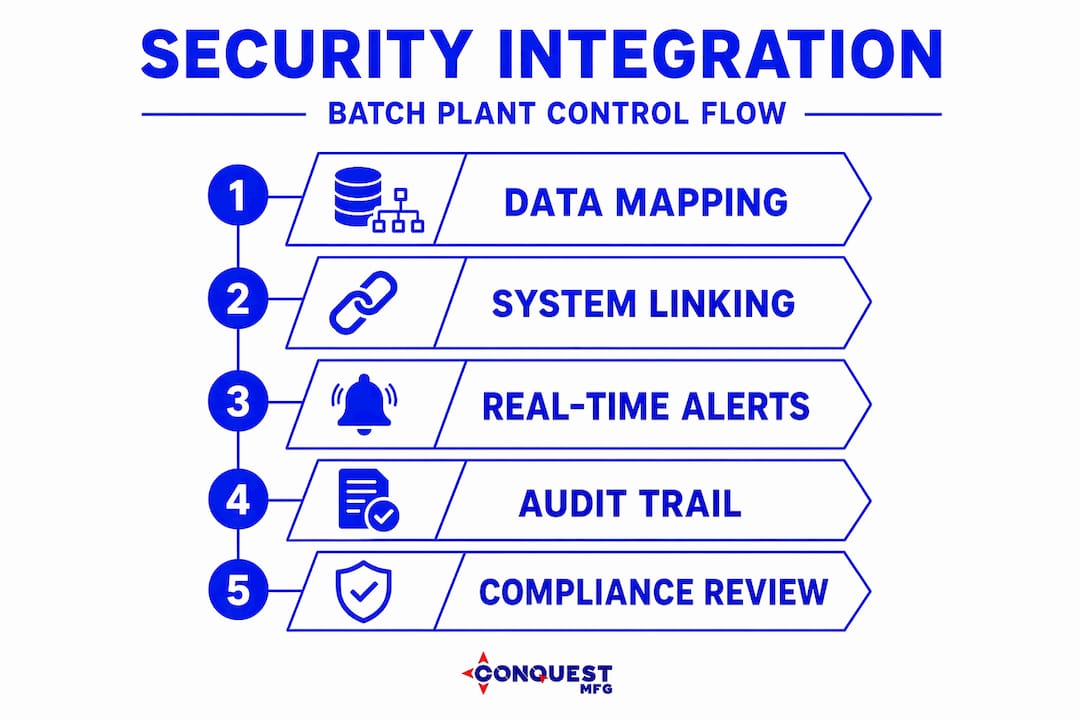
For site safety compliance purposes, this integration also supports documentation requirements and audit trails that regulators and internal safety teams both rely on.
Security risks specific to batch plant environments
The cybersecurity risks facing batch plant control systems are real, well-documented, and frequently underestimated by traditional security teams who focus primarily on IT networks. Batch plants run operational technology (OT) that was often designed for reliability and uptime rather than for cyber defense.
The most common vulnerabilities follow a predictable pattern:
- Management interfaces exposed directly to the public internet, with default or weak credentials left unchanged
- No network segmentation between the corporate IT environment and the OT floor network controlling PLCs
- Infrequent patching cycles on SCADA workstations because downtime for updates is operationally disruptive
- Limited logging or monitoring on the OT network, leaving breaches undetected for extended periods
The consequences extend well beyond data theft. A 2025 breach of Polish water treatment plants showed exactly what happens when attackers gain access to ICS environments through weak credentials and public-facing interfaces. Attackers altered operational parameters, creating direct threats to service continuity. A concrete batch plant faces comparable risks. An attacker who can modify mix ratios, bypass safety interlocks, or shut down a batch sequence creates not just a production problem but a physical safety hazard.
A critical reality for security decision-makers: The OT network in a batch plant is not a secondary concern. It is the nervous system of site operations. A compromise there can disable safety systems, falsify sensor readings, and create conditions for equipment damage or personnel injury.
IT/OT convergence security controls for batch plants need to address patching schedules, endpoint protection on SCADA workstations, multi-factor authentication on remote access, and identity management for both operators and contractors. These are not optional refinements. They are baseline requirements for any site where production and safety are intertwined. The importance of batch plants as security-critical infrastructure only grows as more facilities move toward connected, remote-managed operations.
Strategies for integrating batch plants into security systems
Securing a batch plant environment requires a layered approach that addresses both cyber and physical vectors. The following sequence reflects the most effective order of operations based on current OT security guidance and field experience.
-
Conduct a comprehensive asset inventory. Begin with a full catalog of PLCs, HMIs, switches, firewalls, and communication pathways. Cybersecurity assessments for OT environments start with this step because you cannot segment a network you have not fully mapped. Identify every connection between the OT floor and the corporate IT network.
-
Apply network segmentation. Separate OT systems from IT systems using industrial demilitarized zones (DMZs). Apply firewall rules that restrict communication to only what is operationally necessary. NIST SP 800-82 provides specific OT-focused guidance on access control, configuration management, and communications protections that apply directly to batch plant control systems.
-
Harden remote access. Replace any VPN-only access with multi-factor authentication. Limit remote access to named individuals with time-bounded sessions. Log everything.
-
Integrate video surveillance strategically. Batch plants have predictable high-risk zones: mixer access points, cement silo hatches, aggregate conveyor endpoints, and truck loading lanes. Fixed cameras at these positions, combined with mobile surveillance trailers for perimeter coverage, eliminate blind spots that fixed infrastructure cannot reach.
-
Combine data streams into a unified alert platform. PLC event logs, environmental sensor thresholds, and video motion detection should feed a single monitoring interface. This is where security technology and batch plants genuinely converge. Separate platforms generate separate alerts that operators cannot correlate fast enough to act on in real time.
The following table shows how different security layers compare in terms of coverage, cost, and deployment complexity for a typical batch plant site:
| Security layer | Coverage area | Deployment complexity | Key benefit |
|---|---|---|---|
| Fixed CCTV cameras | High-traffic zones, fixed angles | Low | Consistent coverage of known risk points |
| Mobile surveillance trailers | Dynamic zones, perimeter gaps | Medium | Rapid repositioning without rewiring |
| OT network segmentation | Control system communications | High | Prevents lateral movement by attackers |
| Environmental sensor integration | Emissions, particulate, temperature | Medium | Dual-use for compliance and intrusion detection |
| Centralized monitoring platform | All data streams | High | Unified alert management and incident logging |

Pro Tip: Mobile surveillance trailers are underused in batch plant security. They can be repositioned in hours, which makes them ideal for covering active construction zones adjacent to batch operations where the threat environment changes week to week.
Compliance and monitoring for batch plant security
Regulatory compliance and security monitoring share more overlap at batch plants than most professionals realize. In Texas, for example, the TCEQ permit requirements for concrete batch plants mandate air authorizations and require advance notification before relocation, with submissions processed through the STEERS online system. These requirements directly affect how and where surveillance infrastructure can be deployed. A plant relocation without coordinated security planning creates a compliance gap and a physical security gap simultaneously.
Environmental monitoring data creates a natural feed for security alerting. Consider these dual-use data points at a batch plant:
- Particulate matter spikes can indicate unauthorized material handling, equipment failure, or perimeter breaches near aggregate storage.
- Humidity and temperature deviations in enclosed control rooms can signal HVAC tampering or unauthorized entry.
- Discharge event timing anomalies in batch logs can identify off-schedule truck access or unauthorized mixing operations.
The challenge is calibration. Alarm threshold management requires precision because a threshold set too wide generates noise that operators start ignoring, while a threshold set too tight generates constant false alarms that erode trust in the system. The practical standard is to validate thresholds against at least 30 days of baseline operational data before treating any alert as actionable.
Centralized monitoring platforms address this by enabling rolling threshold adjustments based on historical patterns. When operational data, environmental signals, and video feeds converge in one platform, incident resolution becomes faster and more defensible during audits. The contribution of batch plants to site-wide safety monitoring is most visible precisely when these integrated systems catch a deviation that no single data stream would have flagged alone.
Managing security across multiple batch plant sites
Security programs that cover a single batch plant site are complex. Programs spanning multiple sites add coordination, logistics, and technology management challenges that require deliberate architecture from the start.
The most effective multi-site approach centers on three capabilities:
- Mobile security infrastructure for rapid deployment. Surveillance trailers can be transported between sites as threat priorities shift, providing coverage where permanent installation is not cost-justified. CEMEX’s multi-location deployment across 20-plus batch plant locations resolved 15 critical safety incidents by covering dynamic zones that fixed cameras missed. That result demonstrates the practical value of mobile surveillance in batch plant environments.
- Centralized video management and incident tracking. A single platform managing feeds from multiple sites allows security teams to apply consistent alert logic, compare incident patterns across locations, and maintain unified documentation for regulatory and legal purposes.
- Standardized OT security configurations. When each site runs its own patching schedule, credential policy, and network architecture, the weakest site becomes the entry point for the entire organization. Standardizing the concrete batch plant security baseline across all locations dramatically reduces the attack surface.
The logistical reality is that coordinating security technology across distributed sites requires close collaboration between security operations teams, plant managers, and OT engineers. These groups do not always share the same priorities or communication channels. Building a joint incident response protocol before a breach occurs is the single most practical step a decision-maker can take when managing multi-site batch plant security.
My perspective on where batch plant security actually fails
I’ve spent years working with industrial sites where batch plant automation and physical security existed in completely separate organizational silos. The security team managed cameras and access cards. The production team managed PLCs and SCADA. Nobody owned the intersection between them, and that’s exactly where incidents happened.
What I’ve found is that the most dangerous gap in batch plant security is not technical. It’s organizational. When a temperature sensor fires an alert at 2 a.m., who decides whether it’s a safety issue or a maintenance issue? If the answer is “whoever picks up the phone,” you don’t have a security program. You have a reactive incident log.
The other pattern I’ve seen repeatedly is over-engineered alarm systems that nobody trusts. Teams build 50-alert monitoring setups in the first month, get overwhelmed within 90 days, and start silencing notifications. The plants that actually improve their security posture over time are the ones that start with five high-confidence alerts and earn the right to add more as the team builds confidence in the data.
My honest advice to any decision-maker evaluating batch plants in security systems is this: start with your asset inventory, pick your top three physical and cyber risk scenarios, and design your monitoring specifically around those scenarios. The optimization of security infrastructure follows from discipline, not from complexity.
— Peter
How Conquestmfgusa supports your batch plant security program

At Conquestmfgusa, we design and manufacture stationary dry and mobile concrete batch plants with the operational technology integration needs of modern industrial sites in mind. Our mobile surveillance towers are purpose-built for rapid deployment across multi-site batch plant environments, giving security teams flexible coverage without permanent infrastructure costs. Whether you need a concrete batch plant with integrated monitoring readiness or portable surveillance infrastructure that moves with your operations, we build equipment designed to meet both production and security demands. Contact our team to discuss a solution tailored to your site configuration and compliance requirements.
FAQ
What is the role of batch plants in security infrastructure?
Batch plants contribute to security infrastructure through their PLC and SCADA control systems, which generate operational data streams that integrate with video surveillance, environmental sensors, and access control platforms to support real-time site monitoring.
How do batch plants create cybersecurity risks on industrial sites?
Batch plant OT environments are vulnerable when management interfaces are publicly exposed or when there is no segmentation between IT and OT networks. Attackers who gain access can alter operational parameters, disable safety interlocks, or disrupt production.
What security controls apply to batch plant control systems?
NIST SP 800-82 provides OT-specific guidance covering access control, network segmentation, configuration management, and communications protections. These controls apply directly to the PLC and SCADA systems running batch plant operations.
How does mobile surveillance improve batch plant security?
Mobile surveillance trailers can be repositioned across multiple batch plant sites without permanent wiring, eliminating coverage blind spots in dynamic operational zones. CEMEX’s multi-site deployment resolved 15 critical safety incidents using this approach.
How do TCEQ permit requirements affect batch plant security deployments?
TCEQ requires air authorizations and advance notification before batch plant relocation, which means security infrastructure timelines must align with regulatory submission schedules to avoid compliance gaps during moves or expansions.