
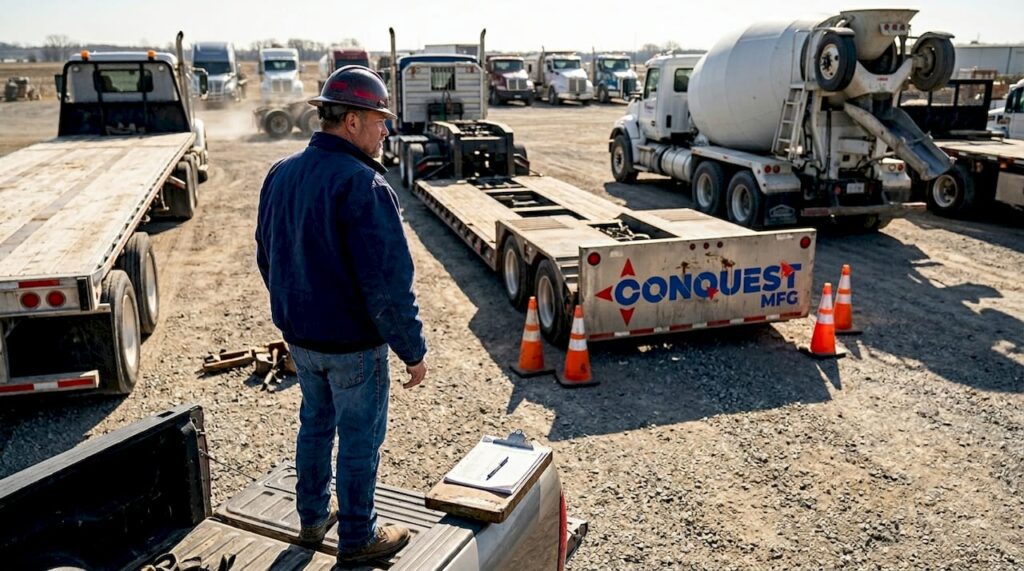
When every project timeline depends on getting the right material to the right place without a compliance violation or a dropped load, knowing your examples of transportation equipment is not a minor detail. It is a core operational decision. Construction and logistics managers in the USA face real consequences when equipment selection mismatches cargo geometry, site conditions, or federal securement rules. This article walks through the most critical types of transport vehicles used in heavy construction and concrete logistics, what specs actually matter, and how to match equipment to your project demands without second-guessing your choices on the job site.
Table of Contents
- Key criteria for choosing transportation equipment
- Examples of road transportation equipment for heavy machinery and concrete
- Rail-yard and off-highway transportation equipment
- Comparison of transportation equipment types
- Guidance on selecting transportation equipment for industrial projects
- Where conventional equipment selection advice falls short
- Explore reliable transportation equipment solutions from Conquest MFG USA
- Frequently asked questions
Key Takeaways
| Point | Details |
|---|---|
| Match equipment to load geometry | Selecting the right transportation equipment depends largely on the size, shape, and weight of your cargo to ensure safety and compliance. |
| Follow FMCSA securement rules | Proper tie-down counts and working load limits are mandatory for legal transport of heavy equipment on flatbed and lowboy trailers. |
| Evaluate concrete equipment performance | Concrete batching and delivery vehicles should be assessed on pumping capacity and placement capabilities, not just drum size. |
| Consider operating environment | Rail movers and mining trucks have specialized features designed for specific industrial environments affecting productivity and safety. |
| Integrate hands-on insights | Combining regulatory guidelines with practical experience prevents overlooked risks and improves equipment selection outcomes. |
Key criteria for choosing transportation equipment
Before you evaluate any transport equipment list, you need a clear framework for what matters on industrial projects. Four factors consistently determine whether a selection decision works in the field.
-
Load geometry and dimensions. The shape of your cargo dictates the trailer type before any other variable. As heavy equipment transportation guidance confirms, selecting the right trailer type based on load geometry is essential to avoid instability and compliance issues. A concrete batch plant component, a silo, or a wide piece of process equipment each demands different deck configurations and height clearances.
-
Tie-down requirements under FMCSA rules. Federal law governs how loads are secured, and the numbers are specific. FMCSA Part 393 requires tie-down counts and working load limits based on cargo length and weight, which is critical for legal securement. A 20-foot load needs a minimum of two tie-downs; loads over 20 feet require additional tie-downs for every additional 10 feet. Working load limits must total at least 50% of cargo weight.
-
Safety and regulatory compliance. Equipment that is legal under one state’s permits may require additional flags, escorts, or route approvals in another. Reviewing your industrial equipment safety checklist before any haul is not optional on a compliant operation.
-
Site and environmental conditions. Soft ground, limited turning radius, and overhead clearance all affect which equipment physically reaches the unloading point. A lowboy may be ideal for height but unusable if your delivery site has a tight entrance.
Pro Tip: Always confirm your gross vehicle weight rating (GVWR), the maximum allowable loaded weight of a vehicle, against state bridge laws before routing heavy equipment through multi-state corridors. Route restrictions can add significant time and cost to a delivery.
With clear criteria established, let’s explore common examples of transportation equipment used in construction and logistics.
Examples of road transportation equipment for heavy machinery and concrete
Road-based transport vehicles do the majority of the heavy lifting in construction logistics. Understanding the varieties of transport equipment available helps you match the right unit to each job.
Flatbed trailers are the workhorses of the construction supply chain. Open decks allow loading from the sides and top, making them practical for structural steel, pipe bundles, and concrete batch plant components. Common trailers include flatbeds, lowboys, and step decks chosen for bulky or oversized machinery transport.
Lowboy trailers drop the deck height between the gooseneck and rear axles, allowing taller equipment to ride within height limits. If you are hauling a mobile concrete mixer or a large piece of site plant with a tall profile, a lowboy is typically your first call.
Step deck trailers, also called drop decks, offer a two-level deck to accommodate loads that are too tall for a standard flatbed but do not require the ultra-low profile of a lowboy. They are common for transporting construction equipment in the 10 to 11.5-foot height range.
Concrete mixer trucks with integrated pump systems represent some of the most capable transportation tools examples in modern construction logistics. Advanced mixer and pump trucks can deliver up to 58 m³/h at 7.2 MPa pressure using a 24-meter placing boom, combining transit, pumping, and placement in a single unit. That capability eliminates the need for a separate pump truck on smaller pours.
Key considerations for road transport vehicle selection:
- Deck type must match load height and weight distribution
- Axle configurations affect legal load limits per state regulations
- Hydraulic systems on specialized trailers require scheduled maintenance programs
- GPS and telematic monitoring on modern units supports dispatching and load tracking
You can explore flatbed trucks and trailers examples and review truck-mounted concrete batching equipment options relevant to your project type.
Beyond road vehicles, rail and off-highway equipment play vital roles in industrial transportation.
Rail-yard and off-highway transportation equipment
Not every jobsite connects directly to a highway. Aggregate plants, mining operations, and large industrial campuses rely on specialized transportation machinery types that most road-focused logistics managers rarely encounter until they need one.
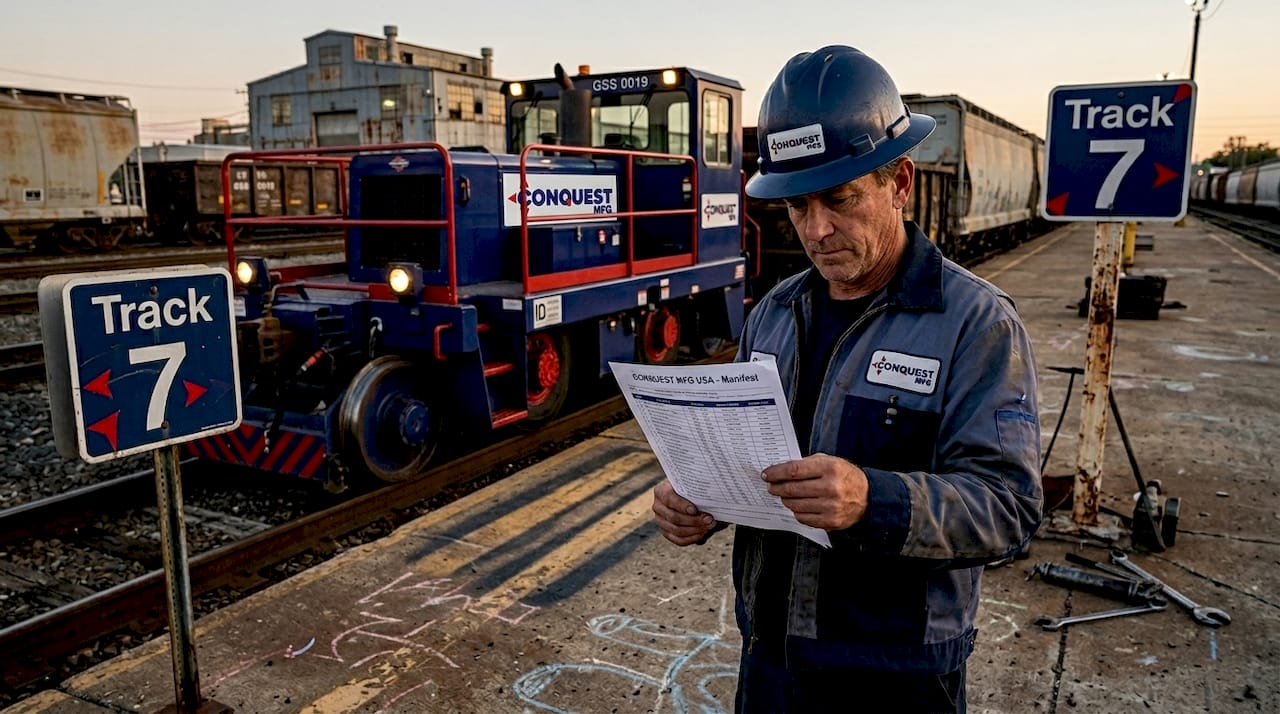
Railcar movers are self-propelled units that reposition railcars within a yard without requiring a full locomotive consist. The Atlas Heavy-Duty Railcar Mover runs a 350 HP diesel engine and uses advanced rail control systems designed for rugged yard conditions. Features like MAX-Tran and MAX-Trac systems optimize traction and switching control in environments where reliability is non-negotiable.
Off-highway haul trucks operate in conditions where road-legal vehicles cannot perform. The Cat 797F mining truck supports a 400-ton payload and targets cost-per-ton efficiency with advanced powertrain and operator productivity features. For aggregate and mining operations feeding construction supply chains, a unit like this significantly affects the economics of material delivery.
Key features of these specialized transport vehicles:
- Railcar movers use train air brake controls to interact directly with railcar brake systems
- Operator cab designs in off-highway trucks reduce fatigue on long shifts
- Engine displacement and transmission configurations match specific load and grade requirements
- Maintenance access is engineered into the design for high-utilization environments
For context on how pneumatic and bulk transport fits alongside these options, see our perspective on off-highway heavy haul trucks.
To better understand how these equipment types compare, let’s examine a side-by-side summary of their key specs.
Comparison of transportation equipment types
The table below summarizes the key features, load capacity context, and compliance notes across the main categories of transport vehicles examples discussed.
| Equipment type | Primary use case | Key performance spec | Compliance consideration |
|---|---|---|---|
| Flatbed trailer | Bulky, wide, or heavy machinery | Standard deck up to 48,000 lb payload | FMCSA Part 393 tie-down counts apply |
| Lowboy trailer | Tall equipment, heavy plant | Low deck height for 11+ ft loads | Oversize permits often required |
| Step deck trailer | Mid-height construction equipment | Two-level deck for 10 to 11.5 ft heights | State-specific height clearance permits |
| Concrete mixer with pump | Transit, pump, and place concrete | 58 m³/h at 7.2 MPa, 24 m boom | DOT weight limits on axle configurations |
| Railcar mover | Yard rail logistics | 350 HP, advanced traction control | Rail brake system compatibility required |
| Off-highway haul truck | Mining and aggregate haulage | 400-ton payload capacity | Non-road use, site-specific safety rules |
Proper securement methods include four-corner tie-downs with Grade 70 chains for heavy machinery, which is the standard to meet FMCSA rules on flatbed and lowboy hauls. Grade 70 chain, also called transport chain, has a higher working load limit than Grade 40 and is color-coded gold for field identification.
Pro Tip: When comparing flatbed trailers alternatives, look beyond deck length. Evaluate king pin placement, rear axle spread, and suspension type relative to your typical load profile. A wider axle spread distributes weight more favorably across bridge law calculations.
Having compared equipment, let’s discuss practical recommendations for selecting transportation gear tailored to your project needs.
Guidance on selecting transportation equipment for industrial projects
Deciding which common transport equipment fits your project is easier when you build the decision around five practical filters.
- Map load dimensions first. Measure height, width, weight, and center of gravity before calling a carrier or specifying equipment. This prevents costly surprises at permit offices.
- Audit tie-down capacity against FMCSA requirements. Count available anchor points on candidate trailers and verify working load limits before assigning loads.
- Evaluate concrete delivery throughput, not just drum volume. Concrete delivery planning focuses on throughput and trip cycle time beyond drum volume to ensure sufficient supply. A truck with a larger drum that runs fewer cycles per shift may deliver less concrete than a smaller truck with a tighter route cycle.
- Identify site restrictions early. Soft soil, overhead power lines, bridge weight limits, and gate dimensions all affect which equipment reaches your pour or unload point.
- Balance reliability with total cost. The lowest-cost trailer option often carries higher maintenance costs or poorer weight distribution, both of which increase your real project cost over a full schedule.
Investing in the right transportation equipment from the start reduces rework, regulatory penalties, and on-site downtime far more than any single cost-saving shortcut at the procurement stage.
You can review concrete batching and placing equipment options alongside transport solutions to align your batching capacity with delivery vehicle throughput.
Pro Tip: When specifying concrete delivery equipment, calculate the number of loads required per pour, estimated cycle time per truck, and peak pour rate to determine how many units you need running simultaneously. Running short during a continuous pour creates cold joints, which are structural defects, and those are far more expensive than renting an extra truck.
With these selection insights in hand, here is a unique perspective on how these criteria influence transportation equipment decisions in practice.
Where conventional equipment selection advice falls short
Most articles on this subject stop at “match your trailer to your load.” That is accurate but incomplete, and it is where we see managers run into trouble on real projects.
The securement issue is more nuanced than the tie-down count alone. Many operators underestimate the need for comprehensive restraint in all directions, specifically forward, rearward, lateral, and vertical lift, and the use of specialized tie-down materials for heavy loads. Four-corner tie-downs with Grade 70 chain or wire rope are the standard for good reason. A load that cannot move forward under hard braking but can shift laterally on a curve is still a hazard and a violation.
The concrete equipment side has its own blind spot. Managers often spec a mixer truck based on drum volume because that number is easy to compare. But drum volume tells you the maximum batch size, not how much concrete actually reaches the pour site per hour. Trip cycle time, pour rate demand, and mixer discharge time together determine whether you are ahead or behind. We have seen projects where managers added trucks mid-pour because the volume calculation looked adequate but the throughput analysis was never done.
Site conditions also receive far less attention than cargo specs in most planning conversations. A 48-foot flatbed with a 40-ton load looks fine on paper until you arrive at a site entrance with a 90-degree turn that a standard combination cannot navigate. Reviewing your equipment safety checklist should include a site access assessment, not just a cargo weight verification.
The managers who consistently get this right integrate formal guidelines with firsthand site knowledge. They ask the site superintendent, not just the logistics coordinator, before finalizing equipment selection.
Explore reliable transportation equipment solutions from Conquest MFG USA
If you are sourcing transportation equipment for industrial construction or logistics projects in the USA, we build equipment specifically for these demands.
At Conquest MFG USA, we manufacture stationary and mobile concrete batch plants, portable cement pig silo trailers, dry bulk pneumatic trailers, steel and aluminum vacuum tanks, bottom dumps, end dumps, sand hoppers, sand chassis, and intermodal chassis. Every unit is built to perform under demanding conditions and to meet federal compliance standards. Explore our full range of construction industry equipment and transportation equipment solutions to find units matched to your project specs. We also support aggregate operations; learn how we approach aggregate plant operations solutions for high-throughput material handling environments. Contact us to discuss your project requirements and get a quote tailored to your operation.
Frequently asked questions
What are common types of transportation equipment for heavy construction machinery?
Common types include flatbed trailers for bulky loads, lowboy trailers for tall items, and step deck trailers for loads that exceed standard flatbed height limits but do not need the ultra-low profile of a lowboy.
What are the FMCSA requirements for securing loads on flatbed or lowboy trailers?
FMCSA 49 CFR Part 393 requires tie-down counts based on cargo length and working load limits at a minimum of 50% of cargo weight, covering forward and rearward restraint as a baseline.
How do concrete mixer trucks differ in capacity and performance?
Concrete mixer trucks vary in drum volume, pumping output, and reach. Advanced mixer and pump trucks can achieve 58 m³/h maximum displacement at 7.2 MPa pumping pressure with a 24-meter placing boom for combined delivery and placement.
What features make railcar movers effective in industrial yards?
Effective railcar movers combine strong diesel engines with specialized transmission and traction systems. The Atlas trackmobile uses a 350 HP Cummins engine, MAX-Tran and MAX-Trac control systems, and train air brake controls to manage heavy rail cars in demanding yard environments.