
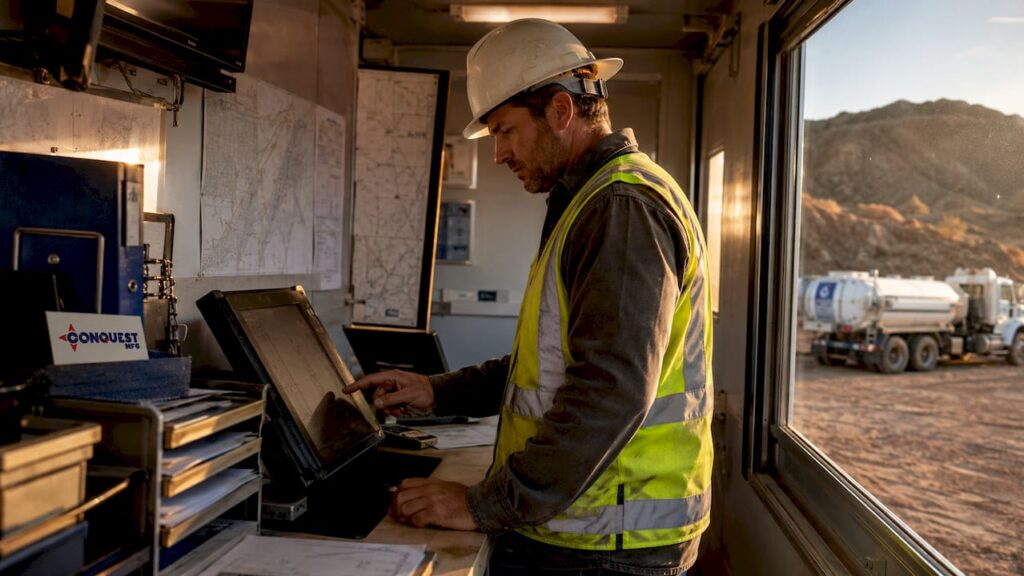
Water delivery logistics for drilling is the coordinated system of hauling, storage, and handling that keeps an uninterrupted water supply flowing to active drilling sites. Remote drilling operations depend almost entirely on hauled water delivered by tanker trucks from municipal or bulk sources, then pumped into onsite storage with volume metering and per-load billing. The industry term for this discipline is water supply chain management for drilling, and it covers everything from Class 7/8 tanker selection to frac tank manifolding and produced-water recycling. Get it wrong and you stop drilling. Get it right and your rig runs without interruption.
How are water hauling and storage organized to support drilling efficiency?
Drilling site water delivery starts at the source and ends at the rig. Tanker trucks fill at a municipal supply point or a permitted bulk water source, then transport to the site where a pump, hose, and metering device transfer the load into onsite storage. Per-load billing and volume metering give project managers a clear cost-per-barrel figure for every delivery cycle.
Storage setup is where most projects either succeed or fail. The three most common storage solutions on active drilling sites are:
- Above-ground storage tanks: Fixed or portable, sized from a few hundred to several thousand barrels. Best for sites with stable road access and predictable delivery windows.
- Frac tanks: Typically 500 BBL capacity, often manifolded together to handle large freshwater, flowback, or produced-water volumes. Their modular nature makes them the default choice for temporary drilling pads.
- Manifolded tank arrays: Multiple frac tanks connected through a common header. This setup allows simultaneous filling and withdrawal, which keeps transfer rates high during peak demand.
Every storage unit requires clear labeling, secondary containment, and a documented inspection schedule. Unlabeled tanks are a contamination risk and a regulatory liability.
| Storage type | Typical capacity | Best use case |
|---|---|---|
| Above-ground tank | 500–10,000 BBL | Long-term or permanent sites |
| Frac tank | 500 BBL per unit | Temporary pads, modular expansion |
| Manifolded array | 1,000+ BBL combined | High-volume continuous operations |
Pro Tip: Stage your storage tanks as close to the rig transfer point as possible. Shorter hose runs reduce pump pressure loss and cut transfer time per load, which directly improves tanker turnover rates.
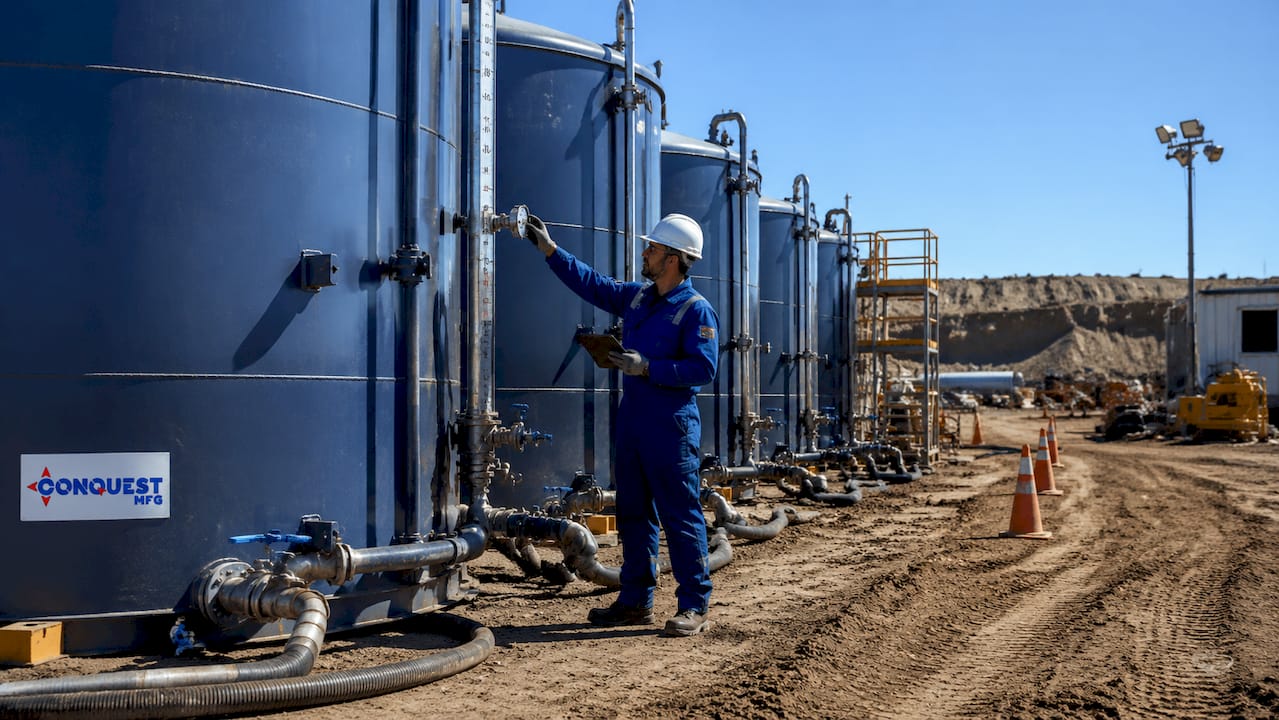
Operational controls matter as much as tank size. Every storage unit should carry a visible label showing water grade, fill date, and the last inspection result. Secondary containment berms sized for the worst-case release volume are non-negotiable on leased equipment. Routine functional inspections catch valve leaks and hose wear before they cause a transfer failure.
Why segregate water types and how does it impact drilling water logistics?
Drill water and potable water must be strictly segregated to prevent health hazards and costly rig downtime caused by contamination. This is not a preference. It is an operational requirement with direct consequences for crew safety and rig scheduling.
The four water grades that typically move through a drilling site are:
- Potable water: Meets drinking water standards. Used for crew consumption, food preparation, and medical facilities. Requires food-grade tanks and dedicated hoses that never contact non-potable sources.
- Utility or service water: Used for dust suppression, equipment washing, and fire suppression. Lower quality standard, but must still be tracked and labeled to prevent accidental use in potable systems.
- Reuse water: Treated produced water or recycled flowback that meets the quality threshold for a specific non-potable application. Requires documentation of treatment history.
- Drill water: Used directly in drilling fluid systems. Composition requirements vary by formation and mud program. Cross-contamination with potable water degrades both grades simultaneously.
Mislabeling or cross-contamination causes major rig-time losses and product damage. A single wrong-grade load pumped into the drill water system can require a full mud system flush, which stops the rig for hours. The financial cost of that delay far exceeds the cost of a proper labeling system.
Best practices for segregation include dedicated hose sets color-coded by water grade, manifold valves locked and tagged when not in use, and a written load plan for every tanker arrival. The load plan specifies the source, grade, volume, and destination tank before the truck leaves the fill point.
Pro Tip: Assign one person per shift as the water transfer coordinator. That person owns the load plan, verifies tank labels before any valve opens, and signs off on every transfer. Single-point accountability eliminates the sequencing errors that cause most contamination events.
Segregation also feeds directly into supply chain scheduling. Potable and drill water deliveries run on different frequencies and use different truck configurations. Mixing those schedules creates confusion at the fill point and increases the risk of loading the wrong grade.
What strategies optimize water supply reliability amid logistical and environmental challenges?
Water-delivery uptime depends more on tanker turnover and rapid recovery from disruptions than on average daily volumes. That single fact changes how project managers should size storage and plan schedules.
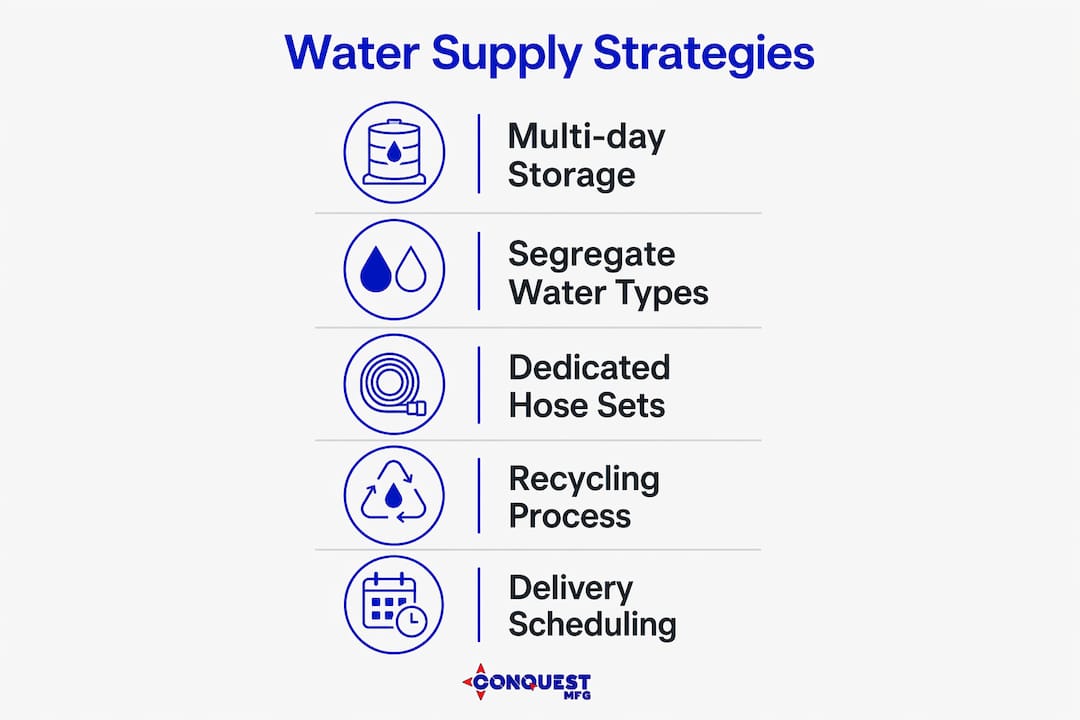
The biggest planning mistake in drilling water logistics is using a single liters-per-person value instead of separating water demand lanes. A 500-person drilling camp typically needs 150–180 m³/day of potable water plus a 15% rotation margin. Utility and drill water demands are calculated separately, using different consumption rates and different supply risk profiles. Combining all three into one number leads to oversized treatment systems and undersized storage, which is exactly the wrong trade-off.
Storage capacity should be sized for multi-day autonomy based on road access, tanker reliability, and supply-chain risk. A site with paved road access and two qualified haulers can carry less buffer than a remote pad with a single dirt road and one truck under contract. Duty and standby equipment configurations are standard practice for high-risk sites.
The comparison below shows how supply risk drives storage sizing decisions:
| Risk factor | Low-risk site | High-risk site |
|---|---|---|
| Road access | Paved, year-round | Seasonal or unpaved |
| Tanker availability | Multiple qualified haulers | Single hauler |
| Recommended buffer | 1–2 days | 3–5 days |
| Storage configuration | Single tank per grade | Duty/standby per grade |
Produced-water recycling reduces freshwater demand and improves overall supply reliability. Western Midstream’s treatment facility in the Permian Basin processes 2,000 barrels per day of produced water, reclaiming approximately 1,000 barrels per day of freshwater. That reclaimed volume directly offsets tanker deliveries, reducing road traffic and supply chain exposure.
Coordination across all three demand lanes requires a written delivery schedule that accounts for tanker maintenance windows, road closure contingencies, and treatment system downtime. Sites that treat water logistics as a quality-managed supply chain for drilling consistently outperform those that manage it informally.
What equipment and safety practices are critical for water delivery at drilling sites?
The right equipment selection determines whether your water supply chain holds under pressure or fails at the worst moment. Core equipment for drilling site water delivery includes:
- Class 7/8 tanker trucks: The standard for bulk water hauling. Payload capacity and axle configuration must match road weight limits on the access route.
- Food-grade tanks: Required for potable water. Stainless steel or NSF-certified polyethylene liners prevent contamination from tank walls.
- Centrifugal and positive-displacement pumps: Centrifugal pumps handle high-volume transfers between tanks. Positive-displacement pumps provide accurate metering for billing and inventory tracking.
- Dedicated hose sets: Color-coded by water grade, stored separately, and inspected before every use. Hose condition is the most commonly overlooked failure point in field water systems.
Safety protocols for leased temporary tank trailers require early coordination on specs, containment sizing for worst-case releases, clear labeling, and routine functional inspections. Proper safety practices reduce transfer failures and prevent cascading schedule delays. Coordinate with your equipment supplier before the trailer arrives on site, not after.
Strategic placement of water storage near transfer points with proper containment and safety testing supports fast pumping and prevents cascade failures during delivery windows. A tank positioned 500 feet from the rig with a 2-inch hose creates a bottleneck that slows every delivery cycle. Position tanks within direct pump reach of the rig’s water intake.
Pro Tip: Build a pre-delivery checklist that covers pump prime, hose connection integrity, valve position, and tank label verification. Run it before every transfer, not just at the start of a shift. Most field contamination events happen during routine transfers, not emergencies.
Routine inspection and testing schedules should cover pump seals, hose fittings, manifold valves, and containment berm integrity. Document every inspection with date, inspector name, and findings. That documentation protects your operation during regulatory audits and insurance reviews. For guidance on safe water transport practices, detailed field protocols are available to support your planning process.
Key Takeaways
Reliable drilling water logistics requires segregated demand lanes, multi-day storage buffers, and documented transfer controls to prevent contamination and maintain rig continuity.
| Point | Details |
|---|---|
| Segregate water grades | Separate potable, utility, reuse, and drill water with dedicated tanks, hoses, and load plans. |
| Size storage for disruption risk | Base buffer capacity on road access and tanker reliability, not just average daily use. |
| Use frac tanks and manifolds | 500 BBL frac tanks manifolded together handle high-volume demand on temporary drilling pads. |
| Integrate produced-water recycling | Reclaimed produced water reduces freshwater hauling demand and lowers supply chain exposure. |
| Document every transfer | Written load plans, labeled tanks, and signed inspection records prevent costly contamination events. |
What I’ve learned planning water logistics for remote drilling sites
The gap between a well-planned water supply chain and a reactive one shows up in rig time lost, not in planning documents. Project managers who treat water logistics as a secondary concern discover its importance the moment a contaminated load shuts down the mud system or a road closure leaves the site with 12 hours of potable water remaining.
The detail that consistently gets missed is storage sizing. Teams calculate average daily demand, multiply by two, and call it a buffer. That approach ignores the actual risk variables: road condition, hauler reliability, pump maintenance cycles, and seasonal weather. A site in the Permian Basin with paved access and three qualified haulers needs a different buffer than a pad in a remote basin with a single dirt road. The math is not complicated, but it requires asking the right questions before equipment gets ordered.
Produced-water recycling is underused on mid-size drilling projects. The assumption is that treatment infrastructure is only viable at large scale. Western Midstream’s Permian Basin results show that even at 2,000 barrels per day of input, the reclaim rate justifies the investment. For projects running 90 days or longer, integrating a mobile treatment unit into the water supply chain reduces hauling frequency and gives the operation a second supply source when the primary chain is disrupted.
The labeling and load plan discipline is where most field operations fall short. A color-coded hose system costs almost nothing. A written load plan takes 10 minutes per delivery. The rig-time cost of a single contamination event dwarfs both investments by a wide margin. Build the controls before the first truck arrives, not after the first incident.
— Sam
Conquest Mfg equipment built for drilling water logistics
Drilling project managers who need purpose-built equipment for water hauling and storage have a direct path to the right solution.
Conquest Mfg manufactures steel and aluminum vacuum tanks, semi trailers, and specialized oilfield equipment designed for the demands of remote drilling operations in the USA. Our vacuum tanks handle potable and non-potable water transport with the containment integrity that leased temporary equipment often cannot match. Our semi trailers for oil industry operations are built to the payload and road-weight specifications that drilling site access routes require. For project managers building out a water supply chain from the ground up, our oilfield equipment solutions cover the full range of hauling and storage needs. Contact Conquest Mfg directly to discuss equipment specifications for your next drilling project.
FAQ
What is water delivery logistics for drilling?
Water delivery logistics for drilling is the coordinated system of tanker hauling, onsite storage, and transfer controls that maintains a continuous water supply for drilling operations. It covers equipment selection, water grade segregation, storage sizing, and delivery scheduling.
How should storage capacity be sized for a drilling site?
Storage capacity should be sized for multi-day autonomy based on road access, tanker reliability, and supply-chain risk factors, not just average daily water use. Sites with limited road access or a single hauler require 3–5 days of buffer per water grade.
Why is water type segregation critical in drilling operations?
Cross-contamination between drill water and potable water causes rig-time losses and crew health risks. Dedicated tanks, color-coded hoses, and written load plans for every delivery prevent mislabeling events that stop drilling.
How does produced-water recycling improve water supply reliability?
Produced-water treatment reclaims freshwater from flowback and produced water, reducing dependence on tanker deliveries. Western Midstream’s Permian Basin facility reclaims approximately 1,000 barrels per day from 2,000 barrels of input, directly offsetting hauling demand.
What are the most common equipment failures in drilling water logistics?
Hose condition and pump seal integrity are the most frequently overlooked failure points. Routine pre-transfer checklists covering hose fittings, valve positions, and pump prime status prevent the majority of transfer failures and contamination events.