
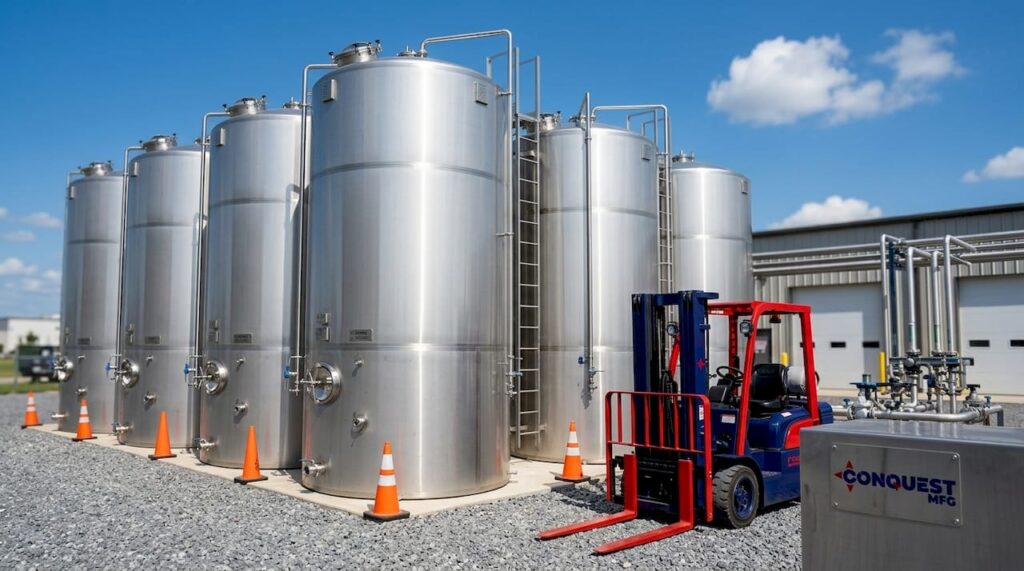
A silo tank is a purpose-engineered bulk storage vessel designed to safely contain liquids, semi-liquids, and solids across industrial processes, with capacities reaching 1,000,000 liters and configurations tailored to specific product, hygiene, and site requirements. Industries from food processing and pharmaceuticals to construction and chemical manufacturing depend on silo tanks to protect material integrity, support continuous production, and meet strict regulatory standards. Choosing the right silo tank means understanding the full range of types, materials, safety requirements, and operational factors before you commit to a specification. This guide covers every dimension of that decision.
What are the main types of silo tanks?
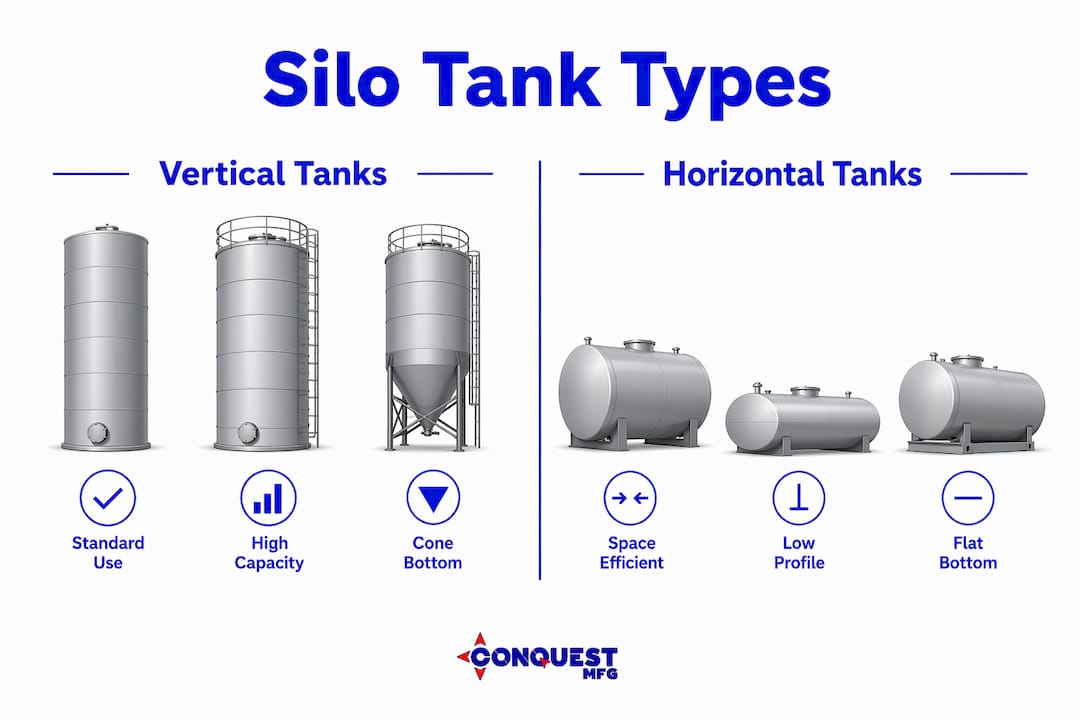
Silo tanks divide into two primary configurations: vertical and horizontal. Vertical silos are the industry standard for most bulk storage applications because they minimize floor space while maximizing volume. Horizontal silos suit low-clearance installations or sites where structural support for tall vessels is impractical. Both formats are available in a wide range of materials and bottom configurations that directly affect how material discharges and how the vessel cleans.
Material selection is one of the most consequential choices in any silo tank specification. Stainless steel grades 304 and 316 are the standard for food, dairy, and pharmaceutical applications because they resist corrosion and support sanitary finishing. Carbon steel with epoxy or other protective coatings handles dry bulk materials like cement, grain, and frac sand at lower cost. Modular bolted panel construction, typically galvanized or epoxy-coated steel, offers a third path for large-volume dry bulk storage where on-site fabrication is impractical.
Bottom configuration determines discharge behavior and cleaning effectiveness. Cone bottoms promote gravity flow and are preferred for viscous liquids or materials prone to bridging. Flat bottoms work for free-flowing dry solids and reduce overall vessel height. Sloped bottoms offer a middle ground, directing material toward a single discharge point without the full height penalty of a cone. Selecting the wrong bottom for your product is one of the most common and costly specification errors.
| Silo tank type | Key features | Typical industries | Capacity range |
|---|---|---|---|
| Vertical stainless steel | 304/316 SS, CIP ports, insulation options | Food, dairy, pharma | 1,000 to 50,000 gallons |
| Horizontal stainless steel | Low-profile, heat jackets, sanitary finish | Chemical, beverage | 500 to 20,000 gallons |
| Carbon steel with coating | Epoxy lining, heavy-duty shell | Cement, construction | 10,000 to 500,000+ gallons |
| Modular bolted panel | Ground-level assembly, relocatable | Grain, frac sand | 50,000 to millions of gallons |
Pro Tip: Specify your bottom configuration and discharge connection size before selecting a vendor. Changing the bottom design after fabrication begins adds significant cost and schedule delay.
How do silo tanks meet hygiene, safety, and compliance requirements?
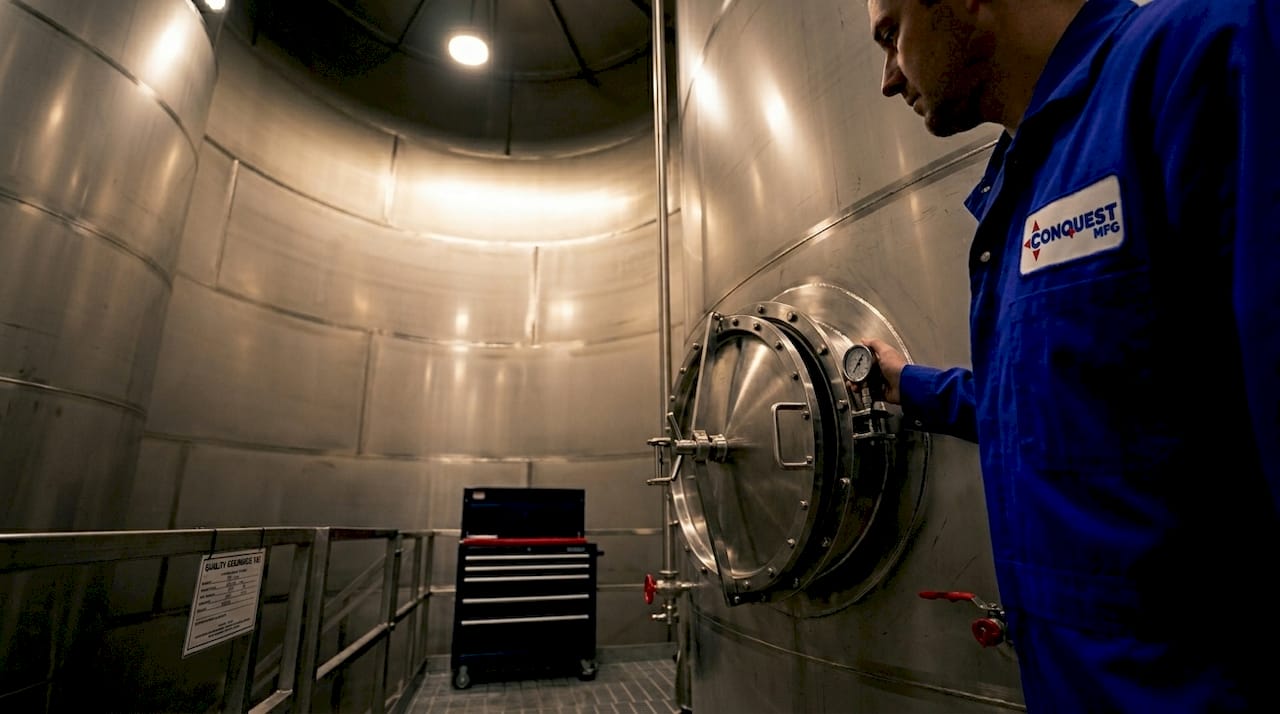
Hygienic design is not a feature you add to a silo tank after the fact. For food and pharmaceutical applications, CIP and sanitary design are core engineering requirements built into the vessel from the start. Spray coverage depends on tank geometry, including cone slope angle, vessel diameter, and the placement of access ports. A sprayball positioned without accounting for internal baffles or agitators will leave dead zones that harbor contamination. GMP and HACCP compliance require documented cleaning validation, which means your tank geometry and CIP circuit must be engineered together.
Dry bulk silo tanks introduce a different category of risk: combustible dust. Grain, wood dust, cement, and frac sand all generate fine particulates that can ignite under the right conditions. Grain storage silos require dust collectors and explosion venting per NFPA and OSHA standards, and this is not optional. A sawdust silo explosion in Maine demonstrated exactly what happens when ignition controls are absent. The incident released large amounts of sawdust and lifted the silo from its base, causing fatal injuries. That outcome is preventable with proper engineering.
Explosion venting systems require precise calculation, not rule-of-thumb sizing. Per NFPA 68, vent panels must open at specific pressures linked to the structural yield of the vessel, and length-to-diameter ratios affect which venting approach applies. L/D ratios up to 5 apply for gas venting and up to 6 for dust venting, with special cases extending to 8. Getting this wrong means your vent system either fails to open in time or damages the structure it was meant to protect.
Structural design for steel silos follows Eurocode 3 Part 4-1 (2026), which sets limits on aspect ratio (height-to-diameter below 10), total height below 70 meters, and equivalent diameter below 60 meters. These limits define the boundary conditions for standard structural calculations. Projects outside these limits require custom engineering analysis.
Key compliance features to specify for any industrial silo tank:
- Explosion venting panels sized per NFPA 68 for combustible dust or gas
- Dust collection connections at fill points and vents
- Sanitary ports, sprayballs, and sloped internal surfaces for CIP
- FDA-approved or epoxy linings for chemical and food contact surfaces
- Pressure and vacuum relief valves for sealed vessels
- Grounding and bonding provisions for static discharge
Pro Tip: Engage your safety engineer and your process engineer at the same time during silo tank specification. Safety venting and hygienic design both affect vessel geometry, and resolving conflicts early costs far less than a redesign.
What factors drive silo tank selection for specific industries?
Industrial silo selection is process-driven customization, not a matter of picking a size from a catalog. The product you store dictates nearly every design parameter. A liquid dairy ingredient requires 316 stainless steel, a polished interior, CIP capability, and possibly a heating jacket to maintain viscosity. A dry cement silo needs carbon steel, an aeration system to keep powder flowing, and a dust collector on the fill vent. These two vessels share a name and almost nothing else.
Environmental conditions shape the specification further. Outdoor installations in northern climates require insulation and heat tracing to prevent freezing or condensation. Coastal or high-humidity environments demand more aggressive corrosion protection, whether through stainless steel selection or high-build epoxy coatings. Indoor installations face ceiling height restrictions that may force a horizontal configuration or a shorter, wider vertical vessel.
Discharge behavior is where many specifications go wrong. Dry bulk silo discharge depends on mass-flow and funnel-flow principles, and the wrong bottom design for your material causes bridging, ratholing, and unplanned downtime. Mass flow, where all material moves simultaneously toward the outlet, requires steeper cone angles and smooth interior surfaces. Funnel flow, where material channels through the center, works for free-flowing granular products but fails with cohesive powders. Your reclaim system, whether pneumatic, screw conveyor, or gravity, must match the flow regime your bottom design produces.
Site constraints often make the final decision. Consider these factors when evaluating your installation:
- Available footprint and ceiling or clearance height
- Foundation load capacity for full vessel weight
- Access for maintenance, inspection, and cleaning
- Proximity to fill points, conveyors, and process equipment
- Local zoning and permit requirements for vessel height
Industries like dairy, grain storage, chemical processing, and frac sand each present distinct combinations of these factors. A frac sand operator in a tight yard needs a modular bolted silo that assembles without a large crane. A dairy processor needs a sanitary vertical tank with documented CIP validation. Tailored solutions, not standard catalog items, produce reliable results.
What are the advantages of modular bolted silo tank systems?
Modular flat-panel bolted silos have changed how contractors approach large-volume dry bulk storage. Traditional field-welded tanks require skilled welders, extended on-site schedules, and significant crane time. Modular bolted silos enable faster commissioning and use a ground-level jacking method that eliminates most high-angle work. This matters on congested industrial sites where crane access is limited and schedule overruns carry real financial penalties.
The operational advantages extend beyond installation. Here is how modular systems compare to conventional welded tanks across the project lifecycle:
- Assembly speed. Panels are pre-fabricated and arrive ready to bolt together. Ground-level jacking means crews work at safe heights throughout erection, reducing both schedule risk and safety incidents.
- Corrosion protection. Full-wrap epoxy powder coatings protect panel edges, not just flat faces, which is where corrosion typically initiates on painted steel tanks. This extends service life in outdoor and humid environments.
- Relocatability. A bolted silo can be disassembled, transported, and reassembled at a new site. For contractors working temporary or multi-site projects, this turns a capital asset into a reusable tool.
- Scalability. Modular systems allow capacity expansion by adding panels or rings without replacing the entire vessel.
- Integration readiness. Standard connection points for dust collectors, conveyors, and discharge hardware are designed into the panel system, reducing field fabrication at commissioning.
For pneumatic trailer integration and continuous bulk material handling, modular silos provide the discharge geometry and connection standardization that keeps material moving without bottlenecks.
Key takeaways
Selecting the right silo tank requires matching vessel type, material, bottom configuration, and safety systems to your specific product, process, and site conditions before fabrication begins.
| Point | Details |
|---|---|
| Configuration drives everything | Vertical vs. horizontal and bottom type must match product flow behavior and site constraints. |
| Material selection is non-negotiable | Food and pharma require 304/316 stainless steel; dry bulk applications use coated carbon steel or modular panels. |
| Safety compliance is structural | Explosion venting per NFPA 68 and structural limits per Eurocode 3 Part 4-1 must be engineered in, not added later. |
| Modular systems reduce project risk | Ground-level jacking, relocatability, and faster commissioning make bolted silos the preferred choice for contractors on tight schedules. |
| Specify early and completely | CIP design, discharge reclaim systems, and safety venting all affect vessel geometry. Resolve conflicts at specification, not during fabrication. |
Why I always push clients to specify the discharge system first
After years of working with bulk material handling equipment, the pattern I see most often is this: a business selects a silo tank based on capacity and price, then discovers the discharge system does not match the material’s flow behavior. The result is bridging, ratholing, or a reclaim system that cannot keep up with production demand. These are not minor inconveniences. They cause unplanned downtime, product loss, and sometimes structural damage to the vessel itself.
The fix is straightforward but requires discipline. Start with your material’s flow properties, particle size, bulk density, and cohesion, then work backward to the bottom configuration and reclaim system. Only then should you finalize vessel dimensions and material of construction. This sequence feels counterintuitive because most procurement processes start with volume and budget, but it produces specifications that actually work.
I also see businesses underestimate the value of modular construction for anything beyond permanent, fixed installations. If there is any chance your operation will expand, relocate, or change product mix within the next decade, a bolted modular silo pays for itself in flexibility. The pig silo trailer approach to portable cement storage is a good example of how mobility and storage capacity can coexist without sacrificing reliability.
The businesses that get silo tank projects right treat the specification process as seriously as the fabrication process. Vendor collaboration, early safety engineering, and process-specific customization are what separate a tank that performs for 20 years from one that causes problems from day one.
— Peter
How Conquestmfgusa supports your bulk storage needs
Conquestmfgusa designs and manufactures specialist bulk material handling equipment built for the demands of construction, oil, and industrial operations across the USA. Our product line includes portable cement pig silo trailers, dry bulk pneumatic trailers, and concrete batch plants that integrate directly with fixed silo tank systems to create complete material handling solutions.
Whether you need a portable silo for a job site or a fixed bulk storage tank solution that connects to your existing construction equipment, our team works with you to specify equipment that fits your process, your site, and your schedule. We also support batch plant integration for concrete production operations where silo capacity and discharge reliability are critical to output. Contact Conquestmfgusa to discuss your project requirements and get a quote tailored to your operation.
FAQ
What is a silo tank used for?
A silo tank stores bulk liquids, semi-liquids, and solids in industrial processes, including food ingredients, chemicals, cement, and grain. Configurations and materials are selected based on the product’s physical properties and hygiene requirements.
What materials are silo tanks made from?
Silo tanks are manufactured from stainless steel grades 304 or 316 for food and pharmaceutical applications, carbon steel with protective coatings for dry bulk and chemical storage, and galvanized or epoxy-coated modular steel panels for large-volume dry bulk systems.
How do you maintain a silo tank?
Maintaining a silo tank involves scheduled CIP cleaning cycles for liquid tanks, inspection of coatings and linings for corrosion, testing of pressure and vacuum relief valves, and verification that explosion venting panels are unobstructed and within their rated burst pressure range.
What is the difference between mass flow and funnel flow in a silo?
Mass flow means all stored material moves simultaneously toward the discharge outlet, which prevents bridging and ensures first-in, first-out product rotation. Funnel flow channels material through the center of the vessel and works only for free-flowing granular products that do not compact or bridge.
How large can a silo tank be?
Silo tanks are available from approximately 1,000 gallons for stainless steel sanitary vessels up to millions of gallons for large modular bolted grain or industrial storage systems, with structural design governed by Eurocode 3 Part 4-1 limits on height and diameter.