
Table of Contents
Key Takeaways
| Point | Details |
|---|---|
| Vacuum tanks drive efficiency | Proper vacuum tanks speed up pumping times, ensuring more jobs get done with less downtime. |
| Full removal is now standard | Modern standards and EPA guidance recommend fully removing all sludge and scum for best performance. |
| Technology upgrades cut costs | Advances like peristaltic pumps and optimized tank design can reduce cleaning costs and increase throughput. |
| Attention to inspection prevents issues | Thorough inspection and cleaning of all compartments and roots prevent future failures or callbacks. |
Understanding the vacuum tank’s function in septic service
The vacuum tank does one job, but it does it under demanding conditions every single day. Understanding exactly how it works helps you make smarter decisions about equipment selection, maintenance schedules, and field procedures.
The core mechanism is straightforward. A vacuum pump mounted on the truck removes air from the sealed tank, creating negative pressure inside. Negative pressure (15-27 inches Hg) allows atmospheric pressure outside the tank to push liquid waste through a 4-inch hose and into the tank at a controlled rate. The atmospheric pressure does the heavy lifting. Your pump just maintains the vacuum.
Several variables determine how efficiently that process runs:
-
Tank size and shape: Larger tanks reduce the number of trips to a disposal site, but tank geometry also affects how completely waste settles and how easily the tank can be cleaned between jobs.
-
Hose diameter: A 4-inch hose is standard for residential work, but larger diameter options move higher volumes faster in commercial or industrial applications.
-
Pump capacity: Pump rating determines how quickly you can pull vacuum and sustain it through a full job cycle.
-
Seal integrity: Any leak in the system reduces vacuum pressure and slows suction dramatically.
The cycle itself runs in phases: the pump evacuates the tank to target vacuum, waste flows in through the hose, the operator monitors fill level, and the system switches to atmospheric venting before transport. Residential jobs cycle through this process quickly. For a standard single-compartment tank, the actual vacuum time is a fraction of total job time.
| Factor | Impact on efficiency |
|---|---|
| Tank vacuum rating | Determines suction speed and waste throughput |
| Hose length and diameter | Longer or narrower hoses reduce flow rate |
| Sludge density | Dense sludge requires sustained vacuum or agitation |
| Seal and valve condition | Worn seals cause vacuum loss and extend job time |
The role and design of vacuum tanks directly affects every one of these variables. Steel and aluminum construction options, baffled interiors, and reinforced valve assemblies all contribute to how reliably a tank performs under daily field conditions.
Pro Tip: Inspect tank seals, pump connections, and valve assemblies at the start of every shift. A five-minute check prevents the kind of mid-job vacuum loss that turns a 45-minute residential call into a two-hour problem.
Step-by-step: The septic waste removal and transport process
Knowing the mechanics is one thing. Executing the job efficiently and completely is another. Here is how a well-run septic pump-out should proceed from arrival to departure.
-
Site assessment on arrival: Locate the access lids, assess ground conditions, and identify any obstacles that could limit hose placement or truck positioning. Root intrusion, settled lids, and tight access points need to be flagged before you set up.
-
Hose setup: Run the hose from the truck to the tank opening. Minimize bends and elevation changes where possible. Every foot of unnecessary hose length and every sharp bend reduces effective suction at the tank inlet.
-
Initial vacuum pull: Start the pump and pull vacuum to operating pressure. Watch the gauge. If vacuum builds slowly or drops unexpectedly, check connections before proceeding.
-
Waste extraction: Begin drawing waste. Monitor the hose for changes in flow that signal sludge density shifts. Liquid layers move fast. Sludge layers slow things down and may require repositioning the hose or adjusting vacuum levels.
-
Level monitoring: Watch tank fill levels carefully. Overfilling creates transport compliance issues and risks spills. Most operators target 90% capacity to allow for expansion and safe transit.
-
Final inspection of the source tank: Before pulling the hose, visually inspect the septic tank interior for structural issues, baffle condition, and any residual buildup that signals incomplete removal.
-
Sealing for transport: Close all valves, confirm seal integrity, and secure the hose. Vacuum tank transport solutions designed for liquid waste must meet leak-proof standards for road transit. This is a regulatory requirement, not a suggestion.
-
Departure and disposal: Transport to an approved disposal facility, following all state and local regulations for liquid waste manifesting and offloading.
“Pumping a standard 1,000-1,500 gallon residential septic tank takes 30-60 minutes using vacuum suction.”
That 30-to-60-minute window is your benchmark. If jobs are consistently running longer, the problem is almost always equipment related. Insufficient vacuum pressure, undersized hose, or worn pump components are the most common culprits. Slow suction does not just hurt your schedule. It increases labor cost per job and limits how many service calls you can complete in a day.
Pro Tip: Always monitor for unusual sludge density during extraction. If the hose goes rigid or suction drops sharply, you may be hitting compacted sludge. Reposition the hose or use backflushing to break up the material before continuing. Forcing through compacted sludge risks hose damage and incomplete removal.
Best practices: Complete removal and tank inspection
There is a persistent myth in the field that leaving some sludge behind helps the septic system restart faster by “seeding” bacteria. This idea is outdated and not supported by current guidance. EPA recommends complete pump-out removing all sludge, scum, and liquid. Bacteria repopulate naturally after a full pump-out without any assistance from residual material.
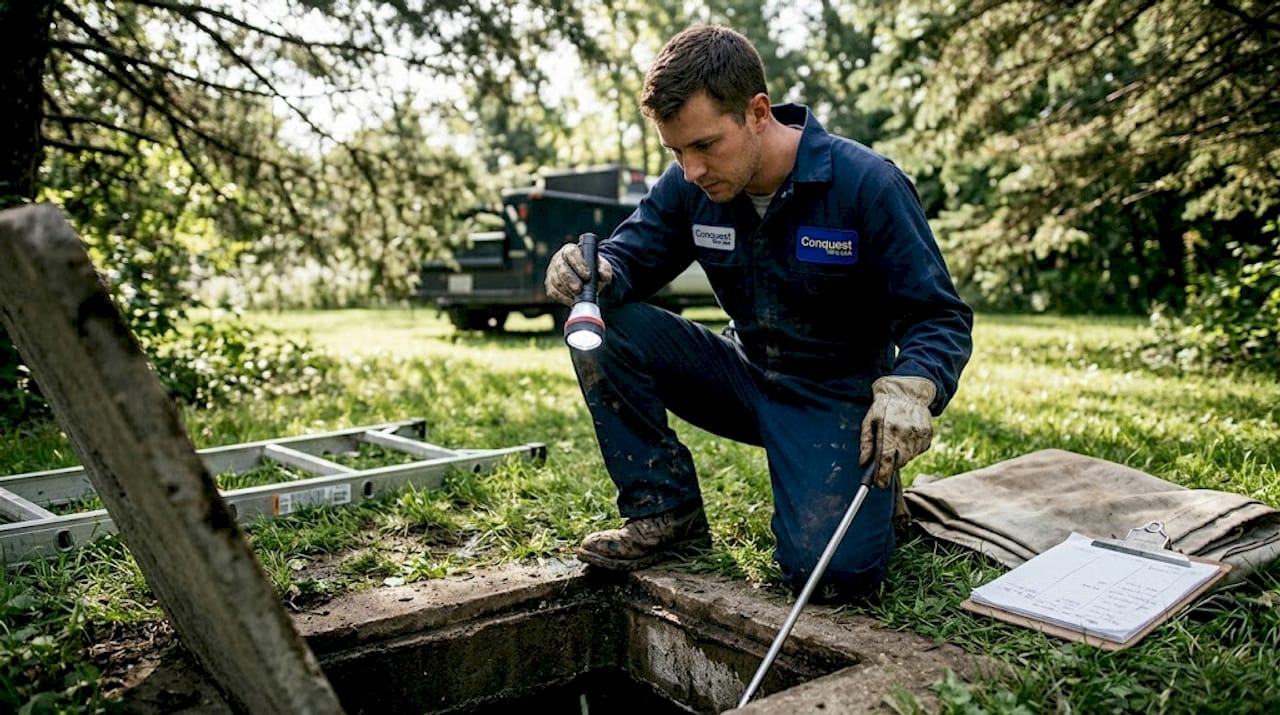
Partial pump-outs create real problems. Residual sludge continues to accumulate on top of what was left behind, shortening the interval before the next service call is needed. For clients, that means more frequent and more expensive service. For your operation, it means callbacks and the reputational risk that comes with them.
The distinction between pumping and cleaning is also worth understanding clearly. Pumping removes liquid and loose solids, while cleaning adds jetting or agitation to address compacted buildup on tank walls and the bottom. Neglected tanks, particularly those that have gone five or more years without service, often require cleaning rather than simple pumping.
Comparison: Pumping vs. cleaning
| Service type | What it removes | When it’s appropriate | Equipment needed |
|---|---|---|---|
| Standard pumping | Liquid, scum, loose solids | Regular maintenance intervals | Vacuum truck, standard hose |
| Full cleaning | All of the above plus compacted residue | Neglected tanks, pre-inspection | Vacuum truck, jetting equipment |
| Backflushing | Breaks up compacted sludge | Dense buildup, two-compartment tanks | Water source, vacuum truck |
Edge cases require specific attention:
-
Two-compartment tanks: Each compartment must be accessed and pumped independently. Missing the second compartment is a common error that leaves significant waste volume behind.
-
Tight access lids: Corroded or settled lids slow access and can create safety hazards. Carry the right tools to handle them without damaging the riser or tank top.
-
Root intrusion: Tree roots growing into the tank or inlet pipe are a sign of structural compromise. Document and report this to the client. It is not something a pump-out alone will resolve.
Advanced inspection steps after each service call:
-
Check inlet and outlet baffles for cracks or displacement
-
Inspect tank walls for signs of structural cracking or settlement
-
Verify that the liquid level drops to the outlet pipe level after pumping (high levels after pumping indicate a drain field issue)
-
Document findings with photos for client records and liability protection
Connecting these practices to vacuum tank innovations in tank design, including reinforced baffles, improved access ports, and corrosion-resistant interiors, makes the entire inspection and cleaning process faster and more reliable.
Efficiency gains: Technology upgrades and cost drivers
Equipment technology has moved well ahead of what many contractors are still running in the field. The gap between an older batch-process vacuum tanker and a modern continuous-flow system is significant in both throughput and operating cost.
The numbers make the case clearly. Switching from a batch vacuum process to a continuous peristaltic pump reduced digester cleaning time and costs by 35%, with throughput increasing from 50 cubic meters per hour to 130 cubic meters per hour. That is not a marginal improvement. That is a fundamental change in how much work a single unit can complete per shift.
Technology comparison: Batch vacuum vs. continuous flow
| System type | Throughput | Cost per job | Best application |
|---|---|---|---|
| Batch vacuum tanker | 50 m³/h | Higher per cycle | Standard residential |
| Continuous peristaltic pump | 130 m³/h | 35% lower overall | High-volume or industrial |
| Hybrid systems | Variable | Mid-range | Mixed residential/commercial |
For field operators, the features that drive the strongest return on investment include:
-
Higher vacuum pump ratings that sustain pressure through dense sludge without cycle interruption
-
Larger tank capacity that reduces disposal trips per day, directly cutting fuel and labor costs
-
Corrosion-resistant tank materials (aluminum or coated steel) that extend service life and reduce maintenance downtime
-
Improved valve and seal assemblies that hold vacuum longer and reduce the risk of mid-job failures
-
Better hose management systems that speed setup and breakdown at each job site
The operational trade-offs are real. Larger tanks cost more upfront and add gross vehicle weight, which affects licensing requirements and road access in some residential areas. Continuous-flow pump systems require more sophisticated maintenance than simpler batch setups. These are decisions that need to match your specific service mix, not just the highest-spec option available.
Advanced vacuum tank features and efficient liquid waste transport configurations should be evaluated against your actual job profile. A contractor running 80% residential work has different needs than one focused on commercial grease trap or industrial wastewater service.
Beyond the specs: What most service pros overlook
We see a consistent pattern in how contractors approach vacuum tank decisions, and it concerns us. Most of the conversation centers on pump ratings and tank capacity. Those specs matter, but they are not where most operations actually lose time and money.
The real losses happen in the field, in decisions that feel minor in the moment. Partial pump-outs are the clearest example. A technician who leaves sludge behind to save 10 minutes is not saving anything. That residual material accelerates the next service interval, increases the risk of system backup between visits, and creates a callback situation that costs far more than those 10 minutes were worth. Modern EPA guidance favors full removal precisely because partial pump-outs compromise system performance in ways that are not immediately visible.
The second overlooked area is interior inspection. Most pump-out calls are treated as extraction-only events. The hose goes in, the tank empties, the hose comes out. But the two to three minutes it takes to visually inspect the baffles, check the liquid level after pumping, and look for signs of root intrusion or cracking is where you catch problems before they become emergencies. Clients who receive that level of attention become long-term clients. They also refer others.
Edge cases are where the best operators separate themselves from the average ones. A two-compartment tank where only one side gets pumped, a root-compromised inlet that gets ignored because it is not part of the work order, an access lid that gets forced instead of properly cleared. These are the moments that define whether your operation builds a reputation for thoroughness or for speed.
Our position is straightforward: field knowledge matters more than spec sheets. The operator who knows how to read sludge density changes through hose behavior, who checks the outlet baffle every time, and who takes the extra minutes to do the job completely is more valuable than the fastest truck on the road with the wrong approach.
Equip your septic operation for greater efficiency
If this article has reinforced anything, it is that vacuum tank performance is central to every outcome in your septic service operation. Job completion time, compliance during transport, client satisfaction, and your cost per service call all trace back to the equipment you run and how well it is matched to your work.
We build steel and aluminum vacuum tanks at Conquest Manufacturing specifically for the demands of liquid waste transport and septic service. Our tanks are engineered for reliability under daily field conditions, with attention to seal integrity, corrosion resistance, and the structural strength that keeps your operation running without unplanned downtime. Explore our septic equipment solutions to see tank configurations built for professional contractors. For transport-focused needs, our liquid waste transport options cover the full range of semi-trailer and tank configurations your operation may require. Contact us to discuss your specific requirements.
Frequently asked questions
How does vacuum pressure move septic waste into the tank?
Vacuum pumps create negative pressure inside the tank, and atmospheric pressure outside pushes waste through large hoses into the tank for rapid removal.
What’s the difference between pumping and cleaning a septic tank?
Pumping removes liquid and loose solids, while cleaning involves breaking up and removing compacted residue from tank walls and the bottom using jetting or agitation equipment.
How long does it take to fully pump a standard residential septic tank?
Fully pumping a 1,000 to 1,500 gallon tank typically takes 30-60 minutes with properly maintained vacuum equipment operating at correct pressure.
Why is full sludge removal better than partial, and does bacteria need reseeding?
Complete removal is EPA-recommended for proper system performance. Bacteria repopulate naturally after a full pump-out without any need for residual sludge to remain in the tank.
What new technology is boosting efficiency in septic operations?
Upgrades like continuous peristaltic pumps drastically reduce cleaning time and cost compared to batch vacuum tankers, with documented throughput increases of more than 2.5 times over older systems.