
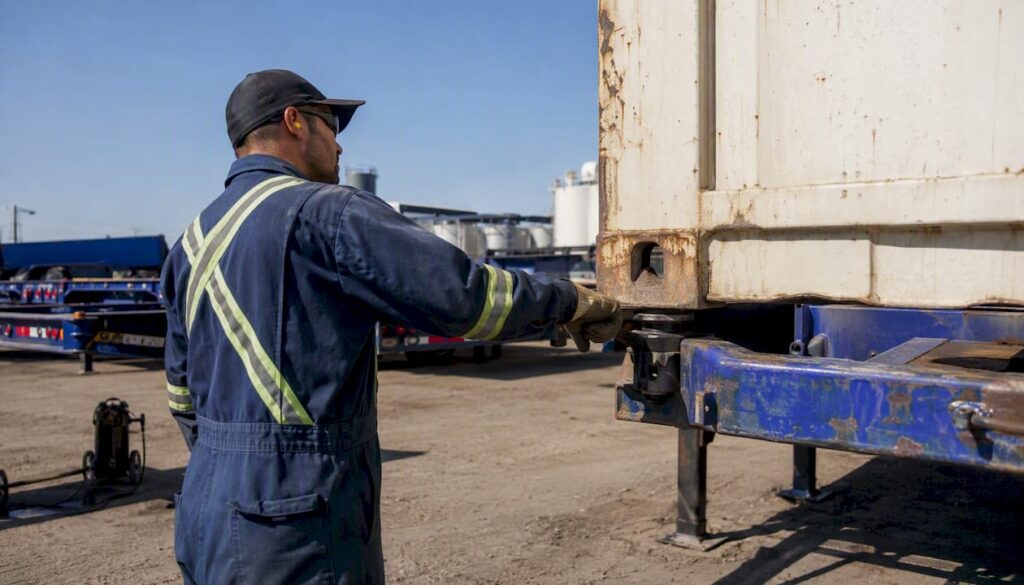
The five primary chassis twist lock types are manual, semi-automatic (SATL), fully automatic (FATL), dovetail, and breech-base, with retractable and chassis-fixed variants serving specialized multi-use decks. For most U.S. intermodal highway chassis, semi-automatic locks deliver the best balance of worker safety and retrofit cost. Fully automatic locks suit high-throughput crane terminals where speed justifies the capital outlay. Manual locks remain viable for low-volume yard and rail applications where budget is the primary constraint. Three factors drive every selection decision:
- Operation mode: manual handling vs. gravity-activated vs. fully automated release
- Chassis compatibility: slot spacing, deck height, and weld/bolt pattern on your specific frame
- Maintenance burden: spring and cable inspection frequency for SATLs vs. simpler wear checks on manual types
Key Takeaways
Selecting the correct chassis twist lock type requires matching operation mode, chassis geometry, and maintenance capacity, not simply choosing the lowest-cost unit available.
| Point | Details |
|---|---|
| Semi-automatic locks lead for highway use | SATLs remove the highest-risk manual action and suit most U.S. intermodal highway chassis without crane infrastructure. |
| ISO conformance is non-negotiable | Every lock must meet ISO corner casting dimensional standards to transfer restraint loads correctly under dynamic conditions. |
| Inspect weekly, document every check | Torque bolts, check weld integrity, and test SATL spring tension on a weekly cycle; record technician name, position, and date. |
| Retractable locks serve mixed-service fleets | For chassis handling both container moves and flatbed freight, retractable locks preserve deck versatility without sacrificing securement. |
| Conquest Mfg supports full integration | Conquest Mfg engineers intermodal chassis with twist lock pockets, retrofit reinforcement, and inspection program support built in from the frame up. |
Table of Contents
- How twist locks interface with ISO corner castings
- A complete catalogue of chassis twist lock types
- Matching lock types to common U.S. chassis configurations
- Standards and approvals that govern twist lock specifications
- Inspection and maintenance checklist for chassis twist locks
- How to select the right twist lock for your chassis
- Conquest Mfg’s perspective on twist lock integration
- Conquest Mfg chassis solutions built for safe container securement
- Sources
How twist locks interface with ISO corner castings
A twist lock is a mechanical fastener that engages the oval aperture of an ISO corner casting on a shipping container’s base. The locking head, typically a cone or truncated-cone profile, inserts into the casting aperture and rotates 90 degrees. That rotation seats the head against the casting’s internal shoulders, transferring vertical, longitudinal, and lateral restraint loads directly into the chassis frame. Without that engagement, a container can shift during hard braking or a lane-change maneuver, with consequences that range from cargo damage to a catastrophic road incident.
Logistics professionals need to know four terms cold: corner casting (the ISO-standardized steel fitting welded to each container corner), locking head (the rotating element of the twist lock), double-ended lock (a lock that engages castings on two stacked containers simultaneously), and recessed/flush lock (a lock that sits below the deck surface when not in use, preserving a flat load floor).
A complete catalogue of chassis twist lock types
Twist-lock designs are classified by automation level and application, with each class carrying distinct trade-offs in cost, throughput speed, and safety exposure. The table below maps every major type across the dimensions that matter most in procurement and fleet engineering.
| Type | Operation mode | Best chassis fit | Retrofit complexity | Maintenance needs | Relative cost |
|---|---|---|---|---|---|
| Manual | Worker rotates head by hand | Low-volume yard, rail | Low | Low (wear checks) | Lowest |
| Semi-automatic (SATL) | Locks on container weight; manual release | Highway intermodal, combo chassis | Moderate | Moderate (springs, cables) | Mid |
| Fully automatic (FATL) | Locks and releases via crane/terminal system | High-throughput crane terminals | High | Higher (actuator service) | Highest |
| Dovetail | Wedge-and-seat, no rotation | Flatbed, rail intermodal | Low to moderate | Low | Low to mid |
| Breech-base | Bayonet-style engagement | Marine deck, specialized chassis | Moderate | Moderate | Mid |
| Chassis-fixed | Permanently welded, non-removable | Dedicated single-size chassis | None (OEM only) | Low | Low (OEM) |
| Retractable/insertable | Folds flush when not in use | Multi-use combo decks | Moderate to high | Moderate | Mid to high |
| Double-ended / mid-lock | Engages two stacked castings | Stacking frames, rail | Moderate | Moderate | Mid |
Manual locks are the simplest and least expensive option. A worker inserts the head, rotates it by hand, and visually confirms engagement. They work well in controlled yard environments with low container turnover, but technical suppliers increasingly phase manual locks out of stacked-container operations because the worker must position themselves under or beside a suspended load during installation.
Semi-automatic twist locks (SATLs) activate automatically when the container’s weight presses down on the locking head. The container’s own weight drives the locking mechanism closed, removing the highest-risk manual action. The worker still pulls a release cable or lever to unlock before the container is lifted. SATLs represent the dominant choice on U.S. highway intermodal chassis for exactly this reason: they cut worker exposure without requiring crane-integrated infrastructure.
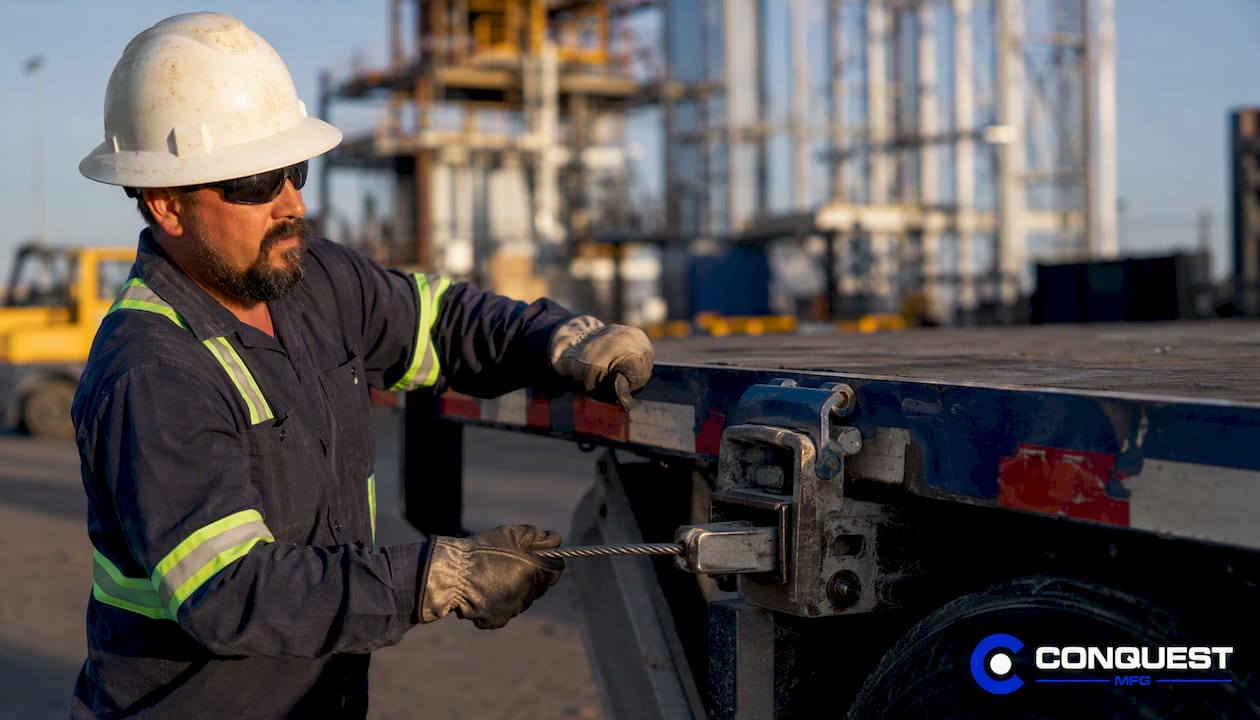
Fully automatic locks (FATLs) lock and release without any manual intervention, relying on crane spreader signals or terminal automation systems. They are optimal where crane infrastructure and throughput volumes justify the higher upfront and service costs. A busy port terminal processing hundreds of lifts per shift gains measurable cycle-time savings; a regional chassis pool with mixed traffic rarely does.
Dovetail locks use a wedge-and-seat geometry rather than a rotating head. They are common on flatbed and rail intermodal equipment where the container slides into position longitudinally. Installation is straightforward, and there are no rotating parts to wear or seize.
Breech-base locks use a bayonet-style engagement, twisting into a base plate that is welded or bolted to the deck. They appear frequently on marine deck applications and some specialized chassis where a removable lock body is needed for deck versatility.
Chassis-fixed locks are welded permanently at the OEM stage for dedicated single-size chassis. They offer no retrofit flexibility but eliminate the possibility of a lock being left off or mispositioned.
Retractable and insertable locks fold or drop below the deck surface when not in use. For chassis used in mixed-service fleets handling both container moves and flatbed freight, retractable locks preserve deck versatility while still providing secure container tie-down when needed.
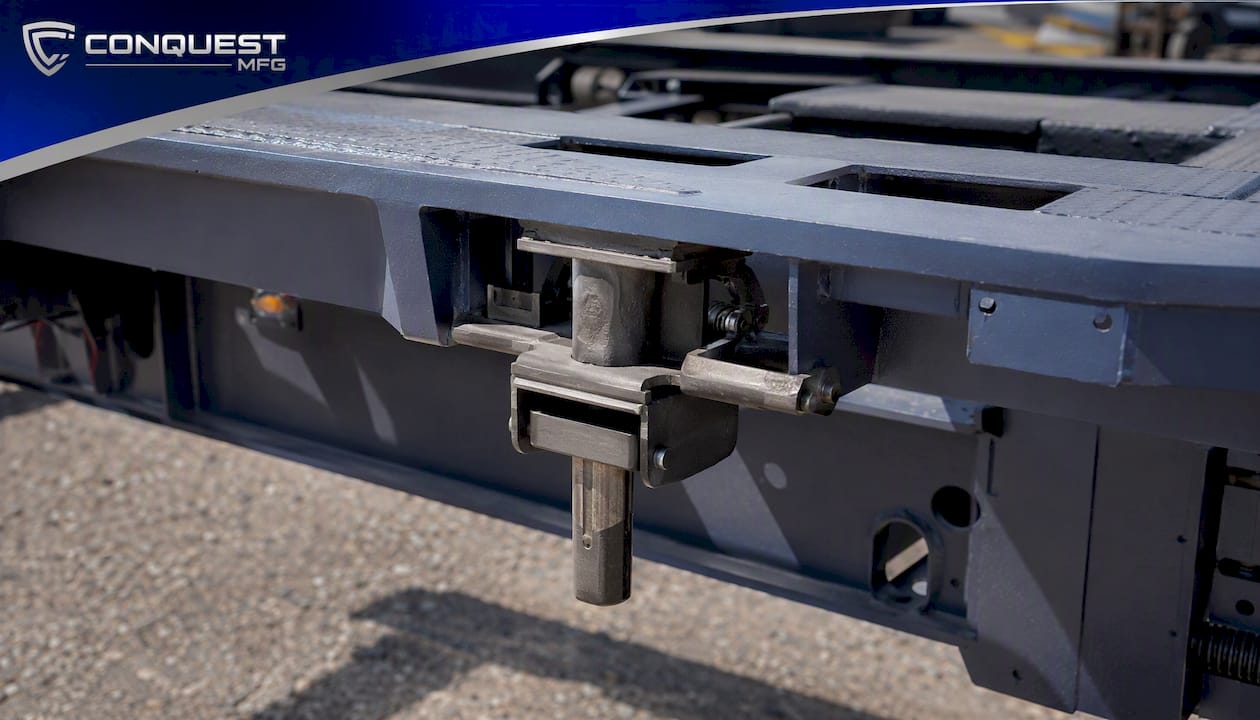
Double-ended and mid-locks engage corner castings on two stacked containers simultaneously, making them standard on stacking frames and rail intermodal equipment where vertical stack integrity is the primary concern.
Matching lock types to common U.S. chassis configurations
Different chassis frames present different mounting constraints. The three configurations most common in U.S. intermodal service each call for a specific approach.
| Chassis type | Recommended lock types | Key caveat |
|---|---|---|
| — | SATLs at all four positions; retractable mid-locks for short slots | Confirm slot spacing matches ISO 1C/1A corner casting centers |
| gooseneck | SATLs or chassis-fixed at rear; dovetail at gooseneck pocket | Gooseneck pocket geometry limits head clearance; verify before specifying |
| drop-frame | Retractable or recessed SATLs | Deck height variation requires recessed profile to clear container base |
Before any installation, technicians must work through the following pre-installation checks:
- Corrosion assessment: inspect all lock mounting pockets and surrounding weld zones for rust pitting deeper than surface scale
- Weld quality: look for cracking, undercut, or porosity at existing lock-seat welds; any defect requires repair before a new lock is fitted
- Slot alignment: measure pocket center-to-center spacing against the container corner casting layout; misalignment by more than a few millimeters prevents full head engagement
- Load path continuity: confirm that the mounting pocket connects directly to a chassis cross-member or main beam, not to a secondary bracket
- Access for maintenance: verify that release cables, springs, and locking heads will be reachable for routine inspection without removing other components
Standards and approvals that govern twist lock specifications
Every twist lock and corner casting used in U.S. intermodal service must conform to ISO dimensional standards for corner fittings. These standards define the aperture geometry, wall thickness, and material requirements that make a twist lock from one manufacturer interoperable with a container from another. Procurement teams that skip this check risk sourcing locks whose head profiles do not fully seat in the casting, leaving the container under-restrained.
Class society approvals from ABS (American Bureau of Shipping) and DNV (Det Norske Veritas) are the two most commonly cited in U.S. marine and intermodal contexts. ABS approval covers structural adequacy and material certification for locks used on vessels calling at U.S. ports; DNV approval carries equivalent weight for internationally traded equipment. Both bodies publish service bulletins when field failures reveal systemic issues with specific lock families, and procurement teams should check current bulletins before finalizing a specification.
For U.S. highway chassis, the Federal Motor Carrier Safety Administration (FMCSA) requires that containers be secured against longitudinal, lateral, and vertical movement. Twist locks are the primary securement device, and their condition is subject to roadside inspection under the Commercial Vehicle Safety Alliance (CVSA) Out-of-Service Criteria. A lock found cracked, seized, or missing at roadside places the vehicle out of service immediately.
Inspection and maintenance checklist for chassis twist locks
A disciplined inspection cadence is what separates a compliant chassis fleet from a liability. The checklist below draws on field-standard practice and Conquest Mfg’s industrial equipment safety guidance.
Daily/pre-trip visual checks:
- Confirm all locks are present and seated in their pockets
- Inspect locking heads for visible cracks, deformation, or missing material
- Check that heads rotate freely (manual and SATL types) with no binding
- Verify release cables and levers on SATLs move without excessive resistance
- Look for corrosion buildup at the head-to-casting interface
Weekly/periodic checks:
- Torque all mounting bolts to the manufacturer’s specified value
- Inspect weld integrity at lock base plates; flag any cracking for immediate repair
- Measure locking head dimensions against ISO corner casting tolerances; replace heads showing wear beyond the manufacturer’s wear limit
- Lubricate pivot points and release mechanisms per the manufacturer’s schedule
- Test SATL spring tension by hand; a spring that does not return the head to the pre-lock position needs replacement
Repair vs. replace decision:
| Condition | Action |
|---|---|
| Surface corrosion, no pitting | Clean, treat, and re-lubricate |
| Pitting or scaling at load-bearing surfaces | Replace lock |
| Any visible crack in locking head or base | Remove from service immediately |
| Worn head profile (beyond manufacturer limit) | Replace lock |
| Seized rotation on manual or SATL | Disassemble, clean, lubricate; replace if binding persists |
Pro Tip: Document every inspection with the lock’s position on the chassis (e.g., “RF front” for right-front), the technician’s name, and the date. This record is your first line of defense during a CVSA roadside inspection or post-incident review.
How to select the right twist lock for your chassis
A structured selection process prevents the two most common specification errors: choosing manual locks for a terminal that needs throughput speed, and specifying fully automatic locks for a chassis pool that lacks the infrastructure to support them.
Decision flow:
- Define your use case: volume of container lifts per shift, crane vs. reach-stacker vs. manual loading, indoor yard vs. coastal exposure
- Shortlist by operation mode: manual for low-volume controlled environments; SATL for highway and mixed intermodal; FATL only where terminal automation exists
- Check chassis compatibility: confirm slot spacing, deck profile, and load path before ordering; a lock that fits the catalog but not your frame is unusable
- Specify inspection cadence and warranty: require manufacturer documentation of ISO conformance, class society approval where applicable, and a defined wear-limit specification
- Calculate life-cycle cost: a lower-priced manual lock that requires more frequent replacement or generates more worker-hours in handling may cost more over a three-year fleet cycle than a mid-priced SATL
Red flags to reject a specification or supplier:
- No documented ISO corner casting conformance
- Release mechanisms that are inaccessible without removing adjacent equipment
- Undocumented modifications to the chassis mounting pocket
- Manual locks proposed for a terminal handling stacked containers
- Mismatched head profiles between the lock catalog and your container fleet’s actual casting dimensions
For mixed-service chassis, the future of industrial trailer design increasingly favors retractable lock systems that preserve deck flexibility without sacrificing container securement integrity.
Conquest Mfg’s perspective on twist lock integration
Specifying the right twist lock type is straightforward once you treat it as a chassis engineering decision rather than a hardware purchase. The mistake we see most often is procurement teams selecting locks based on unit price alone, then discovering that the chosen type requires chassis reinforcement, custom weld work, or a maintenance program the fleet does not have the resources to support. The lock and the chassis are one system.
At Conquest Mfg, our intermodal chassis builds are engineered with twist lock integration from the frame up. For multi-use decks, we specify recessed or retractable lock pockets that maintain a flat load floor while providing full ISO-compliant container securement when needed. For dedicated intermodal chassis, we work with operators to match the lock type to their actual lift cycle and maintenance capacity, not a generic catalog recommendation.
Conquest Mfg chassis solutions built for safe container securement
Conquest Mfg engineers and manufactures intermodal chassis with twist lock integration specified to your fleet’s exact operating profile. Where a standard catalog lock fits, we source and install it. Where your chassis configuration demands custom pocket reinforcement, recessed mounting, or a retrofit from manual to SATL, our engineering team handles the full specification and fabrication.
Our transportation industry chassis capabilities cover new builds, retrofit engineering, and inspection program support. If you are specifying locks for a new chassis order or upgrading an existing fleet, request a specification consultation and we will match the right lock type, mounting configuration, and maintenance cadence to your operation. Contact Conquest Mfg for a direct quote and specification sheet.
Sources
Procurement and engineering teams should consult these vetted references when specifying, validating, or inspecting chassis twist lock installations:
- ISO
- Twist-lock: Mechanism, Principles and Safety Standards – HZ CONTAINERS.com
- Container Twist Locks