

Fleet security in 2026 is no longer simply about padlocks on yard gates and cameras above loading docks. Every connected device on your trucks, trailers, and heavy equipment introduces a new exposure point, and attackers are actively targeting these gaps. For fleet managers and procurement officers in construction, transportation, and oil operations, the regulatory and liability stakes have never been higher. This checklist gives you a structured, layered framework that covers mechanical readiness, operational controls, cyber risk, and procurement governance so you can build real protection instead of just paper compliance.
Table of Contents
- Start with the four pillars of fleet security in 2026
- Mechanical and operational controls: The foundation steps
- Connected devices and cybersecurity: What you can’t overlook in 2026
- Procurement and governance: Secure vehicles start here
- Cargo and asset theft: Layered defenses for real-world security
- Why most fleet checklists miss the mark in 2026
- Take the next step in securing your fleet
- Frequently asked questions
Key Takeaways
| Point | Details |
|---|---|
| Layered approach | Combine mechanical, operational, cyber, and procurement controls for effective fleet security. |
| Cybersecurity is essential | Inventory all connected devices and train drivers on cyber risks to block telematics-based attacks. |
| Procurement matters | Build security requirements into every vehicle acquisition and update governance as assets evolve. |
| Defense in depth wins | Physical deterrents, verification steps, and real-time monitoring drastically lower theft risk. |
| Checklist is not static | Regular review and adaptation are crucial with evolving threats and technology in 2026. |
Start with the four pillars of fleet security in 2026
Before you check any box, you need a framework that reflects how modern fleets actually operate. A single-focus approach, whether physical-only or digital-only, leaves predictable gaps that experienced thieves and cyber actors will find.
We organize our recommended structure around four pillars:
- Mechanical readiness: Vehicles and trailers are physically sound, inspected, and documented.
- Operational controls: Day-to-day procedures are standardized, auditable, and consistently enforced.
- Connected/cyber controls: All telematics, ELD units, and IoT devices are inventoried, monitored, and hardened.
- Procurement/asset governance: New and in-service assets are specified, acquired, and tracked with security requirements built in from the start.
A practical checklist structure that combines these four areas is essential because mechanical condition and documentation are preconditions while connected-device risk has become a separate, must-manage layer. Think of the four pillars as load-bearing posts. Remove one and the structure weakens across the board.
“A layered approach is not optional overhead. It is the minimum standard for protecting high-value fleet assets in 2026.”
Pro Tip: Before auditing any single pillar, map every asset in your fleet to all four categories. You will quickly spot which areas have no documented controls at all.
You can also reference our equipment safety checklist for a detailed starting point tailored to heavy industrial environments.
Mechanical and operational controls: The foundation steps
With the main pillars defined, begin with mechanical and operational controls as your checklist’s core. These are not glamorous topics, but they are the ones that will determine your liability exposure after an incident and your ability to pass an audit under pressure.
Mechanical condition and documentation are preconditions for reliable and secure vehicle operation. A trailer with a failed brake system or a loose load restraint is not just a safety hazard. It is an open invitation for cargo loss events and regulatory penalties.
Here is a prioritized sequence for your mechanical and operational checkpoint:
- Brake and tire inspection: Verify brake adjustment, lining thickness, and tire tread depth on every unit before extended deployment. Document findings in a timestamped system, not paper logs that can be altered.
- Fluid levels and leak checks: Hydraulic, coolant, and fuel systems should be inspected at every service interval. Leaks signal both mechanical failure and potential contamination events on job sites.
- Load restraint verification: On bulk pneumatic trailers, vacuum tanks, and flatbed configurations, confirm that all securement hardware meets current federal standards for the load class being carried.
- Pre-departure documentation: Standardize a driver sign-off process that captures vehicle condition, seal integrity for cargo, and any anomalies observed at pickup. This creates your audit trail.
- Compliance log accessibility: Store maintenance records and inspection reports in a system that authorized personnel can access within minutes. Auditors and insurers do not wait days for documentation.
- Driver and crew security training: Access control starts with the people at your gate. Train yard crews to verify IDs, challenge unfamiliar personnel, and escalate suspicious activity through a defined chain of contact.
Statistic callout: Industry data consistently shows that fleets with standardized pre-departure checklists reduce reportable incidents by a measurable margin compared to those relying on informal driver judgment alone. The documentation itself acts as a deterrent to cutting corners.
Pro Tip: Use your existing telematics platform to trigger automated reminders when a vehicle approaches its service interval. This removes the human memory variable from your maintenance cycle.
Operational controls also matter for insurance and legal defense. If a cargo loss or accident occurs, your documented process is evidence that you operated responsibly. Without it, liability shifts toward the fleet operator. For oil industry operations specifically, review our guide on oil industry equipment to understand the compliance requirements that affect your specific asset classes.
Connected devices and cybersecurity: What you can’t overlook in 2026
Once mechanical and operational basics are set, focus on the fastest-growing threat area: cyber and connected assets. The number of connected endpoints on a modern fleet unit has multiplied significantly. A single Class 8 truck may carry an ELD, a telematics module, a tire pressure monitoring system, an infotainment unit, and one or more aftermarket add-ons installed at the customer’s request. Each of these is a potential entry point.
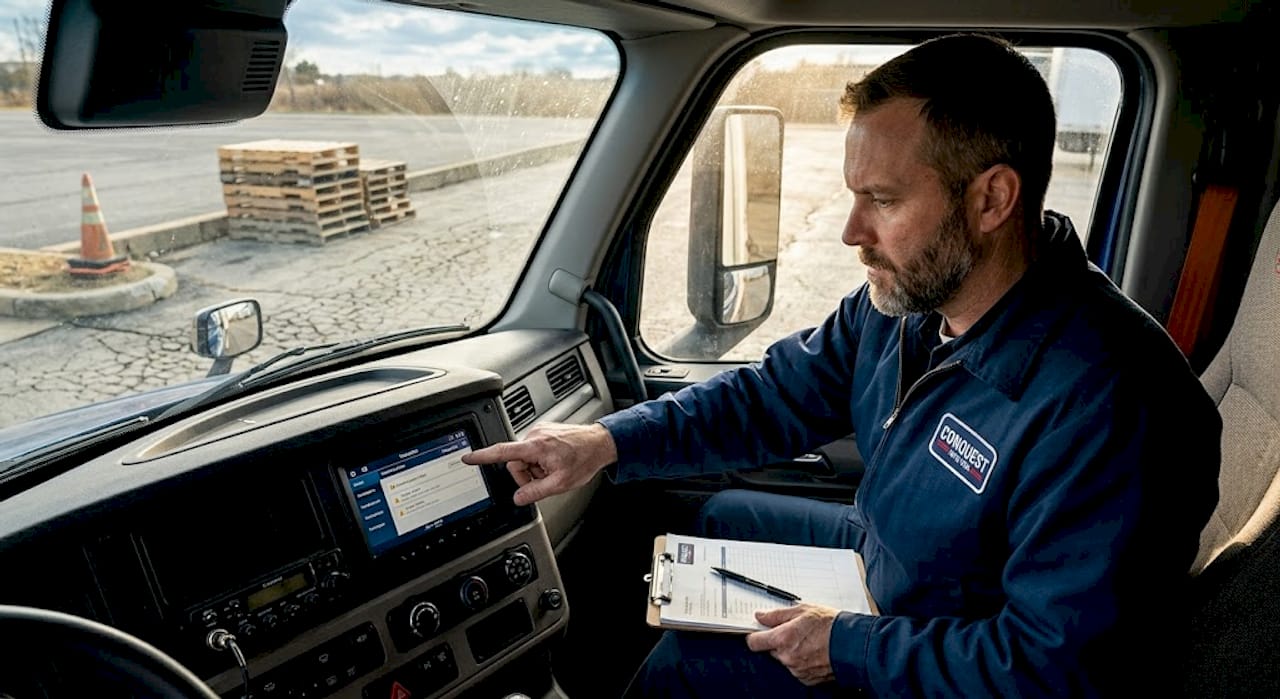
Connected-vehicle security requires driver cybersecurity awareness, inventory control of connected devices, and active defense against telematics manipulation including GPS spoofing and insecure aftermarket devices. The threat is real and it is being actively exploited in cargo theft operations right now.
| Risk category | Example threat | Recommended control |
|---|---|---|
| GPS spoofing | False location data fed to dispatch | Cross-reference telematics with driver check-in calls |
| Diagnostic port access | Unauthorized device plugged at OBD port | Physical port locks and quarterly audits |
| Telematics manipulation | Route data altered to mask theft | Tamper alerts and dual-source location verification |
| Driver phishing | Fake portal login captures credentials | Mandatory phishing awareness training |
| Unsecured Wi-Fi | Data intercepted at truck stops | VPN policy for all fleet-connected devices |
Key controls to implement across your connected fleet:
- Build and maintain a device inventory. Every ELD, telematics unit, and aftermarket module must be cataloged with its firmware version, vendor, and last security review date.
- Audit diagnostic ports regularly. Unauthorized devices plugged into OBD II ports are a known vector for both vehicle manipulation and data theft. Physical port locks are a low-cost, high-value control.
- Set tamper alerts. Configure your telematics platform to generate alerts when a device goes offline unexpectedly or when location data appears inconsistent with known routes.
- Train drivers on cyber hygiene. Most attacks enter through human error. Drivers should know not to use personal USB devices in cab systems and not to connect to unsecured public Wi-Fi without a VPN.
- Review aftermarket device vendors. Not all aftermarket telematics providers maintain the same security standards. Evaluate vendors against published cybersecurity frameworks before approving devices for fleet-wide deployment.
“GPS spoofing and telematics manipulation are not theoretical risks. They are documented tactics used in organized cargo theft operations targeting high-value loads.”
Our security infrastructure solutions include portable, rapid-deployed video surveillance towers that give you real-time visual coverage of yards, staging areas, and remote job sites where connected monitoring alone may not be sufficient.
Procurement and governance: Secure vehicles start here
The strongest checklists integrate procurement and governance risk right from the start of an asset’s lifecycle. A truck or trailer that enters your fleet without verified telematics readiness or with unknown aftermarket devices already installed creates a governance deficit that is costly to correct after the fact.
A 2026 vehicle acquisition checklist requires aligning specs with compliance constraints and total cost of ownership, including telematics readiness and the practical operational effect of terrain on fuel efficiency and safety systems.
Here is a structured procurement sequence for fleet managers and procurement officers:
- Categorize by vehicle class. Different classes carry different regulatory requirements. Establish a classification matrix before writing any specification.
- Mandate native telematics and ADAS. Specify that all new acquisitions must include OEM-installed telematics and advanced driver assistance systems. Retrofitting these later is more expensive and often less secure than OEM integration.
- Review OEM versus aftermarket device security. For any non-OEM device, require a vendor security disclosure. Ask specifically about encryption standards, update frequency, and vulnerability disclosure policies.
- Calculate total cost of ownership with security factors included. Cyber incidents, cargo theft, and compliance failures are quantifiable costs. Include them in your TCO model when comparing bids.
- Update governance documentation at acquisition. Every new asset should trigger an update to your device inventory, compliance calendar, and insurance schedule before it leaves the vendor’s lot.
| Procurement factor | Low-risk indicator | High-risk indicator |
|---|---|---|
| Telematics source | OEM-installed, documented | Aftermarket, unknown vendor |
| ADAS coverage | Full suite, calibrated | Partial or absent |
| Security update policy | Automatic, vendor-supported | Manual, customer-managed |
| Compliance documentation | Complete at handover | Incomplete, requires follow-up |
Pro Tip: Build a one-page security specification sheet into your standard RFQ (request for quote) process. Vendors who cannot respond to it directly are telling you something important about their security posture.
Our compliance checklist and guidance on how to boost transportation equipment efficiency provide additional reference points for procurement decisions across bulk transport and specialty trailer categories.
Cargo and asset theft: Layered defenses for real-world security
No checklist is complete without directly addressing theft. It remains a perennial and evolving threat, and in 2026 the tactics are increasingly sophisticated. Organized groups study your patterns before they act. Predictability is your greatest vulnerability.
Layered defenses and real-time visibility consistently outperform piecemeal solutions because thieves exploit predictability and information gaps. A single camera or a single GPS tracker is a single point of failure.
Build your theft defense in three tiers:
Physical deterrents:
- High-lumen yard lighting covering all perimeter angles
- Locked and monitored perimeter access points
- Visible surveillance equipment (visible cameras increase deterrent effect)
- King pin locks and glad hand locks on unattended trailers
Verification controls:
- Controlled entry with ID verification for all personnel and carriers
- Tamper-evident seals on cargo doors with dual sign-off at departure
- Callback verification for dispatch instructions received after hours
Real-time monitoring:
- GPS tracking on every asset, including trailers and equipment that move between job sites
- Geofencing alerts for any movement outside designated zones during off-hours
- Route monitoring with alerts for unexpected stops or deviations
“Rotating routes and yard assignments regularly removes the pattern predictability that organized theft groups depend on for successful targeting.”
Pro Tip: Conduct a route and yard audit every 90 days. Identify which routes and yard positions have been static for more than one quarter and rotate them. This single step disrupts the reconnaissance phase of most organized cargo theft operations.
Review our resources on bulk transport security and the advantages of specific pneumatic trailer methods for operations where cargo integrity and secure transfer matter most. For broader guidance, our transportation industry security resource covers protocols relevant to multiple asset types.
Why most fleet checklists miss the mark in 2026
Here is the uncomfortable reality we see across fleet operations in construction, oil, and transportation: most checklists are built to satisfy an auditor, not to stop a threat. They are static documents updated once a year during a slow period, checked off by someone who knows the right answers, and filed in a system no one opens until something goes wrong.
The problem is that the threat landscape is not static. GPS spoofing techniques evolve. New aftermarket devices enter the market with unknown security profiles. Drivers turn over and new personnel arrive without the same training their predecessors received. A checklist that was accurate in January can have significant gaps by April if no one is maintaining it as a living document.
We believe the real differentiator in 2026 is not the checklist itself. It is the feedback loop attached to it. Are your operational teams reporting anomalies and seeing those reports result in checklist updates? Is your IT or telematics manager flagging new device risks and seeing procurement respond with updated specifications? Is cargo theft data from across your industry actually informing your physical security posture?
Most fleet organizations answer no to at least two of those three questions. That is where protection breaks down. The goal is a dynamic strategy where cyber, operational, and procurement controls reinforce each other continuously, not annually. Explore our security modernization insights to see how portable surveillance infrastructure supports a living, adaptive security strategy for yards and remote sites.
Take the next step in securing your fleet
With your fleet checklist framework in hand, the next step is moving from planning to action. Understanding the right controls is valuable. Having the right equipment and documentation to implement them is what actually closes the gaps.

We build custom equipment across bulk transport, vacuum tank, pneumatic trailer, and oil industry categories, all with security and compliance considerations built into the design process. Our full equipment safety checklist gives you a detailed, actionable starting point for your mechanical and operational review. And if your operations include vacuum tank transport, our dedicated vacuum tank security protocol guide addresses the specific compliance and safety requirements for that asset class. Contact us to discuss how our solutions can reinforce your layered fleet security strategy.
Frequently asked questions
What is the biggest new security risk for fleets in 2026?
The rise of connected devices and telematics manipulation, including GPS spoofing and insecure diagnostic ports, poses the fastest-growing fleet security risk in 2026.
Should procurement officers mandate telematics on all new vehicles?
Yes, mandating telematics and ADAS in new acquisitions is best practice for total visibility and compliance, as 2026 acquisition guidance confirms that new units should include native telematics from day one.
How often should a fleet security checklist be reviewed?
Review fleet security checklists at least quarterly to stay ahead of evolving cyber and physical threats, and update device inventories any time a new asset enters the fleet.
Are layered theft defenses really more effective than single solutions?
Yes, layered defenses combining deterrence, verification, and real-time monitoring consistently outperform single-point measures because they eliminate the predictability gaps that organized theft operations depend on.
Recommended
- Industrial equipment safety checklist: Essential steps for compliance – CONQUEST MFG USA
- Boost efficiency with bulk transportation equipment in 2026 – CONQUEST MFG USA
- Mobile Security Infrastructure Manufacturing – CONQUEST MFG USA
- Safe vacuum tank transport: Standards and protocols guide – CONQUEST MFG USA