
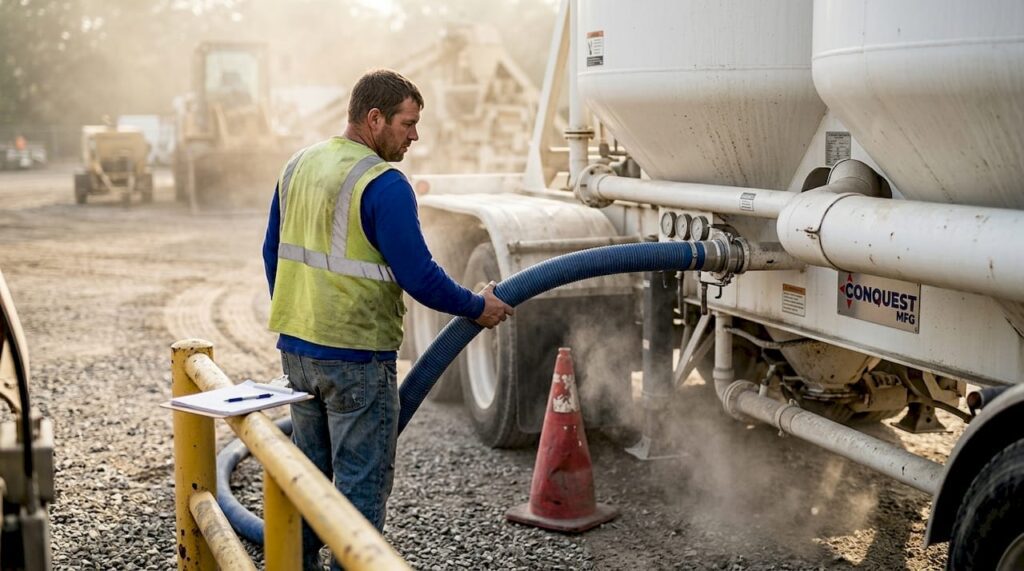
Choosing a trailer based on sticker price alone is one of the most expensive mistakes an industrial manager can make. When you are responsible for moving thousands of tons of cement, frac sand, or dry chemicals across a job site or a state, the trailer you select determines not just your hauling capacity but your total operational efficiency, material purity, regulatory compliance, and long-term cost profile. Pneumatic trucking has earned its place in construction, oil and gas, and transportation precisely because it solves problems that conventional gravity-fed options simply cannot. This guide breaks down the evidence so you can make a confident, informed decision.
Table of Contents
- Key material handling challenges in industrial sectors
- How pneumatic trailers boost operational efficiency
- Pneumatic vs. hopper trailers: A real-world comparison
- Purity, safety, and compliance: Why managers value pneumatic trailers
- What most trailer buyers overlook and how it costs them
- Explore solutions for your material handling needs
- Frequently asked questions
Key Takeaways
| Point | Details |
|---|---|
| Efficiency advantage | Pneumatic trailers significantly improve speed and reliability in dry bulk material handling. |
| Cost-effectiveness | Long-term operational savings often outweigh their higher initial investment. |
| Material purity | Industrial managers choose pneumatic trailers to meet high purity and compliance standards. |
| Versatile applications | Pneumatic trailers perform exceptionally with cement, sand, and sensitive materials. |
Key material handling challenges in industrial sectors
With the importance established, it is crucial to understand what unique demands these industries face before evaluating equipment. The consequences of choosing the wrong trailer go well beyond a single delayed delivery. Wrong choices compound across every load cycle, every shift, and every contract.
Industrial sector needs in construction, oil and gas, and transportation converge around three core demands: efficiency, material purity, and cost control. Industrial managers in these sectors choose pneumatic trailers for superior efficiency in dry bulk handling, whether that means bulk cement on a high-rise construction project or frac sand delivered to a wellsite. Getting the material to the right place, in the right condition, at the right time is non-negotiable.
The most common dry bulk materials these sectors rely on include:
- Cement and fly ash for construction projects, batch plants, and infrastructure work
- Frac sand and silica for oil and gas well stimulation operations
- Lime and carbon black for industrial processing and chemical treatment
- Plastic pellets and resins for manufacturing supply chains
- Potash and fertilizer for agricultural and chemical industries
“Choosing the wrong trailer for fine, moisture-sensitive, or high-purity dry bulk materials does not just slow you down. It can contaminate an entire load, expose you to regulatory penalties, and force costly equipment workarounds on every delivery run.”
When material contamination occurs during transport or unloading, the consequences are immediate and expensive. A batch of cement contaminated with debris during an open-air gravity transfer can compromise structural integrity in a pour. Frac sand with inconsistent particle distribution can underperform during hydraulic fracturing, reducing well output. These are not hypothetical scenarios. They are documented operational risks that experienced managers work to eliminate from their logistics chain.
How pneumatic trailers boost operational efficiency
Knowing the challenges, let us see how pneumatic trailers solve these problems so effectively. The core mechanism is simple but powerful: pneumatic trailers use pressurized air to move material from the tank through a sealed discharge line and into a receiving silo, bin, or tank. No shovels, no manual transfer, no open exposure to the environment during unloading.
Here is how a standard pneumatic trailer operation sequence works:
- Load at origin: Material is loaded into the sealed tank, typically through top hatches, ensuring the integrity of the product from the start.
- Pressurize for transport: The trailer maintains sealed conditions throughout transit, protecting the material from moisture and contamination.
- Connect to discharge point: At the destination, the operator connects the discharge hose to the receiving vessel, silo, or bin.
- Activate the air system: An onboard blower or an external compressed air source builds pressure inside the tank, fluidizing the dry bulk material.
- Transfer the load: Material flows through the line under controlled pressure, allowing precise, clean delivery directly into the receiving vessel, even at elevated heights.
- Verify and disconnect: Once the tank is empty, the operator verifies the transfer and disconnects. No manual cleanup of residual material scattered on the ground.
This process directly addresses the bulk transport advancements that modern industrial operations require. The ability to discharge directly into a silo at height eliminates the need for secondary lifting equipment, reducing both labor cost and equipment wear.
For efficient cement bulk transport, pneumatic systems are the industry standard. A ready-mix concrete operation receiving 900 tons of cement per week, for example, would need significantly more labor and handling equipment with gravity-fed alternatives compared to a pneumatic system that pumps directly into a storage silo in under 45 minutes per load. Reduced operational costs long-term are a consistent outcome when pneumatic trailers replace manual or gravity unloading methods.
Pro Tip: When evaluating a pneumatic trailer for your operation, ask for documented unload times under your specific material bulk density. Unloading speed varies significantly between low-density fly ash and denser materials like cement, and your dispatch schedule must account for that difference.
The safety benefits are equally significant. Sealed transfer eliminates dust clouds during unloading, reducing respiratory risk for operators and keeping job sites compliant with air quality standards. Material never touches the ground, meaning spill cleanup costs are effectively eliminated.
Pneumatic vs. hopper trailers: A real-world comparison
Industrial managers often ask how pneumatic trailers compare with other options. Here are the facts, laid out without bias.
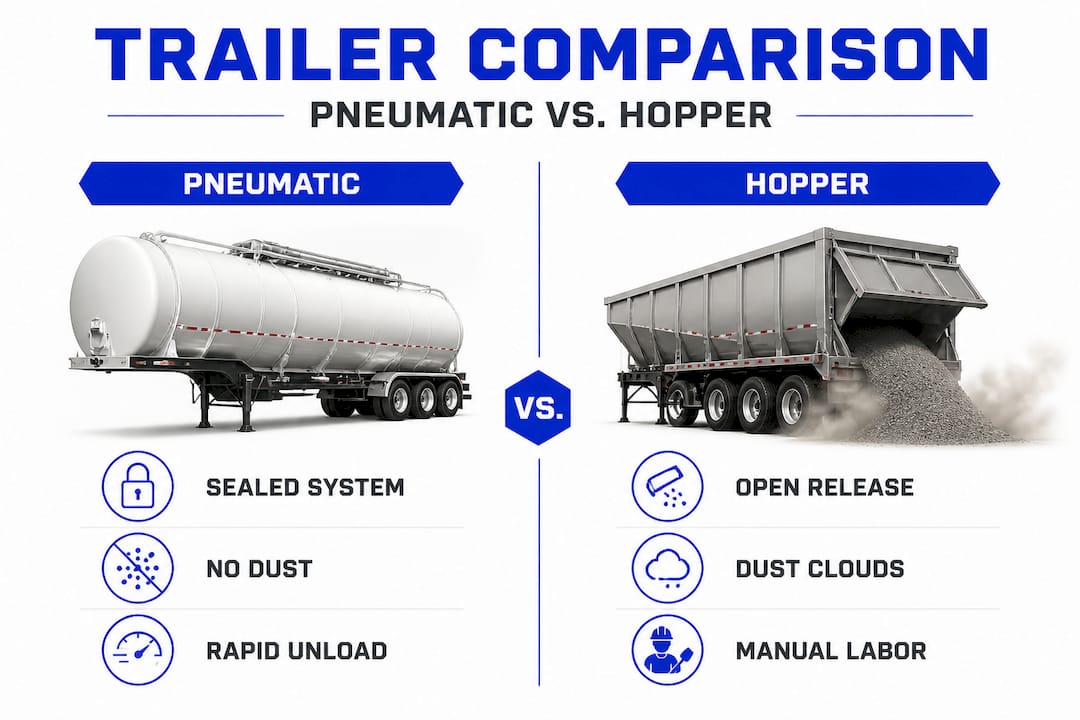
Hopper trailers are gravity-fed alternatives that open from the bottom, allowing material to fall into receiving bins below. They are simpler machines, lower in initial purchase cost, and effective for certain material types. However, hopper and gravity trailers lack clean elevated unloading capabilities for fine materials, which is a fundamental limitation for many industrial applications.
| Feature | Pneumatic trailers | Hopper/gravity trailers |
|---|---|---|
| Unloading method | Pressurized air transfer | Gravity, bottom dump |
| Elevated silo discharge | Yes, standard | Not possible |
| Material contamination risk | Very low, sealed system | Higher, open exposure |
| Suitable for fine materials | Excellent | Limited |
| Labor required during unload | Minimal | Moderate to high |
| Initial purchase cost | Higher | Lower |
| Long-term operating cost | Lower | Higher |
| Dust and spill exposure | Minimal | Significant |
| Maintenance complexity | Moderate | Lower |
When does a hopper trailer make sense?
There are legitimate use cases for hopper trailers. Coarse aggregates like crushed stone, gravel, or large-format sand destined for stockpiles below road grade work well with gravity discharge. If your operation handles exclusively coarse, non-sensitive material with no purity requirements, and the receiving point is always at or below trailer level, a hopper trailer may serve your needs at lower upfront cost.
However, consider these realities:
- Hopper trailers cannot discharge into elevated silos without additional infrastructure
- Open discharge increases dust and material loss, adding cost per load over time
- Fine materials like cement, fly ash, or frac sand tend to bridge, arch, or clump in gravity-fed systems, causing blockages and delays
- Contamination risk during open unloading can disqualify a supplier from contracts requiring material purity certification
For most construction and oil and gas operations where fine dry bulk is involved, pneumatic trailers are not a premium option. They are the practical standard.
Purity, safety, and compliance: Why managers value pneumatic trailers
Beyond efficiency and cost, purity and safety drive many trailer purchasing decisions, especially in regulated industries.
In oil and gas operations, frac sand specifications are precise. Particle size distribution, roundness, and crush strength all affect well performance. Contaminated or degraded sand delivered to a wellsite is not just a material loss. It is a performance risk that can reduce hydrocarbon recovery from an entire well stage. Pneumatic trailers support compliance with purity needs specifically because their sealed design prevents cross-contamination, moisture ingress, and ambient dust introduction during both transport and unloading.
| Compliance area | Risk with gravity trailers | Pneumatic trailer advantage |
|---|---|---|
| Material purity certification | High contamination exposure | Sealed, auditable transfer |
| Dust emission standards | Open discharge creates dust | Contained transfer, minimal dust |
| OSHA silica regulations | High exposure at unload point | Significantly reduced operator exposure |
| Product specification compliance | Variable material condition | Consistent, protected delivery |
| Site cleanliness requirements | Spill risk at discharge | Precise delivery, no ground contact |
The OSHA Silica Standard (29 CFR 1926.1153 for construction and 29 CFR 1910.1053 for general industry) places strict action levels and permissible exposure limits on respirable silica dust. Pneumatic unloading, because it confines material within a sealed transfer line, is a primary engineering control that helps your site maintain compliance without relying on costly personal protective equipment programs alone.
Pro Tip: Before selecting a trailer vendor, ask for their equipment’s documented compliance with OSHA silica exposure controls. A supplier who cannot answer that question specifically has not thought through your risk exposure.
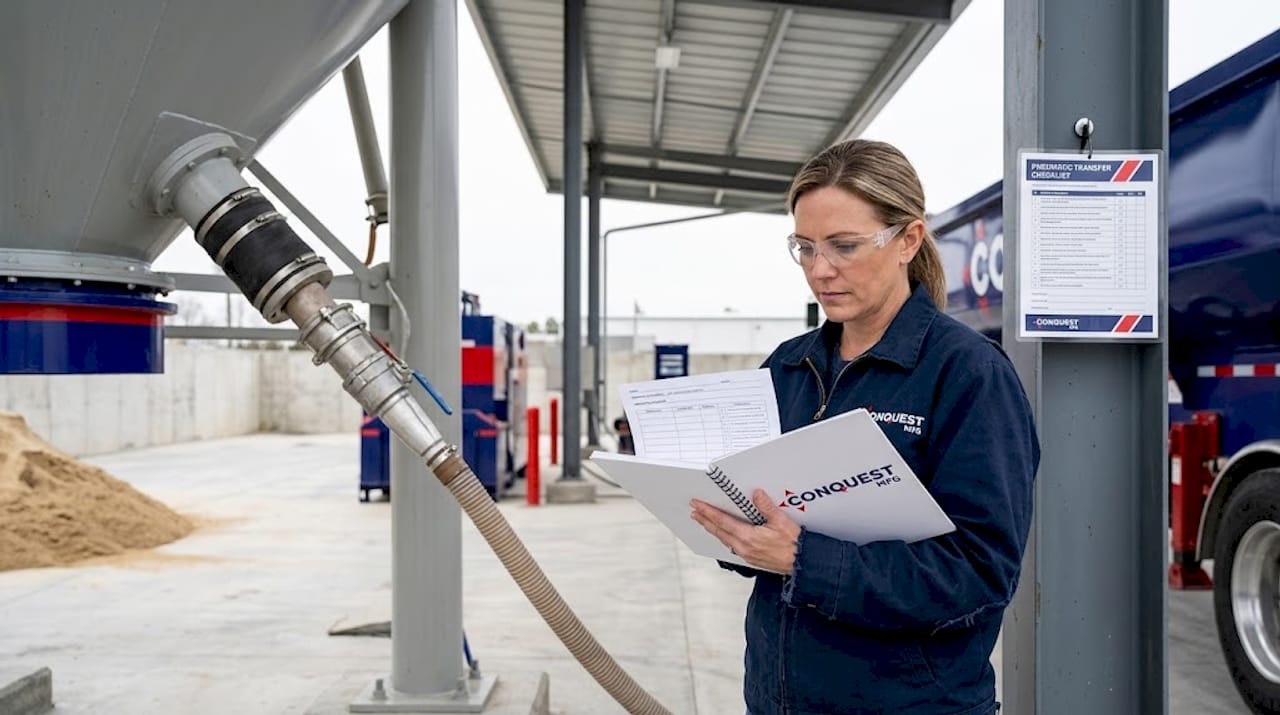
The equipment safety checklist for pneumatic trailers should include pressure relief valves, properly rated hose connections, aeration pads, discharge valve condition, and blower maintenance records. Regular inspection of these components prevents both safety incidents and unplanned downtime. Reviewing safe vacuum tank transport standards alongside pneumatic trailer protocols gives managers a complete picture of sealed transport best practices.
Material purity is not just a technical requirement. It is increasingly a contractual one. Large construction contractors and oil and gas operators now routinely require suppliers to document chain-of-custody handling, and a sealed pneumatic system makes that documentation far more defensible than an open gravity transfer method.
What most trailer buyers overlook and how it costs them
With the facts laid out, it is important to reconsider the purchase process from a strategic angle. We have seen a consistent pattern across buyers in construction, transportation, and oil and gas: managers under budget pressure gravitate toward the lower purchase price of hopper or gravity trailers, and they absorb the ongoing costs without ever connecting them back to that original decision.
Here is the uncomfortable truth. The operational costs that accumulate after purchase typically exceed the initial price difference within two to three years of regular use. Dust suppression programs, product loss per delivery, extended labor time at unload, receiving vessel cleaning, and regulatory compliance workarounds are all real line items. They rarely appear in the original procurement conversation, but they appear every month on the operating budget.
Conventional wisdom says to control capital expenditure. That is sound financial practice. But it breaks down when the equipment you buy to save capital generates operating inefficiencies that cost more over its service life than the capital saved. The construction trailer insights we have gathered from years of working with industrial managers reveal that the managers who build the strongest operational track records treat trailer selection as a total cost of ownership decision, not a purchase price decision.
There is also a risk dimension that finance-focused procurement tends to underweight. A single contaminated load, a compliance citation for silica dust exposure, or a delayed delivery on a critical pour can each carry financial consequences that dwarf the price difference between trailer types. When you factor risk-adjusted cost into the comparison, pneumatic trailers look even stronger.
Our advice to managers facing budget pressure is direct: present the total cost of ownership argument to stakeholders, not just the unit price. If you can show three years of projected operational savings alongside the compliance risk reduction, the business case for pneumatic trailers tends to be straightforward. Push for that conversation before the purchase order is written, not after the first operational problem surfaces.
Explore solutions for your material handling needs
If this analysis reflects the challenges your operation is facing, we are ready to help you find the right equipment for your specific application.
At Conquest Manufacturing, we build dry bulk pneumatic trailers and related equipment designed specifically for the demands of construction, oil and gas, and transportation operations across the USA. Our transportation solutions and construction sector solutions are engineered for reliability, efficiency, and long service life in demanding environments. Whether you need a standard pneumatic trailer or a custom-built solution for a specialized material or site condition, our team is ready to partner with you on the right specification. Browse our available equipment at the shop pneumatic trailers page and connect with our team to get a quote tailored to your operation.
Frequently asked questions
What makes pneumatic trailers better for bulk cement transport?
Pneumatic trailers allow for clean, sealed unloading of bulk cement directly into storage silos, eliminating contamination risk and reducing labor at the discharge point. Their superior efficiency and cleanliness make them the preferred choice for ready-mix and precast operations.
Are pneumatic trailers cost-effective compared to other types?
While initial purchase cost is higher, pneumatic trailers consistently deliver lower long-term operational expenses through reduced labor, minimal product loss, and lower compliance risk. Reduced operational costs long-term typically offset the higher upfront price within a few years of regular operation.
What materials are best suited for pneumatic trailers?
Dry bulk materials like cement, fly ash, frac sand, lime, and certain industrial chemicals are ideal candidates for pneumatic trailer transport. Pneumatic trailers excel at transporting dry bulk materials that require sealed handling and precise delivery.
Do pneumatic trailers help with material purity requirements?
Yes. Their fully sealed design prevents cross-contamination and moisture ingress during both transport and unloading, making it far easier to document and defend material purity for regulated applications. Pneumatic trailers support compliance with purity standards that open gravity systems cannot reliably meet.
How do managers decide between pneumatic and hopper trailers?
The decision should center on material type, required purity, unloading point elevation, and regulatory compliance needs. Selection depends on bulk material characteristics and operational requirements rather than purchase cost alone, and total cost of ownership analysis nearly always favors pneumatic systems for fine dry bulk applications.
Recommended
- Top 4 nexatrailers.com Alternatives 2026 – CONQUEST MFG USA
- Transportation Industry – CONQUEST MFG USA
- How to use pig silos for efficient bulk cement transport – CONQUEST MFG USA
- Industrial equipment safety checklist: Essential steps for compliance – CONQUEST MFG USA
- Trailer Insurance in South Africa | Truck & Plant On-Demand